

What Would Help You Most Right Now?

Choose the option that best matches where you are with your marriage.

I Need Personalized Help

My Marriage Is in Serious Trouble

If you're dealing with separation, divorce, loss of attraction, infidelity, intimacy problems, or a spouse who's pulling away, get help looking at what's happening in your specific situation.

Get Personalized Help →
Get My Marriage Back book cover
I'd Rather Learn What to Do First

Start With Get My Marriage Back

Get the book and start learning the principles for moving your marriage in a better direction.

Get the Free Book →

Wife Starts Arguments During Intimacy? 5 Things You’re Missing

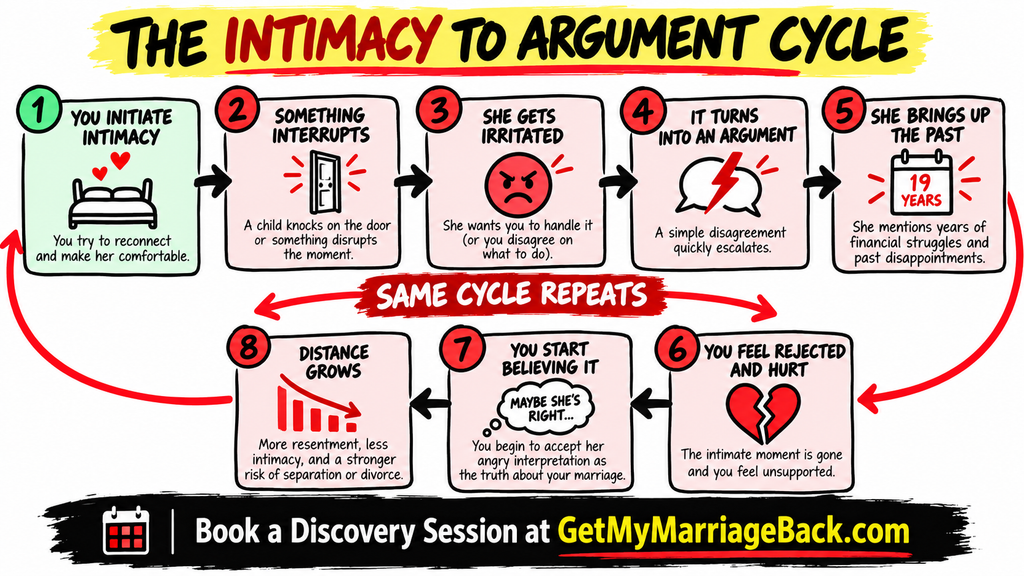
You finally get a chance to be intimate with your wife, but within minutes, a small interruption turns into an argument about everything wrong with your marriage.

Take This 2 Minutes Quiz

Question 1 of 15

You’ve spent days trying to make her comfortable. You’ve been attentive, patient, and intentional about creating an atmosphere where the two of you can reconnect.

Then your child knocks on the bedroom door.

Your wife becomes irritated and expects you to handle the interruption. You believe she understands what the child needs better, so you expect her to respond instead.

Suddenly, neither of you wants to be intimate anymore.

But the argument doesn’t stop with the interruption.

She starts talking about financial struggles, disappointments, and everything she believes has gone wrong over the years.

Perhaps she even says something like, “We’ve been struggling for 19 years.”

Now you’re wondering how an intimate moment turned into a judgment of your entire marriage.

And because some of her complaints contain legitimate concerns, you begin wondering whether everything she’s saying about your marriage is true.

That is where the real danger begins.

When your wife starts arguments during intimacy, the most important question isn’t simply why she ruined the moment.

It’s what the argument reveals about the emotional atmosphere surrounding intimacy—and how you respond without losing your dignity, confidence, or attraction.

There are five things I want you to understand.

  1. One emotional moment does not define your entire marriage.
  2. Your life mission cannot become hostage to your wife’s frustration.
  3. Resentment takes time to unpack, and it requires emotional stability.
  4. Reciprocity matters, but affection cannot become a transaction.
  5. Recognizing when your wife moves toward you again is essential.

Let’s break these down.

Why Does My Wife Start Arguments During Intimacy?

Before examining the five principles, you need to understand something important.

The argument may begin in the bedroom without actually being about the bedroom.

A disagreement about who should answer the door can activate frustrations that have been accumulating for months or years.

Financial insecurity may be involved. Parenting responsibilities might be creating tension. Your wife could be experiencing pressure around intimacy, or she may be carrying resentment that hasn’t been adequately addressed.

These are possibilities, not conclusions you should automatically assign to her.

Notice the pattern.

Does she bring up money during unrelated disagreements? Does she become irritated whenever intimacy is initiated? Are parenting decisions another recurring source of conflict?

Those questions help you distinguish an isolated interruption from a larger marriage problem.

When you understand the pattern, you can stop reacting as though every disagreement is a completely new crisis.

wife starts arguments during intimacy

1. One Emotional Moment Does Not Define Your Entire Marriage

Imagine your wife is frustrated about your financial situation.

During an argument, she says, “We’ve struggled our entire marriage.”

Some of those financial concerns may be legitimate.

But there’s an important difference between acknowledging a real problem and accepting the conclusion that your entire marriage has been a failure.

Her interpretation of the last 19 years is being expressed while she’s upset. That doesn’t automatically make it the complete history of your marriage.

You have shared experiences beyond that argument.

There have been sacrifices, accomplishments, difficult seasons, moments of affection, and things you’ve built together.

An angry moment doesn’t erase those experiences.

Pay particular attention to words like “always” and “never.”

“You never make me comfortable.”

“We always struggle.”

“You never understand me.”

These statements often express the intensity of someone’s current frustration rather than an accurate description of every experience you’ve shared.

However, dismissing the underlying complaint because the language is exaggerated would be another mistake.

Your responsibility is to separate the legitimate concern from the sweeping judgment.

You can acknowledge financial difficulties without agreeing that your marriage has been worthless.

You can recognize her disappointment without turning that disappointment into your identity.

This distinction matters because attraction becomes difficult to nurture when every disagreement sends you into emotional defeat.

Your wife is entitled to her feelings.

You are also responsible for maintaining a balanced understanding of your shared history.
wife starts arguments during intimacy - the intimacy to argument cycle

2. Your Life Mission Cannot Become Hostage to Her Frustration

When your wife stops intimacy to argue, it’s tempting to spend the next several days obsessing over what happened.

Why did she react that way?

Why couldn’t she recognize everything you’ve done?

How could she say those things after you tried so hard to make her comfortable?

I understand the frustration.

But here’s what I want you to recognize.

Your emotional stability cannot depend entirely on whether your spouse responds favorably in a particular moment.

You have responsibilities beyond that bedroom.

Your financial objectives, personal development, family obligations, health, and long-term purpose still matter.

In fact, some of the concerns raised during the argument may reveal areas that genuinely need your attention.

If financial instability has been a recurring problem, examine it.

Not because you are trying to purchase affection.

Not because you’re desperate to prove your wife wrong.

Address those responsibilities because they belong to the life you’re building.

There is something attractive about a spouse who can recognize a problem without becoming consumed by shame or defensiveness.

Emotional maturity means being able to say, “This is an area I need to improve,” without concluding, “I am a failure.”

That kind of self-leadership creates a different emotional presence.

You’re no longer approaching every interaction as a desperate attempt to obtain reassurance.

Instead, you’re becoming someone who can remain thoughtful, purposeful, and emotionally available even when a particular moment is disappointing.

And that matters when you’re trying to rebuild attraction in marriage.

3. Resentment Takes Time to Unpack

Let’s return to the bedroom interruption.

Your child knocks.

Your wife becomes irritated.

You feel offended.

The disagreement escalates into years of financial frustration.

The question is no longer simply who should have answered the door.

Why did that small disagreement activate so much additional emotion?

One possibility is accumulated resentment.

Another is that financial insecurity has become connected to your wife’s experience of emotional safety.

A third possibility is that intimacy itself has become associated with pressure, disappointment, or unresolved conflict.

You need to distinguish those possibilities before deciding what the argument means.

Trying to demand a complete explanation while both of you are upset usually creates more defensiveness.

Resentment isn’t something you unpack successfully by insisting that your spouse immediately justify every feeling.

It requires patience, observation, and emotional stability.

That doesn’t mean accepting personal attacks.

You can recognize that your wife has legitimate concerns while maintaining your own self-respect.

For example, when an argument becomes insulting, you can calmly communicate that you’re willing to address the actual issue but don’t want to continue exchanging hurtful statements.

The important thing is to avoid retaliating.

Retaliation may provide temporary emotional satisfaction, but it rarely improves the atmosphere surrounding intimacy.

What Research Reveals About Emotional Responsiveness and Attraction

Attraction is not simply a function of physical appearance, romantic gestures, or sexual technique.

The emotional experience of being with someone matters.

A 2016 study published in the Journal of Personality and Social Psychology, titled Intimately Connected: The Importance of Partner Responsiveness for Experiencing Sexual Desire, examined how responsiveness relates to sexual desire.

Across three studies, researchers found that perceived partner responsiveness was associated with greater sexual desire, with a stronger association among women.

Feeling special and valued helped explain that relationship.

Other research has also linked positive, compassionate responses to sexual difficulties with greater relationship satisfaction and lower distress.

The implication is important.

When your spouse experiences you as emotionally attentive rather than demanding, the atmosphere surrounding intimacy can change.

But responsiveness is not the same as surrendering your judgment, agreeing with every accusation, or abandoning your needs.

Real emotional intelligence combines attentiveness with self-respect.

That’s the kind of presence worth developing.

4. Reciprocity Matters, but Affection Cannot Become a Transaction

Now let’s talk about you.

You’ve been giving.

You’ve made sacrifices.

You’ve tried to create opportunities for intimacy.

And naturally, you want your wife to recognize those efforts.

You want someone who appreciates what you’re carrying and has your back when life becomes difficult.

There’s nothing unreasonable about wanting that.

But here’s where many distressed spouses create an additional problem.

They begin treating their efforts as an emotional invoice.

“I’ve done everything for you, so why can’t you give me affection?”

“I’ve been patient all week, so why are you rejecting me?”

“I’ve sacrificed so much, and you still don’t appreciate me.”

These thoughts are understandable, but they can quietly turn intimacy into an obligation.

Affection becomes less inviting when it feels like a debt someone is expected to repay.

Reciprocity is important in marriage.

Both people need opportunities to experience generosity, appreciation, care, and emotional support.

However, reciprocity doesn’t mean every loving gesture must produce an immediate romantic return.

You can give because generosity reflects your values, while also recognizing whether the relationship has become persistently one-sided.

Those two ideas can coexist.

You don’t need to keep sacrificing without boundaries.

At the same time, you don’t want every act of kindness to carry an unspoken demand for intimacy.

How to Build Attraction Without Chasing Affection

Start by changing the emotional meaning of your efforts.

Offer warmth without making it a test.

Show affection without assuming it must escalate into sex.

Take responsibility for practical concerns without presenting your improvements as proof that your spouse should desire you.

Maintain your interests, friendships, health, and personal direction.

And when you do experience rejection, resist turning that single moment into an argument about your worth.

Attraction grows more naturally in an atmosphere where affection is freely chosen.

Seduction within marriage is not about creating pressure.

It’s about becoming emotionally engaging, attentive, playful, confident, and respectful of the other person’s freedom to respond.

A relaxed conversation, genuine curiosity, shared laughter, or affectionate touch that both partners welcome can carry more romantic potential than an elaborate evening filled with expectations.

The objective isn’t to force intimacy.

It’s to cultivate the conditions in which closeness feels desirable again.

5. Recognize When Your Wife Moves Toward You Again

One of the most overlooked parts of marriage reconciliation is recognizing positive movement.

When you’ve experienced repeated disappointment, your attention can become trained to detect rejection.

You notice every irritated expression.

Every missed opportunity for intimacy becomes evidence that the marriage is deteriorating.

Every disagreement reinforces the belief that your spouse no longer cares.

But what happens when your wife makes a small effort to reconnect?

Perhaps she starts a friendly conversation.

She sits beside you.

Maybe she asks about your day, laughs at something you say, or shows genuine interest in something important to you.

Do you recognize those moments?

Or are you so focused on the intimacy you didn’t receive that you overlook the connection being offered?

Not every movement toward you will initially look romantic.

Sometimes emotional reconnection begins through ordinary interactions.

That doesn’t mean every pleasant exchange is evidence of renewed sexual desire.

It means you should pay attention to the full pattern of the relationship instead of measuring everything through one disappointing experience.

When your wife makes a genuine effort to connect, allow yourself to receive it.

Respond naturally.

Avoid immediately turning the moment into a discussion about why she hasn’t been more affectionate.

You can appreciate a small gesture without exaggerating its meaning or demanding that it lead somewhere.

Over time, those interactions can help create a more welcoming emotional atmosphere.

The Hidden Connection Between Financial Stress and Sexual Attraction

Let’s address the issue that emerged during the argument: money.

Financial difficulty can influence how people experience security, responsibility, partnership, and their future together.

When financial concerns remain unresolved, a spouse may carry those worries into moments that were supposed to feel romantic.

That doesn’t mean financial success automatically produces sexual attraction.

It also doesn’t mean every intimacy problem is caused by money.

But when financial insecurity repeatedly appears during arguments, treating it as irrelevant would be a mistake.

You need to examine the actual concern.

Is your wife worried about unpaid bills?

Does she feel uncertain about the future?

Are there unresolved disagreements about spending, saving, or responsibility?

Or has money become the language through which broader disappointment is expressed?

Those are different problems.

A thoughtful response requires identifying which one you’re dealing with.

Your objective is not to argue your spouse into feeling financially secure.

It’s to develop greater clarity, responsibility, and consistency in the areas you can influence.

When you address legitimate concerns without resentment or bargaining for affection, you demonstrate a more grounded kind of leadership.

When Every Attempt at Intimacy Becomes an Argument

A single interrupted evening isn’t the same as a recurring pattern of conflict.

But if your wife regularly becomes irritated when you initiate intimacy, something deserves closer examination.

Consider whether the relationship has developed an association between physical closeness and emotional pressure.

Perhaps previous disagreements remain unresolved.

Maybe initiation has become predictable in a way that makes your spouse feel obligated rather than desired.

There could also be exhaustion, parenting stress, physical discomfort, differences in desire, or deeper relationship dissatisfaction.

Don’t automatically interpret every interruption as rejection.

At the same time, don’t ignore a persistent pattern that leaves you feeling unwanted and disconnected.

The goal is to understand what’s happening without turning your spouse into the enemy.

Stop Measuring Attraction Only Through Sex

Sexual intimacy matters, but attraction includes more than the frequency of intercourse.

Look at the emotional quality of your interactions.

Is there warmth?

Does your spouse seem comfortable spending time with you?

Are you still able to enjoy conversations without turning them into negotiations about the marriage?

Do you experience mutual appreciation?

These questions reveal dimensions of connection that sexual frequency alone cannot explain.

If those areas have deteriorated, rebuilding them deserves attention.

And if they remain strong despite difficulties with sexual intimacy, that distinction is equally important.

A marriage can have genuine emotional connection while experiencing sexual challenges.

Understanding the difference helps you respond intelligently rather than making assumptions.

How to Save Your Marriage When Arguments Are Replacing Intimacy

When you’re trying to save your marriage, especially if divorce or separation has entered the conversation, the temptation is to fix everything immediately.

You may want to explain your intentions, defend your sacrifices, and persuade your spouse that the relationship is worth preserving.

But urgency can become pressure.

And pressure often makes emotional connection more difficult.

Instead, focus on five practical shifts.

First, distinguish emotional statements from established facts. Take legitimate complaints seriously without adopting every sweeping judgment.

Second, remain committed to your personal responsibilities. Build a meaningful life rather than making your spouse’s approval the measure of your worth.

Third, study recurring patterns. Look beyond the immediate argument to understand what repeatedly activates resentment or defensiveness.

Fourth, practice generosity without keeping score. Affection and intimacy must remain freely chosen, not treated as compensation for sacrifices.

Fifth, notice genuine opportunities for reconnection. Don’t allow disappointment to blind you to every positive interaction.

These principles are especially important when you’re trying to save your marriage alone, meaning you’re the person currently taking the initiative to improve how you respond.

You cannot control your spouse’s feelings or decisions.

But you can change the emotional atmosphere you contribute to.

That begins with how you interpret conflict, regulate your reactions, and conduct yourself when intimacy doesn’t unfold as expected.

The Difference Between Emotional Strength and Emotional Withdrawal

Some people hear advice about self-leadership and conclude that they should stop caring about their spouse.

That’s not what I’m teaching.

Emotional strength doesn’t require coldness.

You can remain affectionate without begging.

You can express disappointment without attacking.

It’s possible to acknowledge a serious marriage problem without allowing that problem to consume your identity.

And you can respect your spouse’s boundaries while maintaining your own.

The goal is not to become emotionally unavailable so your wife will chase you.

That’s another form of manipulation.

The goal is to become emotionally grounded enough that closeness with you feels welcoming rather than demanding.

That is a more sustainable foundation for rebuilding attraction.

Final Thoughts: Don’t Let One Interrupted Moment Define Your Marriage

When your wife starts arguments during intimacy, it’s easy to become consumed by the immediate rejection.

You wanted closeness.

Instead, you experienced frustration, criticism, and another disappointing evening.

But the argument itself may be pointing toward a larger emotional pattern that deserves your attention.

Remember the distinction between a legitimate concern and an exaggerated conclusion.

Don’t allow one frustrated interpretation to rewrite the entire history of your marriage.

Continue building your life with purpose, address real problems responsibly, and develop the emotional stability required to understand resentment without participating in endless arguments.

Most importantly, stop treating affection as something you must earn through increasingly elaborate sacrifices.

Attraction is not a reward for emotional desperation.

A more inviting marriage begins with emotional intelligence, self-respect, responsiveness, and the ability to recognize genuine connection when it appears.

The objective is not simply to prevent the next argument.

It’s to become more skillful at creating an atmosphere where both emotional and physical intimacy can feel natural again.

19 Signs Your Wife Is Not Sexually Attracted To You

Frequently Asked Questions

Why does my wife start arguments when I try to be intimate?

Arguments during intimacy may reflect unresolved resentment, emotional pressure, financial stress, parenting exhaustion, or other relationship concerns. Pay attention to recurring triggers rather than assuming every argument means your wife no longer desires you.

Why does my wife bring up past problems during intimacy?

Past problems may resurface when an interruption activates feelings that haven’t been fully addressed. Her frustration deserves attention, but statements made while upset shouldn’t automatically become the final judgment of your entire marriage.

Can a marriage survive without physical intimacy?

A marriage can survive periods of reduced physical intimacy, but persistent disconnection deserves attention when it causes distress. Understanding whether the underlying issue involves desire, emotional closeness, resentment, or other concerns is an important starting point.

How can I rebuild attraction when my wife keeps rejecting intimacy?

Focus on emotional responsiveness, personal stability, genuine connection, and affection without pressure or transactional expectations. Recognize positive interactions while addressing recurring relationship problems without begging, retaliation, or manipulation.


Your Wife Is Not Attracted to You? Here Are 5 Mistakes Making It Worse

Your wife still talks to you. You handle responsibilities, raise children, pay bills, solve problems, and keep life moving.


Take This 2 Minutes Quiz

Question 1 of 15

But something feels painfully different.

Affection is rare. Sex feels mechanical, awkward, dutiful, or completely absent. When you touch her, you sense hesitation instead of excitement. You may even sleep in the same bed while feeling like two people sharing a house rather than husband and wife.

Eventually, one thought becomes hard to escape:

“wife is not attracted to me anymore.”

That realization creates more than sexual frustration. It creates a specific kind of emotional starvation—the experience of loving someone, wanting romantic connection with her, yet no longer feeling wanted in return.

The danger begins when emotional starvation starts choosing your behavior.

You try harder. more helpful. Initiate more carefully. You ask questions about sex. You pull away to see whether she notices. Eventually, even your best intentions begin carrying pressure.

That is how a marriage can move deeper into roommate status even while you are desperately trying to save it.

The answer is not to become cold, manipulate your wife, perform tricks to make her jealous, or turn marriage into a negotiation over who owes whom affection.

The skill is learning how to build attraction from self-leadership, emotional intelligence, experiential value, healthy pursuit, curiosity, and personal power.

What Does It Really Mean When Your Wife Is Not Attracted to You?

Loss of attraction is serious, but it does not automatically mean your marriage is finished.

Attraction is an experience, not a moral judgment.

Your wife can believe you are a responsible father, good provider, decent person, and loyal friend while experiencing very little romantic or sexual energy toward you.

That distinction is difficult because most high-functioning husbands naturally think in terms of solutions.

You may reason:

  • “I provide for this family.”
  • “I help around the house.”
  • “I’m working on myself.”
  • “I’m more patient now.”
  • “I’ve apologized.”
  • “Why doesn’t she want me?”

All of those statements can be factually true while missing the central question:

What does being romantically connected to you currently feel like?

Research offers useful support for this distinction. In three studies, Gurit Birnbaum and colleagues found that perceived partner responsiveness—feeling understood, valued, and cared for—was associated with greater sexual desire, with the link especially pronounced among women. Attraction was connected to relational experience, not simply household functionality. (PubMed)

That does not mean “be nicer and she will desire you.”

It means attraction responds to an entire experience.

my wife is not attracted to me - The Roommate Marriage Usually Has a Cycle

The Roommate Marriage Usually Has a Cycle

When your marriage feels like roommates, the external symptom is obvious: romance has faded.

Underneath it, however, a destructive cycle can develop:

Roommate Status → Emotional Starvation → Connection Testing → Transaction Pressure → Romantic Shutdown → Deeper Roommate Status

Understanding this cycle matters because a man can unknowingly intensify the very rejection he is trying to escape.

1. Emotional Starvation

You want to feel desired.

That is normal.

Men do not stop needing affection, sexuality, admiration, playfulness, touch, warmth, and romantic connection simply because they got married.

Once those experiences disappear, however, hunger can become fear.

Now every interaction starts carrying extra meaning.

One rejected advance becomes:

“She’s not attracted to me.”

A week without sex becomes:

“Our marriage is dying.”

A cold response becomes:

“She doesn’t love me anymore.”

Soon, intimacy is no longer simply intimacy. It has become evidence.

That emotional weight sets up the next mistake.

my wife is not attracted to me

Mistake #1: You Start Testing Whether Your Wife Still Wants You

I call this connection testing.

Instead of expressing interest because you genuinely feel it, you begin expressing interest partly to measure her reaction.

You touch her to see if she leans in.

Sex becomes a test of whether attraction still exists.

You ask why she never initiates.

Sometimes you stop initiating completely because you want to see whether she comes looking for you.

Different behaviors can carry the same hidden question:

“Do I still matter to you romantically?”

That is a heavy question to attach to an ordinary hug.

Healthy pursuit has a different energy.

A man can desire his wife, initiate affection, flirt, express sexuality, and pursue without needing every interaction to reassure him that the marriage is safe.

Fear-driven chasing says, “I need your reaction to stabilize me.”

Dignity-based pursuit says, “I can express interest without losing myself inside your response.”

That difference is emotional intelligence.

Mistake #2: You Turn “Choreplay” Into Attraction Currency

Helping at home is not the problem.

Responsibility is attractive when it reflects your standards, leadership, maturity, generosity, and investment in the life you chose.

The problem appears when your behavior quietly becomes an exchange.

You clean.

…handle more errands.

You take care of the kids.

Then somewhere underneath the effort is an expectation:

“After everything I’ve done, why doesn’t she want sex?”

Now your contribution carries an invisible invoice.

Your wife does not have to hear you say the words to feel the transaction developing.

This does not mean domestic workload is irrelevant to desire. Stress, exhaustion, parenting demands, health changes, and unequal responsibilities can absolutely affect sexual interest.

The important distinction is motive.

Research on sexual motivation shows that responsiveness tends to work best when it comes from autonomous desire and genuine care rather than pressure or obligation. Across dyadic studies, people higher in what researchers call sexual communal strength—a willingness to care about a partner’s sexual needs without erasing their own—reported greater satisfaction and desire. By contrast, sex motivated more strongly by pressure and obligation was associated with poorer outcomes. (PubMed)

In plain English:

Care creates a different experience than payment.

Do your part because it represents your character.

Do not convert your character into a bill your wife must pay with attraction.

my wife is not attracted to me - You Keep Having “The Talk” About Why She Doesn't Want Sex

Mistake #3: You Keep Having “The Talk” About Why She Doesn’t Want Sex

Communication is valuable.

Interrogation disguised as communication is not.

Once attraction has already deteriorated, repeated conversations such as these can become emotionally exhausting:

“Why don’t you ever initiate?”

“Do you still find me attractive?”

“Why don’t we have sex anymore?”

“Are you still in love with me?”

“What do I need to change?”

Those questions make sense intellectually.

Emotionally, however, they can turn desire into a performance review.

Now your wife has to explain an experience she may not fully understand herself.

Worse, she starts associating affection with the possibility that another heavy conversation is coming.

A hug carries expectations.

A kiss becomes a signal.

Going to bed becomes tense.

Sex feels like proof that progress is happening.

Research on 1,054 married couples found that greater gaps between desired and actual sexual frequency were generally associated with poorer relationship outcomes, including lower satisfaction and stability and more conflict. The discrepancy itself matters, but turning that discrepancy into constant relational pressure does not solve it. (PubMed)

The better question is not:

“Why won’t she give me what I need?”

Ask:

“What has intimacy started to feel like inside this marriage?”

That question gives you something useful to work with.

Mistake #4: You Quietly Withdraw So She Will Miss You

After enough rejection, many husbands stop pursuing altogether.

You tell yourself:

“Fine. I’m done trying.”

You become polite but distant.

Warmth disappears.

You focus on work.

Sometimes you secretly hope your wife will finally notice the difference and begin chasing you.

That is still connection testing.

It simply wears a colder outfit.

Grounded detachment is different from quiet punishment.

You can stop over-pursuing without becoming emotionally dead.

And you can regain your independence without manufacturing scarcity.

You can respect her distance without turning silence into a manipulation strategy.

The purpose of reclaiming yourself is not to make your wife panic.

It is to stop allowing her current attraction level to control your identity, behavior, mood, and purpose.

Mistake #5: You Confuse Being a Good Husband With Being Experientially Attractive

This is one of the hardest ideas to accept.

Being a good person matters.

So does integrity.

Responsibility matters.

Faithfulness matters.

Providing matters.

None of those automatically creates romantic attraction.

Attraction has an experiential dimension.

Ask yourself:

What does my presence feel like?

Are you alive or chronically tense?

Curious or predictable?

Purposeful or emotionally dependent?

Playful or constantly serious?

Warm or defensive?

Present or mentally elsewhere?

Capable of hearing something painful without turning it into an argument?

Romantic attraction is not a reward for moral performance.

Your moral character establishes who you choose to be.

Experiential value affects what it feels like to interact with you.

That is why the goal is not merely “be a better husband.”

Become a fuller human being.

How to Rebuild Attraction Without Turning Your Wife Into a Project

Once you understand the destructive cycle, the constructive work becomes clearer.

The roadmap is:

Emotional Starvation → Grounding → Purpose → Self-Discovery → Value → Curiosity & Attraction

Notice where the work happens.

It starts with you.

Ground Yourself Before You Try to Fix the Marriage

Your wife’s attraction level is information about the present condition of the relationship.

It is not your source of truth.

Grounding means returning to your higher self before fear decides your next move.

You can acknowledge:

“My wife is not attracted to me sexually right now.”

without turning that sentence into:

“I am unattractive.”

Those are completely different statements.

Gratitude also matters here.

Not fake positivity.

Real gratitude widens your field of vision when fear has narrowed your entire life down to whether one person desires you today.

That is personal power.

Rebuild a Purpose Bigger Than Your Marriage

A marriage crisis can consume every available mental resource.

You wake up thinking about her.

You analyze her tone.

Work becomes harder.

Your phone becomes a source of anxiety.

Every quiet moment becomes another opportunity to think about the relationship.

Purpose interrupts that collapse.

Your life needs a mission greater than your wife and greater than your marriage.

Think about your children, health, faith, business, career, creativity, contribution, service, friendships, community, legacy, and the man you are becoming.

Purpose is not avoidance.

It is emotional structure.

When your entire identity depends on your wife’s current feelings, neediness naturally rises.

A purposeful life gives attraction room to breathe because you are no longer asking the marriage to carry the full weight of your identity.

Use the Crisis for Self-Discovery, Not Self-Blame

Now become curious about your own capacity.

Ask difficult questions without attacking yourself.

Where did you become complacent?

When did playfulness disappear?

Have resentment and defensiveness changed your energy?

Did work swallow your personality?

Have you become emotionally predictable?

Are you treating sex as reassurance rather than connection?

Do you listen to understand, or listen long enough to prepare your defense?

Self-discovery does not mean accepting blame for your wife’s feelings.

Her emotions remain hers.

Your behavior remains yours.

That boundary allows you to grow without surrendering your dignity.

Build Experiential Value

This is where attraction work becomes skillful and seductive in the healthiest sense of the word.

Seduction is not trickery.

It is the art of creating an experience that feels engaging enough to invite curiosity.

Experiential value includes presence, confidence, humor, emotional steadiness, competence, style, vitality, purpose, curiosity, warmth, sensuality, boundaries, social intelligence, and a genuine life of your own.

You are not assembling these qualities as bait.

Develop them because they expand you.

One useful body of research comes from Arthur Aron and colleagues. Their studies found that couples who participated in novel and arousing activities experienced increases in relationship quality compared with couples assigned more mundane activities. (DOI)

A 2026 review of self-expansion research likewise highlights evidence that novel, challenging, growth-oriented shared experiences can strengthen relationship quality and well-being.

The lesson is bigger than “plan a date.”

Routine can turn two interesting people into efficient coworkers.

Value requires aliveness.

Create Novelty Without Performing for Approval

Many husbands hear “bring excitement back” and immediately create another assignment.

Date night.

Vacation.

Flowers.

Fancy dinner.

Then comes the hidden scorecard:

“Did she appreciate it?”

“Was she affectionate afterward?”

“Did we have sex?”

Now novelty has become another transaction.

Instead, approach shared experiences with curiosity.

Try something different because life should be interesting.

Introduce more personality into your own life.

Become less predictable in healthy ways.

Explore.

Learn.

Create.

Invite rather than pressure.

Your wife can participate or decline.

The value of your growth does not disappear because her response was not what you hoped for.

That mindset is far more seductive than performing for approval.

Pursue Without Begging

A husband does not need to pretend he has stopped wanting his wife.

That performance usually feels fake anyway.

You can pursue.

Flirt.

Express attraction.

Initiate.

Compliment.

Create openings for connection.

The skill is removing emotional debt from the invitation.

A genuine invitation allows another person to say yes or no without having to manage your self-esteem afterward.

That is confidence.

When your wife says no, you do not have to sulk, interrogate, punish, or immediately diagnose the entire marriage.

You continue being a man whose emotional state belongs to him.

Over time, that difference changes the experience of you.

Stop Monitoring Whether Attraction Is “Working”

One of the fastest ways to turn personal growth back into pressure is to begin measuring your wife.

“She touched me twice this week.”

AND “She texted first.”

“She smiled at me.”

“We had sex, so this must be working.”

“She was cold tonight, so nothing is changing.”

Stop.

Curiosity, warmth, reciprocity, and attraction belong on her side of the equation.

Your job is value.

Her response is information—not your identity.

Attraction also fluctuates naturally. Stress, sleep, parenting, health, hormonal changes, medication, emotional history, and relational dynamics all influence sexual desire.

Research on desire discrepancy repeatedly shows that mismatched desire is common and connected with relationship and sexual satisfaction, but the meaning of the discrepancy varies across couples.

Do not convert every fluctuation into a marriage verdict.

What Attraction Recovery Actually Looks Like

Attraction recovery rarely begins with one dramatic romantic moment.

Often, the first changes are experiential.

Interactions become lighter.

Defensiveness decreases.

You stop forcing certainty.

Your identity expands beyond the marriage crisis.

Conversation stops feeling like crisis management every day.

Your energy becomes less predictable because your life is growing again.

Warmth can exist without demand.

Sexual interest can be expressed without making sex compulsory.

Curiosity has room to return.

That final word matters: room.

You cannot force curiosity.

You create an experience where curiosity has somewhere to live.

Your Wife’s Rejection Is Not a Command to Become Cold

Some men respond to rejection by deciding vulnerability itself is the problem.

It is not.

Emotional dependence and emotional openness are different things.

A strong man can say:

“I want my wife.”

“miss our connection.”

“I care about this marriage.”

“want romance in my life.”

None of those statements makes you weak.

The issue is what happens next.

Can you still stand when she does not immediately give you what you want?

Can you continue creating a meaningful life?

OR Can you learn from the crisis?

Can you pursue with dignity?

AND Can you remain warm without begging?

That is the kind of emotional capacity that makes reconciliation possible without turning it into an obsession.

The Goal Is Not to Restore the Old Marriage

When your marriage has reached deep roommate status, trying to recover exactly what you had before is often the wrong objective.

That version of the relationship produced the current result.

Build something more mature.

More emotionally intelligent.

alive.

More honest.

….purposeful.

More seductive.

…spacious.

Romantic attraction thrives when two people remain capable of experiencing each other as individuals—not merely roles performing household functions.

You are not only “husband.”

She is not only “wife.”

Marriage becomes far more compelling when the people inside it continue growing.

That is how you stop treating attraction like something you either have or lose forever.

It becomes a capacity you learn to nurture.

5 Physical Signs She Just Slept With Someone Else

Frequently Asked Questions

Why is my wife not attracted to me anymore?

Loss of attraction can grow from emotional disconnection, accumulated pressure, resentment, excessive routine, sexual obligation, stress, health changes, or a relational experience that has become more functional than romantic. The useful question is what attraction and intimacy currently feel like inside your marriage, not simply who is to blame.

Can a wife become attracted to her husband again?

Yes, attraction can change because it is responsive to relational experience, emotional connection, novelty, individual growth, sexual dynamics, and many other factors. Your strongest position is to improve what you control without trying to force her feelings.

How do I know if my wife is not sexually attracted to me?

Common signs include consistently avoiding sexual initiation, pulling away from affectionate touch, describing the marriage as friendship or roommate-like, and experiencing intimacy as obligation rather than desire. One isolated rejection does not establish the overall condition of your marriage.

What should I do when my wife rejects intimacy?

Do not interrogate, punish, sulk, or turn the rejection into proof that your marriage is over. Ground yourself, examine the larger relational pattern, express interest without pressure, and focus on building experiential value rather than demanding reassurance.


What Would Help You Most Right Now?

Choose the option that best matches where you are with your marriage.

I Need Personalized Help

My Marriage Is in Serious Trouble

If you're dealing with separation, divorce, loss of attraction, infidelity, intimacy problems, or a spouse who's pulling away, get help looking at what's happening in your specific situation.

Get Personalized Help →
Get My Marriage Back book cover
I'd Rather Learn What to Do First

Start With Get My Marriage Back

Get the book and start learning the principles for moving your marriage in a better direction.

Get the Free Book →