


Your wife still calls you a good husband, a good father, and a dependable provider—but she no longer wants you romantically, and every attempt to close the distance seems to push her further away.
Take This 2 Minutes Quiz
You have invested years in this marriage. You’ve remained loyal, paid the bills, made sacrifices, and tried to give your family a stable life.
Now your wife sleeps in another room, avoids your touch, and treats you more like a roommate than a romantic partner.
That hurts.
It feels unfair when someone you’ve sacrificed so much for no longer seems interested in the relationship you worked to build.
And the most frustrating part is that you don’t know what else you’re supposed to do.
Should you become more romantic? Give her more attention? Buy flowers? Explain how much you’ve sacrificed? Show her how good you’ve been?
I want you to understand something before you make another move:
Being morally good and being romantically attractive are not the same thing.
Your integrity matters. Loyalty matters. Being responsible matters.
But those qualities establish a foundation for marriage; they do not automatically create romantic desire.
When you’re trying to understand how to rebuild attraction during separation, your first responsibility is to recognize what has actually changed in the emotional experience of your marriage.
That is where the real work begins.
Why Your Wife Can Respect You but No Longer Feel Attracted to You
A wife can genuinely respect her husband’s character while no longer enjoying the emotional experience of being around him.
She can appreciate his financial contributions while feeling emotionally disconnected.
Your wife can acknowledge that you’re dependable and still experience little romantic excitement.
These realities are painful, but they are not contradictory.
Respect and attraction are related, but they are not identical experiences.
Consider the difference between being appreciated for what you provide and being desired for the experience of connecting with you.
One recognizes your contributions. The other involves emotional engagement, curiosity, warmth, and romantic interest.
When your wife says she’s no longer attracted to you, repeating your marriage résumé doesn’t address what she’s describing.
You cannot argue someone into feeling desire.
What you need to know is whether your marriage is dealing primarily with unresolved resentment, emotional exhaustion, lost attraction, or a more settled decision to leave.
Those circumstances require different responses.
And the first step is to stop treating every sign of distance as proof that the marriage is permanently over.

1. Focus on Attraction, Not Your Moral Résumé
You have never cheated.
You’ve provided for your family.
You have consistently shown up when your wife needed you.
Those contributions deserve recognition, but they are not romantic bargaining chips.
When your wife avoids intimacy, reminding her of your loyalty does not automatically make her want to kiss you.
The problem is not necessarily that you need to become a better person.
The problem is that the emotional experience of being around you has changed.
Ask yourself:
- Does your wife describe you as dependable but avoid romantic contact?
- Have your conversations become mostly about responsibilities, schedules, and problems?
- Does she seem more relaxed when you’re not trying to secure affection?
- Have you been presenting your sacrifices as reasons she should desire you?
These questions reveal whether you’re trying to solve an attraction problem with evidence of moral character.
I want you to preserve your integrity while developing the emotional qualities that make connection enjoyable.
Your marriage needs more than a list of everything you’ve done right.
2. Get a Grip of Yourself Before Trying to Reconnect
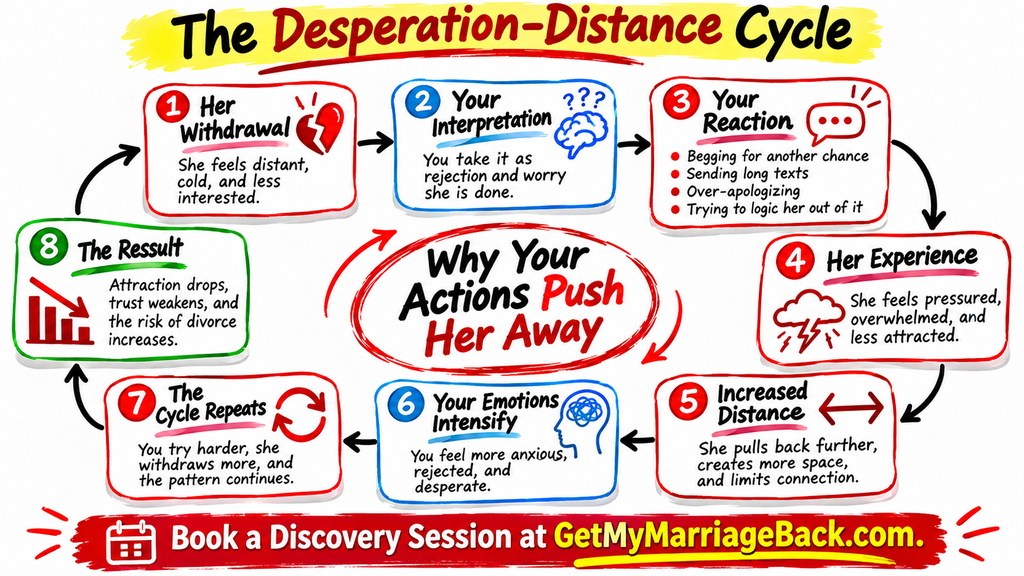
Your wife walks past you in the kitchen without saying good morning.
Immediately, your stomach tightens.
You follow her, demand an explanation, and ask why she’s acting so cold.
She withdraws even further.
Now you’re convinced she doesn’t care about you anymore.
But what actually happened?
The observable behavior was silence. Your interpretation was rejection.
Her silence alone does not establish what she intended.
She may be angry, exhausted, distracted, resentful, or deliberately maintaining distance.
Your reaction can make the interaction more uncomfortable before you understand what you’re responding to.
This is why emotional self-control matters.
Before another conversation, regulate your breathing. Relax your shoulders. Stop following her around the house.
You cannot become emotionally compelling while treating every uncomfortable interaction as an emergency.
Confidence begins with your ability to handle discomfort without immediately transferring that discomfort to your wife.
And confidence is always sexy.
3. Start Giving to Yourself Again
You’ve spent years giving your time, energy, money, and attention to your marriage.
Somewhere along the way, you stopped investing in yourself.
Your sleep deteriorated. Physical activity disappeared. Personal interests became irrelevant.
Now you’re exhausted, resentful, and waiting for your wife to make those sacrifices feel worthwhile.
That is not sustainable generosity.
You cannot consistently offer an engaging emotional experience while running on exhaustion and resentment.
Start rebuilding the person who exists beyond the marriage crisis.
Take care of your health.
Return to meaningful activities.
Invest in your education, emotional well-being, and personal development.
Reconnect with the qualities that make your life fulfilling even when your marriage is experiencing uncertainty.
This is not about becoming selfish or pretending your wife doesn’t matter.
It’s about restoring the personal capacity that allows you to show up with genuine warmth rather than emotional depletion.
A fuller life gives you something meaningful to bring into your relationships.
4. Stop Turning Kindness Into an Invoice
You wash the dishes and expect affection.
You buy flowers and wait for a romantic response.
When nothing happens, you become bitter.
Suddenly, your kindness has become an invoice.
I want you to consider a familiar situation.
Your wife returns from work exhausted. You prepare dinner because you know she’s had a difficult day.
Then, almost immediately, you ask whether she appreciates you more now.
The dinner was helpful.
The demand afterward made the gesture transactional.
Instead of simply experiencing your care, she now feels responsible for providing the emotional payment you expected.
Genuine giving does not require an immediate emotional return.
Reciprocity absolutely matters in a healthy marriage. However, expecting every individual gesture to produce affection turns the relationship into a running calculation.
That calculation changes how your presence feels.
Before your next act of generosity, ask yourself whether you’re expressing care or trying to secure a particular response.
If the gesture only feels worthwhile when she rewards you, your expectations are driving the interaction.
Give because you choose to give.
Let appreciation remain appreciation rather than turning it into a demand for desire.
5. Develop the Kind of Confidence That Creates Attraction
Confidence is always sexy.
But confidence is not pretending you don’t care about your marriage.
It isn’t becoming emotionally unavailable, acting superior, or playing hard to get.
Real confidence is caring deeply without abandoning your dignity and self-respect.
Suppose you reach for your wife’s hand and she pulls away.
You have a choice.
You can sulk, demand an explanation, or turn her refusal into an argument.
Alternatively, you can respect her answer, remain composed, and continue your evening without making her responsible for regulating your emotions.
That response communicates emotional strength.
It also protects her freedom to choose whether and when she wants physical closeness.
Research supports the importance of emotional responsiveness in intimate relationships. A series of studies published in the Journal of Personality and Social Psychology found that perceived partner responsiveness was associated with greater sexual desire, particularly among women. The researchers examined how feeling understood, valued, and cared for contributes to romantic interest.
You can explore the findings in the research on partner responsiveness and sexual desire.
The practical lesson is not to perform sensitivity as another attraction tactic.
It is to become someone who can respond thoughtfully, respect boundaries, and create an emotionally engaging experience without demanding immediate affection.
6. Build Confidence Through Education and Practice
You cannot develop lasting confidence by repeating affirmations while continuing the same desperate behaviors.
Saying you don’t care means very little when your face, posture, and actions communicate panic.
Confidence is developed through education and repeated practice.
Learn communication skills.
Practice emotional regulation.
Develop social awareness and the ability to recognize what an interaction actually requires.
For example, before sending your wife another lengthy message, write it privately.
Then ask yourself:
- Am I sharing necessary information?
- Am I seeking reassurance?
- Am I trying to prove my value?
- Am I venting because I feel rejected?
- Will this message respect the space she requested?
The answer tells you whether your communication is serving a meaningful purpose or simply relieving your anxiety.
Confidence grows when you repeatedly handle difficult moments competently.
You don’t have to eliminate uncomfortable emotions.
Instead, develop the ability to experience those emotions without letting them dictate every decision.
That skill changes how you carry yourself through separation.
7. Appreciate the Current State of Your Marriage
Your wife says she needs space.
You continue behaving as though the relationship still has the same level of romantic access it enjoyed five years ago.
Then you feel insulted when she declines affection.
I understand why that hurts.
You remember the closeness, laughter, physical intimacy, and ordinary affection that once made your marriage feel secure.
But you cannot navigate your relationship effectively while refusing to acknowledge its present condition.
Respect the current reality without automatically declaring it permanent.
When I say appreciate the current state, I don’t mean celebrate the separation or pretend you’re happy about it.
I mean recognize what is actually happening and identify what the situation reveals.
Is your wife asking for temporary space because she’s emotionally exhausted?
Has resentment accumulated through repeated unresolved experiences?
Does she still engage warmly in some situations but avoid romance?
Has she consistently communicated a concrete decision to end the marriage?
These are different relationship dynamics.
Pay attention to her stated boundaries, consistent behavior, and the history surrounding the change.
Don’t use one affectionate moment as proof that everything is repaired.
Likewise, don’t treat one cold interaction as a final verdict.
Your next move should reflect the marriage you have today, not the marriage you remember having.
8. Allow Your Wife to Become Curious About You Again
You start exercising again.
You take a course, improve your appearance, and become more intentional about your daily routine.
Then you report every improvement to your wife.
You tell her how much you’ve changed and repeatedly check whether she’s noticing.
That is not creating curiosity.
It’s another performance demanding attention.
Stop narrating your personal growth.
Let your actions speak.
When your wife encounters someone calmer, more engaged, and genuinely occupied with meaningful activities, she has room to notice the change herself.
There is an important difference between becoming interesting and trying to look interesting.
Manufacturing jealousy, disappearing to provoke anxiety, or using calculated silence to punish your wife does not create the kind of attraction I’m teaching.
Those tactics replace emotional connection with insecurity.
Real curiosity develops when someone encounters genuine qualities or experiences they find engaging.
Your responsibility is to build those qualities.
Her response remains her choice.
And that freedom is part of what makes authentic romantic interest meaningful.
9. Pursue a Meaningful Life Mission
You cannot fake busy.
A calendar filled with distractions is not the same thing as having a purpose.
When your entire emotional world revolves around whether your wife responds to your latest message, every interaction carries enormous pressure.
Her mood becomes your mood.
Her silence determines your day.
Your personal growth becomes another attempt to get her attention.
I want you to redirect that energy toward something meaningful.
Reconnect with your calling, meaningful work, service, personal development, and the legacy you want to create.
Your purpose must be greater than your wife’s current feelings about you.
This does not mean your marriage becomes unimportant.
It means the marriage stops being the sole source of your identity, emotional stability, and sense of direction.
A meaningful mission gives you something substantial to pursue even when your relationship is uncertain.
And a person who is genuinely engaged with life brings a different kind of energy into romantic interactions.
How GPS5 Connects Self-Leadership With Romantic Attraction
I use a framework called GPS5 to organize the personal work that supports sustainable attraction.
The process begins with three foundational areas: Grounding, Purpose, and Self.
Grounding: Stop Letting Every Reaction Control Your Day
Grounding redirects your attention away from the latest painful symptom and toward your higher self, a more accurate understanding of reality, and gratitude.
You acknowledge that your wife is distant without allowing that distance to define your entire identity.
Rather than building another catastrophic story around her silence, you return to what you know and what you can control.
Purpose: Turn Pain Into Meaningful Direction
Purpose redirects the emotional energy of the crisis toward your calling, contribution, impact, and legacy.
Your marriage matters, but your life has responsibilities and possibilities beyond the immediate relationship problem.
That broader direction reduces the pressure to extract all your emotional stability from your wife’s responses.
Self: Build Sustainable Emotional Capacity
Self involves accountability, responsibility, emotional maturity, and the capacity to love without abandoning yourself.
You take ownership of your conduct without turning every relationship problem into self-blame.
The goal is to become more capable of handling difficulty while remaining warm, engaged, and self-respecting.
Value Leads to Curiosity, Attraction, and Influence
As these qualities develop, you create greater experiential value.
In plain language, being around you becomes a calmer, more engaging, less pressured experience.
That experience creates room for curiosity.
Curiosity can support attraction when your wife begins noticing meaningful changes without being pressured to reward them.
Influence then becomes possible through the quality of your conduct rather than attempts to control her feelings.
The sequence is:
Grounding + Purpose + Self → Experiential Value → Curiosity and Attraction → Influence
This is not a strategy for forcing someone to desire you.
It is a roadmap for becoming more emotionally compelling while respecting another person’s freedom.
Why Attraction Doesn’t Return Just Because You Stop Chasing
Stopping desperate behavior is important, but removing pressure is only the beginning.
You can stop begging and still remain emotionally reactive.
Your wife can experience less pressure without suddenly feeling romantic desire.
Likewise, becoming quieter does not automatically repair months of resentment, loneliness, or emotional disconnection.
Research on romantic relationships consistently identifies perceived responsiveness as an important part of intimacy. In a 2012 daily-life study involving 102 couples, researchers found that concrete responsive behaviors were associated with feeling understood and with greater intimacy.
Other research has linked perceived responsiveness with affectionate touch, reinforcing the importance of the emotional experience surrounding physical connection.
The lesson is that attraction involves more than avoiding mistakes.
You need to develop a different way of engaging with yourself, your life, and the people around you.
That takes practice, not just a temporary change in tactics.
What to Do Tonight When Your Wife Gives You the Cold Shoulder
Tonight, your wife walks past you without acknowledging your presence.
You feel the familiar urge to follow her, ask what’s wrong, or send another message.
Here is what I want you to do.
Put your phone down. Relax your shoulders. Continue one meaningful activity without pursuing a reaction.
Don’t demand reassurance.
Avoid turning her silence into another argument.
Respect her space while maintaining your own composure.
You are not pretending the marriage crisis doesn’t exist.
You’re practicing the emotional self-control required to navigate it effectively.
That one decision reduces immediate pressure.
However, the deeper work involves developing the confidence, emotional intelligence, and personal direction that make your presence more engaging over time.
You cannot control whether your wife becomes attracted to you again.
You can control whether your conduct communicates desperation or dignity, emotional pressure or steadiness, resentment or genuine generosity.
And that is where rebuilding attraction begins.
Average Length of Separation Before Reconciliation: Data Reveals!
Frequently Asked Questions
Yes, attraction can return when the emotional dynamics that contributed to disconnection change. Rebuilding confidence, reducing pressure, and creating more positive experiences can support renewed romantic interest.
Focus on emotional self-control, personal development, genuine generosity, and respecting her boundaries rather than begging for affection. Become more engaging through consistent actions instead of repeatedly asking whether she notices your progress.
Respect the boundaries she has communicated and keep necessary communication clear, calm, and purposeful. Avoid excessive messages intended primarily to obtain reassurance or provoke a romantic response.
There is no universal timeline because unresolved resentment, emotional exhaustion, attraction loss, and a settled decision to leave involve different circumstances. Consistent behavior and the actual state of your marriage matter more than counting days.