


Your wife wants space, and now she’s sleeping in another bedroom—leaving you wondering whether you’re watching your marriage fall apart or whether there’s still a way back.
Take This 2 Minutes Quiz
The bed is still there. Your pillow hasn’t moved. But the woman you’ve shared your life with has decided she no longer wants to sleep beside you.
You’re still married. You might even be living under the same roof, sharing bills, raising children, and carrying on with everyday responsibilities.
Yet something fundamental has changed.
The bedroom that once represented intimacy, comfort, and belonging has become a painful reminder of the emotional distance between you.
And the temptation is to do something immediately.
You want another conversation. You want reassurance. Most importantly, you want her to come back.
But here’s what I need you to understand: your wife moving out of your bedroom is a serious sign of distance, not automatic proof that your marriage is over.
What happens next depends partly on whether you understand the distance or allow your fear to make it worse.
1. Your Wife Wants Space After Months of Complaints
One of the biggest mistakes you can make is treating the bedroom move as the beginning of your marriage crisis.
In many struggling marriages, it’s actually the latest development in a much longer story.
Think about what happened before she moved.
Did your wife repeatedly complain about feeling disconnected? Did arguments become more frequent? Was she telling you that she was tired, frustrated, or emotionally exhausted?
Perhaps you believed you were doing everything possible to resolve those disagreements.
You explained your intentions. You defended your decisions. Whenever she complained, you had an answer.
But there’s a difference between answering a complaint and understanding its emotional impact.
Your intentions don’t automatically cancel the experience your spouse is having.
That doesn’t mean every accusation she makes is objectively correct. It means her emotional experience deserves to be understood without automatically accepting every interpretation as fact.

The Husband Who Never Expected His Wife to Leave the Bedroom
I worked with a husband whose wife had complained about their marriage for months.
Eventually, she started asking for space.
Then came the moment he never expected.
She moved out of their bedroom.
That single decision almost devastated him emotionally.
He hadn’t imagined reaching a point where his wife would deliberately choose to sleep somewhere else.
And she didn’t return the following night.
Or the next week.
His wife remained outside their bedroom for a little more than three months.
The physical separation made every unresolved problem feel more permanent.
But his greatest obstacle wasn’t simply the empty bed.
It was what his fear was pushing him to do about it.
2. Your Wife Needs Space—But Does That Mean She Wants Divorce?
When your wife wants separation, you need to distinguish what she has actually done from what you fear her actions mean.
Several different relationship dynamics can produce similar behavior.
Emotional Exhaustion
Repeated arguments can make ordinary interactions feel overwhelming.
Your wife may associate the bedroom with another difficult conversation, another disagreement, or another attempt to convince her that things are improving.
Sleeping separately creates immediate distance from those interactions.
That doesn’t establish whether she wants divorce. It establishes that she wants something about her current experience to change.
Accumulated Resentment
Sometimes the problem is much older than the latest argument.
Unresolved disappointments, broken expectations, and repeated conflicts can gradually weaken emotional closeness.
Your wife may no longer experience the same warmth or desire for connection.
The bedroom move becomes an outward expression of a longer emotional withdrawal.
Loss of Attraction
Physical attraction in marriage is more than appearance or sexual performance.
It’s also influenced by the emotional experience of being around someone.
When your interactions become dominated by anxiety, defensiveness, resentment, and demands for reassurance, the relationship can lose the playfulness and ease that once supported intimacy.
You may still love your wife deeply while struggling to create an experience she finds emotionally attractive.
Preparation for Separation
There’s also a possibility you shouldn’t ignore.
Your wife may be considering a more permanent separation.
Look for additional evidence.
Has she explicitly said she wants divorce? Is she making arrangements to live elsewhere? Has she begun separating finances or discussing legal decisions?
Those actions provide different information from sleeping in another room.
Don’t turn a bedroom move into proof of divorce, but don’t dismiss concrete separation plans either.
Your responsibility is to respond to reality rather than predictions.
3. Why Trying Harder Can Push Your Wife Further Away
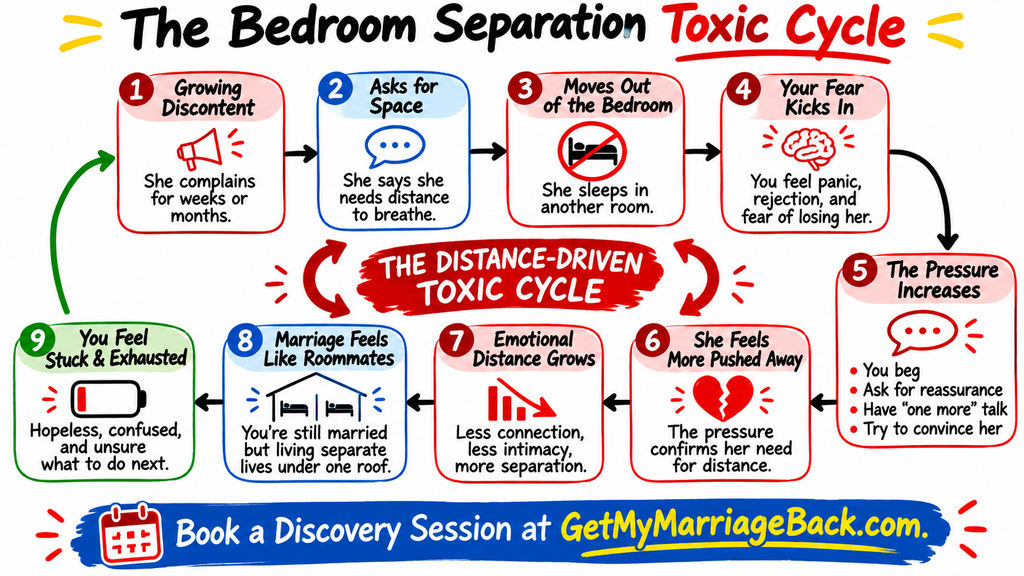
This is where a painful marriage crisis can become a destructive cycle.
Your wife asks for space.
You become frightened.
That fear creates an urgent desire to restore closeness.
So you pursue another conversation.
You send long text messages explaining everything you’ve sacrificed.
Perhaps you promise to change, then become frustrated when she doesn’t immediately acknowledge your efforts.
You call it fighting for your marriage.
But your wife experiences another demand when she has already asked for room to breathe.
The more she withdraws, the more anxious you become.
Your anxiety produces additional pressure, and that pressure gives her another reason to maintain her distance.
The Demand-Withdrawal Cycle
Relationship researchers have examined this pattern extensively.
A study involving 116 married couples found that demand-withdraw interactions were associated with more negative emotions, less constructive conflict behavior, and lower levels of conflict resolution.
The researchers observed this pattern in both husband-demand/wife-withdraw and wife-demand/husband-withdraw interactions.
You can examine the findings in the published research on demand-withdraw patterns in marital conflict.
This matters because the problem isn’t simply that one spouse wants communication while the other wants silence.
It’s the repetitive interaction that develops between pressure and withdrawal.
And the pattern can continue even when both individuals believe they’re protecting themselves.
Stop Confusing Begging With Pursuit
I want to make an important distinction.
There’s nothing inherently wrong with expressing romantic interest in your wife.
Healthy pursuit communicates interest, affection, confidence, and dignity.
Begging communicates something different.
It makes your emotional stability dependent on receiving a particular response.
When you repeatedly demand reassurance, you place responsibility for regulating your fear onto the person who has already requested distance.
That creates an unattractive emotional dynamic.
The objective isn’t to stop loving your wife. It’s to stop allowing fear to control how you express that love.
4. What Changes When You Stop Chasing and Start Leading Yourself
Inside our book Get My Marriage Back, we have a chapter called Stop the Bleeding.
That’s where I began working with the husband whose wife had moved out of their bedroom.
He initially feared that backing off would give her even more freedom to drift away.
From his perspective, doing less felt like surrendering.
But his attempts to control the distance were contributing to the pressure surrounding their interactions.
We began with self-development.
Not as a performance designed to make his wife jealous.
Not as a manipulation tactic to force her back into the bedroom.
We focused on developing the emotional capacity to respond differently.
Grounding: Stop Letting Panic Make Decisions
Your wife’s withdrawal can trigger powerful feelings of rejection.
Grounding begins when you recognize those feelings without allowing them to determine your next action.
You can acknowledge the pain of sleeping separately without demanding that she resolve it tonight.
Instead of standing outside her door requesting another conversation, return to your emotional center.
Notice the difference between an actual emergency and the discomfort of uncertainty.
Your fear deserves attention, but it doesn’t deserve control of your behavior.
Purpose: Become Bigger Than the Marriage Crisis
Your marriage matters.
But your entire identity cannot depend on whether your wife chooses to sleep beside you.
Redirect meaningful energy toward your health, responsibilities, work, personal mission, and contribution to others.
This isn’t about pretending you don’t care.
It’s about becoming someone whose emotional presence isn’t dominated by desperation.
A purposeful life creates stability and gives you something meaningful to bring into your relationships.
Self-Discovery: Recognize Your Own Patterns
Pay attention to your reactions when your wife withdraws.
Do you become argumentative?
Are you constantly explaining yourself?
Does every uncomfortable silence trigger another attempt to secure reassurance?
These questions aren’t invitations to blame yourself for everything wrong in the marriage.
They’re opportunities to discover what you can control.
You cannot force your wife to return to the bedroom.
You can change the way you respond to disappointment, rejection, and uncertainty.
And that capacity becomes especially important when your marriage is under pressure.
How Emotional Attraction Can Begin to Return
Building attraction in marriage isn’t about becoming cold, unavailable, or indifferent.
It’s about improving the experience of being around you.
Consider the difference between two interactions.
In the first, your wife walks into the kitchen and immediately senses that you’re waiting for an opportunity to discuss the marriage.
Your expression is tense. You’re monitoring her mood. Every response becomes evidence of whether reconciliation is approaching.
In the second, you’re grounded in your own activities.
You acknowledge her naturally. Your tone is relaxed, your presence is respectful, and you don’t turn an ordinary encounter into another relationship negotiation.
The second interaction removes a source of emotional pressure.
That matters because attraction needs room for positive experiences.
Value, Curiosity, Attraction, and Influence
Our framework builds from self-leadership toward experiential value.
Value isn’t merely your moral worth or your ability to provide financially.
It’s also the quality of the emotional experience you create through your presence, confidence, emotional intelligence, and personal development.
As your behavior changes consistently, your wife has the opportunity to experience you differently.
Curiosity can develop when familiar negative patterns no longer dominate your interactions.
Attraction becomes more possible when emotional safety, warmth, and positive engagement have room to emerge.
Influence grows through credibility and consistency rather than demands.
None of this requires treating your wife as a project to manage.
The focus remains on becoming responsible for your own behavior while respecting her freedom to make decisions.
What Happened After Three Months Outside the Bedroom?
The husband I worked with began changing how he responded to his marriage crisis.
He stopped begging.
Instead of repeatedly attempting to close the distance through emotional pressure, he concentrated on self-development and changing his own behavior.
Eventually, his wife revealed something significant.
She had become exhausted by the distance she herself had created.
After spending more than three months outside their shared bedroom, she independently raised the possibility of returning to the marriage.
That development mattered.
He had been terrified that respecting her space would make reconciliation less likely.
Yet reducing the pressure created a different environment from the one that had surrounded their earlier interactions.
The lesson isn’t that three months is a magical reconciliation timeline.
Nor should you interpret giving space as a technique for controlling someone’s feelings.
The meaningful change was that he stopped trying to govern his wife’s response and started governing his own.
Interestingly, his story eventually developed another complication.
By the end of our sessions, he faced a personal decision involving his wife and a younger woman who had been giving him attention.
His responsibility for making thoughtful, principled decisions hadn’t disappeared simply because his marriage was in crisis.
Personal power includes being accountable for the choices available to you.
What to Do Tonight When Your Wife Sleeps in Another Room
When you pass the closed bedroom door tonight, resist the urge to demand another conversation.
Don’t stand outside asking why she refuses to sleep beside you.
Avoid turning the evening into another debate about everything you’ve sacrificed.
Instead, carry yourself with dignity.
Relax your shoulders. Maintain your composure. If you cross paths, interact respectfully without making the encounter a test of her feelings.
Continue with your responsibilities.
This isn’t silent treatment, punishment, or pretending that everything is fine.
You’re removing unnecessary pressure while preserving your self-respect.
When an appropriate opportunity for communication arises, approach it without demanding an immediate emotional outcome.
Can You Save Your Marriage Alone?
You can begin changing your contribution to the relationship without waiting for your spouse to participate.
That means improving your emotional regulation, communication habits, self-awareness, and ability to create positive interactions.
You cannot make another person choose reconciliation.
But you can stop reinforcing behaviors that make constructive engagement more difficult.
If you’re trying to save your marriage while separated, remember that physical proximity isn’t the same as emotional intimacy.
Living under one roof doesn’t automatically mean you’re connected.
Likewise, sleeping in separate bedrooms doesn’t automatically establish that reconciliation is impossible.
The deeper question is whether the patterns that produced the distance are changing.
The Real Goal Is More Than Sharing a Bedroom Again
Getting your wife back into your bed isn’t the same as rebuilding your marriage.
You can restore physical proximity while leaving the original problems untouched.
That’s why your focus needs to extend beyond the immediate symptom.
Develop the emotional intelligence to recognize what is happening without reacting impulsively.
Build the self-leadership to maintain your dignity during uncertainty.
Create opportunities for attraction through authentic growth, positive experiences, and respectful engagement.
Your wife is responsible for her decisions.
You’re responsible for yours.
And the quality of those decisions matters whether you’re facing emotional withdrawal, a wife who wants separation, or the possibility of divorce.
Stop making the bedroom door the measure of your value. Start becoming someone who brings stability, confidence, and meaningful connection into the marriage.
“Wife Makes NO EFFORT In BED” (5 Tips For INSTANT Solution)
Frequently Asked Questions
It means she wants some form of distance, but the reason may involve emotional exhaustion, unresolved conflict, attraction loss, or consideration of separation. Examine what she has communicated and how her behavior has changed before drawing conclusions.
Respect her clearly expressed boundaries while continuing to handle your responsibilities with dignity. Giving space doesn’t require abandoning your marriage or using silence to punish her.
Sleeping separately can signal serious relationship distress, but it doesn’t independently establish that divorce is inevitable. Explicit divorce statements, separation plans, and the broader history of your marriage provide more meaningful context.
Emotional attraction can change as relationship experiences and behavior patterns change. Focus on becoming more grounded, emotionally intelligent, and genuinely engaging rather than attempting to force affection or reconciliation.