
What Would Help You Most Right Now?

Choose the option that best matches where you are with your marriage.

I Need Personalized Help

My Marriage Is in Serious Trouble

If you're dealing with separation, divorce, loss of attraction, infidelity, intimacy problems, or a spouse who's pulling away, get help looking at what's happening in your specific situation.

Get Personalized Help →
Get My Marriage Back book cover
I'd Rather Learn What to Do First

Start With Get My Marriage Back

Get the book and start learning the principles for moving your marriage in a better direction.

Get the Free Book →

Wife Wants Separation? Why Your Apologies Push Her Away

Your wife wants separation, and the more desperately you try to convince her to stay, the more determined she seems to become about leaving.

Take This 2 Minutes Quiz

Question 1 of 15

She told you to pack a bag and leave the house while she figures out whether she still wants this marriage.

You are staring at a suitcase, wondering how years of building a life together have reached this moment.

Your instinct is to fix everything immediately.

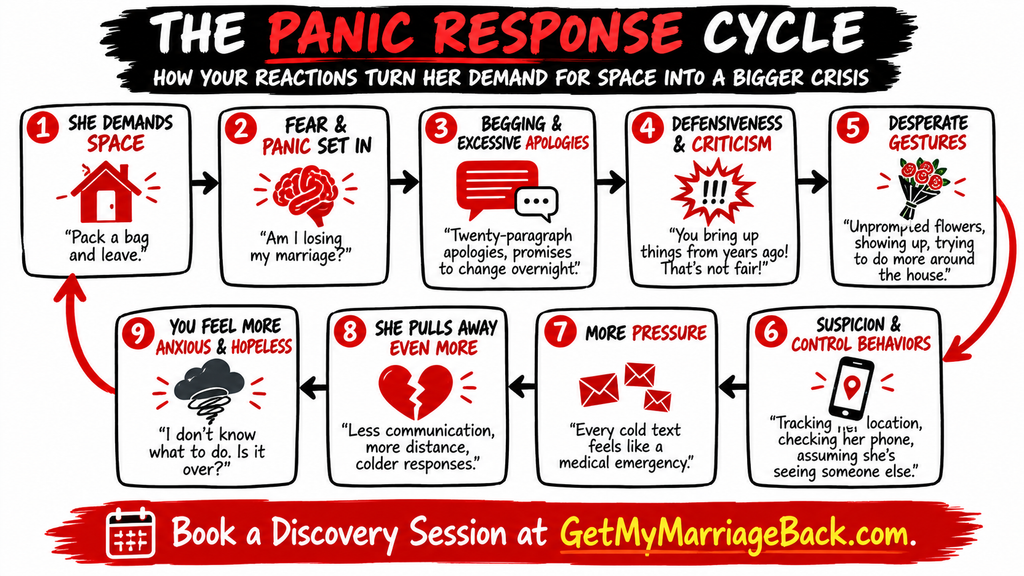
You apologize for something that happened six years ago. Then you apologize again, sending twenty paragraphs explaining how much you’ve changed and promising to become a different husband overnight.

She doesn’t respond the way you hoped.

Now you’re angry because she refuses to forgive you.

You start doing more around the house, bring flowers she never requested, and listen to friends who insist she must be seeing someone else.

Before long, you’re checking her location and treating every cold text like a medical emergency.

The problem is no longer just that your wife wants separation. Your reaction to the separation has become another source of pressure inside an already struggling marriage.

And if your objective is marriage reconciliation, you need to understand that distinction before doing anything else.

Why Your Wife Wants Separation May Not Be What You Think

When your wife tells you to move out, you immediately want an explanation.

Is she cheating?

Has she stopped loving you?

Does she want a divorce?

Is she deliberately trying to hurt you?

Or is she genuinely afraid that remaining in the same environment will create more conflict?

These possibilities are not interchangeable.

A demand for physical distance often reflects some kind of perceived threat or unresolved problem.

That threat can involve emotional pressure, recurring arguments, resentment, broken trust, or genuine concerns about physical safety.

Sometimes the demand itself is unfair or controlling.

Your first responsibility is to distinguish what actually happened from the meaning you’re assigning to it.

For example, suppose your wife says, “You’ve never cared about me.”

That statement tells you something important about her emotional experience. It doesn’t establish that you’ve literally never cared.

She can genuinely feel neglected while overlooking meaningful ways you’ve contributed to the marriage.

Likewise, you can sincerely believe you’ve been a good husband while failing to recognize how certain behaviors have affected her.

The purpose of emotional intelligence isn’t to automatically agree with her interpretation.

It’s to recognize the legitimate concerns without treating every emotionally charged accusation as an objective description of your entire marriage.

If violence, intimidation, or credible safety concerns are involved, respect physical separation and prioritize safety. That situation must not become an attraction exercise.

wife wants separation

1. You Keep Apologizing Because You Want an Immediate Result

Let’s examine the twenty-paragraph apology.

You describe everything you’ve done wrong.

You promise to change.

You explain your intentions.

Then you wait for forgiveness.

When forgiveness doesn’t arrive, you become frustrated.

Here’s the contradiction.

You’re presenting your apology as accountability while expecting an emotional reward for giving it.

An apology acknowledges harm. It doesn’t purchase forgiveness.

The distinction becomes obvious when you examine what happens after she refuses to reassure you.

Do you become defensive?

Do you remind her how much you’ve sacrificed?

Do you demand recognition for everything you’ve started doing differently?

If so, the apology has become part of a negotiation.

You’re effectively communicating that your willingness to take responsibility depends on whether she gives you the response you want.

That isn’t the emotional experience that makes reconciliation attractive.

Genuine accountability means acknowledging specific behavior, accepting appropriate responsibility, and demonstrating change without demanding immediate emotional payment.

It also means refusing responsibility for things you didn’t do simply because you’re afraid of losing the marriage.

Unwarranted apologies are not humility.

They’re often fear disguised as agreement.
wife wants separation - the panic response cycle

2. You Confuse Emergency Performance With Lasting Change

After your wife announces separation, you suddenly become exceptionally helpful.

You wash dishes.

You clean the house.

You offer to handle responsibilities you’ve previously neglected.

These can be constructive actions when they reflect genuine responsibility.

But consider your motivation.

Are you contributing because you’ve recognized a legitimate problem?

Or are you performing household duties in the hope that she’ll reverse her separation decision by Friday?

Your wife can experience the difference between sustained character and emergency performance.

When every good deed comes with an invisible request for reassurance, ordinary responsibility becomes another source of pressure.

And the same problem appears with grand romantic gestures.

You arrive at her workplace with flowers she never requested.

You send affectionate messages despite her asking for distance.

You try to manufacture a romantic moment before the underlying conflict has been addressed.

That’s not skillful seduction.

Attraction cannot be demanded as compensation for effort.

Romantic pursuit expresses interest while respecting another person’s autonomy.

Chasing attempts to escape rejection by increasing pressure.

The distinction is not whether you love your wife.

It’s whether your behavior communicates grounded interest or emotional desperation.

3. Your Wife Keeps Bringing Up Something From Six Years Ago

Your wife mentions an old grievance.

You become furious.

You’ve already apologized, and you believe you’ve paid for that mistake.

Why can’t she move forward?

Because six years on the calendar doesn’t necessarily mean six years of repair.

The original issue may have been discussed without being resolved.

Perhaps a promise was broken repeatedly.

Maybe the behavior stopped, but its emotional consequences were never meaningfully addressed.

It’s also possible that you’ve made genuine, sustained changes while your wife continues using an old grievance unfairly.

Those are different marriage dynamics.

One involves unresolved injury.

Another involves recurring behavior.

A third raises legitimate questions about fairness and accountability.

You cannot diagnose them simply by counting the years that have passed.

Ask yourself what actually changed.

Did you acknowledge the impact of your actions, or spend years defending your intentions?

Has the same pattern appeared in different forms?

What evidence demonstrates that the original problem was repaired rather than merely abandoned as a conversation?

And has your wife recognized meaningful improvements, or does every disagreement return to the same accusation regardless of your conduct?

These questions matter because good intentions do not erase real damage, and genuine pain does not make every accusation accurate.

When you become obsessed with proving you’re the good person, you stop examining the actual relationship problem.

That defensiveness can make marriage reconciliation considerably more difficult.

4. Your Fear Turns Into Suspicion and Control

Your wife asks for space.

A friend suggests she’s probably seeing another man.

Social media reinforces the suspicion.

Now you’re checking her movements, analyzing her messages, and interpreting every unexplained absence as evidence of an affair.

But suspicion is not proof.

The fact that your wife wants separation doesn’t establish that she’s cheating.

And if she is involved with someone else, monitoring her location won’t create the trust, emotional connection, or personal power required to make wise decisions.

You need facts, not a story constructed from fear.

Tracking her location without permission, appearing uninvited, and bombarding her phone can violate boundaries and intensify the very conflict you’re trying to resolve.

The underlying pattern is straightforward.

You experience uncertainty.

Uncertainty produces fear.

Fear drives monitoring, confrontation, and repeated reassurance-seeking.

Those behaviors increase pressure.

She becomes more distant.

Her distance increases your fear.

The cycle repeats.

This resembles the demand-withdraw relationship pattern studied in marriage research, where one partner’s pursuit of engagement and the other’s withdrawal can reinforce each other.

The central issue is not which spouse deserves all the blame.

It’s recognizing when your own response is contributing to the interaction you desperately want to change.

How to Save Your Marriage While Separated Without Begging

When your wife wants separation, you still have influence over your marriage.

But influence and control are not the same thing.

Your wife controls her decisions.

You control your behavior, your emotional responses, your personal development, and the quality of your interactions.

Your conduct helps shape the emotional environment in which future interactions occur.

That is where your personal power begins.

You don’t need to beg for permission to remain emotionally invested in your marriage.

Nor do you need to pretend you no longer care.

The objective is to become someone who can express genuine interest without emotional coercion, demonstrate accountability without self-erasure, and handle uncertainty without turning every interaction into a crisis.

This is the foundation of rebuilding attraction intelligently.

Grounding: Stop Making Every Feeling an Emergency

Grounding means returning to your higher self, your source of truth, and gratitude while the marriage crisis remains unresolved.

It doesn’t mean pretending you’re unaffected.

You can feel frightened, rejected, angry, and disappointed without allowing those feelings to dictate your next action.

Before responding to a cold message, identify what actually happened.

Did she ask a practical question?

Did she communicate a boundary?

Or did she simply take longer than expected to reply?

Respond to the reality, not the catastrophic interpretation.

Purpose: Reconnect With a Life Greater Than the Crisis

Your marriage matters.

But your purpose cannot be reduced to obtaining your wife’s approval.

Reconnect with your responsibilities, meaningful work, physical well-being, friendships, personal development, and the legacy you’re building.

This isn’t a performance designed to make your wife jealous.

It’s a commitment to living with direction regardless of the uncertainty surrounding your relationship.

A life organized entirely around another person’s reactions becomes emotionally exhausting for everyone involved.

Purpose restores perspective.

Self-Discovery: Recognize Your Patterns Without Self-Blame

Self-discovery requires examining your actual capacity.

Where do you become defensive?

What situations trigger excessive apologizing?

When do you confuse reassurance with connection?

Which behaviors reflect your values, and which are reactions to fear?

The goal isn’t to label yourself as the villain.

It’s to identify the patterns you can change.

From this foundation, you begin developing genuine experiential value through consistency, emotional steadiness, engaging conversation, healthy boundaries, and personal responsibility.

Curiosity and attraction can develop when the experience of interacting with you becomes different.

But they must emerge voluntarily.

You cannot force your wife to become curious, attracted, or interested in reconciliation.

Your influence comes from credible conduct, not emotional pressure.

Why Attraction Requires More Than Giving Her Space

Many people interpret separation advice as a choice between chasing their spouse and disappearing completely.

That’s a false choice.

You can respect distance while remaining emotionally mature, responsible, and open to appropriate connection.

You can communicate about necessary responsibilities without turning every exchange into a relationship negotiation.

And you can demonstrate growth without announcing that you’ve changed every twenty-four hours.

The deeper challenge is consistency.

Research on stress and decision-making has examined how pressure affects goal-directed behavior and habitual responses. Some studies have found shifts toward habitual responding under stress, while later research has produced mixed results.

A useful review of this research is available in Stress-Induced Modulation of Instrumental Behavior.

The practical lesson is that recognizing a destructive reaction doesn’t automatically eliminate it.

You can understand why begging is ineffective and still feel an overwhelming urge to send another apology tonight.

That’s why lasting development requires practicing different responses repeatedly rather than relying on one moment of inspiration.

What to Do Tonight When Your Wife Wants You to Leave

Suppose your wife gives you another cold response.

Your instinct is to demand an explanation.

You want to ask whether she still loves you, whether there’s someone else, or whether separation means divorce.

Instead, stop turning that moment into an emergency.

Put your phone down.

Don’t send another twenty-paragraph apology.

Don’t follow her around the house demanding reassurance.

Maintain your composure, respect her boundaries, and attend to your responsibilities.

If she has asked for physical separation because of safety concerns, respect that boundary and handle practical arrangements appropriately. Where housing, children, or legal obligations are involved, obtain appropriate professional guidance rather than escalating a confrontation.

The immediate objective is to stop feeding the conflict.

Removing pressure creates breathing room.

But breathing room alone doesn’t repair years of resentment, restore trust, or rebuild attraction.

Those outcomes depend on the actual problems within your marriage and the quality of the changes that follow.

Can Your Marriage Be Saved When Your Wife Wants Separation?

Your wife’s demand for separation is a serious development, but it doesn’t automatically tell you what the final outcome will be.

She may be overwhelmed by conflict.

She may have lost attraction.

She may be responding to legitimate safety concerns.

She may be emotionally disengaged or actively considering divorce.

And she may be interpreting the relationship through unresolved resentment that neither of you has adequately understood.

Your task isn’t to invent a reassuring explanation.

It’s to examine the facts, recognize your own contribution, and respond with dignity and emotional intelligence.

You cannot control whether your wife chooses reconciliation. You can stop making your fear the most powerful influence on your behavior.

That’s where rebuilding your personal power begins.

And that’s where the possibility of a different experience of you becomes real.

5 Physical Signs She Just Slept With Someone Else: The Truth

Frequently Asked Questions

What should I do when my wife wants separation?

Respect legitimate boundaries, avoid begging or repeated confrontations, and identify the underlying marriage problems before deciding your next steps. If safety concerns are involved, prioritize safety and appropriate arrangements.

Does separation mean my wife wants a divorce?

Not necessarily; separation and divorce are different decisions, although separation can precede divorce. Examine what your wife has actually communicated rather than treating fear as evidence of her final intentions.

How do I save my marriage when my wife wants to separate?

Focus on consistent accountability, emotional steadiness, respecting boundaries, and addressing the specific patterns contributing to the crisis. Marriage reconciliation depends on more than persuading your wife to reverse her decision.

Can my wife fall back in love after separation?

Attraction and emotional connection can change as relationship experiences change, but renewed feelings cannot be forced. Your strongest contribution is becoming consistently responsible, emotionally grounded, and genuinely engaging without making her response the measure of your progress.


Your Wife Asked You to Move Out? 5 Mistakes That Push Her Further Away

Your wife asked you to move out, and right now leaving your own home can feel exactly like agreeing that your marriage is over.

Take This 2 Minutes Quiz

Question 1 of 15

I understand why your first reaction can be, “Absolutely not.”

This is your house too. You may pay the mortgage or rent. Your children may live there. Your routines, memories, belongings and entire family life are wrapped up in that home.

Then the person you married tells you to leave.

It feels unfair.

And depending on the circumstances, it may genuinely be unfair.

But when your wife asks you to move out during a marriage crisis, the argument about who is right can quickly become less important than what happens next.

Your fear wants immediate action. Your anger wants justice. Your anxiety wants certainty.

None of those emotions should be driving the car.

I know this from more than coaching people through marriage crises. During the darkest period of my own marriage, I packed a small bag and left my house.

Our conflict eventually escalated further. During one argument, I became so frustrated that I picked up a bowl of water from the kitchen countertop and poured it onto the floor.

My logic at that moment was almost comical in hindsight: I was trying to demonstrate that anybody could fly off the handle.

Think about that.

I was demonstrating the problem of losing control by losing control.

Eventually, Lola called the police.

That is why I draw a hard line here. If anybody feels unsafe, safety comes first. If police or emergency assistance is necessary, call them. If there are legal questions about leaving the marital home, custody, property, a protective order or your rights, get qualified legal advice.

Marriage strategy does not override safety or the law.

Once those issues are separated from the reconciliation problem, however, you can ask a much more productive question:

What kind of man are you going to become while your marriage is under this pressure?

Wife Asked Me to Move Out: Does That Mean the Marriage Is Over?

No single request for physical distance can tell you the entire future of your marriage.

Your wife asking you to move out is serious information. Treat it seriously without turning it into a prophecy.

Separation and divorce are not identical.

Physical distance and emotional finality are not identical either.

The danger is that fear collapses all of those distinctions into one terrifying conclusion:

“If I leave, I lose her.”

Once you accept that conclusion as fact, almost anything can feel justified.

You argue.

You refuse.

You explain why she has no right to ask.

You remind her how much you pay.

You demand another conversation.

You send enormous text messages.

You insist that you’re “fighting for your marriage.”

But there is an uncomfortable question underneath all of this:

Are you fighting for your marriage—or is fear fighting through you?

That distinction changes everything.

wife asked me to move out

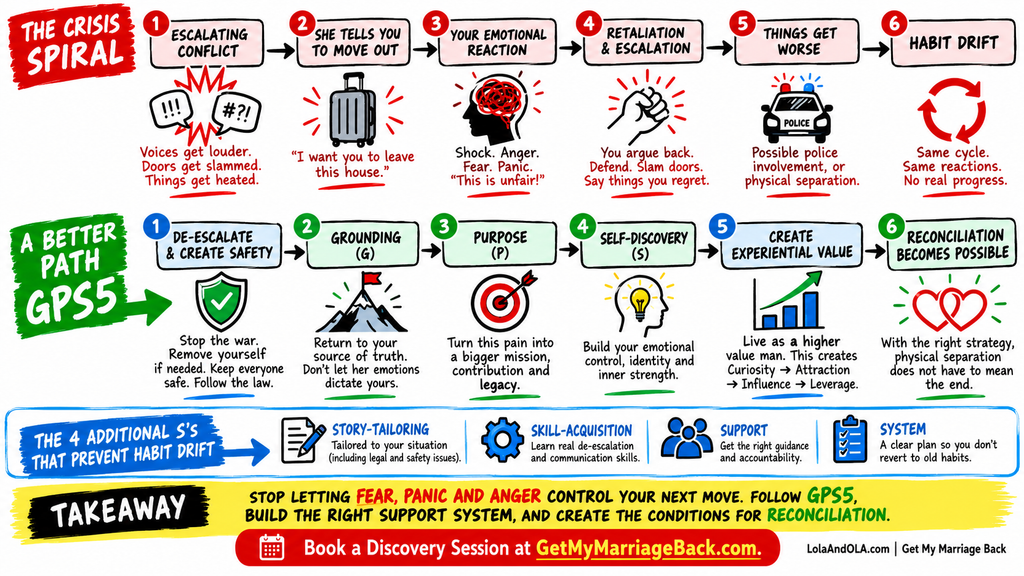
Mistake #1: Treating Retaliation Like Strength

One client I worked with had lived through years of increasingly heated marital conflict.

Arguments became normal. Doors were slammed. Emotions escalated.

His philosophy was straightforward:

If somebody brings war, retaliate with war. Otherwise, they’ll think you’re weak.

That philosophy felt powerful until his wife told him to move out.

Suddenly, everything he believed about strength was being tested.

This is one of the most seductive mistakes in a marriage crisis because retaliation feels like Personal Power.

It isn’t.

If your wife can raise her voice and automatically make you raise yours, she is influencing your emotional state.

If one sentence about separation makes you lose control, separation is controlling you.

When fear, panic, anger and anxiety determine your next move, those emotions have power over you.

Self-control is not submission. De-escalation is not weakness.

You can be physically strong enough to slam every door in your house and still be emotionally controlled by fear.

wife asked me to move out, not what

Mistake #2: Believing You Must Choose Between Fighting and “Giving Her Space”

Generic marriage advice loves extremes.

“Never leave your house.”

“Fight for your marriage.”

“Don’t let her push you around.”

Then another corner of the internet tells you:

“Just give her space.”

“Do whatever she wants.”

“Don’t contact her.”

“If she loves you, she’ll come back.”

Neither collection of slogans knows your marriage.

There is an enormous difference between fear-driven chasing and dignity-based pursuit.

You can want your wife.

You can want your marriage.

You can make your interest clear.

None of that requires you to beg for reassurance, force conversations, repeatedly ask whether she still loves you, or use every interaction to measure your chances of reconciliation.

Likewise, respecting legitimate distance does not require becoming cold, passive or manipulative.

You are not disappearing to “make her miss you.”

Your objective is much bigger.

Become someone whose emotional center is no longer dependent on what mood your wife is in today.

Mistake #3: Trying to Talk Your Way Back Into Attraction

When your wife wants separation, words become extremely tempting.

You want to explain your intentions.

You want her to understand how much you love her.

Maybe you have finally recognized mistakes that she complained about for years, and now you desperately need her to believe you have changed.

So you talk.

And talk.

And talk.

But attraction is experiential.

Your wife does not experience your transformation because you gave her a PowerPoint presentation about it.

She experiences you.

How do you respond under pressure?

What happens when she disagrees with you?

Can you hear something painful without immediately defending yourself?

Does every warm interaction become an opportunity to ask about reconciliation?

Can you experience rejection without collapsing, exploding or retaliating?

Those experiences communicate far more than another promise.

Why Chasing and Withdrawal Can Make the Crisis Worse

There is useful research behind this dynamic.

A study involving 116 married couples examined what researchers call demand-withdraw communication—a pattern where one spouse pushes for discussion, change or resolution while the other avoids or withdraws.

Both husband-demand/wife-withdraw and wife-demand/husband-withdraw patterns were associated with more negative emotions and tactics and lower conflict resolution. The pattern was not simply a “husband problem” or a “wife problem”; either spouse could occupy either side of the cycle. You can read the research on demand-withdraw patterns in marital conflict.

Look at how easily this can appear after your wife asks you to move out:

Fear → Pursuit → Pressure → Withdrawal → More Fear → More Pursuit

You want reassurance, so you push for a conversation.

She experiences pressure and retreats.

Her retreat frightens you, so you push harder.

Now she wants even more distance.

You interpret that distance as proof that you need to fight harder for the marriage.

The cycle feeds itself.

Breaking that cycle creates emotional breathing room. And emotional breathing room matters when you are trying to rebuild attraction.

Mistake #4: Making Your Wife Responsible for Your Emotional Stability

This is where separation exposes things ordinary married life can hide.

When your wife is warm, you feel powerful.

When she becomes cold, you fall apart.

When she texts you, you see hope.

When she doesn’t, you start imagining divorce.

When she laughs with you, you think reconciliation has started.

Then she mentions separation again and your entire emotional world crashes.

That’s not Personal Power.

Your wife has effectively become the thermostat controlling your emotional temperature.

Attraction struggles under that burden because every interaction acquires a hidden job:

“Please make me feel safe about us.”

Your wife can feel that pressure even when you never say those exact words.

This is why your first job is not making her change her mind.

Your first job is recovering your ability to lead yourself.

Grounding: Stop Letting the Symptom Become Your Identity

The symptom is:

“My wife asked me to move out.”

Grounding does not mean pretending that symptom doesn’t exist.

It means returning to a source of truth higher than the symptom.

Your marriage crisis cannot become your identity.

Your wife’s current emotional state cannot become your definition of your worth.

Her rejection cannot become the authority determining whether today has meaning.

Grounding brings you back to truth and gratitude while allowing you to confront the crisis exactly as it is.

Now you can respond instead of react.

That difference is enormous.

Purpose: Become Bigger Than the Crisis

Pain has a nasty habit of shrinking your entire world.

Suddenly everything becomes about your wife.

What did she mean by that text?

Why didn’t she call?

Is she talking to somebody else?

Does she miss you?

Is she filing?

When is she coming back?

Your marriage matters tremendously, but your purpose must be bigger than any single living human being—including your wife and including you.

Redirect pain into mission.

Reconnect with contribution, impact and legacy.

Build something meaningful enough that your marriage crisis cannot consume every available piece of your identity.

This isn’t a trick for making your wife jealous.

Purpose is attractive because purpose creates life.

A person with direction generates a different experience from a person whose entire existence has become monitoring whether someone else still wants them.

Self-Discovery: Find Out Who You Are Under Pressure

A marriage crisis reveals capacity.

It exposes your beliefs about masculinity, love, conflict, rejection, control, fairness and strength.

Don’t turn that discovery into self-blame.

Use it.

You may discover that what you called “standing up for yourself” was sometimes emotional reactivity.

Perhaps what you called “fighting for the marriage” was occasionally panic.

What looked like communication may have become repeated demands for reassurance.

Self-Discovery means developing enough emotional capacity to see those patterns without needing to declare yourself either the hero or villain.

Then you can change what you actually control.

How Attraction Starts Rebuilding During Separation

Attraction isn’t something you demand from your wife.

It emerges from experience.

I describe the progression this way:

Value → Curiosity → Attraction → Influence → Leverage

Value here does not mean moral worth.

You already have human worth.

I’m talking about experiential value: what does interacting with you feel like?

Are you emotionally exhausting or emotionally engaging?

Predictable or interesting?

Desperate or grounded?

Reactive or responsive?

Consumed by the marriage or connected to a meaningful life?

When your experience changes consistently, curiosity can emerge.

Your wife begins encountering something different instead of hearing another sales pitch about how different you are.

Curiosity gives attraction room to breathe.

Attraction can expand influence.

Influence creates leverage—not leverage to control her, but a stronger relational position from which reconciliation becomes possible.

Mistake #5: Trying to Recreate the Old Marriage

You don’t need the broken marriage back.

Read that again.

The goal is a brand-new marriage with the same person.

Going back to exactly what existed before the separation simply restores the conditions that produced the crisis.

You need a different relational experience.

More emotional intelligence.

Better conflict skills.

Greater self-control.

More curiosity.

Stronger individuality.

More play.

More purpose.

Greater experiential value.

That is how reconciliation becomes something more meaningful than getting your wife physically back inside the same house.

What to Do After Your Wife Asks You to Move Out

Start with reality.

Determine whether there is an immediate safety issue.

Separate legal questions from emotional questions.

Do not make irreversible housing, financial, property or custody decisions based solely on marriage advice from the internet.

Then look directly at your emotional pattern.

What happens inside you when she says, “I want you to leave”?

Does fear become anger?

Do you retaliate?

Do you start proving?

Does panic make you send paragraphs of text?

Do you immediately demand certainty about divorce?

Identify the automatic reaction before trying to perfect your next speech.

From there, rebuild your foundation:

Grounding. Purpose. Self-Discovery.

Create experiential value through the way you live and interact.

Allow curiosity and attraction to emerge from experience rather than pressure.

Develop influence through consistency.

Build leverage through emotional intelligence, dignity and a life that does not collapse every time your wife has a difficult emotion.

This is not passivity.

This is strategic self-leadership.

Physical Separation Does Not Have to Mean Emotional Surrender

I packed a bag and left my house during my own marriage crisis.

I understand the fear attached to that moment.

Walking through a door with luggage can feel like you’re physically acting out the death of your marriage.

But distance itself does not write the ending.

What matters enormously is what happens inside that distance.

You can spend separation obsessing, retaliating, monitoring, begging and waiting.

Or you can use the crisis to become grounded, purposeful, emotionally intelligent and experientially attractive.

You cannot control whether your wife ultimately chooses reconciliation.

But you have tremendous influence over the experience of you that you bring into every interaction from this point forward.

That’s where your Personal Power lives.

Stop trying to win the argument about who has the right to be angry.

Stop allowing fear to masquerade as strength.

Don’t make your wife responsible for regulating your emotions.

Build the man who can experience this crisis without becoming the crisis.

That is where rebuilding your marriage begins.

Wife or Husband Denying You Sex? DO THIS!!!

Frequently Asked Questions

What should I do if my wife asks me to move out?

De-escalate first, address any immediate safety or legal issues appropriately, and avoid making panic-driven decisions. Then identify the fear-driven behaviors you control and begin changing the experience you create in the marriage.

Does moving out mean my marriage is over?

No; physical separation and divorce are different events, although a request to move out should be treated seriously. Focus less on predicting the ending and more on responding with emotional intelligence, dignity and deliberate action.

Should I give my wife space when she wants separation?

Respecting legitimate space can reduce pressure, but don’t use distance as a manipulation tactic to make her miss you. Research on demand-withdraw conflict suggests that cycles of pressure and withdrawal are associated with more negative interactions and poorer conflict resolution.

Can I save my marriage while separated?

You cannot single-handedly dictate reconciliation, but you can change your contribution to destructive patterns and rebuild grounding, purpose, experiential value and emotional intelligence. Those changes create healthier conditions in which curiosity, attraction and reconciliation can develop.


What Would Help You Most Right Now?

Choose the option that best matches where you are with your marriage.

I Need Personalized Help

My Marriage Is in Serious Trouble

If you're dealing with separation, divorce, loss of attraction, infidelity, intimacy problems, or a spouse who's pulling away, get help looking at what's happening in your specific situation.

Get Personalized Help →
Get My Marriage Back book cover
I'd Rather Learn What to Do First

Start With Get My Marriage Back

Get the book and start learning the principles for moving your marriage in a better direction.

Get the Free Book →