


You became a better provider, a more responsible husband, and a more available father, only to become less sexually desirable to your wife.
Take This 2 Minutes Quiz
How does that even happen?
You’re paying the bills, fixing things around the house, sacrificing your personal time, and somehow, the woman you’re doing all this for doesn’t even want you to touch her anymore.
After everything you’ve invested in your marriage, you’re sitting there wondering why your wife is not attracted to you anymore.
It’s frustrating, confusing, and emotionally exhausting.
But here’s what I want you to understand:
Being useful to your wife and being desirable to your wife are two different experiences.
You can become an exceptionally responsible husband while unintentionally neglecting the romantic dynamics that once made your relationship exciting.
That doesn’t mean responsibility is unattractive. It means responsibility alone doesn’t fulfill every dimension of a romantic relationship.
Before you conclude that your marriage is over, you need to understand which behaviors are contributing to the loss of attraction and which changes are within your personal power.
Why Is My Wife Not Attracted to Me Anymore Even Though I Do Everything for Her?
One of the biggest misunderstandings about marriage is the belief that increased sacrifice automatically produces increased romantic desire.
You work harder because you want your family to be comfortable. When your wife complains about your shortcomings, you make adjustments.
You become more available, dependable, and accommodating.
Yet she becomes emotionally distant.
The flirting disappears. Physical intimacy becomes increasingly rare, and your attempts to reconnect are met with indifference.
Naturally, you start wondering whether anything you do will ever be enough.
But attraction doesn’t operate like a rewards program.
Your commitment, financial contribution, and sacrifices deserve appreciation. However, sexual desire is not an obligation your wife owes you in exchange for those contributions.
Attraction involves how someone experiences you emotionally, romantically, physically, and psychologically.
That experience changes over time.
Sometimes the cause involves your relationship dynamic. Other explanations include chronic stress, depression, hormonal changes, medication, physical discomfort, or personal struggles unrelated to your conduct.
Understanding what has changed matters more than immediately assigning blame.
With that in mind, let’s break down five mistakes that contribute to attraction loss in marriage.
5 Mistakes That Make Your Wife Lose Attraction to You
1. You Replaced Romance With Responsibility
Let me tell you a story.
Imagine your wife once complained that you weren’t responsible enough.
She wanted you to take your career more seriously, contribute more to the household, and become more dependable.
You listened.
Over the years, you became the responsible husband she said she wanted.
Then one day, she tells you there’s no spark anymore.
What exactly are you supposed to do with that information?
You followed her requests, made sacrifices, and now you’re experiencing the rejection you thought those improvements would prevent.
I understand why that feels unfair.
But somewhere along the way, your conversations became almost exclusively about logistics.
Who’s picking up the children?
Which bills need to be paid?
What are you having for dinner?
When is the car going in for maintenance?
You’ve become excellent at managing a household while neglecting the romantic experience of being married.
When your wife starts treating you like a roommate
A roommate marriage doesn’t necessarily begin with a major betrayal or catastrophic argument.
Sometimes it develops through thousands of ordinary interactions that contain responsibility but very little romance.
You become familiar with each other’s schedules without remaining curious about each other’s personalities.
The relationship functions, but it no longer feels particularly exciting.
Research by Arthur Aron and colleagues, published in the Journal of Personality and Social Psychology in 2000, found that couples participating in novel and exciting activities experienced greater short-term improvements in relationship quality than those participating in mundane activities.
The practical implication is that familiarity doesn’t have to eliminate excitement, but a relationship benefits from experiences beyond routine obligations.
How to recognize this mistake
Think about your most recent interactions with your wife.
- When did you last make her laugh without trying to get something from her?
- How frequently do your conversations involve something other than household responsibilities?
- Has every invitation to spend time together become another scheduled obligation?
- Are you bringing new experiences, ideas, and interests into your marriage?
Responsibility isn’t the problem.
Making responsibility your entire romantic identity is the problem.
Don’t become less responsible to regain attraction. Become more romantically engaging without abandoning your responsibilities.
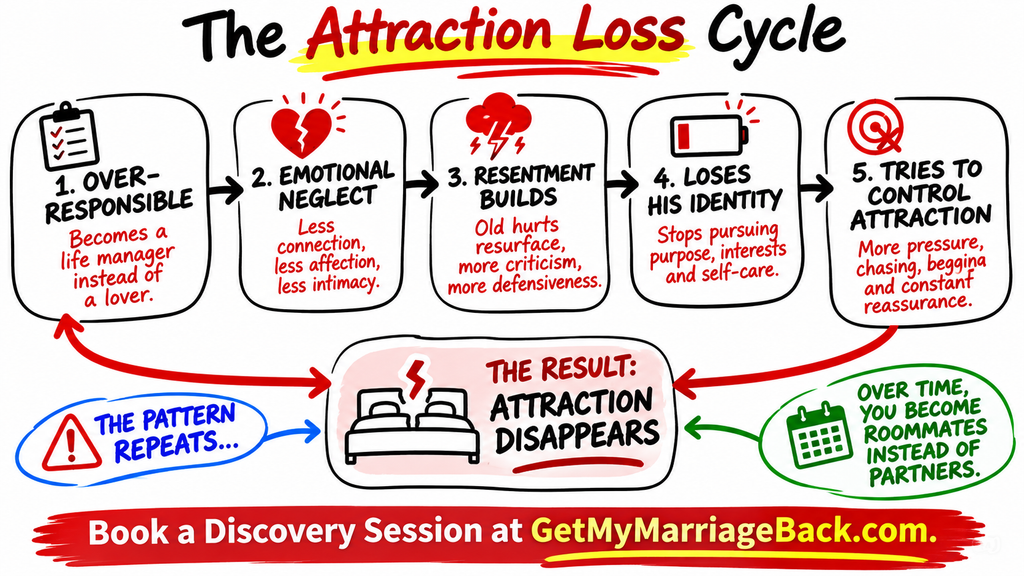
2. You Neglected Emotional and Physical Intimacy
You didn’t necessarily stop loving your wife.
Somewhere along the way, however, you stopped expressing interest in ways she enjoyed experiencing.
Remember when you wanted to know everything about her?
Her interests fascinated you. Learning about her personality felt exciting, and spending time together didn’t require a complicated reason.
Now you know her schedule better than you know what’s happening emotionally in her life.
That shift matters.
A marriage can contain loyalty, commitment, and genuine affection while gradually losing the emotional connection that supports romantic desire.
Why your wife rejects your sexual advances
Here’s where the problem becomes even more complicated.
Physical affection becomes something you initiate primarily when you want sex.
An innocent kiss starts carrying an expectation.
When you put your arm around her, she anticipates what comes next.
Eventually, she starts avoiding even the affectionate interactions that once felt natural.
You interpret that withdrawal as evidence that she finds you unattractive.
But I want you to differentiate a wife who dislikes being touched from a wife who dislikes the expectations attached to being touched.
Those are different experiences.
Her rejection is real, but your interpretation of that rejection still requires attention.
A 2016 series of three studies led by Gurit Birnbaum found that perceived partner responsiveness was associated with increased sexual desire, with a stronger association among women. Feeling valued and understood helped explain that connection.
The research on partner responsiveness and sexual desire reinforces an important principle: how your wife experiences your attention outside the bedroom matters.
When affection becomes an unspoken transaction
Think about what happens when your wife doesn’t respond to your physical advances.
Does your mood immediately change?
Do you become distant, frustrated, or argumentative?
Has affection become something you offer with the expectation of receiving sexual reassurance?
When declining sex consistently produces an unpleasant emotional consequence, your wife has another reason to avoid situations involving physical closeness.
That doesn’t mean your desire for intimacy is unreasonable.
It means the emotional pressure surrounding intimacy deserves attention.
Seduction is about creating an inviting experience rather than imposing an obligation.
Affection needs room to exist without becoming a transaction.
When did physical intimacy stop being enjoyable on its own?
Your answer tells you something important about the current romantic dynamic in your marriage.
3. You Allowed Resentment to Poison Your Interactions
You’re tired of hearing everything you’ve done wrong.
Your wife brings up something that happened three years ago, and you’re wondering why nothing you’ve done since then seems to count.
Every disagreement becomes another opportunity for her to remind you of your shortcomings.
Eventually, you become defensive before she even finishes speaking.
She becomes critical, and an ordinary conversation starts feeling like a courtroom.
The romantic dynamic gets buried beneath the ongoing battle over who’s right and who’s wrong.
Why your wife has become emotionally distant
Imagine your wife telling you:
“You never listen to me.”
You immediately produce five examples proving that you listen.
Technically, you have demonstrated that the word “never” is inaccurate.
Emotionally, however, you haven’t necessarily addressed what she was expressing.
Her observable behavior was making a complaint. Her expressed emotional experience was feeling unheard.
Those are important pieces of information.
You don’t have to agree with every accusation to understand the emotional experience behind it.
And listen, you deserve to feel heard too.
Being emotionally intelligent doesn’t require accepting disrespect, tolerating hostility, or pretending your own feelings don’t matter.
What it requires is enough self-leadership to avoid turning every disagreement into a competition.
How unresolved resentment destroys attraction
When resentment becomes a regular feature of your marriage, ordinary interactions begin carrying the emotional weight of previous conflicts.
A forgotten errand becomes evidence that you don’t care.
Her irritated response becomes evidence that she doesn’t respect you.
The actual event gets overshadowed by everything it represents.
Before long, you’re no longer responding exclusively to what’s happening today. You’re reacting to years of accumulated frustration.
Consider whether these patterns resemble your marriage:
- Small disagreements repeatedly become major arguments.
- Previous mistakes dominate unrelated conversations.
- Sarcasm replaces affectionate teasing.
- Apologies are followed by demands for immediate forgiveness.
- Ordinary requests are interpreted as personal attacks.
Research by Eldridge and colleagues, published in the Journal of Family Psychology in 2007, examined demand-withdraw communication among distressed and nondistressed couples, highlighting how pursuit and withdrawal patterns relate to relationship distress.
The more your interactions revolve around defending yourself, demanding answers, or extracting reassurance, the less space remains for enjoyable romantic connection.
What emotional intelligence looks like during conflict
Rather than immediately proving your wife wrong, recognize what she actually said and how she expressed feeling.
Separate her emotional interpretation from the objective facts.
You can acknowledge frustration without accepting an inaccurate characterization of your entire marriage.
Where disrespect occurs, calm boundaries are more constructive than retaliatory insults.
Your greatest immediate opportunity is changing the way you participate in these interactions.
Winning an argument and nurturing attraction are not necessarily the same achievement.
4. You Abandoned Your Personal Identity
Before marriage, you had ambitions.
Your interests extended beyond the relationship. There were friendships, personal standards, career goals, and experiences you wanted to pursue.
Now your entire emotional condition depends on how your wife treats you today.
When she’s affectionate, you’re having a good day.
When she’s cold, everything falls apart.
Perhaps you’ve stopped exercising consistently. Personal interests have disappeared, and your appearance reflects how discouraged you’ve become.
You spend your evenings analyzing her behavior, searching for signs that she still loves you, and worrying about whether she’ll eventually leave.
Without realizing it, the marriage crisis has consumed your identity.
Why losing yourself doesn’t save your marriage
Your wife originally encountered someone with a personality, interests, ambitions, and a life beyond her.
Marriage naturally changes your priorities, but it doesn’t require abandoning the individual you are.
The problem develops when you expect your relationship to provide all the excitement, confidence, fulfillment, and emotional stability you’ve stopped cultivating elsewhere.
That creates a tremendous amount of pressure.
You’re no longer simply enjoying affection when it happens. You’re depending on it to determine whether you feel valuable.
Every rejected kiss becomes a personal crisis.
An ordinary evening without intimacy feels like confirmation that your life is falling apart.
That emotional dependency makes attraction difficult to nurture skillfully.
Reclaiming your identity without abandoning your wife
Your wife doesn’t need to become your enemy for you to reclaim your identity.
You don’t need to manufacture jealousy, deliberately ignore her, threaten divorce, or pretend you’ve stopped caring.
Instead, reconnect with the parts of yourself that deserve development regardless of what happens in your marriage.
Restore your physical self-care.
Revisit meaningful friendships and personal interests.
Develop a skill you’ve always wanted to master.
Invest energy in your career, contribution, faith, creativity, or personal mission.
Having a purpose outside your marriage doesn’t mean abandoning your marriage.
It means bringing a fuller version of yourself into it.
Confidence is always sexy, but genuine confidence comes from developing personal capacity rather than performing indifference to manipulate someone else’s feelings.
5. You Started Trying to Control Attraction Instead of Nurturing It
This mistake becomes especially destructive during an active marriage crisis.
Your wife tells you she’s unhappy.
She moves into another bedroom, stops wearing her wedding ring, or begins threatening divorce.
Suddenly, everything feels urgent.
You’re buying flowers, writing long text messages, promising changes, and repeatedly asking whether she notices your efforts.
Underneath those romantic gestures, however, there’s often an unspoken expectation.
You want affection in exchange for improvement.
When she doesn’t respond the way you anticipated, frustration takes over.
You remind her how much you’ve changed.
More promises follow.
Then another argument.
The very behaviors you’re using to rebuild attraction start creating more pressure.
The difference between pursuit and chasing
I teach people to differentiate dignity-based pursuit from fear-driven chasing.
Genuine pursuit expresses romantic interest while respecting another person’s freedom to respond.
Fear-driven chasing attempts to extract reassurance, commitment, or affection because you cannot tolerate uncertainty.
One creates an invitation.
The other creates an expectation.
Consider the difference between offering your wife an enjoyable experience and arranging a romantic gesture primarily to test whether she still wants you.
The outward behavior appears similar, but the emotional experience is different.
Your intentions become particularly visible through how you react when she declines.
Why broken trust cannot be repaired through romantic performance
When trust has been damaged, the underlying problem isn’t necessarily a shortage of flowers, compliments, dates, or sexual excitement.
Your wife needs credible reasons to believe your behavior has changed.
Consistent accountability matters more than dramatic declarations.
If dishonesty, infidelity, broken promises, or repeated disrespect contributed to the crisis, attraction-building techniques cannot substitute for addressing those behaviors.
Real improvement continues even when immediate forgiveness isn’t offered.
Skillful seduction doesn’t bypass trust.
It operates alongside integrity, respect, emotional intelligence, and personal responsibility.
The Better Husband Paradox: How Attraction Disappears Despite Your Efforts
The painful contradiction is that you can become a more responsible husband while unintentionally participating in a dynamic that weakens romantic attraction.
I call this the Better Husband Paradox.
Here’s how that cycle develops:
- Your wife becomes less affectionate.
- You interpret her withdrawal as evidence that you’re failing.
- Fear motivates you to increase your sacrifices and romantic efforts.
- Those efforts become attached to expectations of affection.
- She experiences additional emotional pressure and withdraws further.
- Her withdrawal intensifies your fear and resentment.
- You try even harder to prove your worth.
Eventually, your romantic behavior becomes organized around preventing rejection rather than creating enjoyable experiences.
You stop operating from desire and start operating from desperation.
That’s an important change to recognize.
The solution isn’t becoming irresponsible, emotionally unavailable, or deliberately difficult.
It’s developing the capacity to express love and romantic interest without making another person’s response responsible for your emotional stability.
Can My Wife Love Me but Not Be Sexually Attracted to Me?
Absolutely.
Commitment, emotional attachment, sexual desire, and romantic curiosity are related but different experiences.
Your wife can appreciate everything you’ve contributed to the marriage while experiencing little sexual desire.
She can consider you a dependable partner while feeling that the romantic spark has disappeared.
Alternatively, her sexual withdrawal can reflect exhaustion, medication, unresolved pain, or emotional difficulties without indicating that attraction itself is gone.
That’s why I encourage you to identify patterns rather than treating every rejection as a final verdict.
Pay particular attention to when the change began.
Did her withdrawal follow a major conflict?
Were there changes in her health, workload, or life circumstances?
Has emotional affection disappeared alongside sexual intimacy, or does she remain affectionate outside the bedroom?
The answers help you identify what you’re actually dealing with.
How to Rebuild Attraction With Your Wife Using GPS5
My wife, Lola, and I recently celebrated 19 years of marriage.
As co-authors of Get My Marriage Back and #1 Red Flag, we’ve experienced our own version of these relationship challenges.
Those experiences helped shape the reconciliation framework I teach today.
Rather than focusing exclusively on how to change your wife’s behavior, I want you to begin with the personal power available to you.
That’s where GPS5 comes in.
Grounding: Return to What Is True
Grounding means redirecting your attention away from the immediate symptom and toward your higher self, truth, and gratitude.
Your wife declined affection tonight.
That’s an observable event.
The conclusion that you’re unattractive, worthless, or destined to lose your marriage is an interpretation.
Grounding helps you recognize the difference without ignoring how painful rejection feels.
Instead of allowing fear to determine your actions, become more deliberate about how you respond.
This is the foundation of emotional composure.
Purpose: Redirect Your Pain Into Something Greater
Pain generates emotional energy.
When your entire focus is on whether your wife still wants you, that energy often becomes anxiety, obsession, resentment, or desperate pursuit.
Purpose gives it a constructive direction.
Reconnect with a mission larger than your immediate marriage crisis.
What contribution do you want to make?
Which personal goals have you abandoned?
What legacy do you want to build?
Your marriage matters, but it doesn’t need to become the sole source of meaning in your life.
A meaningful purpose creates opportunities for personal development that don’t depend on your wife’s emotional state.
Self: Build Your Personal Capacity
Self-leadership means accepting responsibility for your behavior without accepting blame for everything happening in your marriage.
Develop emotional regulation, social intelligence, physical self-care, conversational skills, and personal accountability.
Recognize the behavioral patterns that emerge when you’re frightened or discouraged.
Do you become argumentative when you feel ignored?
Does rejection immediately trigger another desperate text message?
Are you abandoning your personal standards to avoid upsetting her?
Your answers identify practical areas for development.
Loving yourself doesn’t mean becoming selfish.
It means cultivating enough internal stability to express love without making it a demand for emotional repayment.
Value: Become Experientially Attractive
When I talk about value, I’m not suggesting that your worth as a human being depends on whether your wife desires you.
Your dignity is not negotiable.
Experiential value refers to the quality of experiences your presence contributes to.
Are you engaging, emotionally present, interesting, composed, playful, and considerate?
Can you express romantic interest without making every interaction feel emotionally expensive?
Developing these qualities makes attraction-building less about performing techniques and more about how you genuinely conduct yourself.
An entertaining conversation, a thoughtfully timed compliment, or an enjoyable experience can be meaningful without requiring an immediate romantic reward.
Curiosity: Create Room for Attraction
Attraction involves curiosity.
Familiarity doesn’t eliminate the possibility of discovering something new about someone you’ve known for years.
As you develop meaningful interests, improve your emotional capacity, and interrupt destructive relationship patterns, you become less defined by the repetitive behaviors surrounding your marriage crisis.
Your wife has an opportunity to experience you differently.
She is free to become curious about those changes.
The important thing is that you don’t deliberately create confusion, insecurity, or jealousy to manufacture that curiosity.
Real attraction has room for voluntary interest.
Influence: Develop Leverage Without Control
Influence is the opportunity to contribute constructively to the romantic dynamic through your conduct and the experiences you create.
It isn’t authority over your wife’s feelings.
The leverage you’re developing comes from becoming more intentional, emotionally intelligent, accountable, and skillful in the interactions available to you.
You cannot demand sexual attraction.
What you can develop is the personal capacity to nurture healthier conditions for romantic connection.
That’s the difference between attempting to control your marriage and leading yourself skillfully within it.
What to Do Tonight When Your Wife Rejects You Again
When your wife gives you the cold shoulder tonight, start with one behavioral change.
Put your phone down.
Don’t send another paragraph explaining why she should appreciate everything you’ve done.
Avoid turning her rejection into another argument about whether she loves you.
Relax your shoulders, carry yourself with dignity, and continue your evening without punishing her for declining affection.
Confidence is always sexy.
But understand that composure isn’t a performance designed to make your wife suddenly want you.
It’s how you stop contributing additional emotional pressure to an already difficult situation.
Research by Lars Schwabe and Oliver Wolf, published in the Journal of Neuroscience in 2009, demonstrated that acute stress can shift behavior away from deliberate, goal-directed decisions and toward established habits.
That helps explain why understanding a destructive pattern intellectually doesn’t automatically stop you from repeating it when rejection hurts.
Developing new responses requires consistent practice.
I emphasize three elements: Skills, Support, and a System.
Skills help you respond differently.
Support helps you maintain perspective during emotionally difficult circumstances.
A system creates the consistency necessary to develop healthier habits.
Removing pressure tonight only stops the bleeding.
Rebuilding attraction requires addressing the underlying patterns that developed over months or years.
Attraction Is Something You Nurture, Not Something You Negotiate
You don’t need to become a less responsible husband to become a more attractive one.
Responsibility, integrity, confidence, playfulness, emotional intelligence, and romantic curiosity can coexist.
The mistake is expecting any single quality to substitute for every other dimension of your relationship.
Your financial contributions matter.
So do your emotional presence, individuality, romantic awareness, and ability to navigate disappointment without creating additional conflict.
The objective isn’t to convince your wife that she should find you attractive.
It’s to develop the personal capacity to participate in an engaging, respectful, and emotionally intelligent romantic relationship.
You can begin that work as an individual, even when your wife isn’t presently participating in reconciliation.
Your personal power begins with what you can control.
19 Signs Your Wife Is Not Sexually Attracted To You
Frequently Asked Questions
Your wife can experience reduced attraction because of emotional disconnection, unresolved resentment, excessive familiarity, sexual pressure, damaged trust, stress, or health-related changes. Identifying when her behavior changed and what was happening around that time helps you understand the underlying problem.
Persistent sexual rejection, reduced physical affection, disappearing flirtation, avoidance of private time, and emotional withdrawal are possible signs of declining attraction. Consider the broader relationship pattern instead of interpreting one rejected advance as proof that attraction is gone.
Yes, your wife can genuinely love you and remain committed to your marriage while experiencing reduced sexual desire. Emotional attachment and sexual attraction are connected but different aspects of a romantic relationship.
Focus on reducing emotional pressure, rebuilding your personal identity, developing emotional intelligence, addressing broken trust, and creating enjoyable interactions without demanding affection in return. Nurture attraction through genuine romantic interest, consistent conduct, and respect for her freedom to reciprocate.