


Your wife used to initiate sex, reach for you, and make you feel wanted—but now you’re wondering how something that once happened naturally turned into something you feel like you’re begging for.
Take This 2 Minutes Quiz
When your wife stopped initiating sex, you probably didn’t experience it as just a change in your sex life.
You experienced a change in her.
That’s why this can become so destabilizing.
Maybe she used to be the one who reached for you. Perhaps intimacy survived disagreements that would have wrecked other couples. You could argue, cool down, reconnect physically, and somehow everything still felt basically okay.
Then something changed.
You initiate.
“Not tonight.”
Okay. No big deal.
You try again.
Another rejection.
By the third or fourth time, you’re no longer experiencing each rejection independently. You’re collecting evidence.
You notice her facial expression. …noticing how she responds when you touch her. You start counting how long it’s been since she initiated.
Eventually, an uncomfortable question starts forming:
Does my wife still want me?
That’s the point where a sexual problem can quietly become an attraction problem, a security problem, and ultimately a marriage problem.
When Your Wife Stops Initiating Sex, Don’t Rush to Diagnose Her
A sudden decline in sexual interest is information.
It is not automatically an explanation.
That distinction matters.
Your wife not initiating sex does not, by itself, prove she’s cheating. It doesn’t prove she has fallen out of love. Nor does it automatically mean she wants a divorce.
Sexual desire is affected by relationship dynamics, stress, parenthood, health, resentment, emotional connection, individual differences, and many other variables.
Research supports treating desire as a couple dynamic, rather than automatically locating the “problem” inside the lower-desire partner. Studies of married couples have associated greater discrepancies between desired and actual sexual frequency with lower relationship satisfaction and stability and greater conflict. PubMed
That’s important because the question isn’t merely:
“Why doesn’t she want sex?”
A more useful question is:
“What changed in the experience of this marriage?”

You May Be Living in the Old Marriage
This is one of the hardest realities to recognize during a marriage crisis.
You’re operating from the old marriage while your wife is experiencing the current marriage.
You remember the woman who reached for you.
You’re interacting with the woman who’s pulling away.
Those are two completely different realities.
Your memories tell you, We’ve always been able to get through things.
Her present behavior tells you, Something isn’t operating the way it used to.
When those realities collide, it’s tempting to keep invoking history.
“We’ve always had sex after arguments.”
“You never used to have a problem with this.”
“You used to initiate.”
“What happened to you?”
Those statements may be factually accurate, but they don’t necessarily create attraction.
In fact, repeatedly reminding someone that they used to desire you can make the present absence of desire feel even heavier.
The Dangerous Question Isn’t “Why Doesn’t She Want Sex?”
It’s what you make her rejection mean about you.
At first, you want an explanation.
Soon you may want reassurance.
There’s a significant difference.
You think you’re asking:
“What’s wrong?”
But emotionally, you may really be asking:
“Tell me you still want me.”
“Nobody else?”
“Tell me we’re going to be okay.”
“Prove that I’m still desirable to you.”
That’s when your wife’s sexual desire can become your security meter.
Every “not tonight” becomes a reading.
Sex happens? Marriage must be okay.
She initiates? …still wants me.
She rejects me? Something must be wrong.
She turns away? Maybe there’s somebody else.
Now your emotional stability is being controlled by whether another human being desires sex at a particular moment.
That’s a dangerous position from which to rebuild attraction.
Pressure Can Turn Sexual Rejection Into a Cycle
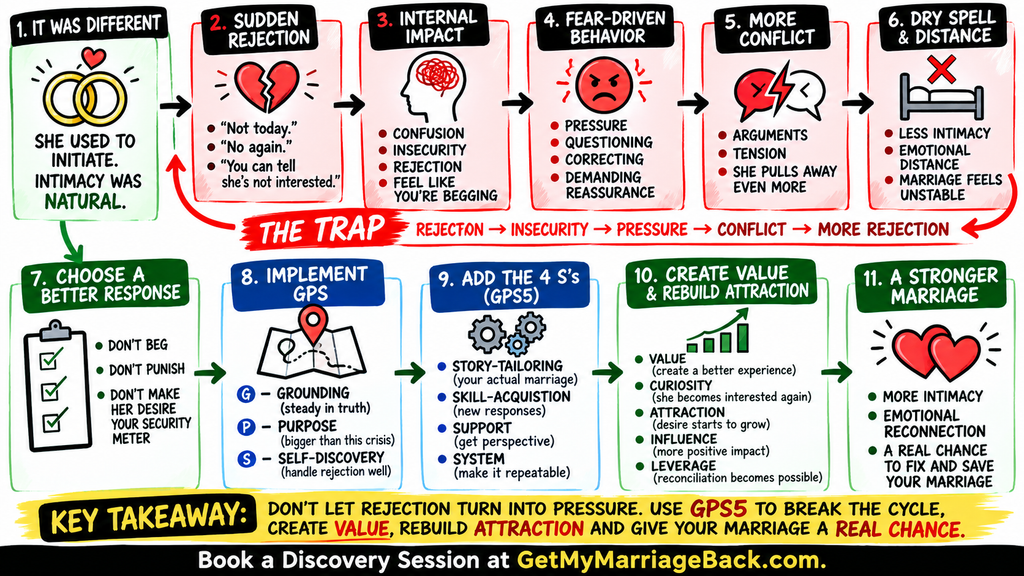
Here’s the trap.
You feel rejected.
Rejection creates fear.
Fear seeks reassurance.
When reassurance doesn’t arrive, you apply pressure.
Pressure creates conflict.
Conflict can make intimacy less appealing.
Then the resulting lack of intimacy creates even more fear.
You’re attempting to solve rejection with an emotional experience capable of producing more rejection.
Research on couples transitioning to parenthood is particularly relevant here. Researchers found that responsiveness included not only caring about a partner’s desire for sex but also being understanding when a partner didn’t want sex; that understanding was associated with sexual and relationship satisfaction. research on understanding a partner’s need not to have sex
That doesn’t mean pretending you’re happy about rejection.
Emotional intelligence means being able to experience disappointment without immediately converting it into pressure, punishment, interrogation, or panic.
Stop Making Sex Prove Your Marriage Is Okay
Imagine what happens from your wife’s perspective when sex acquires another job.
It isn’t simply intimacy anymore.
…has to reassure you.
It has to demonstrate attraction.
…has to prove fidelity.
It has to confirm the marriage isn’t ending.
That’s a lot of emotional weight to place on intimacy.
And attraction tends to struggle under compulsory emotional labor.
You cannot skillfully rebuild attraction by making your spouse responsible for constantly regulating your insecurity.
This doesn’t require becoming indifferent.
It requires becoming grounded.
Ground Yourself Before Trying to Rebuild Attraction
When your wife stopped initiating intimacy, your first assignment isn’t figuring out the perfect technique for making her desire you again.
Your first assignment is learning to handle what her rejection activates inside you.
I call the beginning of this process GPS: Grounding, Purpose, and Self-Discovery.
Grounding
Ground yourself in a source of truth that doesn’t change every time your wife says “not tonight.”
Your identity cannot rise and fall with her libido.
Grounding allows you to remain emotionally present without pretending you don’t care.
That distinction is attractive because groundedness feels radically different from neediness disguised as authority.
Purpose
Redirect some of that emotional energy toward purpose: your mission, contribution, impact, and legacy beyond the immediate marriage crisis.
This isn’t about becoming busy to make your wife jealous.
It isn’t strategic withdrawal.
Purpose makes your world larger than tonight’s rejection.
A person consumed by obtaining reassurance creates one experience. A person capable of loving deeply while remaining connected to purpose creates another.
Self-Discovery
Now discover your actual capacity.
Can you hear “no” without retaliating?
…experience disappointment without becoming passive-aggressive?
Can you feel uncertainty without interrogating your spouse?
…notice fear without immediately obeying it?
That’s self-discovery.
You aren’t trying to become emotionless.
You’re developing the emotional capacity to experience rejection without allowing rejection to dictate your next move.
Attraction Is an Experience, Not a Reward for Good Behavior
One of the most frustrating beliefs in marriage sounds like this:
“But I’m a good husband.”
Maybe you are.
Being responsible, faithful, hardworking, and committed matters enormously.
But moral value and experiential value aren’t identical.
Someone can respect you without currently experiencing attraction toward you.
That’s why rebuilding attraction isn’t merely a matter of proving that you’re good enough.
You have to pay attention to the experience created in your presence.
Does your presence increasingly communicate pressure?
Anxiety?
Correction?
Monitoring?
Resentment?
Or does your presence communicate groundedness, emotional range, curiosity, purpose, playfulness, confidence, warmth, and genuine connection?
That shift matters.
Research involving more than 1,500 participants found that unmet sexual ideals were associated with poorer sexual satisfaction and relationship quality, while responsiveness to a partner’s sexual needs appeared to buffer some of those associations. PubMed
Attraction can’t be demanded.
But you can become more skillful at creating conditions in which attraction has room to breathe.
Don’t Confuse Seduction With Manipulation
Seduction in a marriage crisis isn’t about tricks.
It’s not withholding affection until your wife chases you.
It’s not manufacturing jealousy.
It isn’t pretending you suddenly don’t care.
Healthy seduction begins with becoming capable of creating an experience that feels better than the cycle you’ve been repeating.
Become curious instead of interrogative.
Be warm without demanding a reward.
Flirt without turning every affectionate interaction into an attempt to get sex.
Create moments that can simply be enjoyable.
Allow tension to breathe instead of demanding immediate resolution.
Most importantly, stop using every interaction to determine whether “it’s working.”
Constantly measuring attraction destroys some of the spontaneity you’re trying to recover.
Stop Testing Whether She’ll Initiate
This is subtle.
You decide you’re not going to initiate anymore.
But internally, you’re watching.
Let’s see how long it takes her.
Day three.
And day five.
Day nine.
Nothing.
Now you’re furious.
Technically, you stopped pursuing.
Emotionally, you never stopped testing.
That’s not detachment from the outcome. It’s a silent experiment your wife doesn’t know she’s participating in.
Real change begins when you stop making every interaction produce a verdict.
“My Wife Never Initiates Intimacy Anymore”—What Should I Watch For?
Look beyond the bedroom.
Did affection disappear too?
Has conflict become chronic?
Does she appear emotionally withdrawn?
Did the change coincide with childbirth, major stress, resentment, illness, medication, exhaustion, or another life transition?
Does she enjoy spending time with you but avoid sexual contact?
Has your communication become primarily logistical or conflict-oriented?
Those patterns don’t automatically tell you why your wife stopped initiating sex.
They help you understand the larger story.
A qualitative study of people in long-term relationships experiencing distressing desire discrepancy identified changes in sexual frequency and desire, barriers to sex, relationship satisfaction, and how couples coped with the discrepancy as important themes. PubMed
Your marriage has its own story.
Treat it accordingly.
The Goal Isn’t to Get Her to Have Sex Tonight
That objective is too small.
If the marriage is in crisis, one successful sexual encounter can temporarily reassure you while leaving the underlying dynamic untouched.
Your bigger objective is to change the experience surrounding the relationship.
Grounding creates stability.
Purpose expands you.
Self-discovery builds emotional capacity.
Those qualities can create greater experiential value.
Value creates room for curiosity.
Curiosity can create room for attraction.
Attraction increases influence.
Influence creates leverage for reconciliation.
None of that requires forcing, convincing, or begging another person into desire.
It requires becoming increasingly capable of responding to the marriage you’re actually in rather than desperately trying to recreate the marriage you remember.
When Something Changed, Get Curious Before You Panic
The disappearance of intimacy is useful information.
Something changed.
Take that seriously without turning it into a catastrophe before you understand it.
Your job isn’t to beg your wife for sex.
It’s also not to punish her for not wanting it.
Don’t immediately turn her rejection into evidence of cheating, divorce, or your inadequacy.
Instead, develop enough emotional stability to study what’s actually happening.
Because when your wife stopped initiating sex, the most important question isn’t simply how to get sex happening again.
It’s this:
What happened to the experience between us—and what kind of experience am I creating now?
That question gives you somewhere productive to begin.
Wife or Husband Denying You Sex? DO THIS!!!
There isn’t one universal explanation; relationship conflict, stress, parenthood, health factors, resentment, changing desire, and other circumstances can all matter. Look for what changed in the broader relationship rather than diagnosing the cause from rejection alone.
Not necessarily; sexual initiation and attraction aren’t interchangeable measures. However, a sustained change in intimacy deserves attention as information about the sexual or relational dynamic.
Don’t turn withdrawal into a hidden test designed to see whether she’ll chase you. Instead, respect sexual boundaries while examining the pattern, your response to rejection, and the broader state of connection.
Attraction and desire can change over time, and research shows that sexual desire discrepancies are meaningfully connected with sexual and relationship experiences. Focus on reducing pressure, understanding the actual relationship dynamic, and developing the emotional and relational skills that give desire room to emerge.