


Your wife used to reach for your hand, kiss you without being asked, and make you feel wanted, but now you can sit right next to her and feel like you’re married to a stranger.
Take This 2 Minutes Quiz
The hardest part isn’t necessarily the absence of sex. It’s realizing that the woman who once made you feel desired no longer seems interested in touching you, kissing you, or even turning to you emotionally.
And when your wife never initiates affection anymore, something changes inside you.
You start noticing every rejection.
You remember when she used to reach across the couch to touch your arm. Walking down the street, she would naturally hold your hand. Sometimes she initiated intimacy without you having to say anything.
Now you’re the one making every move.
Even worse, your efforts to restore that connection seem to make her withdraw further.
I’m Ola, coauthor of Get My Marriage Back, and I’ve experienced this personally.
My wife and I recently celebrated 19 years of marriage. But around eight or nine years into our relationship, we experienced a major crisis that changed how affection showed up between us.
Before that crisis, I never kept score of who initiated physical affection.
Why would I?
When your wife naturally makes you feel wanted, you simply enjoy it.
But when something you’ve enjoyed for years suddenly disappears, its absence becomes impossible to ignore.
And how you respond to that disappearance can determine whether you create more emotional distance or begin rebuilding the conditions for attraction.
Why Your Wife Stopped Initiating Affection
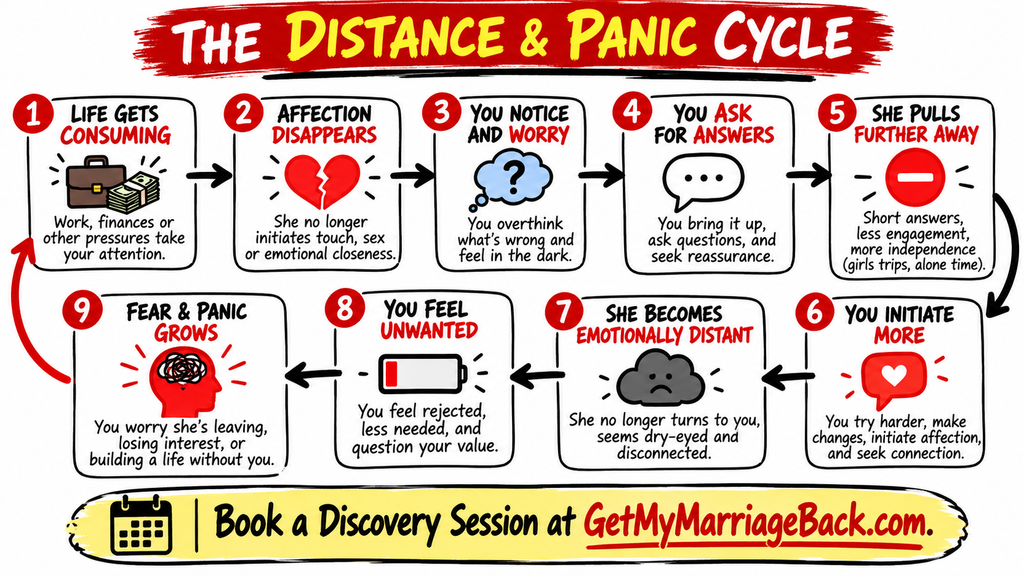
When your wife stops initiating physical affection, your first instinct is usually to find out why.
“What’s wrong?”
“Is everything okay?”
“Why don’t you kiss me anymore?”
Then come the answers that make everything worse.
“Nothing.”
“I’m fine.”
“Nothing’s wrong.”
You know something has changed, but you cannot get a meaningful explanation.
That’s when fear begins filling the gaps.
You start wondering whether your wife is no longer sexually attracted to you, whether someone else has her attention, or whether your marriage is quietly approaching divorce.
Those possibilities deserve careful attention, but none can be established from the absence of affection alone.
The more important question is what has changed in the emotional experience of your marriage.
Physical affection doesn’t exist in isolation. It is connected to emotional responsiveness, desire, trust, stress, and the experience two people create around each other.
In fact, research published in Personality and Social Psychology Bulletin found that feeling a partner was responsive predicted subsequent affectionate touch. The researchers also observed that affectionate touch could contribute to the partner’s perception of responsiveness.
You can examine the research on partner responsiveness and affectionate touch to understand why emotional connection and physical affection are closely linked.
The important distinction is that demanding more touching does not automatically create the emotional conditions that make someone want to initiate it.
Affection is an expression of connection, not proof you can demand whenever you feel insecure.

When Your Wife No Longer Needs You Emotionally
I worked with a man whose experience illustrates how quickly this crisis can escalate.
He and his wife had been together for eight years before getting married. After another thirteen years of marriage, they had shared more than two decades of their lives.
Then his business collapsed.
He found himself dealing with millions of dollars in debt, and for approximately eight months, trying to revive the business consumed his attention.
He was overwhelmed.
During that period, there were times his wife wanted affection, and he simply wasn’t in the mood.
Eventually, he began noticing something different.
His wife no longer initiated affection.
At first, that seemed like the central problem. But as we examined his situation, something more significant emerged.
She began taking multiple girls’ trips during the summer and insisted on going without him.
That behavior was unfamiliar in their marriage.
He started panicking.
His natural response was to initiate more affection, read marriage advice, attend therapy, and make changes he believed would win her back.
But she seemed to keep slipping away.
Then he told me something that revealed the deeper crisis.
His wife used to cry on his shoulder whenever something upsetting happened at work.
He was the person she turned to.
Now she seemed completely disconnected.
No tears.
No emotional vulnerability.
No desire to bring him into her inner world.
And after twenty-one years together, he began wondering whether she simply didn’t need him anymore.
The loss of physical affection hurts. The loss of emotional significance can make you panic.
That’s where many husbands begin making mistakes that unintentionally intensify the distance.
5 Mistakes When Your Wife Never Initiates Affection
1. Interrogating Her About Why She Doesn’t Want You
When affection disappears, you naturally want answers.
The problem begins when every conversation becomes another investigation into your wife’s feelings.
You ask why she doesn’t kiss you. When she gives a short answer, you press harder.
Soon, even an ordinary evening becomes another opportunity to question the relationship.
This creates a recognizable demand-withdraw pattern: one partner pushes for engagement while the other increasingly avoids the conversation.
Research on marital conflict has repeatedly associated this pattern with negative emotional exchanges and difficulties resolving conflict.
Your desire for clarity is understandable.
But repeatedly demanding reassurance can turn emotional connection into an obligation.
Stop treating every moment of distance as an emergency requiring an immediate explanation.
2. Initiating More Affection to Test Whether She Still Wants You
You reach for her hand, but you’re not simply enjoying the possibility of holding hands.
You’re watching how she responds.
When you kiss her, you’re measuring whether she kisses you back enthusiastically enough.
Even your attempts at intimacy become tests.
Does she still want me?
Is she rejecting me?
Am I losing my marriage?
The problem is no longer the affectionate gesture itself. It’s the emotional pressure attached to the gesture.
Genuine pursuit communicates interest without making the other person’s response responsible for your self-worth.
Fear-driven chasing demands evidence that you’re still desirable.
Those are two very different experiences.
If your wife doesn’t welcome a particular touch, respect that boundary without turning the moment into an argument.
Attraction needs room for genuine choice.
3. Trying to Earn Attraction Through Endless Changes
You begin reading books, watching marriage advice, improving your appearance, and doing more around the house.
Those changes can be valuable.
But there’s a dangerous assumption underneath them when you’re trying to save your marriage.
You believe that doing enough good things should produce the affection you’re missing.
So when your wife doesn’t respond, you become frustrated.
After everything you’ve changed, why isn’t she attracted to you again?
Because attraction isn’t a payment issued for completing a list of improvements.
Being responsible, dependable, and hardworking matters. But those qualities don’t automatically create romantic desire.
Experiential value is different.
It’s about what being around you actually feels like.
Are your interactions dominated by tension, disappointment, and emotional pressure?
Or are you becoming more grounded, engaging, emotionally intelligent, and comfortable in your own identity?
Being a good person and creating an attractive experience are related, but they are not identical.
4. Confusing Being Needed With Being Desired
This mistake is particularly painful when you’ve spent years providing for your family.
You work hard.
You handle responsibilities.
You sacrifice to create stability.
Then your wife becomes emotionally distant, and suddenly you wonder whether everything you’ve contributed means nothing.
It doesn’t mean nothing.
But providing stability and inspiring desire are different dimensions of marriage.
In the case I described earlier, the husband’s deepest fear wasn’t simply that his wife stopped initiating intimacy.
He feared becoming irrelevant to her.
She no longer came to him with her problems. She was making independent plans, and he felt left behind.
The temptation was to become more necessary.
But trying to make your wife depend on you is not the same as becoming someone she genuinely enjoys connecting with.
Being needed is not the same as being desired.
A healthier form of attraction allows your wife to maintain her independence while experiencing your presence as something valuable, enjoyable, and freely chosen.
5. Making Her Affection the Measurement of Your Worth
This is the mistake that holds the others together.
Your mood depends on whether she kisses you.
Your confidence rises when she touches you and collapses when she turns away.
One affectionate evening convinces you the marriage is recovering.
One distant morning sends you back into panic.
Now your emotional stability is being controlled by responses you cannot command.
That instability changes how you behave.
You become reactive, hypervigilant, and increasingly preoccupied with obtaining reassurance.
Your wife is no longer simply your partner. She has become the person you depend on to confirm that you’re still worthy of love.
That is an exhausting emotional arrangement.
And it undermines the very qualities that make someone engaging and attractive.
How to Rebuild Attraction When Your Wife Doesn’t Initiate Intimacy
Here is what I want you to do.
Instead of concentrating exclusively on how to make your wife initiate affection again, focus on becoming someone who creates a different emotional experience.
That starts with GPS: Grounding, Purpose, and Self-Discovery.
Grounding: Stop Letting Her Reactions Define You
Grounding means returning to a source of truth bigger than your wife’s latest response.
Her emotional distance is real.
Your disappointment is real.
But neither determines your entire identity.
Reconnect with your principles, gratitude, spiritual foundation where applicable, and the values that guide how you carry yourself.
When your wife withdraws, you don’t have to respond with another interrogation.
You can acknowledge what is happening without surrendering control of your emotional behavior.
Purpose: Rebuild a Life Bigger Than the Marriage Crisis
When you’re desperately trying to save your marriage, the relationship can consume every waking thought.
You stop pursuing meaningful goals.
Your friendships weaken.
Everything becomes about getting your wife back.
Purpose redirects your energy toward a mission, contribution, and legacy greater than any single person, including yourself.
That doesn’t mean pretending you don’t care about your marriage.
It means refusing to abandon the rest of your identity while working toward reconciliation.
A man with meaningful direction brings a different presence into his relationships than someone whose entire emotional world depends on receiving affection.
Self-Discovery: Reclaim What You Can Control
Self-Discovery is not an invitation to blame yourself for your wife’s withdrawal.
It’s an opportunity to recognize your own capacity.
Examine how you respond to rejection, disappointment, uncertainty, and fear.
Can you express interest without demanding reassurance?
Can you remain warm without becoming intrusive?
Are you able to respect her independence without immediately interpreting it as proof that your marriage is over?
Those are emotional intelligence skills.
And they influence the experience you create around yourself.
The Real Connection Between Emotional Intelligence and Sexual Attraction
A more attractive marital experience is not created through manipulation, jealousy, or pretending to be unavailable.
It’s built through authentic behavior, emotional intelligence, confidence, playfulness, responsiveness, and self-respect.
Research on romantic desire has found an association between perceived partner responsiveness and sexual desire, particularly when responsiveness makes a partner feel special and valued.
That doesn’t mean becoming endlessly accommodating.
It means learning how to give authentically but mindfully.
I call this GAME:
Giving Authentically but Mindfully with Emotional intelligence.
You can express affection without chasing.
Show interest without interrogating.
Be playful without forcing sexual tension.
Give your wife room to approach you without punishing her when she doesn’t.
Seduction in a long-term marriage is not about tricks. It’s about creating an experience in which warmth, curiosity, attraction, and desire have room to emerge naturally.
And that begins with how you carry yourself when the affection you want isn’t immediately available.
Why Understanding Attraction Isn’t Enough
You can understand everything I’ve explained and still return to the same behavior tonight.
Your wife comes home.
She barely acknowledges you.
Then she walks into another room.
Suddenly, all your understanding disappears.
You want to ask another question, initiate another conversation, or explain how much you’ve changed.
That’s habitual behavior returning under emotional pressure.
Psychological research on habits shows that familiar contexts can activate established responses with relatively little conscious deliberation.
You need more than information to interrupt those patterns consistently.
That’s where GPS5 becomes important.
GPS establishes the foundation. Four additional elements support execution:
- Story-Tailoring: Understand the circumstances, history, and emotional dynamics of your particular marriage.
- Skill-Acquisition: Practice emotional intelligence and authentic, mindful giving rather than relying on good intentions.
- Support: Maintain perspective when rejection and uncertainty distort your interpretation.
- System: Establish reliable responses to familiar emotional triggers instead of improvising from fear.
These elements help transform insight into consistent behavior.
Can You Save Your Marriage When Your Wife Isn’t Attracted to You?
A marriage crisis involving lost affection is serious, particularly when emotional withdrawal has been developing for months.
But don’t confuse the current absence of desire with a complete explanation of your marriage’s future.
Attraction is influenced by emotional experiences, relationship patterns, stress, personal circumstances, and how people respond to one another over time.
You cannot manufacture your wife’s desire by demanding it.
What you can do is change the emotional experience you contribute to the relationship.
Stop making every interaction an investigation.
Replace fear-driven chasing with genuine, respectful interest.
Build confidence around a meaningful life rather than constant reassurance.
Become more intentional about your emotional presence, responsiveness, and personal direction.
Most importantly, understand that your job isn’t to make your wife initiate affection tonight.
Your job is to become someone who can offer connection without demanding it, express desire without losing dignity, and remain grounded even when the response you want doesn’t arrive.
That’s where the work of rebuilding attraction begins.
“I Feel Disgusted When My Husband Touches Me” – [5 Solutions]
Frequently Asked Questions
Your wife may have stopped initiating affection because of unresolved relationship tension, emotional disconnection, stress, changes in desire, or other personal circumstances. The pattern deserves attention, but it doesn’t automatically mean she has stopped loving you.
Stop using intimacy as a test of whether she still wants you, and focus on emotional responsiveness, respectful pursuit, and rebuilding your own confidence. Make room for genuine affection without pressuring her to provide reassurance.
A marriage can continue without frequent physical affection, but persistent differences in intimacy needs can create serious dissatisfaction. Addressing the emotional dynamics behind the distance is more productive than ignoring it or demanding physical contact.
Focus on creating a more emotionally engaging experience through confidence, self-leadership, playfulness, responsiveness, and genuine interest. Attraction cannot be commanded, but you can improve how you show up and interrupt behaviors that intensify emotional distance.