
What Would Help You Most Right Now?

Choose the option that best matches where you are with your marriage.

I Need Personalized Help

My Marriage Is in Serious Trouble

If you're dealing with separation, divorce, loss of attraction, infidelity, intimacy problems, or a spouse who's pulling away, get help looking at what's happening in your specific situation.

Get Personalized Help →
Get My Marriage Back book cover
I'd Rather Learn What to Do First

Start With Get My Marriage Back

Get the book and start learning the principles for moving your marriage in a better direction.

Get the Free Book →

Why Is My Wife Not Attracted to Me Anymore? 5 Mistakes You Can Fix

You became a better provider, a more responsible husband, and a more available father, only to become less sexually desirable to your wife.

Take This 2 Minutes Quiz

Question 1 of 15

How does that even happen?

You’re paying the bills, fixing things around the house, sacrificing your personal time, and somehow, the woman you’re doing all this for doesn’t even want you to touch her anymore.

After everything you’ve invested in your marriage, you’re sitting there wondering why your wife is not attracted to you anymore.

It’s frustrating, confusing, and emotionally exhausting.

But here’s what I want you to understand:

Being useful to your wife and being desirable to your wife are two different experiences.

You can become an exceptionally responsible husband while unintentionally neglecting the romantic dynamics that once made your relationship exciting.

That doesn’t mean responsibility is unattractive. It means responsibility alone doesn’t fulfill every dimension of a romantic relationship.

Before you conclude that your marriage is over, you need to understand which behaviors are contributing to the loss of attraction and which changes are within your personal power.

Why Is My Wife Not Attracted to Me Anymore Even Though I Do Everything for Her?

One of the biggest misunderstandings about marriage is the belief that increased sacrifice automatically produces increased romantic desire.

You work harder because you want your family to be comfortable. When your wife complains about your shortcomings, you make adjustments.

You become more available, dependable, and accommodating.

Yet she becomes emotionally distant.

The flirting disappears. Physical intimacy becomes increasingly rare, and your attempts to reconnect are met with indifference.

Naturally, you start wondering whether anything you do will ever be enough.

But attraction doesn’t operate like a rewards program.

Your commitment, financial contribution, and sacrifices deserve appreciation. However, sexual desire is not an obligation your wife owes you in exchange for those contributions.

Attraction involves how someone experiences you emotionally, romantically, physically, and psychologically.

That experience changes over time.

Sometimes the cause involves your relationship dynamic. Other explanations include chronic stress, depression, hormonal changes, medication, physical discomfort, or personal struggles unrelated to your conduct.

Understanding what has changed matters more than immediately assigning blame.

With that in mind, let’s break down five mistakes that contribute to attraction loss in marriage.
why is my wife not attracted to me anymore

5 Mistakes That Make Your Wife Lose Attraction to You

1. You Replaced Romance With Responsibility

Let me tell you a story.

Imagine your wife once complained that you weren’t responsible enough.

She wanted you to take your career more seriously, contribute more to the household, and become more dependable.

You listened.

Over the years, you became the responsible husband she said she wanted.

Then one day, she tells you there’s no spark anymore.

What exactly are you supposed to do with that information?

You followed her requests, made sacrifices, and now you’re experiencing the rejection you thought those improvements would prevent.

I understand why that feels unfair.

But somewhere along the way, your conversations became almost exclusively about logistics.

Who’s picking up the children?

Which bills need to be paid?

What are you having for dinner?

When is the car going in for maintenance?

You’ve become excellent at managing a household while neglecting the romantic experience of being married.

When your wife starts treating you like a roommate

A roommate marriage doesn’t necessarily begin with a major betrayal or catastrophic argument.

Sometimes it develops through thousands of ordinary interactions that contain responsibility but very little romance.

You become familiar with each other’s schedules without remaining curious about each other’s personalities.

The relationship functions, but it no longer feels particularly exciting.

Research by Arthur Aron and colleagues, published in the Journal of Personality and Social Psychology in 2000, found that couples participating in novel and exciting activities experienced greater short-term improvements in relationship quality than those participating in mundane activities.

The practical implication is that familiarity doesn’t have to eliminate excitement, but a relationship benefits from experiences beyond routine obligations.

How to recognize this mistake

Think about your most recent interactions with your wife.

  • When did you last make her laugh without trying to get something from her?
  • How frequently do your conversations involve something other than household responsibilities?
  • Has every invitation to spend time together become another scheduled obligation?
  • Are you bringing new experiences, ideas, and interests into your marriage?

Responsibility isn’t the problem.

Making responsibility your entire romantic identity is the problem.

Don’t become less responsible to regain attraction. Become more romantically engaging without abandoning your responsibilities.
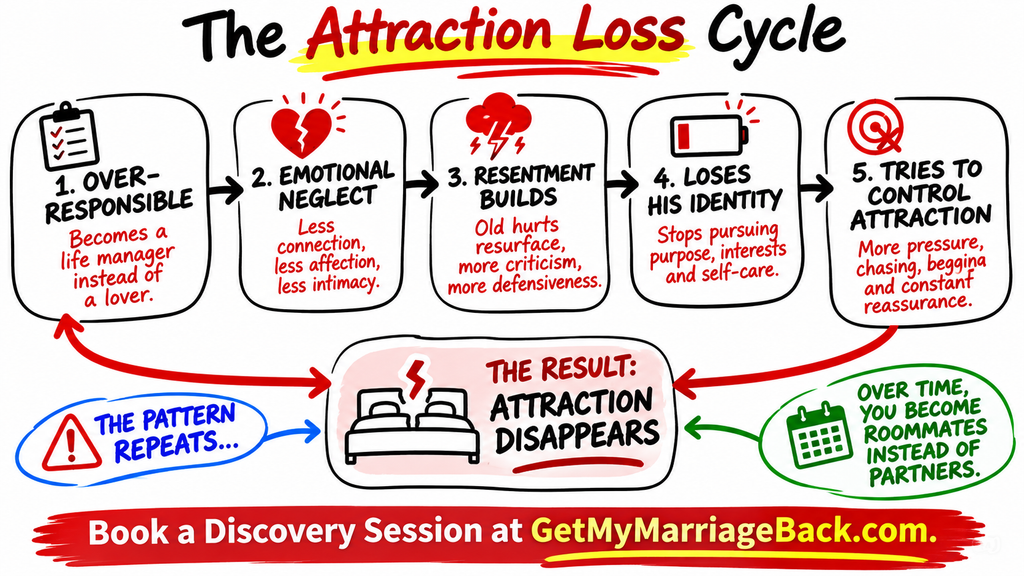
why is my wife not attracted to me anymore - the attraction loss cycle

2. You Neglected Emotional and Physical Intimacy

You didn’t necessarily stop loving your wife.

Somewhere along the way, however, you stopped expressing interest in ways she enjoyed experiencing.

Remember when you wanted to know everything about her?

Her interests fascinated you. Learning about her personality felt exciting, and spending time together didn’t require a complicated reason.

Now you know her schedule better than you know what’s happening emotionally in her life.

That shift matters.

A marriage can contain loyalty, commitment, and genuine affection while gradually losing the emotional connection that supports romantic desire.

Why your wife rejects your sexual advances

Here’s where the problem becomes even more complicated.

Physical affection becomes something you initiate primarily when you want sex.

An innocent kiss starts carrying an expectation.

When you put your arm around her, she anticipates what comes next.

Eventually, she starts avoiding even the affectionate interactions that once felt natural.

You interpret that withdrawal as evidence that she finds you unattractive.

But I want you to differentiate a wife who dislikes being touched from a wife who dislikes the expectations attached to being touched.

Those are different experiences.

Her rejection is real, but your interpretation of that rejection still requires attention.

A 2016 series of three studies led by Gurit Birnbaum found that perceived partner responsiveness was associated with increased sexual desire, with a stronger association among women. Feeling valued and understood helped explain that connection.

The research on partner responsiveness and sexual desire reinforces an important principle: how your wife experiences your attention outside the bedroom matters.

When affection becomes an unspoken transaction

Think about what happens when your wife doesn’t respond to your physical advances.

Does your mood immediately change?

Do you become distant, frustrated, or argumentative?

Has affection become something you offer with the expectation of receiving sexual reassurance?

When declining sex consistently produces an unpleasant emotional consequence, your wife has another reason to avoid situations involving physical closeness.

That doesn’t mean your desire for intimacy is unreasonable.

It means the emotional pressure surrounding intimacy deserves attention.

Seduction is about creating an inviting experience rather than imposing an obligation.

Affection needs room to exist without becoming a transaction.

When did physical intimacy stop being enjoyable on its own?

Your answer tells you something important about the current romantic dynamic in your marriage.

3. You Allowed Resentment to Poison Your Interactions

You’re tired of hearing everything you’ve done wrong.

Your wife brings up something that happened three years ago, and you’re wondering why nothing you’ve done since then seems to count.

Every disagreement becomes another opportunity for her to remind you of your shortcomings.

Eventually, you become defensive before she even finishes speaking.

She becomes critical, and an ordinary conversation starts feeling like a courtroom.

The romantic dynamic gets buried beneath the ongoing battle over who’s right and who’s wrong.

Why your wife has become emotionally distant

Imagine your wife telling you:

“You never listen to me.”

You immediately produce five examples proving that you listen.

Technically, you have demonstrated that the word “never” is inaccurate.

Emotionally, however, you haven’t necessarily addressed what she was expressing.

Her observable behavior was making a complaint. Her expressed emotional experience was feeling unheard.

Those are important pieces of information.

You don’t have to agree with every accusation to understand the emotional experience behind it.

And listen, you deserve to feel heard too.

Being emotionally intelligent doesn’t require accepting disrespect, tolerating hostility, or pretending your own feelings don’t matter.

What it requires is enough self-leadership to avoid turning every disagreement into a competition.

How unresolved resentment destroys attraction

When resentment becomes a regular feature of your marriage, ordinary interactions begin carrying the emotional weight of previous conflicts.

A forgotten errand becomes evidence that you don’t care.

Her irritated response becomes evidence that she doesn’t respect you.

The actual event gets overshadowed by everything it represents.

Before long, you’re no longer responding exclusively to what’s happening today. You’re reacting to years of accumulated frustration.

Consider whether these patterns resemble your marriage:

  • Small disagreements repeatedly become major arguments.
  • Previous mistakes dominate unrelated conversations.
  • Sarcasm replaces affectionate teasing.
  • Apologies are followed by demands for immediate forgiveness.
  • Ordinary requests are interpreted as personal attacks.

Research by Eldridge and colleagues, published in the Journal of Family Psychology in 2007, examined demand-withdraw communication among distressed and nondistressed couples, highlighting how pursuit and withdrawal patterns relate to relationship distress.

The more your interactions revolve around defending yourself, demanding answers, or extracting reassurance, the less space remains for enjoyable romantic connection.

What emotional intelligence looks like during conflict

Rather than immediately proving your wife wrong, recognize what she actually said and how she expressed feeling.

Separate her emotional interpretation from the objective facts.

You can acknowledge frustration without accepting an inaccurate characterization of your entire marriage.

Where disrespect occurs, calm boundaries are more constructive than retaliatory insults.

Your greatest immediate opportunity is changing the way you participate in these interactions.

Winning an argument and nurturing attraction are not necessarily the same achievement.

4. You Abandoned Your Personal Identity

Before marriage, you had ambitions.

Your interests extended beyond the relationship. There were friendships, personal standards, career goals, and experiences you wanted to pursue.

Now your entire emotional condition depends on how your wife treats you today.

When she’s affectionate, you’re having a good day.

When she’s cold, everything falls apart.

Perhaps you’ve stopped exercising consistently. Personal interests have disappeared, and your appearance reflects how discouraged you’ve become.

You spend your evenings analyzing her behavior, searching for signs that she still loves you, and worrying about whether she’ll eventually leave.

Without realizing it, the marriage crisis has consumed your identity.

Why losing yourself doesn’t save your marriage

Your wife originally encountered someone with a personality, interests, ambitions, and a life beyond her.

Marriage naturally changes your priorities, but it doesn’t require abandoning the individual you are.

The problem develops when you expect your relationship to provide all the excitement, confidence, fulfillment, and emotional stability you’ve stopped cultivating elsewhere.

That creates a tremendous amount of pressure.

You’re no longer simply enjoying affection when it happens. You’re depending on it to determine whether you feel valuable.

Every rejected kiss becomes a personal crisis.

An ordinary evening without intimacy feels like confirmation that your life is falling apart.

That emotional dependency makes attraction difficult to nurture skillfully.

Reclaiming your identity without abandoning your wife

Your wife doesn’t need to become your enemy for you to reclaim your identity.

You don’t need to manufacture jealousy, deliberately ignore her, threaten divorce, or pretend you’ve stopped caring.

Instead, reconnect with the parts of yourself that deserve development regardless of what happens in your marriage.

Restore your physical self-care.

Revisit meaningful friendships and personal interests.

Develop a skill you’ve always wanted to master.

Invest energy in your career, contribution, faith, creativity, or personal mission.

Having a purpose outside your marriage doesn’t mean abandoning your marriage.

It means bringing a fuller version of yourself into it.

Confidence is always sexy, but genuine confidence comes from developing personal capacity rather than performing indifference to manipulate someone else’s feelings.

5. You Started Trying to Control Attraction Instead of Nurturing It

This mistake becomes especially destructive during an active marriage crisis.

Your wife tells you she’s unhappy.

She moves into another bedroom, stops wearing her wedding ring, or begins threatening divorce.

Suddenly, everything feels urgent.

You’re buying flowers, writing long text messages, promising changes, and repeatedly asking whether she notices your efforts.

Underneath those romantic gestures, however, there’s often an unspoken expectation.

You want affection in exchange for improvement.

When she doesn’t respond the way you anticipated, frustration takes over.

You remind her how much you’ve changed.

More promises follow.

Then another argument.

The very behaviors you’re using to rebuild attraction start creating more pressure.

The difference between pursuit and chasing

I teach people to differentiate dignity-based pursuit from fear-driven chasing.

Genuine pursuit expresses romantic interest while respecting another person’s freedom to respond.

Fear-driven chasing attempts to extract reassurance, commitment, or affection because you cannot tolerate uncertainty.

One creates an invitation.

The other creates an expectation.

Consider the difference between offering your wife an enjoyable experience and arranging a romantic gesture primarily to test whether she still wants you.

The outward behavior appears similar, but the emotional experience is different.

Your intentions become particularly visible through how you react when she declines.

Why broken trust cannot be repaired through romantic performance

When trust has been damaged, the underlying problem isn’t necessarily a shortage of flowers, compliments, dates, or sexual excitement.

Your wife needs credible reasons to believe your behavior has changed.

Consistent accountability matters more than dramatic declarations.

If dishonesty, infidelity, broken promises, or repeated disrespect contributed to the crisis, attraction-building techniques cannot substitute for addressing those behaviors.

Real improvement continues even when immediate forgiveness isn’t offered.

Skillful seduction doesn’t bypass trust.

It operates alongside integrity, respect, emotional intelligence, and personal responsibility.

The Better Husband Paradox: How Attraction Disappears Despite Your Efforts

The painful contradiction is that you can become a more responsible husband while unintentionally participating in a dynamic that weakens romantic attraction.

I call this the Better Husband Paradox.

Here’s how that cycle develops:

  • Your wife becomes less affectionate.
  • You interpret her withdrawal as evidence that you’re failing.
  • Fear motivates you to increase your sacrifices and romantic efforts.
  • Those efforts become attached to expectations of affection.
  • She experiences additional emotional pressure and withdraws further.
  • Her withdrawal intensifies your fear and resentment.
  • You try even harder to prove your worth.

Eventually, your romantic behavior becomes organized around preventing rejection rather than creating enjoyable experiences.

You stop operating from desire and start operating from desperation.

That’s an important change to recognize.

The solution isn’t becoming irresponsible, emotionally unavailable, or deliberately difficult.

It’s developing the capacity to express love and romantic interest without making another person’s response responsible for your emotional stability.

Can My Wife Love Me but Not Be Sexually Attracted to Me?

Absolutely.

Commitment, emotional attachment, sexual desire, and romantic curiosity are related but different experiences.

Your wife can appreciate everything you’ve contributed to the marriage while experiencing little sexual desire.

She can consider you a dependable partner while feeling that the romantic spark has disappeared.

Alternatively, her sexual withdrawal can reflect exhaustion, medication, unresolved pain, or emotional difficulties without indicating that attraction itself is gone.

That’s why I encourage you to identify patterns rather than treating every rejection as a final verdict.

Pay particular attention to when the change began.

Did her withdrawal follow a major conflict?

Were there changes in her health, workload, or life circumstances?

Has emotional affection disappeared alongside sexual intimacy, or does she remain affectionate outside the bedroom?

The answers help you identify what you’re actually dealing with.

How to Rebuild Attraction With Your Wife Using GPS5

My wife, Lola, and I recently celebrated 19 years of marriage.

As co-authors of Get My Marriage Back and #1 Red Flag, we’ve experienced our own version of these relationship challenges.

Those experiences helped shape the reconciliation framework I teach today.

Rather than focusing exclusively on how to change your wife’s behavior, I want you to begin with the personal power available to you.

That’s where GPS5 comes in.

Grounding: Return to What Is True

Grounding means redirecting your attention away from the immediate symptom and toward your higher self, truth, and gratitude.

Your wife declined affection tonight.

That’s an observable event.

The conclusion that you’re unattractive, worthless, or destined to lose your marriage is an interpretation.

Grounding helps you recognize the difference without ignoring how painful rejection feels.

Instead of allowing fear to determine your actions, become more deliberate about how you respond.

This is the foundation of emotional composure.

Purpose: Redirect Your Pain Into Something Greater

Pain generates emotional energy.

When your entire focus is on whether your wife still wants you, that energy often becomes anxiety, obsession, resentment, or desperate pursuit.

Purpose gives it a constructive direction.

Reconnect with a mission larger than your immediate marriage crisis.

What contribution do you want to make?

Which personal goals have you abandoned?

What legacy do you want to build?

Your marriage matters, but it doesn’t need to become the sole source of meaning in your life.

A meaningful purpose creates opportunities for personal development that don’t depend on your wife’s emotional state.

Self: Build Your Personal Capacity

Self-leadership means accepting responsibility for your behavior without accepting blame for everything happening in your marriage.

Develop emotional regulation, social intelligence, physical self-care, conversational skills, and personal accountability.

Recognize the behavioral patterns that emerge when you’re frightened or discouraged.

Do you become argumentative when you feel ignored?

Does rejection immediately trigger another desperate text message?

Are you abandoning your personal standards to avoid upsetting her?

Your answers identify practical areas for development.

Loving yourself doesn’t mean becoming selfish.

It means cultivating enough internal stability to express love without making it a demand for emotional repayment.

Value: Become Experientially Attractive

When I talk about value, I’m not suggesting that your worth as a human being depends on whether your wife desires you.

Your dignity is not negotiable.

Experiential value refers to the quality of experiences your presence contributes to.

Are you engaging, emotionally present, interesting, composed, playful, and considerate?

Can you express romantic interest without making every interaction feel emotionally expensive?

Developing these qualities makes attraction-building less about performing techniques and more about how you genuinely conduct yourself.

An entertaining conversation, a thoughtfully timed compliment, or an enjoyable experience can be meaningful without requiring an immediate romantic reward.

Curiosity: Create Room for Attraction

Attraction involves curiosity.

Familiarity doesn’t eliminate the possibility of discovering something new about someone you’ve known for years.

As you develop meaningful interests, improve your emotional capacity, and interrupt destructive relationship patterns, you become less defined by the repetitive behaviors surrounding your marriage crisis.

Your wife has an opportunity to experience you differently.

She is free to become curious about those changes.

The important thing is that you don’t deliberately create confusion, insecurity, or jealousy to manufacture that curiosity.

Real attraction has room for voluntary interest.

Influence: Develop Leverage Without Control

Influence is the opportunity to contribute constructively to the romantic dynamic through your conduct and the experiences you create.

It isn’t authority over your wife’s feelings.

The leverage you’re developing comes from becoming more intentional, emotionally intelligent, accountable, and skillful in the interactions available to you.

You cannot demand sexual attraction.

What you can develop is the personal capacity to nurture healthier conditions for romantic connection.

That’s the difference between attempting to control your marriage and leading yourself skillfully within it.

What to Do Tonight When Your Wife Rejects You Again

When your wife gives you the cold shoulder tonight, start with one behavioral change.

Put your phone down.

Don’t send another paragraph explaining why she should appreciate everything you’ve done.

Avoid turning her rejection into another argument about whether she loves you.

Relax your shoulders, carry yourself with dignity, and continue your evening without punishing her for declining affection.

Confidence is always sexy.

But understand that composure isn’t a performance designed to make your wife suddenly want you.

It’s how you stop contributing additional emotional pressure to an already difficult situation.

Research by Lars Schwabe and Oliver Wolf, published in the Journal of Neuroscience in 2009, demonstrated that acute stress can shift behavior away from deliberate, goal-directed decisions and toward established habits.

That helps explain why understanding a destructive pattern intellectually doesn’t automatically stop you from repeating it when rejection hurts.

Developing new responses requires consistent practice.

I emphasize three elements: Skills, Support, and a System.

Skills help you respond differently.

Support helps you maintain perspective during emotionally difficult circumstances.

A system creates the consistency necessary to develop healthier habits.

Removing pressure tonight only stops the bleeding.

Rebuilding attraction requires addressing the underlying patterns that developed over months or years.

Attraction Is Something You Nurture, Not Something You Negotiate

You don’t need to become a less responsible husband to become a more attractive one.

Responsibility, integrity, confidence, playfulness, emotional intelligence, and romantic curiosity can coexist.

The mistake is expecting any single quality to substitute for every other dimension of your relationship.

Your financial contributions matter.

So do your emotional presence, individuality, romantic awareness, and ability to navigate disappointment without creating additional conflict.

The objective isn’t to convince your wife that she should find you attractive.

It’s to develop the personal capacity to participate in an engaging, respectful, and emotionally intelligent romantic relationship.

You can begin that work as an individual, even when your wife isn’t presently participating in reconciliation.

Your personal power begins with what you can control.

19 Signs Your Wife Is Not Sexually Attracted To You

Frequently Asked Questions

Why is my wife not attracted to me anymore?

Your wife can experience reduced attraction because of emotional disconnection, unresolved resentment, excessive familiarity, sexual pressure, damaged trust, stress, or health-related changes. Identifying when her behavior changed and what was happening around that time helps you understand the underlying problem.

What are the signs my wife is no longer sexually attracted to me?

Persistent sexual rejection, reduced physical affection, disappearing flirtation, avoidance of private time, and emotional withdrawal are possible signs of declining attraction. Consider the broader relationship pattern instead of interpreting one rejected advance as proof that attraction is gone.

Can my wife love me but not be sexually attracted to me?

Yes, your wife can genuinely love you and remain committed to your marriage while experiencing reduced sexual desire. Emotional attachment and sexual attraction are connected but different aspects of a romantic relationship.

How do I get my wife attracted to me again?

Focus on reducing emotional pressure, rebuilding your personal identity, developing emotional intelligence, addressing broken trust, and creating enjoyable interactions without demanding affection in return. Nurture attraction through genuine romantic interest, consistent conduct, and respect for her freedom to reciprocate.

7 Signs Your Wife Is Not Sexually Attracted to You—and What to Do

Your wife used to reach for you, kiss you without being asked, and enjoy being close to you—but now she turns away when you touch her, avoids sex, and seems perfectly comfortable living without physical intimacy.

Take This 2 Minutes Quiz

Question 1 of 15

After years of marriage, sacrifice, and building a life together, sexual rejection hurts differently. You’re not simply missing sex. You’re missing the feeling that your wife actually wants you.

And when that feeling disappears, the questions become painful.

Why doesn’t my wife want to have sex with me anymore? Why does she reject me sexually? Has she lost attraction? Does she still love me?

Here’s what I want you to understand immediately:

Your wife rejecting sex does not automatically mean she has lost sexual attraction to you.

The behavior is real. The explanation requires a closer look.

Sometimes attraction has weakened. Other times, stress, unresolved resentment, emotional disconnection, physical discomfort, or the pressure surrounding intimacy creates the same outward behavior.

Your responsibility is to recognize what’s happening before reacting in ways that make an already difficult situation worse.

I’m going to show you seven signs worth paying attention to, what they can mean, and how to start rebuilding the conditions that make attraction possible.

7 Signs Your Wife Is No Longer Sexually Attracted to You

1. She Consistently Avoids Sexual Intimacy

You initiate sex, and she’s tired.

Tomorrow comes, and there’s another reason.

Eventually, you stop initiating because rejection becomes more painful than silence.

What used to feel natural between you now feels like an uncomfortable negotiation.

But before concluding that your wife is no longer sexually attracted to you, identify when the rejection started.

Did it begin after childbirth, a medical issue, a major disagreement, or months of unresolved marital tension?

Has her interest in sex disappeared entirely, or does she specifically avoid intimate situations with you?

These are different problems.

Research supports taking stress seriously when evaluating changes in sexual desire. A 2024 study of newlywed couples found that greater daily stress was associated with changes in sexual activity and physical affection. The researchers examined these patterns using repeated daily reports rather than relying on a single snapshot.

You can review the research on stress and physical intimacy in marriage to understand why reduced affection does not always indicate reduced attraction.

What you need to know: Sexual avoidance is a symptom. The timing, circumstances, and surrounding relationship patterns help explain its meaning.

signs my wife is not sexually attracted to me

2. Your Wife Never Initiates Physical Affection Anymore

Remember when your wife would spontaneously hug you, kiss you, or rest her hand on your shoulder?

Now every affectionate interaction begins with you.

When you stop initiating, nothing happens.

You aren’t simply missing physical contact. You’re missing the experience of being desired.

That absence can gradually damage your confidence, especially when you start interpreting every rejection as proof that something is wrong with you.

But here’s an important question:

Was your wife always less physically expressive, or has something dramatically changed?

A spouse who has never been especially affectionate is different from someone who was once physically expressive and has recently withdrawn.

Pay attention to whether she welcomes affection when there’s no expectation of sex.

If she enjoys an occasional hug but pulls away when she senses sexual pressure, the problem may involve the expectations surrounding physical contact.

On the other hand, if nearly every form of closeness has disappeared, you’re looking at a broader change in the relationship.

Don’t overlook that difference.

the attraction loss cycle - signs my wife is not sexually attracted to me

3. The Flirting and Playfulness Have Disappeared

Your wife used to tease you.

An ordinary conversation could turn into a playful exchange, a meaningful glance, or an unexpected kiss.

Now your conversations revolve around bills, children, responsibilities, and schedules.

You attempt something flirtatious, and she responds as though you’re discussing tomorrow’s grocery list.

The romantic energy has disappeared.

Here’s something many people misunderstand about attraction in marriage:

Being responsible, dependable, and committed does not automatically create romantic excitement.

Those qualities matter tremendously. But attraction also benefits from enjoyable experiences, emotional engagement, individuality, and opportunities to discover something interesting about each other.

When every interaction becomes another household obligation, the marriage can begin to feel like a business partnership.

That doesn’t mean you should manufacture excitement or become someone you’re not.

It means you need to recognize whether your daily interactions still create room for laughter, curiosity, warmth, and genuine enjoyment.

Ask yourself whether your wife has become less playful only around you or whether she’s experiencing a broader period of exhaustion or emotional withdrawal.

A difficult season is not necessarily a permanent verdict on your marriage.

4. She Avoids Spending Time Alone With You

There’s always another errand.

Another responsibility.

Another reason to stay occupied.

When you finally have an evening together, she disappears into her phone, finds something to clean, or goes to bed early.

You begin feeling like your wife is deliberately avoiding you.

And sometimes, that’s exactly what her behavior indicates.

But why?

Consider what typically happens when you finally get her alone.

Do you immediately bring up the marriage?

Do you ask why she doesn’t want sex?

Do you repeatedly demand reassurance that she still loves you?

If every private moment becomes another emotionally exhausting conversation, spending time alone with you can begin to feel like an obligation.

Your desire for reassurance can unintentionally become the very pressure she’s trying to escape.

This doesn’t mean you’re wrong for wanting affection or clarity.

It means your method of seeking those things matters.

Attraction becomes difficult to nurture when someone associates private time with conflict, interrogation, or emotional pressure.

5. Emotional Intimacy Has Disappeared Alongside Physical Intimacy

Your wife no longer asks about your day.

Personal conversations have become shorter.

When you share something meaningful, her response feels distant or obligatory.

You live in the same house, but the emotional connection feels increasingly absent.

Here’s what you need to know:

Sexual attraction and emotional intimacy are not identical.

However, changes in both can reveal important patterns in the marriage.

Start by identifying which disappeared first.

Did emotional disconnection develop months before sexual rejection?

Or did sexual difficulties create resentment, embarrassment, and emotional withdrawal afterward?

The order matters because different problems require different responses.

For example, unresolved conflict can make affection feel emotionally unsafe.

Alternatively, ongoing sexual difficulties can create tension even when affection and goodwill remain.

Your job isn’t to assign blame.

It’s to understand the sequence.

When you identify what changed first, you gain a clearer picture of what needs attention.

6. Your Presence Seems to Irritate Her

You ask an ordinary question, and she snaps.

You offer help, and somehow you’re doing it wrong.

Small things that never bothered her before suddenly become arguments.

It feels like you can’t win.

Let me tell you a story.

Imagine coming home determined to reconnect with your wife.

You arrange a romantic dinner, make an effort with your appearance, and approach her affectionately.

She pulls away.

The rejection hurts, so you demand an explanation.

You remind her how much you’ve sacrificed and ask why she can’t appreciate your efforts.

Within minutes, an attempted romantic evening becomes another argument.

Now look at what actually happened.

Your wife withdrew from physical affection.

You interpreted that withdrawal as evidence that she no longer desired you.

Then your reaction added another layer of emotional pressure.

Her behavior deserves attention. So does your response.

You cannot control whether your wife welcomes affection, but you can control whether rejection turns into another confrontation.

This is where emotional intelligence becomes practical rather than philosophical.

A skillful response requires enough self-control to recognize painful emotions without immediately acting on them.

7. Your Marriage Feels Like a Roommate Arrangement

You share a house.

You manage expenses.

You raise children, handle responsibilities, and maintain the household.

But the romantic relationship has practically disappeared.

There’s little flirting, limited affection, and almost no sense of sexual anticipation.

You function efficiently as a household while feeling increasingly disconnected as romantic partners.

This is what people commonly describe as a roommate marriage.

And it becomes especially painful when you remember how different your relationship used to feel.

Here’s what I want you to recognize:

One warning sign alone tells you very little. Several persistent changes, especially alongside expressed dissatisfaction, deserve serious attention.

If your wife no longer initiates intimacy, avoids being alone with you, expresses resentment, and describes the marriage as emotionally empty, you’re seeing a larger pattern.

Still, you cannot read her mind.

Attraction is not something you can demand, negotiate, or force.

Understanding the pattern is your starting point.

Why Your Wife May Love You but Not Feel Sexually Attracted to You

One of the most confusing experiences in marriage occurs when your wife says she loves you but no longer feels sexually attracted to you.

You hear the word love, but her behavior feels like rejection.

That contradiction can make you question everything.

However, love, commitment, affection, sexual desire, and romantic attraction are related experiences—not interchangeable ones.

Your wife can value the marriage while experiencing low sexual desire.

She can care about you while carrying unresolved resentment.

She can also feel emotionally connected but struggle with stress, exhaustion, pain, or changes in her sexual response.

And yes, attraction itself can weaken when the romantic dynamic changes.

The key is identifying which explanation fits your circumstances instead of treating every problem as proof that the marriage is over.

The Attraction Trap: Why Trying Harder Can Push Her Away

Here’s a painful cycle I want you to recognize.

Your wife becomes less affectionate.

You feel rejected.

That rejection creates anxiety, so you pursue reassurance.

You initiate more conversations about the relationship, increase romantic gestures, or repeatedly ask whether she still loves you.

She experiences additional pressure and withdraws further.

Her withdrawal increases your fear.

And the cycle repeats.

I call this the Rejection–Pressure–Withdrawal Cycle.

The tragedy is that your intentions can be loving while your behavior creates an experience that feels increasingly uncomfortable to your wife.

You want closeness.

She wants relief from pressure.

The harder you chase reassurance, the more difficult it becomes to create relaxed, enjoyable interactions.

This is why generic advice such as “just communicate more” doesn’t address every marriage crisis.

Communication matters, but timing, emotional regulation, and the experience surrounding communication matter too.

Your goal is not to stop caring.

It’s to stop allowing fear to determine how you express that care.

How to Start Rebuilding Attraction Without Chasing or Begging

Here is what I want you to do.

Start with yourself—not because you’re responsible for everything wrong in the marriage, but because your own behavior is where you have the most immediate influence.

Ground Yourself Before Reacting

When your wife rejects affection, resist the urge to turn that moment into an interrogation.

Relax your shoulders.

Give her physical space.

Continue your evening without sulking, punishing her, or demanding an explanation.

Confidence is always sexy, but respecting someone’s space isn’t a technique for manufacturing desire.

It’s a way to stop adding unnecessary pressure.

Reconnect With Your Purpose

A marriage crisis can consume your entire identity.

You become so focused on whether your wife wants you that your work, friendships, health, interests, and personal mission begin disappearing.

That imbalance makes every interaction emotionally heavier.

Redirect some of your attention toward meaningful responsibilities, personal growth, and the contribution you want to make beyond your immediate relationship problems.

Purpose gives you somewhere constructive to direct your energy.

Develop Emotional Self-Leadership

Self-leadership means taking responsibility for your reactions without blaming yourself for your wife’s feelings.

You can acknowledge that rejection hurts without using that pain to justify pressure, hostility, or manipulation.

Practice responding rather than reacting.

Pay attention to the difference between expressing genuine interest and pursuing reassurance out of fear.

Dignity-based pursuit respects another person’s choices.

Fear-driven chasing attempts to secure an emotional outcome immediately.

Those experiences feel very different to the person receiving them.

Become Experientially Attractive Again

Attraction isn’t simply about looking better, earning more money, or performing romantic gestures.

It’s also about the experience someone has in your presence.

Are your interactions consistently tense?

Do ordinary conversations become arguments?

Have you stopped developing your interests, confidence, humor, and emotional range?

You can work on becoming more engaging without pretending to be someone else.

Bring more steadiness into difficult situations.

Reintroduce playfulness where it’s welcome.

Build a life that remains meaningful even while your marriage is experiencing uncertainty.

The goal isn’t to create jealousy or manipulate your wife into noticing you.

It’s to develop genuine personal value that can support healthier romantic interactions.

Allow Curiosity and Attraction to Develop Naturally

When your conduct changes consistently, your wife has an opportunity to experience you differently.

She may notice that you no longer turn every rejection into an argument.

Conversations may become less tense.

Shared moments can begin feeling more enjoyable.

Curiosity and attraction can grow in an environment where both people have room to choose closeness.

You don’t need to announce every improvement or demand recognition for your efforts.

Let your conduct speak through repeated experiences.

That’s how self-leadership becomes a foundation for influence without turning your wife into a project you need to control.

What to Do Tonight When Your Wife Rejects You Again

Your next move doesn’t need to be dramatic.

When she turns away from a kiss or declines intimacy, respect the boundary without turning the moment into another emotional confrontation.

Don’t demand sex.

Avoid delivering a speech about everything you’ve done for the marriage.

And don’t use silence, resentment, or withdrawal as punishment.

Instead, carry yourself calmly and continue with your evening.

Later, when there’s an appropriate opportunity for a respectful conversation, you can express your concerns without making her responsible for immediately resolving your anxiety.

Pay attention to patterns over time rather than treating one interaction as the final answer.

Reducing pressure creates breathing room.

But breathing room is only the beginning.

Rebuilding attraction requires understanding the history of your marriage, identifying the underlying problems, and developing more effective emotional and relational skills.

The objective is not to convince your wife to desire you. It’s to become someone who can participate in a healthier, more engaging romantic relationship without sacrificing dignity or personal responsibility.

That’s where meaningful change begins.

Average Length of Separation Before Reconciliation: Data Reveals!

Frequently Asked Questions

How do you know if your wife is no longer sexually attracted to you?

Persistent sexual rejection, disappearing affection, reduced flirting, emotional withdrawal, and avoidance of private time can indicate declining attraction. Look for changes from her previous behavior and consider the surrounding circumstances before drawing conclusions.

Why is my wife not sexually attracted to me anymore?

Sexual attraction can change because of unresolved resentment, emotional disconnection, chronic stress, physical discomfort, medication, relationship conflict, or changing romantic dynamics. Understanding when the change began and what else was happening helps identify the most relevant explanation.

Can my wife love me but not be sexually attracted to me?

Yes, emotional attachment, commitment, and sexual desire are different experiences, so your wife can genuinely love you while experiencing reduced sexual attraction. The important question is whether the underlying issue involves desire, emotional connection, unresolved conflict, or another factor.

How do I get my wife sexually attracted to me again?

Start by reducing pressure, respecting her boundaries, improving emotional self-control, and rebuilding enjoyable interactions rather than chasing reassurance. Focus on your personal growth and the relationship patterns you can influence while allowing attraction to develop through genuine, voluntary connection.

Your Wife Is Not Attracted to You? Here Are 5 Mistakes Making It Worse

Your wife still talks to you. You handle responsibilities, raise children, pay bills, solve problems, and keep life moving.


Take This 2 Minutes Quiz

Question 1 of 15

But something feels painfully different.

Affection is rare. Sex feels mechanical, awkward, dutiful, or completely absent. When you touch her, you sense hesitation instead of excitement. You may even sleep in the same bed while feeling like two people sharing a house rather than husband and wife.

Eventually, one thought becomes hard to escape:

“wife is not attracted to me anymore.”

That realization creates more than sexual frustration. It creates a specific kind of emotional starvation—the experience of loving someone, wanting romantic connection with her, yet no longer feeling wanted in return.

The danger begins when emotional starvation starts choosing your behavior.

You try harder. more helpful. Initiate more carefully. You ask questions about sex. You pull away to see whether she notices. Eventually, even your best intentions begin carrying pressure.

That is how a marriage can move deeper into roommate status even while you are desperately trying to save it.

The answer is not to become cold, manipulate your wife, perform tricks to make her jealous, or turn marriage into a negotiation over who owes whom affection.

The skill is learning how to build attraction from self-leadership, emotional intelligence, experiential value, healthy pursuit, curiosity, and personal power.

What Does It Really Mean When Your Wife Is Not Attracted to You?

Loss of attraction is serious, but it does not automatically mean your marriage is finished.

Attraction is an experience, not a moral judgment.

Your wife can believe you are a responsible father, good provider, decent person, and loyal friend while experiencing very little romantic or sexual energy toward you.

That distinction is difficult because most high-functioning husbands naturally think in terms of solutions.

You may reason:

  • “I provide for this family.”
  • “I help around the house.”
  • “I’m working on myself.”
  • “I’m more patient now.”
  • “I’ve apologized.”
  • “Why doesn’t she want me?”

All of those statements can be factually true while missing the central question:

What does being romantically connected to you currently feel like?

Research offers useful support for this distinction. In three studies, Gurit Birnbaum and colleagues found that perceived partner responsiveness—feeling understood, valued, and cared for—was associated with greater sexual desire, with the link especially pronounced among women. Attraction was connected to relational experience, not simply household functionality. (PubMed)

That does not mean “be nicer and she will desire you.”

It means attraction responds to an entire experience.

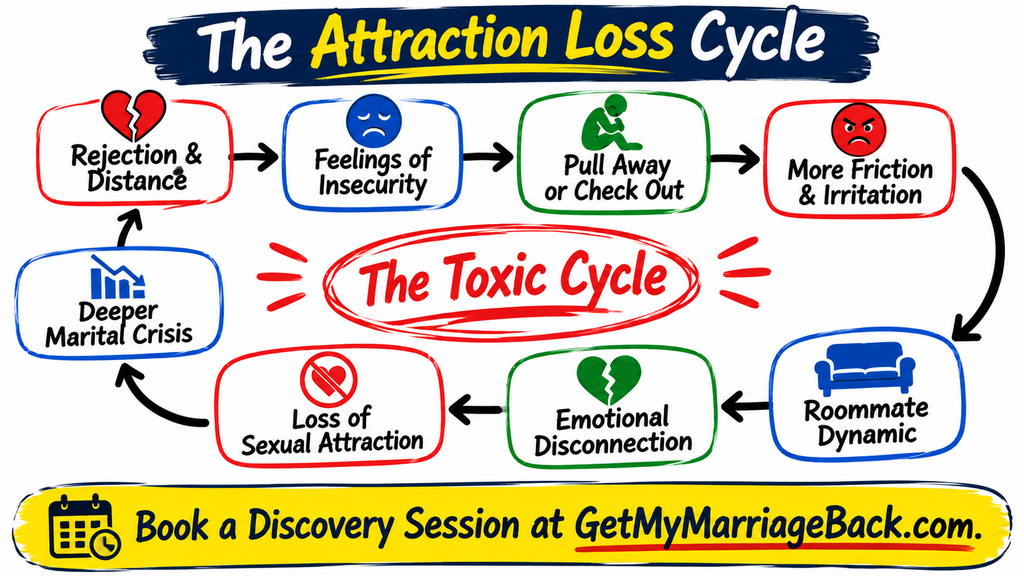
my wife is not attracted to me - The Roommate Marriage Usually Has a Cycle

The Roommate Marriage Usually Has a Cycle

When your marriage feels like roommates, the external symptom is obvious: romance has faded.

Underneath it, however, a destructive cycle can develop:

Roommate Status → Emotional Starvation → Connection Testing → Transaction Pressure → Romantic Shutdown → Deeper Roommate Status

Understanding this cycle matters because a man can unknowingly intensify the very rejection he is trying to escape.

1. Emotional Starvation

You want to feel desired.

That is normal.

Men do not stop needing affection, sexuality, admiration, playfulness, touch, warmth, and romantic connection simply because they got married.

Once those experiences disappear, however, hunger can become fear.

Now every interaction starts carrying extra meaning.

One rejected advance becomes:

“She’s not attracted to me.”

A week without sex becomes:

“Our marriage is dying.”

A cold response becomes:

“She doesn’t love me anymore.”

Soon, intimacy is no longer simply intimacy. It has become evidence.

That emotional weight sets up the next mistake.

my wife is not attracted to me

Mistake #1: You Start Testing Whether Your Wife Still Wants You

I call this connection testing.

Instead of expressing interest because you genuinely feel it, you begin expressing interest partly to measure her reaction.

You touch her to see if she leans in.

Sex becomes a test of whether attraction still exists.

You ask why she never initiates.

Sometimes you stop initiating completely because you want to see whether she comes looking for you.

Different behaviors can carry the same hidden question:

“Do I still matter to you romantically?”

That is a heavy question to attach to an ordinary hug.

Healthy pursuit has a different energy.

A man can desire his wife, initiate affection, flirt, express sexuality, and pursue without needing every interaction to reassure him that the marriage is safe.

Fear-driven chasing says, “I need your reaction to stabilize me.”

Dignity-based pursuit says, “I can express interest without losing myself inside your response.”

That difference is emotional intelligence.

Mistake #2: You Turn “Choreplay” Into Attraction Currency

Helping at home is not the problem.

Responsibility is attractive when it reflects your standards, leadership, maturity, generosity, and investment in the life you chose.

The problem appears when your behavior quietly becomes an exchange.

You clean.

…handle more errands.

You take care of the kids.

Then somewhere underneath the effort is an expectation:

“After everything I’ve done, why doesn’t she want sex?”

Now your contribution carries an invisible invoice.

Your wife does not have to hear you say the words to feel the transaction developing.

This does not mean domestic workload is irrelevant to desire. Stress, exhaustion, parenting demands, health changes, and unequal responsibilities can absolutely affect sexual interest.

The important distinction is motive.

Research on sexual motivation shows that responsiveness tends to work best when it comes from autonomous desire and genuine care rather than pressure or obligation. Across dyadic studies, people higher in what researchers call sexual communal strength—a willingness to care about a partner’s sexual needs without erasing their own—reported greater satisfaction and desire. By contrast, sex motivated more strongly by pressure and obligation was associated with poorer outcomes. (PubMed)

In plain English:

Care creates a different experience than payment.

Do your part because it represents your character.

Do not convert your character into a bill your wife must pay with attraction.

my wife is not attracted to me - You Keep Having “The Talk” About Why She Doesn't Want Sex

Mistake #3: You Keep Having “The Talk” About Why She Doesn’t Want Sex

Communication is valuable.

Interrogation disguised as communication is not.

Once attraction has already deteriorated, repeated conversations such as these can become emotionally exhausting:

“Why don’t you ever initiate?”

“Do you still find me attractive?”

“Why don’t we have sex anymore?”

“Are you still in love with me?”

“What do I need to change?”

Those questions make sense intellectually.

Emotionally, however, they can turn desire into a performance review.

Now your wife has to explain an experience she may not fully understand herself.

Worse, she starts associating affection with the possibility that another heavy conversation is coming.

A hug carries expectations.

A kiss becomes a signal.

Going to bed becomes tense.

Sex feels like proof that progress is happening.

Research on 1,054 married couples found that greater gaps between desired and actual sexual frequency were generally associated with poorer relationship outcomes, including lower satisfaction and stability and more conflict. The discrepancy itself matters, but turning that discrepancy into constant relational pressure does not solve it. (PubMed)

The better question is not:

“Why won’t she give me what I need?”

Ask:

“What has intimacy started to feel like inside this marriage?”

That question gives you something useful to work with.

Mistake #4: You Quietly Withdraw So She Will Miss You

After enough rejection, many husbands stop pursuing altogether.

You tell yourself:

“Fine. I’m done trying.”

You become polite but distant.

Warmth disappears.

You focus on work.

Sometimes you secretly hope your wife will finally notice the difference and begin chasing you.

That is still connection testing.

It simply wears a colder outfit.

Grounded detachment is different from quiet punishment.

You can stop over-pursuing without becoming emotionally dead.

And you can regain your independence without manufacturing scarcity.

You can respect her distance without turning silence into a manipulation strategy.

The purpose of reclaiming yourself is not to make your wife panic.

It is to stop allowing her current attraction level to control your identity, behavior, mood, and purpose.

Mistake #5: You Confuse Being a Good Husband With Being Experientially Attractive

This is one of the hardest ideas to accept.

Being a good person matters.

So does integrity.

Responsibility matters.

Faithfulness matters.

Providing matters.

None of those automatically creates romantic attraction.

Attraction has an experiential dimension.

Ask yourself:

What does my presence feel like?

Are you alive or chronically tense?

Curious or predictable?

Purposeful or emotionally dependent?

Playful or constantly serious?

Warm or defensive?

Present or mentally elsewhere?

Capable of hearing something painful without turning it into an argument?

Romantic attraction is not a reward for moral performance.

Your moral character establishes who you choose to be.

Experiential value affects what it feels like to interact with you.

That is why the goal is not merely “be a better husband.”

Become a fuller human being.

How to Rebuild Attraction Without Turning Your Wife Into a Project

Once you understand the destructive cycle, the constructive work becomes clearer.

The roadmap is:

Emotional Starvation → Grounding → Purpose → Self-Discovery → Value → Curiosity & Attraction

Notice where the work happens.

It starts with you.

Ground Yourself Before You Try to Fix the Marriage

Your wife’s attraction level is information about the present condition of the relationship.

It is not your source of truth.

Grounding means returning to your higher self before fear decides your next move.

You can acknowledge:

“My wife is not attracted to me sexually right now.”

without turning that sentence into:

“I am unattractive.”

Those are completely different statements.

Gratitude also matters here.

Not fake positivity.

Real gratitude widens your field of vision when fear has narrowed your entire life down to whether one person desires you today.

That is personal power.

Rebuild a Purpose Bigger Than Your Marriage

A marriage crisis can consume every available mental resource.

You wake up thinking about her.

You analyze her tone.

Work becomes harder.

Your phone becomes a source of anxiety.

Every quiet moment becomes another opportunity to think about the relationship.

Purpose interrupts that collapse.

Your life needs a mission greater than your wife and greater than your marriage.

Think about your children, health, faith, business, career, creativity, contribution, service, friendships, community, legacy, and the man you are becoming.

Purpose is not avoidance.

It is emotional structure.

When your entire identity depends on your wife’s current feelings, neediness naturally rises.

A purposeful life gives attraction room to breathe because you are no longer asking the marriage to carry the full weight of your identity.

Use the Crisis for Self-Discovery, Not Self-Blame

Now become curious about your own capacity.

Ask difficult questions without attacking yourself.

Where did you become complacent?

When did playfulness disappear?

Have resentment and defensiveness changed your energy?

Did work swallow your personality?

Have you become emotionally predictable?

Are you treating sex as reassurance rather than connection?

Do you listen to understand, or listen long enough to prepare your defense?

Self-discovery does not mean accepting blame for your wife’s feelings.

Her emotions remain hers.

Your behavior remains yours.

That boundary allows you to grow without surrendering your dignity.

Build Experiential Value

This is where attraction work becomes skillful and seductive in the healthiest sense of the word.

Seduction is not trickery.

It is the art of creating an experience that feels engaging enough to invite curiosity.

Experiential value includes presence, confidence, humor, emotional steadiness, competence, style, vitality, purpose, curiosity, warmth, sensuality, boundaries, social intelligence, and a genuine life of your own.

You are not assembling these qualities as bait.

Develop them because they expand you.

One useful body of research comes from Arthur Aron and colleagues. Their studies found that couples who participated in novel and arousing activities experienced increases in relationship quality compared with couples assigned more mundane activities. (DOI)

A 2026 review of self-expansion research likewise highlights evidence that novel, challenging, growth-oriented shared experiences can strengthen relationship quality and well-being.

The lesson is bigger than “plan a date.”

Routine can turn two interesting people into efficient coworkers.

Value requires aliveness.

Create Novelty Without Performing for Approval

Many husbands hear “bring excitement back” and immediately create another assignment.

Date night.

Vacation.

Flowers.

Fancy dinner.

Then comes the hidden scorecard:

“Did she appreciate it?”

“Was she affectionate afterward?”

“Did we have sex?”

Now novelty has become another transaction.

Instead, approach shared experiences with curiosity.

Try something different because life should be interesting.

Introduce more personality into your own life.

Become less predictable in healthy ways.

Explore.

Learn.

Create.

Invite rather than pressure.

Your wife can participate or decline.

The value of your growth does not disappear because her response was not what you hoped for.

That mindset is far more seductive than performing for approval.

Pursue Without Begging

A husband does not need to pretend he has stopped wanting his wife.

That performance usually feels fake anyway.

You can pursue.

Flirt.

Express attraction.

Initiate.

Compliment.

Create openings for connection.

The skill is removing emotional debt from the invitation.

A genuine invitation allows another person to say yes or no without having to manage your self-esteem afterward.

That is confidence.

When your wife says no, you do not have to sulk, interrogate, punish, or immediately diagnose the entire marriage.

You continue being a man whose emotional state belongs to him.

Over time, that difference changes the experience of you.

Stop Monitoring Whether Attraction Is “Working”

One of the fastest ways to turn personal growth back into pressure is to begin measuring your wife.

“She touched me twice this week.”

AND “She texted first.”

“She smiled at me.”

“We had sex, so this must be working.”

“She was cold tonight, so nothing is changing.”

Stop.

Curiosity, warmth, reciprocity, and attraction belong on her side of the equation.

Your job is value.

Her response is information—not your identity.

Attraction also fluctuates naturally. Stress, sleep, parenting, health, hormonal changes, medication, emotional history, and relational dynamics all influence sexual desire.

Research on desire discrepancy repeatedly shows that mismatched desire is common and connected with relationship and sexual satisfaction, but the meaning of the discrepancy varies across couples.

Do not convert every fluctuation into a marriage verdict.

What Attraction Recovery Actually Looks Like

Attraction recovery rarely begins with one dramatic romantic moment.

Often, the first changes are experiential.

Interactions become lighter.

Defensiveness decreases.

You stop forcing certainty.

Your identity expands beyond the marriage crisis.

Conversation stops feeling like crisis management every day.

Your energy becomes less predictable because your life is growing again.

Warmth can exist without demand.

Sexual interest can be expressed without making sex compulsory.

Curiosity has room to return.

That final word matters: room.

You cannot force curiosity.

You create an experience where curiosity has somewhere to live.

Your Wife’s Rejection Is Not a Command to Become Cold

Some men respond to rejection by deciding vulnerability itself is the problem.

It is not.

Emotional dependence and emotional openness are different things.

A strong man can say:

“I want my wife.”

“miss our connection.”

“I care about this marriage.”

“want romance in my life.”

None of those statements makes you weak.

The issue is what happens next.

Can you still stand when she does not immediately give you what you want?

Can you continue creating a meaningful life?

OR Can you learn from the crisis?

Can you pursue with dignity?

AND Can you remain warm without begging?

That is the kind of emotional capacity that makes reconciliation possible without turning it into an obsession.

The Goal Is Not to Restore the Old Marriage

When your marriage has reached deep roommate status, trying to recover exactly what you had before is often the wrong objective.

That version of the relationship produced the current result.

Build something more mature.

More emotionally intelligent.

alive.

More honest.

….purposeful.

More seductive.

…spacious.

Romantic attraction thrives when two people remain capable of experiencing each other as individuals—not merely roles performing household functions.

You are not only “husband.”

She is not only “wife.”

Marriage becomes far more compelling when the people inside it continue growing.

That is how you stop treating attraction like something you either have or lose forever.

It becomes a capacity you learn to nurture.

5 Physical Signs She Just Slept With Someone Else

Frequently Asked Questions

Why is my wife not attracted to me anymore?

Loss of attraction can grow from emotional disconnection, accumulated pressure, resentment, excessive routine, sexual obligation, stress, health changes, or a relational experience that has become more functional than romantic. The useful question is what attraction and intimacy currently feel like inside your marriage, not simply who is to blame.

Can a wife become attracted to her husband again?

Yes, attraction can change because it is responsive to relational experience, emotional connection, novelty, individual growth, sexual dynamics, and many other factors. Your strongest position is to improve what you control without trying to force her feelings.

How do I know if my wife is not sexually attracted to me?

Common signs include consistently avoiding sexual initiation, pulling away from affectionate touch, describing the marriage as friendship or roommate-like, and experiencing intimacy as obligation rather than desire. One isolated rejection does not establish the overall condition of your marriage.

What should I do when my wife rejects intimacy?

Do not interrogate, punish, sulk, or turn the rejection into proof that your marriage is over. Ground yourself, examine the larger relational pattern, express interest without pressure, and focus on building experiential value rather than demanding reassurance.


What Would Help You Most Right Now?

Choose the option that best matches where you are with your marriage.

I Need Personalized Help

My Marriage Is in Serious Trouble

If you're dealing with separation, divorce, loss of attraction, infidelity, intimacy problems, or a spouse who's pulling away, get help looking at what's happening in your specific situation.

Get Personalized Help →
Get My Marriage Back book cover
I'd Rather Learn What to Do First

Start With Get My Marriage Back

Get the book and start learning the principles for moving your marriage in a better direction.

Get the Free Book →