
What Would Help You Most Right Now?

Choose the option that best matches where you are with your marriage.

I Need Personalized Help

My Marriage Is in Serious Trouble

If you're dealing with separation, divorce, loss of attraction, infidelity, intimacy problems, or a spouse who's pulling away, get help looking at what's happening in your specific situation.

Get Personalized Help →
Get My Marriage Back book cover
I'd Rather Learn What to Do First

Start With Get My Marriage Back

Get the book and start learning the principles for moving your marriage in a better direction.

Get the Free Book →

7 Bad Signs During Separation: Is Your Wife Pulling Away for Good?

Your wife is making plans without you, treating you like a roommate, and acting as though your marriage barely matters—but the most dangerous part may be how you’re responding to her distance.

Take This 2 Minutes Quiz

Question 1 of 15

You remember when your presence mattered to her. There was affection, curiosity, shared decision-making, and a sense that you were building something together.

Now, she barely acknowledges you when you enter the room. She makes decisions without consulting you, and when you express concern, you’re accused of being controlling, insecure, or overly emotional.

That’s painful, especially when you’ve invested years in building a life together.

But here’s what I want you to understand: Bad signs during separation are information, not a verdict.

A change in behavior tells you something about the present condition of your relationship. It doesn’t automatically tell you why the change happened, whether your wife has stopped loving you, or whether attraction can return.

Your responsibility is to recognize the patterns accurately, stop reacting from fear, and develop the emotional intelligence to make your next move more attractive rather than more desperate.

Let’s talk about seven warning signs that deserve your attention.

1. Sudden Male Friendships With Changing Boundaries

Your wife suddenly starts mentioning a male coworker you’ve never met.

His name comes up frequently. She’s texting him late at night, sharing personal experiences, and appearing emotionally engaged in conversations that don’t include you.

When you express discomfort, she says you’re insecure.

Naturally, that hurts.

You remember when you were the person receiving that attention, curiosity, and emotional openness.

However, having male friends doesn’t automatically establish infidelity.

What you need to know is whether the emotional boundaries have changed.

Ask yourself:

  • Has she become secretive about interactions that were previously transparent?
  • Is she sharing intimate concerns with someone else while withdrawing emotionally from you?
  • Have previously established relationship boundaries been abandoned?
  • Does she respond to reasonable concerns with honest conversation or repeated dismissal?

A friendship and an emotional affair are two different realities.

Don’t turn your imagination into evidence. At the same time, don’t pretend that repeated secrecy and broken agreements are meaningless.

The attractive response isn’t surveillance, interrogation, or competing with another man.

It’s emotional steadiness, clear boundaries, and enough self-respect to address observable behavior without losing control of yourself.

bad signs during separation

2. Sudden Girls’ Trips That Exclude You From Her Life

Your wife used to discuss vacations and weekend plans with you.

Now, she announces trips after everything has already been arranged.

You find yourself asking questions that once would have been part of a normal conversation.

Where is she going? When is she returning? What happens to the household responsibilities while she’s away?

Suddenly, you’re told she doesn’t need your permission.

But perhaps you weren’t demanding permission in the first place. You wanted consideration.

There’s an important difference between healthy independence and repeated exclusion from shared responsibilities.

A spouse can enjoy friendships, travel, and personal freedom without disregarding the practical commitments of marriage.

Consider the pattern rather than obsessing over the destination.

Does she coordinate responsibilities fairly? Is she becoming more independent while remaining respectful, or increasingly treating your shared life as an inconvenience?

Here’s another uncomfortable question: When you previously discussed her plans, did your conversations feel collaborative or interrogative?

That isn’t an invitation to blame yourself. It’s an opportunity to recognize whether your approach contributed to the tension.

Attraction becomes easier to nurture when your presence feels emotionally safe rather than controlling.

You can communicate expectations clearly without making your spouse feel that every independent decision requires a courtroom defense.
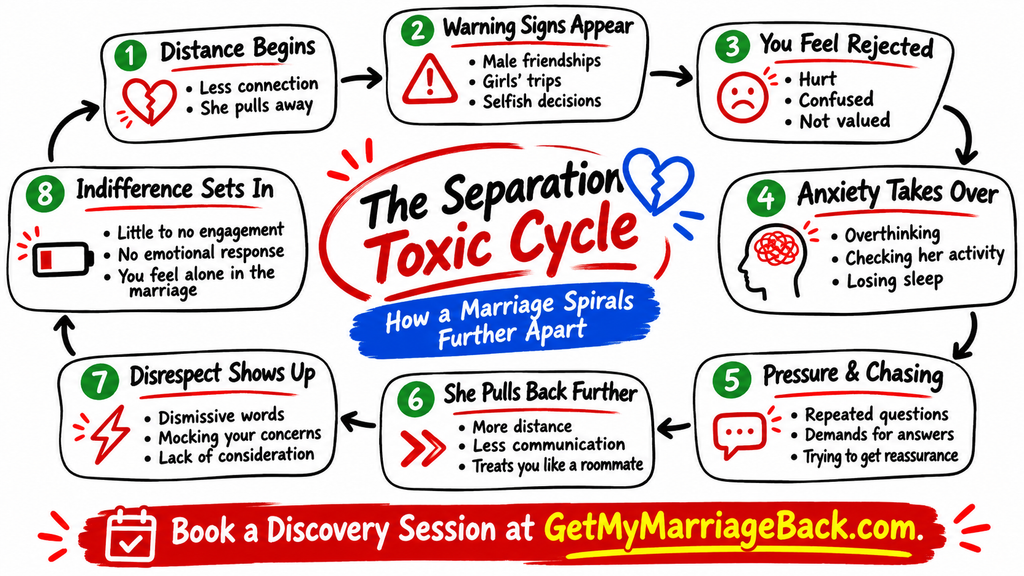
bad signs during separation - the separation toxic cycle

3. Selfish Decisions That Ignore Shared Responsibilities

Your wife changes financial arrangements, household expectations, or family schedules without discussing the consequences with you.

When you object, she explains that she’s finally doing what’s best for herself.

You experience that as abandonment.

And when her choices directly affect shared commitments, your concerns are legitimate.

Still, independence isn’t automatically selfishness.

A spouse establishing reasonable autonomy is different from someone repeatedly breaking agreements and expecting you to absorb the consequences.

The issue is not whether she makes decisions independently. It’s whether those decisions violate commitments, disregard practical responsibilities, or create an unfair burden.

Pay attention to repeatable behavior instead of treating every disagreement as proof that the marriage is finished.

Then respond with clarity.

You might say, “I respect your ability to make your own decisions. When those decisions affect our shared finances or responsibilities, we need a workable agreement.”

Notice what’s missing from that statement.

There’s no begging, character attack, or emotional threat.

You’re communicating a boundary without surrendering your composure.

That combination of self-respect and emotional maturity is far more compelling than trying to win every argument.

4. Indifference Replaces Emotional Engagement

This is one of the most painful bad signs during separation.

Your wife no longer argues with you.

When you tell her you’re struggling, she barely responds. You enter the room, and her expression doesn’t change.

Even conflict once felt like evidence that she cared enough to engage.

Now, you’re facing silence.

It’s tempting to conclude that she’s emotionally checked out of the marriage forever.

But indifference can have several explanations.

She may be emotionally exhausted from repeated conflict, protecting herself from another painful interaction, or actively disengaging from the relationship.

What you need to know is whether her withdrawal happens primarily during conflict or consistently across everyday interactions.

Someone overwhelmed by arguments may still demonstrate kindness, practical concern, or warmth in calmer moments.

Persistent emotional disengagement across different situations deserves closer attention.

Relationship research supports the importance of emotional responsiveness. A daily-diary study involving 99 couples found that perceived partner responsiveness was associated with relationship satisfaction.

That matters because emotional connection isn’t simply about how often you communicate. It’s also about whether interactions feel understanding, considerate, and responsive.

If your wife has become indifferent, demanding an emotional reaction can make your presence feel like another obligation.

Instead, focus on becoming someone who can remain grounded, listen without immediately defending himself, and participate in conversations without turning every interaction into a referendum on the marriage.

That doesn’t mean accepting endless indifference.

It means recognizing that emotional safety creates better conditions for connection than emotional pressure.

5. You’ve Become a Friend-Zoned Husband or Roommate

You still share a home, bills, schedules, and responsibilities.

She may even describe you as a good father, reliable provider, or wonderful friend.

Yet the romantic connection has disappeared.

There’s little affection, playful interaction, sexual curiosity, or excitement about spending time together.

You feel appreciated for what you provide but no longer desired for who you are.

This is where many husbands make a critical mistake.

They assume that if they become more helpful, more agreeable, or more persistent about intimacy, attraction will eventually return.

But attraction isn’t restored by demanding affection or accumulating favors.

What matters is the emotional experience of being around you.

I call this experiential value.

It involves how someone feels in your presence: relaxed or pressured, respected or judged, curious or exhausted, emotionally safe or constantly evaluated.

Your integrity, loyalty, and responsibilities matter. However, those qualities don’t automatically create romantic desire.

A marriage can have excellent logistical cooperation while suffering from a serious shortage of emotional and romantic energy.

Start paying attention to when the connection changed.

Did affection decline after unresolved resentment? Did your conversations become exclusively about bills, children, and schedules?

Have you stopped bringing playfulness, personal ambition, curiosity, and emotional presence into the relationship?

Research on sexual autonomy support and relationship satisfaction examined 786 participants across three studies and found positive associations between feeling supported in sexual autonomy, sexual need fulfillment, and relationship satisfaction.

The practical implication is important: Desire thrives more naturally when intimacy feels freely chosen rather than demanded.

You cannot force your wife to desire you.

What you can do is cultivate the personal confidence, emotional maturity, and enjoyable interactions that make genuine curiosity more possible.

Seduction in a marriage isn’t manipulation.

It’s the art of making connection feel inviting again, while respecting the other person’s freedom to respond.

6. Disrespectful Words Become Normal

Your wife dismisses your concerns, mocks your emotions, or repeatedly speaks to you with contempt.

Conversations that once felt respectful now leave you feeling small.

Perhaps she rolls her eyes, ridicules your intentions, or attacks your character whenever you disagree.

Disrespect matters.

However, not every disagreement is contempt, and not every frustrated statement means your spouse has lost all respect for you.

What you need to recognize is the difference between an isolated disagreement and a recurring pattern of humiliation.

Relationship researcher John Gottman’s work identifies criticism, contempt, defensiveness, and stonewalling as destructive patterns in distressed relationships.

Contempt is particularly concerning because it communicates superiority or disgust rather than a willingness to address the problem together.

Your response matters, too.

Are you retaliating with insults? Do you plead for approval, or abandon your boundaries to prevent another argument?

Neither aggression nor desperation creates genuine respect.

A grounded response might sound like this:

“I want to understand your concerns, but I’m not continuing a conversation where we’re insulting each other. We can discuss this respectfully.”

Then follow through calmly.

Your dignity doesn’t depend on winning the argument.

In fact, one of the most attractive qualities you can develop is the ability to maintain your standards without becoming emotionally volatile.

7. Your Anxiety Starts Controlling Your Behavior

This final warning sign isn’t necessarily about your wife’s behavior.

It’s about yours.

You’re checking her online status, rereading old messages, monitoring her mood, and struggling to sleep.

Every interaction feels like a test.

If she smiles, you feel hopeful. When she becomes distant, your entire day falls apart.

Her emotional availability has become the center of your existence.

I understand why that happens.

When your marriage feels threatened, your nervous system can start treating every unanswered message or cold response as an emergency.

But anxiety isn’t evidence that your marriage is beyond repair.

It tells you fear is beginning to direct your decisions.

And fear-driven behavior often creates additional pressure in an already strained relationship.

Repeated reassurance-seeking, emotional interrogation, and constant monitoring can make even ordinary conversations feel exhausting.

You need to stop treating every symptom as an emergency demanding an immediate reaction.

That shift begins with emotional self-leadership.

How to Rebuild Attraction During Separation Without Chasing

Recognizing the signs is only half the work.

The bigger question is what you do next.

If your wife has become distant, you may feel compelled to explain yourself repeatedly, convince her of your value, or make grand gestures to prove your commitment.

But attraction doesn’t respond well to pressure.

What you need is a more grounded way of showing up.

Ground Yourself Before Responding

In my GPS5 framework, the first principle is Grounding.

Instead of allowing every change in your wife’s mood to determine your emotional state, reconnect with your values, gratitude, and a perspective bigger than the immediate conflict.

When she gives you the cold shoulder, you don’t have to follow her around demanding an explanation.

Put your phone down. Relax your shoulders.

Give yourself enough space to respond thoughtfully rather than impulsively.

You’re not pretending the problem doesn’t exist. You’re refusing to let fear make your decisions.

Reconnect With Your Purpose

The second principle is Purpose.

Your marriage matters, but your entire identity cannot depend on your spouse’s current feelings.

Reconnect with your health, meaningful work, responsibilities, friendships, personal development, and long-term mission.

This isn’t about acting unavailable to provoke jealousy.

It’s about becoming a person whose life contains meaning beyond the relationship crisis.

Someone with a genuine sense of purpose often brings a different energy into conversations: less desperation, more steadiness, and greater capacity to be present.

Strengthen Your Sense of Self

The third principle is Self.

Develop accountability, emotional capacity, and personal responsibility without confusing those qualities with self-blame.

You can acknowledge your mistakes without accepting responsibility for every problem in the marriage.

Practice communicating your needs directly, maintaining boundaries respectfully, and listening without immediately defending yourself.

Research on self-determination and romantic conflict has found associations between autonomy and less defensive, more understanding responses during disagreements.

That makes emotional self-control more than a motivational slogan. It’s a practical relationship skill.

Develop the Skills, Support, and Systems to Sustain Change

A single calm response is valuable, but lasting change requires repetition.

That’s where the remaining elements of GPS5—Skills, Support, and Systems—become important.

Build the communication skills needed to de-escalate conflict. Surround yourself with constructive support, and establish routines that prevent anxious habits from controlling your day.

For example, stop checking your spouse’s online activity whenever you feel uncertain.

Replace that habit with a deliberate pause, physical movement, or a meaningful task.

When a conversation becomes heated, practice taking a respectful break rather than forcing immediate resolution.

Over time, these behaviors change the experience of interacting with you.

You become less reactive, more emotionally available, and more capable of genuine connection.

The Attraction Shift Most People Miss During Separation

Here’s the paradox.

The more desperately you try to secure your wife’s attraction, the more pressure she may experience.

Yet when you become emotionally grounded, maintain your dignity, and create more positive experiences, you stop making every interaction about what you need from her.

That changes the emotional atmosphere.

You can become playful without demanding affection, attentive without monitoring, and confident without becoming arrogant.

A warm smile, a thoughtful conversation, or a moment of genuine humor can feel more inviting than another intense discussion about whether the marriage will survive.

This isn’t about hiding your concerns or ignoring broken agreements.

It’s about understanding that repairing practical problems and rebuilding romantic attraction are related but different tasks.

You still need honesty, accountability, mutual respect, and workable agreements.

At the same time, emotional connection benefits from freedom, curiosity, and interactions that feel good rather than obligatory.

Confidence is always sexy.

Confidence isn’t the absence of fear. It’s the ability to act according to your values even when the outcome feels uncertain.

And that kind of confidence becomes especially powerful when it is combined with empathy.

What These Seven Warning Signs Really Mean for Your Marriage

The most important lesson isn’t that sudden male friendships, girls’ trips, selfish decisions, indifference, roommate dynamics, disrespect, or anxiety automatically predict divorce.

It’s that these patterns reveal where your marriage may be losing trust, cooperation, emotional safety, or attraction.

Some changes reflect healthy independence. Others reveal unresolved resentment, neglected boundaries, or serious emotional disengagement.

Your job is to differentiate those realities instead of allowing fear to decide what every behavior means.

When you recognize the pattern accurately, you can respond with more intelligence.

You stop chasing every emotional signal and start developing the qualities that support a healthier connection.

The goal isn’t to control your wife’s choices.

It’s to become a more grounded, self-respecting, emotionally compelling person while addressing the actual problems in your marriage.

That’s how you move from reacting to separation toward creating better conditions for trust, curiosity, and attraction to grow again.

5 Physical Signs She Just Slept With Someone Else: The Truth

Frequently Asked Questions

What are the biggest bad signs during separation?

Persistent emotional indifference, repeated boundary violations, contempt, exclusion from shared responsibilities, and disappearing romantic connection are important warning signs. Look for consistent patterns rather than treating one incident as a final verdict.

How do you know if your wife is emotionally checked out during separation?

She may show little interest in emotional connection, avoid meaningful conversations, and remain disengaged even when there is no conflict. Emotional exhaustion can look similar, so pay attention to whether warmth and consideration still appear in calmer situations.

Can attraction come back after separation?

Yes, attraction can return when emotional safety, mutual respect, curiosity, and positive experiences begin to develop again. Pressuring your spouse for affection is less constructive than addressing resentment and creating space for genuine connection.

What should you avoid doing during marriage separation?

Avoid constant monitoring, repeated reassurance demands, emotional interrogation, retaliation, and treating every interaction as an emergency. Focus instead on clear boundaries, emotional self-control, respectful communication, and personal growth.

What to Do When Your Wife Wants a Divorce: 5 Mistakes That Destroy Attraction

Your wife wants a divorce, and the more desperately you try to defend yourself, prove your point, or save your marriage, the more emotionally distant she becomes.

Take This 2 Minutes Quiz

Question 1 of 15

You may believe the biggest problem is that she no longer trusts you, refuses to communicate, or won’t acknowledge your side of the story.

But I want you to consider something more uncomfortable.

What if your attempts to regain control are making you less attractive to the person you desperately want to keep?

Attraction in marriage is not just about physical appearance, romance, or sexual chemistry. It is also influenced by how someone experiences you emotionally.

Do they feel understood or interrogated? Do they experience steadiness or constant anxiety? Can they disagree with you without being punished for having a different perspective?

When your wife says she wants a divorce, these questions become especially important.

I’m going to show you five mistakes that can damage trust, intensify emotional withdrawal, and weaken attraction. More importantly, you’ll learn how to replace those habits with the emotional intelligence, self-respect, and personal leadership that make genuine reconnection possible.

Why Your Wife Wants a Divorce Even Though You Still Love Her

One of the most painful marriage crises happens when you genuinely love your wife but she experiences your behavior as emotionally exhausting.

You may be trying to get answers, resolve a disagreement, or reassure yourself that your marriage is secure.

Meanwhile, she may experience those same efforts as criticism, surveillance, pressure, or control.

This is where couples begin living in two different emotional realities.

You believe you’re fighting for the marriage. She believes she’s fighting for breathing room.

Neither person’s feelings automatically establish the facts. However, the emotional impact of your conduct matters even when your underlying concern is legitimate.

Consider a husband who becomes suspicious because his wife starts protecting her phone more carefully.

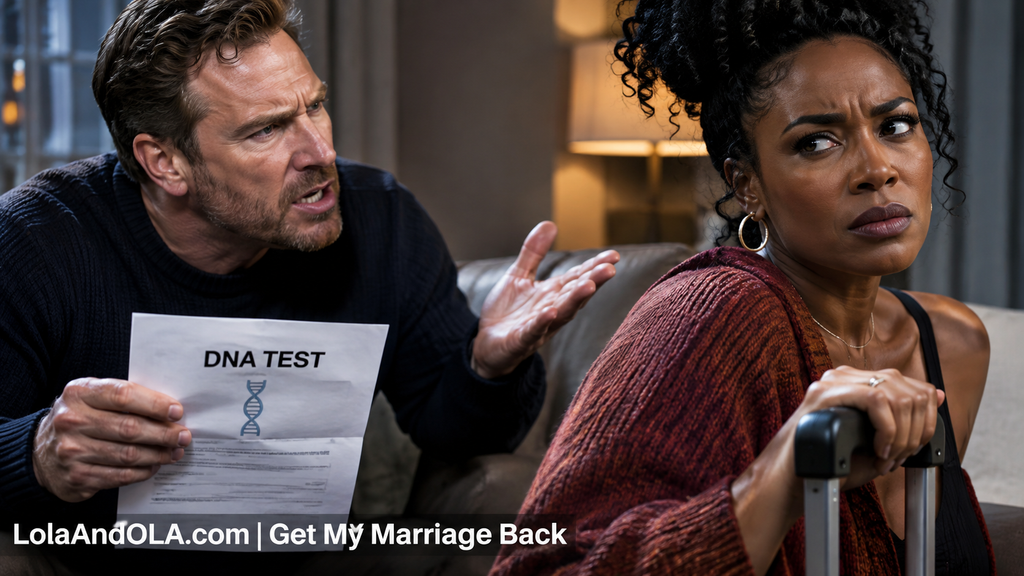
He notices a changed password, a turned screen, and occasional late arrivals. Eventually, he demands a DNA test because he fears their child might not be biologically his.

From his perspective, he’s asking for certainty.

From hers, he’s questioning her fidelity, her integrity, and the identity of their family.

When she threatens divorce, he becomes even more convinced that something must be wrong.

Now the marriage has two separate problems: an unresolved question about trust and an escalating pattern of accusation.

The first problem requires facts. The second requires emotional intelligence.

Confusing those two problems is how many people turn a difficult conversation into a relationship crisis.

what to do when your wife wants a divorce

Mistake #1: Treating Your Fear Like It’s Already a Fact

When your wife wants a divorce, your mind may become obsessed with explanations.

Perhaps she’s having an affair. Maybe she never loved you. You might even convince yourself that every ordinary change in her behavior confirms your worst fear.

But fear is not evidence.

A locked phone is an observation. Concluding that she’s hiding another relationship is an interpretation.

A late arrival is an event. Deciding that it proves infidelity is a separate judgment.

You must learn to distinguish what happened from what you believe it means.

How to separate facts from fears

Create three categories:

  • What I know: Specific, observable events or verified information.
  • What I suspect: Interpretations that have not been established.
  • What I still need to understand: Legitimate questions requiring a proportionate response.

This simple distinction changes how you communicate.

Instead of saying, “You’re obviously hiding something,” you can identify the actual concern without presenting suspicion as a conviction.

That doesn’t require you to abandon your judgment or ignore genuine inconsistencies.

It requires intellectual discipline.

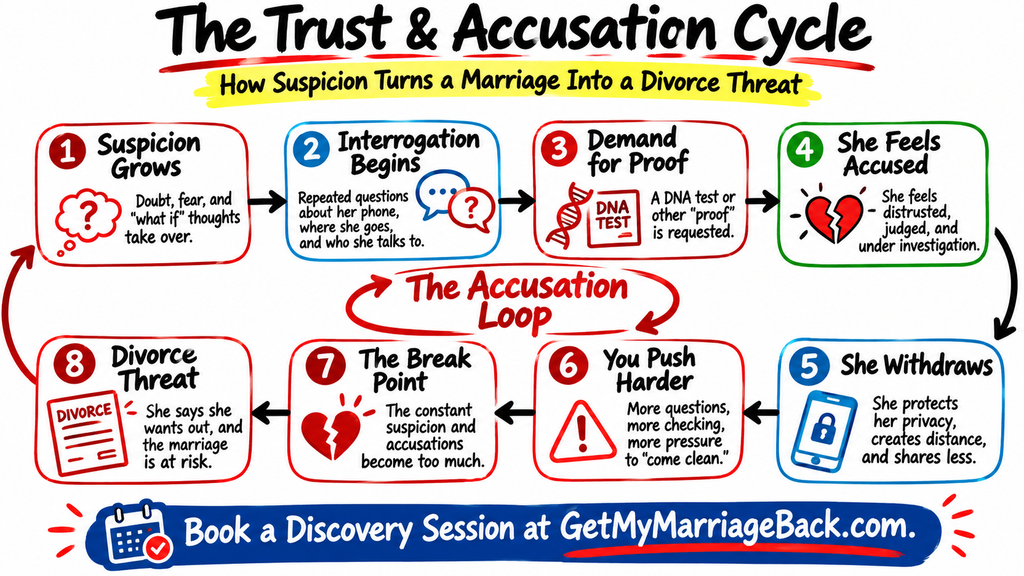
what to do when your wife wants a divorce - the accusation loop

Why emotional discipline builds attraction

Someone who can tolerate uncertainty without becoming aggressive communicates inner stability.

That stability matters because attraction is difficult to nurture when every interaction feels like an emergency.

Your spouse should not have to manage your anxiety before discussing the actual issue.

I want you to develop the capacity to experience a difficult emotion without immediately converting it into a demand.

That is a practical form of confidence.

And confidence rooted in self-control is far more compelling than confidence performed through intimidation.

Mistake #2: Confusing Privacy With Proof of Cheating

A marriage requires honesty, but honesty does not mean surrendering every personal boundary.

Privacy and secrecy are different.

Privacy protects reasonable personal space. Secrecy involves intentionally concealing something material to the relationship.

The distinction depends on behavior, agreements, and context—not simply whether you can access someone’s phone.

Imagine your wife changes her password.

You ask why. She says she needs privacy.

You interpret that response as evidence of an affair.

When she becomes angry, you decide her anger proves guilt. If she explains herself calmly, you assume she rehearsed an excuse.

Notice the trap.

Every possible response now supports your accusation.

She cannot answer her way out of a conclusion you’ve already reached.

The question that exposes the problem

Ask yourself:

“Is there any answer my wife could give that I would genuinely consider?”

If the answer is no, you’re no longer investigating a concern with an open mind.

You’re seeking confirmation for a belief.

That behavior can destroy emotional safety because your spouse begins to experience conversation as a trial rather than a connection.

What makes you more attractive instead?

Develop discernment.

You can have standards without becoming controlling. You can expect honesty without demanding unrestricted access to every private interaction.

When you have concrete evidence of deception, address it specifically and respectfully.

If you don’t have evidence, stop treating discomfort with surveillance as a confession.

An emotionally intelligent person knows the difference between having boundaries and trying to dominate another person’s boundaries.

That distinction preserves both dignity and the possibility of intimacy.

Mistake #3: Defending Your Intentions While Dismissing Her Experience

This is one of the biggest mistakes people make when trying to save a marriage from divorce.

You explain what you meant.

Your wife explains how it affected her.

Instead of acknowledging her experience, you repeat your intentions more forcefully.

You might say:

“I was only asking a question.”

“I have a right to know.”

“If you’re innocent, why are you so upset?”

These statements may express genuine concerns, but they can also communicate that her emotional experience is irrelevant.

Here’s the distinction I want you to understand:

You can have a legitimate question and still handle that question badly.

A DNA test can establish biological paternity. It cannot establish whether your spouse feels respected, understood, or emotionally secure in the marriage.

Those are separate matters.

Acknowledgment is not surrender

Suppose you tell your wife:

“I understand why that question felt like an accusation. I can see that the way I approached you was hurtful. I still need to understand my concern, but I don’t want to keep treating you like you’re already guilty.”

That is different from either attacking her or pretending you no longer have questions.

You’re acknowledging two emotional realities at the same time.

Your feelings matter. Hers do too.

This ability to recognize another person’s experience without erasing your own is a cornerstone of emotional maturity.

Why responsiveness matters to attraction

Research on romantic relationships offers an important insight here.

A series of three studies published in the Journal of Personality and Social Psychology found that perceived partner responsiveness was associated with greater sexual desire, particularly among women.

The researchers examined how feeling understood, valued, and cared for relates to attraction and desire. Their findings support the importance of partner responsiveness in romantic desire.

This doesn’t mean you should manufacture empathy as a technique for getting affection.

Quite the opposite.

Your responsiveness must become part of your character rather than a performance designed to produce an immediate reward.

People notice the difference between genuine understanding and strategic agreement.

The seductive quality of emotional intelligence is that your spouse can feel seen without feeling managed.

Mistake #4: Turning Your Marriage Into an Investigation

One question becomes five.

Your wife withdraws.

You feel rejected, so you ask again.

She becomes frustrated and mentions divorce.

Now you panic, send a long message, demand another conversation, or follow her around trying to settle everything immediately.

The cycle becomes predictable.

Suspicion → Interrogation → Withdrawal → Panic → More Interrogation.

Eventually, the marriage starts feeling like a courtroom.

You become the investigator, your spouse becomes the suspect, and ordinary affection disappears beneath the pressure to defend or prosecute.

Why pursuing harder can push her away

When someone feels emotionally overwhelmed, more questions may increase the urge to withdraw.

That withdrawal can then intensify the other partner’s fear of abandonment.

Relationship research has examined this demand-withdraw pattern for decades, finding associations between demanding or withdrawing behaviors and lower relationship satisfaction.

The practical lesson is straightforward: escalating pursuit does not necessarily create understanding.

Sometimes it creates the very distance you’re trying to eliminate.

Interrupt the cycle without abandoning the relationship

The next time a conversation becomes heated, notice what is happening inside you.

Are you trying to establish a fact, or are you trying to eliminate anxiety through your spouse’s immediate compliance?

Those are different objectives.

If you need a specific answer about an important issue, pursue it through an appropriate, lawful, respectful process.

Don’t grab her phone, demand passwords through intimidation, involve relatives to pressure her, or turn social media into a jury.

When children or paternity concerns are involved, their privacy and well-being also matter.

You can say:

“I don’t want this conversation to become another interrogation. I need some time to collect my thoughts, and I’d rather discuss the actual issue when we can both think clearly.”

Then follow through.

Avoid using the pause as a punishment or as a way to make her chase you.

The attraction shift: Become emotionally steady

There is something deeply appealing about a person who can remain grounded during an uncomfortable moment.

They don’t need to win every argument.

Their self-worth doesn’t collapse because someone disagrees with them.

They can listen, reflect, and make decisions without turning every disagreement into a test of loyalty.

This is the kind of steadiness I want you to cultivate.

Not coldness. Not indifference. Not emotional suppression.

Calm strength with genuine emotional availability.

That combination makes room for curiosity, respect, and renewed connection.

Mistake #5: Demanding Forgiveness Before Demonstrating Change

When your wife wants a divorce, you may become desperate for a sign that things are improving.

You apologize and immediately ask whether she’s forgiven you.

After one peaceful evening, you want to know whether she’s reconsidered the divorce.

When she remains distant, you feel that your effort has been rejected.

But rebuilding trust is not a transaction.

You cannot deposit one apology and demand affection as the withdrawal.

Attraction responds to lived experience

Imagine the husband who demanded a DNA test begins changing his behavior.

He stops monitoring every movement. He no longer disguises repeated accusations as innocent questions.

Instead of obsessing over every unanswered concern, he becomes more deliberate about how he responds to uncertainty.

He keeps his commitments, maintains his daily responsibilities, and develops a life that is not organized around checking his wife’s emotional temperature.

These actions matter because they change what living with him feels like.

His wife no longer has to anticipate an interrogation every time she puts down her phone.

Conversations can gradually become less defensive.

That creates an opportunity for warmth to return.

How to rebuild attraction without chasing

I teach this through five interconnected shifts.

Ground yourself. Learn to regulate your reactions before trying to influence someone else’s behavior.

Reconnect with purpose. Maintain meaningful responsibilities, friendships, health, and personal direction beyond the current marriage conflict.

Discover your patterns. Examine the insecurity, assumptions, and emotional habits that repeatedly turn disagreement into confrontation.

Build value through consistency. Become someone whose conduct communicates reliability, respect, and emotional maturity.

Allow curiosity to emerge. Give your spouse room to notice real change without demanding immediate recognition.

The final point is especially important.

You cannot force someone to feel attracted to you.

But you can stop behaving in ways that repeatedly extinguish attraction.

And you can build the qualities that make closeness more inviting.

How to Be Seductive Again When Your Wife Is Emotionally Distant

Seduction in a troubled marriage is often misunderstood.

People imagine grand romantic gestures, carefully timed compliments, gifts, or sexual advances.

Those gestures may have their place in a healthy relationship.

During a divorce crisis, however, they can feel like another form of pressure when the underlying conflict remains unresolved.

I want you to think about seduction differently.

Seduction begins with becoming someone your spouse can approach freely.

That means you create emotional room rather than demanding access.

You show interest without interrogating. You express warmth without requiring reciprocation.

When your wife needs space, you respect it without turning the moment into a dramatic rejection.

If she shares something vulnerable, listen without immediately correcting her.

And when a disagreement arises, let your self-control speak louder than your frustration.

Emotional intelligence creates a different atmosphere

Attraction is influenced by the emotional atmosphere of a relationship.

A spouse who expects criticism may become guarded.

Someone who anticipates pressure may avoid intimacy because affection feels like the beginning of another obligation.

By contrast, feeling understood and respected can make emotional closeness more appealing.

Studies of couples have associated perceived responsiveness with intimacy and affectionate touch, while research on conflict-day interactions has linked greater responsiveness with higher daily sexual satisfaction and desire.

These findings reinforce a principle worth remembering: the way you treat your spouse outside romantic moments influences the emotional meaning of those moments.

You cannot separate everyday conduct from intimacy.

Keep your dignity while becoming more inviting

Don’t beg for attraction.

Avoid performing confidence through jealousy, emotional withdrawal, or threats.

You don’t need to become mysterious by refusing to communicate.

Instead, become less reactive, more purposeful, and more comfortable with yourself.

Take care of your appearance because you respect yourself.

Pursue meaningful goals because your life has direction.

Express affection when it’s welcome, and respect a lack of interest without retaliating.

A spouse who feels free to say no is in a better position to offer a genuine yes.

That freedom is essential to mature attraction.

What to Do Tonight When Your Wife Goes Quiet Again

Imagine your wife is sitting nearby.

She places her phone face down.

You feel the familiar tension rising.

Your mind begins creating explanations, and you feel tempted to ask another question.

This is where your real work begins.

Relax your shoulders.

Notice the fear without treating it as an instruction.

Remember that you do not need to resolve every uncertainty in the next thirty seconds.

If there’s an unresolved concern, choose an appropriate time to discuss it directly.

For now, allow an ordinary moment to remain ordinary.

Don’t follow her into another room to continue an argument.

Avoid saying, “If you have nothing to hide, prove it.”

Give her space without making a spectacle of how much space you’re giving.

That single choice will not repair months of conflict, but it interrupts the behavior that keeps reinforcing the same emotional distance.

Every time you respond with steadiness instead of panic, you practice becoming a different partner.

And repeated experiences are what allow someone to evaluate whether change is real.

Can You Save Your Marriage When Your Wife Wants a Divorce?

A divorce threat can represent many things.

Sometimes it reflects accumulated resentment. Other times, it follows a specific betrayal, ongoing incompatibility, or years of unresolved conflict.

You cannot determine its meaning by panic or speculation alone.

Start by understanding the actual reasons your wife gives.

Listen carefully enough to distinguish the immediate argument from the longer relationship pattern.

If she says she no longer feels emotionally connected, examine the daily interactions that may have contributed to that distance.

When she describes feeling controlled, look honestly at your behavior instead of debating whether she has the right to feel that way.

If the relationship contains deception or broken agreements, address those facts without confusing accountability with coercion.

And remember that repairing a marriage ultimately requires two people’s voluntary participation.

Your responsibility is to lead your own behavior intelligently.

Stop trying to control the outcome

The more obsessed you become with making your wife change her mind, the easier it is to neglect the personal growth that could improve the relationship.

You may spend hours analyzing her words while ignoring your own conduct.

You might search for reassurance while failing to create experiences that feel reassuring.

Or you could focus on winning an argument while losing the ability to connect.

That is why I want you to redirect your attention.

Stop asking only, “How do I make her stay?”

Begin asking, “What does my behavior make it feel like to be married to me?”

The second question puts your attention where you have genuine influence.

The Real Secret to Rebuilding Trust and Attraction

When your wife wants a divorce, your instinct may be to increase your effort.

More explanations. More promises. More emotional conversations.

But greater effort applied through the same unhealthy patterns often creates more of the same conflict.

What you need is a different quality of behavior.

You need the emotional intelligence to distinguish facts from fears, the discipline to respect boundaries, and the confidence to acknowledge someone else’s pain without abandoning your own legitimate concerns.

You also need patience.

Trust develops through consistent experiences, not a single dramatic speech.

Attraction grows more naturally when a relationship has room for individuality, warmth, mutual respect, and emotional freedom.

So the next time you feel compelled to chase an answer, demand reassurance, or defend yourself at any cost, remember this:

You don’t become more attractive by winning control over your spouse. You become more attractive by developing control over yourself.

That is where your influence begins.

And that is how you create the conditions for a different kind of marriage.

“Wife Makes NO EFFORT In BED” (5 Tips For INSTANT Solution)

Frequently Asked Questions

What should I do first when my wife says she wants a divorce?

Listen to her reasons without immediately arguing, threatening, or demanding reassurance. Identify the specific relationship problems she describes and begin addressing the behaviors within your control.

Can I save my marriage if my wife wants a divorce but I don’t?

You can improve your conduct, address unresolved problems, and invite constructive conversations, but reconciliation requires your wife’s willingness too. Focus on consistent change rather than pressuring her to reverse her decision.

How do I make my wife attracted to me again during a divorce crisis?

Rebuild emotional steadiness, respect her boundaries, and demonstrate reliability through daily behavior rather than trying to force romantic feelings. Genuine responsiveness, confidence, and personal purpose can help create an atmosphere where attraction becomes more possible.

Should I give my wife space if she wants a divorce?

Respecting a request for space can reduce pressure and interrupt repeated conflict. Space should not become silent punishment or an excuse to avoid necessary conversations about children, responsibilities, or important decisions.

Wife Wants Divorce? 7 Attraction Mistakes That Push Her Away

Your wife says she’s no longer attracted to you, wants space, or is thinking about divorce—and the harder you try to save your marriage, the further away she seems to move.

Take This 2 Minutes Quiz

Question 1 of 15

I want you to understand something that took me years to appreciate: being committed to your marriage and knowing how to create attraction within that marriage are not necessarily the same skill.

You can work hard, pay the bills, remain faithful, raise your children, and genuinely love your wife. Yet none of those things automatically determines how she experiences you emotionally, romantically, or sexually.

At 30, I believed that enough effort, provision, and commitment would naturally produce a successful marriage. Now, at 47, I understand that marriage also requires emotional intelligence, self-leadership, relational awareness, and the ability to remain attractive through the way you live.

If your wife wants a divorce, the immediate temptation is to do more of whatever you believe should make her appreciate you.

More explanations. More apologies. More conversations. More attempts to convince her that leaving would be a mistake.

Unfortunately, more effort does not always create more attraction. Sometimes it creates more pressure.

Here are seven mistakes worth examining if you want to understand how to save your marriage when your wife wants divorce—and how to develop the emotional and romantic skills that make connection possible.

Why Your Wife May Lose Attraction Even When You Love Her

Before we examine the seven mistakes, I want to distinguish three things: commitment, connection, and attraction.

Commitment is your decision to remain invested in the relationship.

Connection is the experience of being emotionally understood, valued, and engaged with each other.

Attraction is the romantic, emotional, and sometimes sexual pull that makes closeness desirable.

These experiences can influence one another, but they are not interchangeable.

You may be committed while your wife feels emotionally disconnected. She may appreciate your financial contributions without experiencing much romantic desire.

Likewise, a temporary reduction in sexual interest does not necessarily mean the marriage is ending.

Stress, unresolved conflict, resentment, exhaustion, health concerns, and years of negative interaction can all affect intimacy.

The question is not simply whether you are doing enough.

It is whether your presence, habits, communication, and emotional responses are creating an experience that supports closeness.

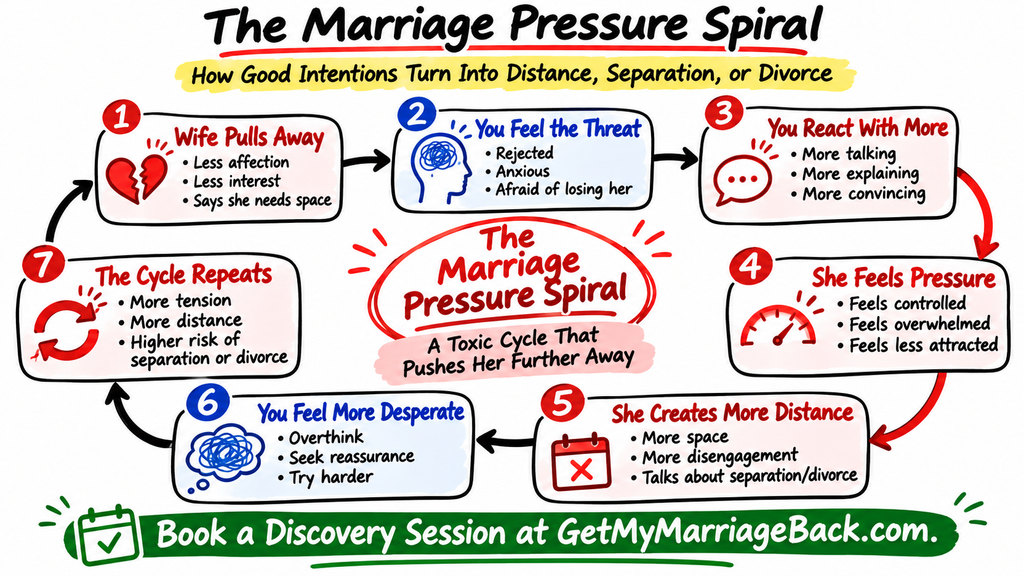
The Marriage Pressure Spiral

Consider a familiar pattern:

Your wife pulls away → You feel threatened → You pursue harder → She experiences pressure → She creates more distance → You become increasingly desperate.

Eventually, both spouses begin reacting to each other’s reactions instead of addressing the original disconnection.

She may experience your pursuit as another demand. Meanwhile, you interpret her distance as proof that you must try even harder.

The pattern reinforces itself.

Breaking that cycle requires more than good intentions. It requires recognizing how your own responses affect the emotional atmosphere of the marriage.

wife wants divorce

Mistake 1: Trying to Negotiate Attraction Instead of Becoming More Attractive

When your wife says she is no longer attracted to you, your instinct may be to ask what you must change to make her want you again.

You might remind her of your sacrifices, question her fairness, or explain why you deserve another chance.

But attraction is not a debt your spouse owes you.

You cannot negotiate desire by presenting evidence of how much you have contributed.

That does not mean you should change your core identity to please another person. It means developing the qualities that influence how you show up in difficult situations.

Ask yourself:

  • Can I manage disappointment without becoming desperate?
  • Can I handle disagreement without losing emotional self-control?
  • Can I remain purposeful when my wife is not reassuring me?
  • Can I communicate confidently without demanding an immediate response?
  • Am I still curious, playful, and engaged with life outside this crisis?

These are questions about emotional capacity, not performance.

Attraction grows more naturally around genuine confidence than around a constant need for reassurance.

Confidence is not loudness, dominance, or pretending not to care.

It is the ability to remain grounded when circumstances are uncomfortable.

There is also a seductive quality to someone who is comfortable in their own skin. Their warmth is freely offered rather than used as a bargaining tool.

That distinction matters.

A playful smile, an appropriate compliment, or a moment of affectionate attention feels different when it comes without the expectation that your spouse must respond romantically.

If your wife is uncomfortable with flirting or physical contact, respect that boundary. Emotional intelligence includes knowing when affection is welcome and when space is necessary.

The goal is to become someone whose presence feels more emotionally secure, interesting, and enjoyable—not someone who has mastered techniques for extracting a reaction.

wife wants divorce attraction mistakes attraction loss

Mistake 2: Refusing to Let Go When Your Wife Wants Space

Your wife asks for space.

Suddenly, you feel compelled to explain everything.

You send another message, then a longer message, then a clarification of the previous message.

Perhaps you try to prove that separation would be a mistake.

I understand that impulse. When the marriage feels threatened, uncertainty can become almost unbearable.

However, there is a difference between fighting for your marriage and fighting to control your wife’s decision.

Letting go does not mean giving up on your marriage. It means releasing the desperation that is making your behavior less effective.

You can release the need for immediate approval without abandoning your values.

You can stop demanding that every disagreement end with your wife acknowledging your perspective.

Most importantly, you can recognize that commitment does not give you ownership of another person’s emotions.

How to Give Space Without Becoming Cold

Giving space is not the silent treatment.

The silent treatment uses withdrawal as punishment. Healthy space creates breathing room while preserving respect.

Suppose your wife says she does not want to discuss the relationship tonight.

An emotionally grounded response might be:

“I understand. We don’t need to force this conversation tonight. I’m willing to talk when we’re both ready.”

Then follow through.

Do not spend the evening sending additional explanations or monitoring whether she has changed her mind.

Continue your responsibilities. Get some rest, take care of your health, and allow the situation to settle.

You can remain warm without being intrusive.

There is quiet strength in communicating that you care about the marriage without requiring your spouse to regulate your emotions every hour.

Mistake 3: Believing Financial Provision Automatically Creates Emotional Connection

At 30, it is easy to believe that if you make enough money and build enough security, everything else will fall into place.

You work harder. Your income increases, and your family enjoys a better lifestyle.

Yet your wife may still say she feels alone.

Why?

Because your wife does not experience your intentions. She experiences your presence.

She experiences your habits, your attention, and the emotional atmosphere around you.

You can provide an incredible lifestyle while becoming emotionally unavailable.

Marriage is not something waiting at home after you finish building your career or accumulating money.

Marriage is part of the life you are building.

Presence Is More Than Being in the Same Room

Imagine coming home after a long workday.

Your spouse wants to share something that happened, but you are mentally occupied with tomorrow’s responsibilities.

You nod without really listening.

Later, you wonder why she says you never connect.

From your perspective, you have been working for the family. From hers, she may have experienced another evening of emotional absence.

Both experiences deserve examination.

Research supports the importance of feeling understood and cared for in romantic relationships. A 2024 study published in Scientific Reports, involving 825 participants, found that perceived partner responsiveness helped explain the association between gratitude and relationship satisfaction.

In practical terms, being appreciated matters, but feeling genuinely understood and emotionally responded to matters too.

Build Attraction Through Intentional Presence

Start paying attention to the experience you create during ordinary interactions.

Put your phone down when a meaningful conversation begins. Notice your spouse’s emotional state without immediately trying to fix it.

Ask thoughtful questions, listen to the answers, and remember details that matter to her.

When the relationship allows it, introduce warmth and lightheartedness into moments that have become overly serious.

Not every interaction needs to become a discussion about the marriage.

Sometimes a relaxed conversation, shared laughter, or sincere appreciation does more for emotional connection than another hour of relationship analysis.

The point is not to manufacture romance.

It is to stop allowing the marriage to receive whatever attention remains after everything else has been served.

Mistake 4: Doing More When Less Would Create More Connection

When your marriage starts falling apart, your instincts may tell you to increase your activity.

More conversations. More gifts. More apologies.

Perhaps you become more assertive, speak louder, or repeatedly defend your intentions.

But more activity does not automatically create more connection.

Sometimes the most productive action is ending an argument before it becomes destructive.

At other times, it is keeping your word without announcing that you kept it.

You may also need to give your wife space without turning that space into a punishment.

Apply the 80/20 Principle to Marriage

The 80/20 principle is a useful way to examine how a small number of repeated behaviors may disproportionately affect your relationship.

Consider whether a few habits are responsible for much of the tension:

  • Turning every disagreement into a debate.
  • Interrupting your spouse to defend your intentions.
  • Asking repeatedly whether she still loves you.
  • Making promises without consistent follow-through.
  • Bringing relationship anxiety into otherwise peaceful moments.

You do not necessarily need 20 new marriage strategies.

You may need to identify two or three behaviors that repeatedly make the situation worse.

For example, if conversations regularly escalate when you feel criticized, your immediate priority is learning to respond without defensiveness.

That one improvement can influence many different interactions.

Why Emotional Regulation Matters

When people become overwhelmed during conflict, they often lose the ability to listen carefully and respond thoughtfully.

Relationship research has long examined this experience of emotional flooding.

A practical response is to recognize when a conversation has become unproductive, pause respectfully, and return when both people are calmer.

That is different from walking away to punish your spouse.

Emotional control is not the absence of emotion. It is the ability to choose your behavior while experiencing emotion.

Progress will not always be linear.

One good conversation does not erase months of resentment. Likewise, one difficult evening does not invalidate every improvement.

Stop measuring progress by how many arguments you won or how many apologies you received.

Instead, examine whether your behavior is improving the emotional experience of the relationship.

Mistake 5: Neglecting Yourself While Trying to Save Your Marriage

You can become so obsessed with preserving the institution of marriage that you neglect the people the marriage was supposed to support.

That includes you.

Your health suffers, friendships disappear, and your children may begin feeling the tension.

Eventually, your sense of purpose becomes dependent on whether your wife responds positively.

That is not sustainable self-leadership.

Protect Yourself Without Becoming Selfish

Protecting yourself means maintaining the personal foundation that allows you to participate in a healthy relationship.

Continue exercising, sleeping, and eating properly.

Stay engaged with meaningful work, supportive friendships, and your responsibilities as a parent.

Preserve your dignity during disagreements.

You do not need to make your wife the villain to acknowledge your own needs.

Neither should you confuse self-respect with constantly demanding respect from someone else.

Self-respect begins with the standard you maintain in your own conduct.

It is visible when you communicate without humiliating yourself or your spouse.

You can acknowledge mistakes without turning every conversation into self-condemnation.

You can express a need without issuing an ultimatum.

And you can recognize when repeated conflict requires boundaries, outside support, or a more structured conversation.

Why Self-Respect Can Support Attraction

There is a meaningful difference between someone who wants connection and someone who needs constant approval to feel emotionally stable.

The first can express affection with confidence. The second may experience every delayed response as rejection.

When your life retains purpose, your romantic interest becomes an invitation rather than an emotional demand.

That makes room for genuine desire.

It also allows you to remain emotionally available without becoming consumed by your spouse’s every reaction.

Mistake 6: Treating Your Wife as the Enemy Instead of Recognizing Distraction

When your marriage is struggling, it becomes easy to focus entirely on what your wife is doing wrong.

You may analyze her tone, her phone habits, her social interactions, and every moment of withdrawal.

Meanwhile, distractions continue to erode meaningful presence.

Your work, entertainment, social media, and outside attention may consume the emotional energy that your relationship needs.

But not every distraction is destructive.

Sometimes exercising, enjoying a hobby, or stepping away from a heated conversation helps restore emotional balance.

The important question is whether the activity helps you return stronger or helps you avoid reality.

Healthy Space Versus Emotional Avoidance

Consider two people who spend an evening exercising after a difficult conversation.

One uses that time to regulate emotions and returns home more relaxed and willing to connect.

The other uses exercise to avoid discussing a serious relationship problem indefinitely.

The activity is identical. The intention and pattern are different.

That is why self-awareness matters more than simply labeling an activity good or bad.

If your wife feels emotionally distant, disappearing into work will not automatically repair the connection.

Obsessively monitoring her behavior will not repair it either.

You need to develop the judgment to recognize when to engage, when to listen, and when to create breathing room.

Restore the Conditions for Romantic Interest

Romantic attraction benefits from experiences that are not dominated by conflict management.

When appropriate and mutually welcome, introduce moments of playfulness, curiosity, novelty, and genuine appreciation.

A thoughtful compliment can communicate desire without becoming a request for reassurance.

An enjoyable shared activity can remind both spouses that the relationship contains more than unresolved problems.

Affectionate touch can also support closeness when both people welcome it. Research on perceived partner responsiveness has found associations with affectionate touch, while other studies connect responsiveness with more comfortable sexual communication and intimacy.

The lesson is simple: emotional connection and romantic attraction are influenced by how people experience one another, not merely by how often they discuss their problems.

Seduction within marriage is not manipulation.

It is the art of creating genuine, mutual romantic possibility through confidence, attentiveness, emotional awareness, and respect.

Mistake 7: Confusing Emotional Noise With Serious Marriage Signals

Your wife has a bad day.

She does not smile, and her response feels colder than usual.

Suddenly, you interpret that moment as proof that the marriage is over.

This is where emotional intelligence becomes essential.

One emotional fluctuation is not necessarily a permanent decision.

However, repeated withdrawal, explicit separation plans, and consistent refusal of connection deserve serious attention.

You must learn to distinguish between an isolated moment and an established pattern.

Signal Versus Noise in a Marriage Crisis

Emotional noise includes temporary irritation, tiredness, occasional disagreement, and an isolated request for solitude.

More significant signals include repeated statements about wanting divorce, sustained emotional disconnection, concrete separation arrangements, and unresolved patterns that continue despite attempts to address them.

The distinction is not whether a particular interaction hurts.

It is what the broader pattern actually tells you.

If your wife says she feels disconnected, take that information seriously.

But do not automatically conclude that every year of your marriage was a failure.

Look at patterns, context, and consistency before deciding what you are dealing with.

What to Do When Your Wife Becomes Cold or Distant

Suppose your wife seems emotionally withdrawn tonight.

Your first impulse may be to ask whether she still loves you.

You have already asked that question several times this week.

Another interrogation is unlikely to produce the clarity you want.

Instead, relax your shoulders, regulate your breathing, and speak calmly.

If a practical matter needs attention, address it directly and respectfully.

Avoid repeating the same emotional demand when it is clearly not producing a productive conversation.

Give the situation room without using silence as a weapon.

Later, when there is an appropriate opportunity, discuss the underlying pattern rather than treating one evening as the entire marriage.

That is how you begin replacing reactive communication with deliberate emotional leadership.

How to Rebuild Attraction When Your Wife Wants a Divorce

Understanding these mistakes is useful, but the real question is how you apply the lessons.

I would begin by separating what you can influence from what you cannot control.

You cannot dictate your wife’s attraction, feelings, or decisions.

However, you can improve the emotional experience you create through your behavior.

Become Emotionally Grounded Before Pursuing More Intimacy

When your marriage feels threatened, your nervous system may treat every interaction as urgent.

That urgency can lead to excessive reassurance-seeking, repeated conversations, and emotional overreaction.

Start by developing your ability to remain composed.

Take care of your body, maintain your responsibilities, and learn to tolerate uncertainty without immediately acting on it.

This is not about pretending you are unaffected.

It is about refusing to let fear dictate every interaction.

Replace Pressure With Responsive Attention

Being emotionally responsive means noticing what your spouse communicates and responding with care rather than defensiveness.

For example, if your wife says she feels unheard, immediately listing everything you have done for her misses the point.

A more constructive response begins with curiosity.

Ask what she means, listen carefully, and reflect on whether your behavior has contributed to that experience.

Responsiveness does not require agreement with every accusation.

It requires the ability to understand another person’s perspective without losing your own.

Reintroduce Attraction Without Demanding It

As the emotional atmosphere becomes less pressured, look for appropriate opportunities to restore warmth.

Be genuinely interested in your spouse as a person.

Maintain your appearance, health, personal interests, and confidence.

Allow humor and lightness to exist without forcing romantic outcomes.

When affection is mutually welcome, let it be affectionate rather than transactional.

You are not trying to trade a compliment for a kiss or a date for sexual intimacy.

The goal is to create the conditions in which two people can experience each other positively again.

Evaluate Progress Through Patterns, Not Daily Reactions

A spouse may respond warmly one day and remain distant the next.

That fluctuation does not necessarily mean your efforts are failing.

Look instead at whether communication is becoming more respectful, arguments are less destructive, and both people are increasingly willing to engage.

Notice whether you are developing greater emotional stability regardless of the immediate response.

Attraction is not something you can force on a deadline.

You can, however, become more skillful in the way you participate in your marriage.

What If Your Wife Has Already Asked for Separation?

A request for separation changes the practical situation.

You should take it seriously rather than assuming it is simply an emotional test.

Ask for clarity about immediate responsibilities, living arrangements, children, finances, and the communication that remains appropriate.

Avoid treating the separation as an invitation to intensify romantic pursuit.

Repeated persuasion can reinforce the very pressure your spouse is trying to escape.

At the same time, you do not have to become cold, hostile, or emotionally unavailable.

You can remain respectful, dependable, and clear about your desire to repair the relationship.

If both spouses are willing, structured marriage counseling or another mutually agreed process can help address the patterns behind the disconnection.

Where one spouse is unwilling to participate, your work begins with your own conduct, emotional regulation, and decisions.

That is still meaningful work.

The Real Difference Between Chasing Attraction and Building It

At 30, I thought marriage would naturally reflect the effort I invested in it.

At 47, I understand that effort must be accompanied by awareness.

You can work harder without becoming more emotionally available.

You can communicate more without becoming easier to understand.

And you can pursue your spouse more intensely while making closeness feel increasingly difficult.

The better question is not, “How do I make my wife want me again?”

It is, “What kind of emotional and relational experience am I consistently creating?”

That question changes your focus.

Instead of obsessing over every response, you begin developing the qualities that make you a stronger partner: confidence, emotional stability, attentiveness, integrity, warmth, and self-respect.

Instead of trying to win every argument, you learn to recognize what actually improves connection.

Rather than treating romance as a reward for sacrifice, you begin understanding attraction as part of a living relationship that requires attention and skill.

You can love your wife deeply and still have important things to learn about attraction.

That realization is not a defeat.

It is the beginning of a more mature way to approach marriage.

11 Physical Attraction Signs That Reveal Real Desire

Frequently Asked Questions

How can I save my marriage when my wife wants a divorce?

Take her concerns seriously, reduce pressure, and identify the recurring behaviors contributing to disconnection. Focus on emotionally responsible communication and practical changes while respecting her right to make her own decisions.

Can my wife become attracted to me again after losing feelings?

Attraction can change as emotional connection, responsiveness, and relationship experiences change. Rebuilding it involves addressing the underlying disconnection rather than demanding reassurance or immediate intimacy.

Should I give my wife space if she says she wants a divorce?

Respect her request for space while maintaining necessary communication about children, finances, and shared responsibilities. Space should reduce emotional pressure, not become punishment or a strategy for provoking a reaction.

What should I avoid doing when my wife wants to leave?

Avoid repeated pleading, emotional interrogation, defensiveness, and attempts to control her decisions. Pay attention to consistent patterns, regulate your reactions, and communicate with clarity and self-respect.


What Would Help You Most Right Now?

Choose the option that best matches where you are with your marriage.

I Need Personalized Help

My Marriage Is in Serious Trouble

If you're dealing with separation, divorce, loss of attraction, infidelity, intimacy problems, or a spouse who's pulling away, get help looking at what's happening in your specific situation.

Get Personalized Help →
Get My Marriage Back book cover
I'd Rather Learn What to Do First

Start With Get My Marriage Back

Get the book and start learning the principles for moving your marriage in a better direction.

Get the Free Book →