

What Would Help You Most Right Now?

Choose the option that best matches where you are with your marriage.

I Need Personalized Help

My Marriage Is in Serious Trouble

If you're dealing with separation, divorce, loss of attraction, infidelity, intimacy problems, or a spouse who's pulling away, get help looking at what's happening in your specific situation.

Get Personalized Help →
Get My Marriage Back book cover
I'd Rather Learn What to Do First

Start With Get My Marriage Back

Get the book and start learning the principles for moving your marriage in a better direction.

Get the Free Book →

Wife Threatens Divorce During Arguments? 3 Traps to Avoid

Your wife threatens divorce during arguments, and now every serious conversation feels like one wrong sentence could end your marriage.

Take This 2 Minutes Quiz

That changes you.

You notice something that needs to be addressed, but instead of simply expressing your perspective, you calculate the consequences first.

Will she get angry?

Will she shut down?

Will this become another two days of cold silence?

Will she say she wants a divorce again?

Is this finally the argument where she files?

Eventually, you can become so focused on preventing your wife from leaving that you stop showing up as yourself inside your own marriage.

And that is where a divorce threat becomes much more than something said during an argument.

It starts changing the entire emotional structure of the relationship.

When Your Wife Keeps Threatening Divorce, Silence Starts Feeling Safe

One of the first changes is subtle.

You start letting things go.

Then you let another thing go.

Soon, you are no longer choosing your battles from a place of emotional intelligence. You are avoiding battles because you are afraid of what disagreement will trigger.

There is a major difference.

You don’t suddenly agree with everything your wife says. You simply decide that silence feels safer than another explosive argument, another shutdown, or another threat to leave the marriage.

That may reduce conflict tonight.

It can also destroy attraction over time.

Attraction needs room for two adults to exist as two adults. Your wife does not need a frightened version of you whose opinions change according to her emotional temperature.

Neither does she need somebody constantly correcting her.

The skill is learning to stand in your perspective without making her agreement necessary for your emotional stability.

Why “Just Communicate More” Can Make the Problem Worse

Generic marriage advice often tells distressed couples to communicate more.

More is not automatically better.

Research on what psychologists call the demand-withdraw pattern helps explain why. One partner pushes for discussion, resolution, or change while the other withdraws, avoids, or attempts to end the interaction. Research involving everyday marital conflicts found these patterns were associated with more negative emotion and lower conflict resolution.

So imagine that your wife withdraws after an argument.

You explain harder.

She still doesn’t respond the way you expected.

Now you explain again.

She becomes increasingly defensive or distant, so you produce an even better argument.

You think clarity is the missing ingredient.

It may not be.

Your repeated explanation can become pressure.

Her withdrawal then increases your anxiety, which makes you explain even more.

Before long, you are not solving the original problem anymore. You are trapped inside a cycle.
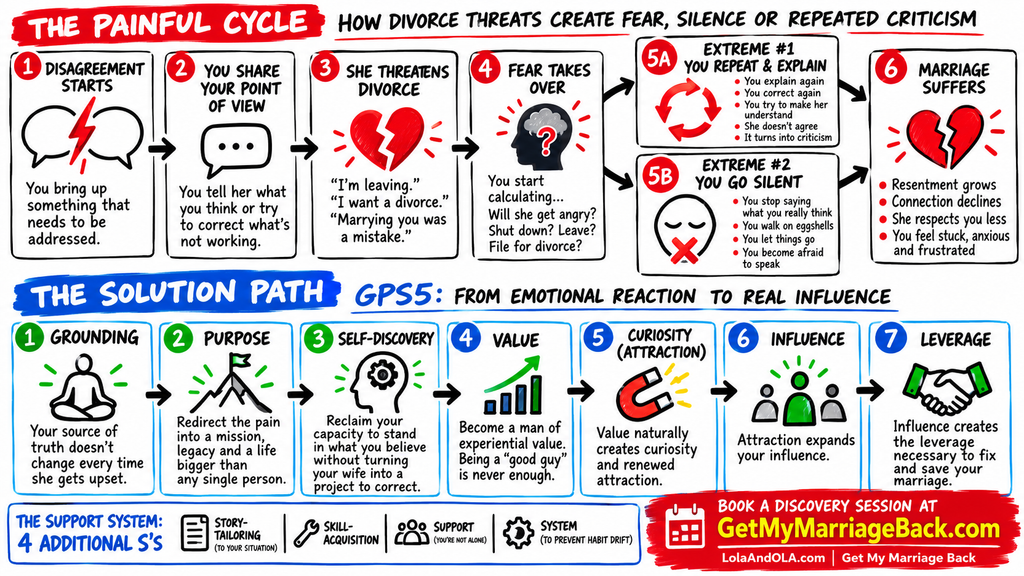
The Fine Line Between Correction and Criticism

I learned this distinction during my own marriage crisis with Lola.

There was a period when I wanted things to operate a certain way. When something wasn’t working according to what I believed was right, I corrected it.

I explained what was wrong.

I explained what wasn’t working.

Then I showed her what I believed needed to change.

For a long time, there wasn’t enough obvious pushback for me to understand the cumulative impact.

Years later, during our crisis, I discovered that Lola had been carrying resentment connected to some of the things I had said.

Suddenly, I swung toward the opposite extreme.

Instead of being completely comfortable correcting, I became scared to say certain things.

I would see something differently and hesitate.

Would saying it make everything worse?

That is no way to live inside a marriage either.

The answer wasn’t becoming silent.

It was developing the emotional intelligence to understand where correction crossed the line.

The Line Is Repetition

You have a perspective?

State it.

You believe a behavior is hurting the marriage?

State it clearly.

You believe something needs to change?

Say what you believe.

Then watch what happens inside you when your wife doesn’t agree.

That’s the moment that exposes the difference.

When you say it again because she didn’t accept it, then again because she didn’t respond correctly, and again because you need her to acknowledge that your interpretation is the right interpretation, you are moving beyond expressing your perspective.

You are trying to force acceptance of it.

That’s where correction can become criticism.

The more available your correction becomes, the less weight your words can carry.

You don’t need fourteen speeches.

You don’t need another three-hour conversation.

And you certainly don’t need to keep explaining until your wife finally gives you the facial expression that makes you feel understood.

State your position.

Then give an adult room to be an adult.

Trap #1: Over-Explaining Because You Are Afraid She Will Leave

When your wife threatens divorce during arguments, fear can disguise itself as communication.

You tell yourself that you simply need to explain this one more time.

Maybe she misunderstood.

So you send the longer text.

You initiate another conversation.

Soon, your emotional objective is no longer expression. It is obtaining the response that will make you feel safe again.

That dependency drains attraction because your emotional center is now sitting in somebody else’s hands.

Your position is only allowed to feel valid when she validates it.

That’s not confidence.

Trap #2: Becoming Afraid to Tell the Truth

The opposite reaction isn’t better.

You decide you won’t say anything.

Your wife appears calmer, so silence seems to be working.

But what exactly have you created?

Peace—or fear with good manners?

You can save a marriage without turning yourself into a person who walks on eggshells.

In fact, developing the capacity to express yourself without needing to dominate, convince, correct, or retreat is part of becoming more experientially attractive.

That distinction matters.

Value in attraction is not the same thing as moral worth.

Being a good person does not automatically make somebody feel curiosity, attraction, or emotional engagement toward you.

Experiential value is about what interacting with you actually feels like.

Can you remain grounded during disagreement?

Can you hold a perspective without turning it into a courtroom argument?

Can you tolerate her disappointment without collapsing?

Can you remain emotionally present without trying to control her?

Those qualities change the experience of being around you.

Trap #3: Making Your Wife’s Reaction Your Emotional Compass

This is the deeper trap.

She is happy with you, so you’re okay.

She becomes cold, so you panic.

She mentions separation, and your entire identity collapses into saving the marriage before bedtime.

She threatens divorce, so every principle you held yesterday suddenly becomes negotiable.

Now her emotional state controls yours.

That makes genuine attraction difficult because attraction requires differentiation: the ability to remain emotionally connected without losing your own center.

Your goal isn’t to become cold.

It isn’t to punish her with silence.

And it isn’t to manufacture indifference so she’ll chase you.

The goal is self-leadership.

What To Do When Your Wife Threatens Divorce During Arguments

Start with Grounding.

Your absolute source of truth cannot change every time your wife gets upset.

Grounding means returning to something higher than the immediate symptom—the argument, the cold shoulder, the divorce threat—and reconnecting with your source of truth and gratitude.

Next comes Purpose.

Pain wants to shrink your entire world down to your marriage crisis.

Don’t allow it.

Redirect that energy toward a mission, contribution, impact, legacy, and reason to wake up that is bigger than any single human being—including you and your wife.

Then comes Self-Discovery.

Instead of obsessively discovering what is wrong with her, discover what you are capable of becoming under pressure.

That is GPS: Grounding, Purpose, Self-Discovery.

From there, you build experiential Value.

Value naturally creates Curiosity.

Curiosity opens the possibility for Attraction.

Attraction expands Influence.

Influence creates Leverage.

That leverage gives you a stronger position from which to create the conditions for marriage reconciliation instead of desperately protecting the broken version of the marriage you already have.

Attraction Is Not About Manipulating Her Back

This distinction is critical.

You are not improving yourself as a trick to produce a specific reaction from your wife.

That’s still control.

Building attraction skillfully means becoming somebody whose presence feels different because you are different.

Your words become less frantic.

Your emotional state becomes less dependent on immediate reassurance.

Your purpose becomes bigger than the crisis.

You stop treating your wife like a project requiring constant correction.

That creates space.

Space creates room for curiosity.

Curiosity matters because somebody who believes they completely understand your pattern has very little reason to look again.

When your pattern changes authentically, the experience changes.

Why You May Fall Back Into the Same Pattern Tonight

Understanding all of this intellectually is not enough.

Conflict creates pressure, and pressure has a way of resurrecting old behaviors.

In a controlled experiment, researchers found that stress shifted participants away from goal-directed behavior and toward habitual responding. You can read the NIH-indexed research on stress and habitual behavior.

That helps explain a frustrating experience many people have during a marriage crisis.

You know you shouldn’t deliver another lecture.

Then she gets upset.

You panic.

Suddenly you’re explaining again.

Or you retreat into silence because that is the habit your nervous system has learned feels safest.

This is Habit Drift.

Breaking it requires more than information. Your strategy has to fit your actual story, you need the skill to execute under emotional pressure, and you need enough structure to stop improvising according to whether your wife looks happy with you that day.

Your Marriage Cannot Be Built Around Fear of the Next Divorce Threat

You cannot control whether your wife gets upset.

You cannot force her to understand your perspective.

And you cannot guarantee that the perfect sentence will make a spouse who wants out suddenly want back in.

What you can control is far more powerful.

You can stop over-explaining.

You can stop disappearing.

You can tell the truth without demanding acceptance.

You can build the emotional capacity to withstand disagreement without turning your wife into either your enemy or your emotional life-support system.

That’s where personal power begins.

A marriage crisis naturally makes you want to grab harder at the marriage you are terrified of losing.

The more powerful move is to become capable of building something better.

Not through begging.

Not through fear.

Not through fourteen speeches.

Through Grounding, Purpose, Self-Discovery, Value, Curiosity, Attraction, Influence, and ultimately the Leverage necessary to create a different experience of you—and different conditions for saving your marriage.

Average Length of Separation Before Reconciliation: Data Reveals!

Frequently Asked Questions

Why does my wife threaten divorce during every argument?

Repeated divorce language can serve different functions in different marriages, including expressing genuine intent to leave, escalating conflict, or attempting to end an overwhelming argument. Treat the pattern seriously without assuming you already know exactly what each threat means.

What should I do when my wife threatens divorce during an argument?

Don’t panic into another marathon explanation or surrender your position simply to restore temporary peace. Regulate yourself, state what needs to be stated clearly, and avoid turning the moment into a contest over who can force the other person to concede.

Can a marriage be saved when your wife wants a divorce?

Some marriages do reconcile after one spouse has expressed a desire to leave, but the immediate task is not forcing that spouse to reverse the decision. Focus first on changing the destructive patterns you control and creating healthier conditions for future interaction.

Should I stop talking when my wife threatens divorce?

No—silence driven by fear is different from intentionally refusing to escalate an unproductive argument. Research on marital conflict has linked demand-withdraw patterns with negative emotions and poorer conflict resolution, so the objective is not permanent withdrawal but more emotionally intelligent engagement.


Wife Never Initiates Sex? 7 Traps That Kill Desire—and What Works

When your wife never initiates sex anymore, the rejection can become so personal that every night in bed starts feeling like another verdict on your marriage.

Take This 2 Minutes Quiz

Question 1 of 15

You reach for her. You initiate the kiss. You initiate affection. You try to create sexual intimacy.

Then you stop initiating just to see what happens.

Nothing.

That silence can hurt more than an argument because now you are left trying to interpret it.

Does she still love you? Is your wife still sexually attracted to you? Is somebody else getting her attention? Has the marriage become sexless? Are you becoming roommates? Is separation or divorce coming next?

What you are experiencing is completely unfair.

You married this woman. You have invested years of your life, built memories, carried responsibilities, made sacrifices, and possibly raised children together.

You should not have to pretend that sexual rejection from your own wife does not hurt.

But there is an important distinction between validating the unfairness of the situation and allowing that unfairness to control what you do next.

That distinction can determine whether you become increasingly attractive to experience—or increasingly associated with pressure.

Why Does My Wife Never Initiate Sex?

Your wife’s lack of sexual initiation is a symptom.

It is not automatically the diagnosis.

She may love you and still experience low sexual desire. There may be resentment, chronic stress, exhaustion, unresolved conflict, hormonal or health factors, emotional disconnection, attraction loss, sexual dissatisfaction, routine, or a combination of issues underneath the visible behavior.

Research also suggests that desire naturally changes in long-term relationships. A systematic review of long-term sexual desire describes desire as something that can ebb and flow within individuals and relationships rather than remaining permanently fixed.

That matters because one of the most destructive conclusions you can make is:

“She doesn’t want sex right now, therefore she will never want me again.”

Those are not the same statement.

Your current reality matters.

It just does not have to become your permanent identity.

Trap #1: Turning Her Rejection Into Your Identity

At first, the problem is:

“My wife never initiates sex.”

Eventually, the problem becomes:

“My wife doesn’t desire me.”

Then:

“I am undesirable.”

Notice what happened.

A relationship condition became an identity.

Now her behavior determines how you feel about yourself.

When she kisses you passionately, you feel confident.

When she turns away, you collapse.

When sex happens, you think the marriage is recovering.

Three days without affection and panic returns.

This is where sexual intimacy stops being intimacy and becomes emotional evidence.

You are no longer simply enjoying your wife.

You are using her response to answer a much more frightening question:

“Am I still okay?”

That is too much emotional weight to place on sex.

wife never initiates sex

Trap #2: Begging for Reassurance Instead of Building Attraction

Once rejection starts controlling your emotional state, reassurance becomes addictive.

“Do you still love me?”

“Are you attracted to me?”

“What’s wrong?”

“Are we okay?”

“Why don’t you ever touch me anymore?”

“Is there somebody else?”

You are looking for certainty.

I understand why.

But reassurance and attraction perform completely different jobs.

Reassurance temporarily calms fear.

Attraction creates desire.

You can successfully convince your wife to tell you that she loves you and still have absolutely no improvement in your sex life.

That is because love and sexual attraction are related experiences, but they are not identical experiences.

Two people can care deeply about each other while their romantic marriage slowly becomes a roommate relationship.

Trap #3: Believing “Love Is Give and Take”

You have probably heard this your entire life:

“Marriage is give and take.”

There is truth in reciprocity, but attraction becomes dangerous when you turn that principle into a sexual transaction.

You touched her, therefore she should touch you.

You have been a good husband, therefore she should desire you.

You provided for the family, therefore she should appreciate you sexually.

You planned the date, therefore intimacy should follow.

You helped around the house, therefore she should recognize your effort.

But how is that working?

Desire does not operate like an invoice.

Once your generosity secretly requires sexual repayment, she can experience the expectation even when you never explicitly state it.

Now dinner has an agenda.

Affection has an agenda.

The romantic getaway has an agenda.

Even self-improvement can develop an agenda.

“Did she notice me yet?”

That is not seduction.

That is performance followed by evaluation.

Trap #4: Trying to Communicate Her Into Desire

“Just communicate” has become one of the most repeated pieces of relationship advice on the internet.

Communication matters.

But another emotionally loaded conversation does not automatically manufacture desire.

Your wife probably already knows that you are unhappy about the lack of sex.

She probably knows you want more affection.

Explaining your rejection for the seventh time may give you temporary emotional release while making intimacy feel increasingly connected to obligation, guilt, and pressure for her.

There is also an important difference between quality communication and constant communication.

An honest conversation can increase understanding.

Repeated interrogation can turn the marriage into a permanent relationship meeting.

So communicate when communication actually serves understanding.

Then stop trying to verbally negotiate attraction into existence.

Trap #5: Chasing Harder When She Withdraws

You notice her pulling away.

Fear says:

Close the distance immediately.

So you initiate more.

You become extra affectionate.

You send longer texts.

You apologize for things you have not even decided were wrong.

You explain your intentions.

You become unusually agreeable.

You ask for another conversation.

You pursue reassurance.

She withdraws more.

Now you chase harder.

This is the rejection cycle:

Rejection → Fear → Chasing → Pressure → Withdrawal → More Rejection

Your original desire to save your marriage is not the problem.

The fear-driven execution is.

There is a difference between pursuit and chasing.

Healthy pursuit expresses interest with dignity.

Chasing demands a response because your emotional stability depends on receiving one.

You can desire your wife without begging her to desire you back.

Trap #6: Assuming No Initiation Means No Love

Your wife can love you and not feel strong sexual desire right now.

That reality is painful, but understanding it gives you a much more useful starting point than arguing with it.

Research supports the idea that relationship context matters to desire. For example, research on partner responsiveness and sexual desire found that perceived partner responsiveness—experiencing a partner as understanding, validating, and caring—was associated with sexual desire. The research does not reduce attraction to one factor, but it reinforces an important point: desire exists inside an experience, not merely inside a marriage certificate.

That means being married does not automatically create attraction.

Being responsible does not automatically create attraction.

Having history together does not automatically create attraction.

Love itself does not automatically create attraction.

This is where your opportunity begins.

Instead of demanding:

“Why doesn’t she want me?”

Ask:

“What has it become like to experience this marriage—and what can I control about the experience of me?”

That question takes you somewhere useful.

Trap #7: Making Sex the Only Goal

Of course you want sex.

Let’s not pretend otherwise.

The objective is not to turn you into a man who becomes emotionally comfortable with a permanently sexless roommate marriage.

You want your wife to want you.

You want her reaching for you because she genuinely desires you.

You want her to kiss you because she wants to kiss you.

You want sexual intimacy that does not have to be negotiated, extracted through guilt, or requested repeatedly.

But obsessing over the outcome can sabotage the process.

When every interaction is evaluated according to whether it produced sex, your wife stops being someone you are experiencing and becomes the scoreboard for your recovery.

That creates pressure.

The smarter objective is to build the conditions from which genuine attraction has room to emerge.

How to Rebuild Attraction When Your Wife Never Initiates Sex

Here is what I want you to do.

Stop trying to destroy the symptom directly.

Build your capacity.

I teach this through Grounding, Purpose, and Self-Discovery—GPS.

From there, you develop experiential Value, which creates opportunities for Curiosity, Attraction, Influence, and Leverage.

Grounding: Stop Making Her Desire Your Source of Truth

Your wife can reject sex tonight.

That is real.

The rejection can hurt.

That is real too.

Neither fact gets to become your absolute source of truth about who you are.

Grounding means returning to something deeper than her current response.

Your emotions can give you information without becoming your commander.

Instead of immediately reacting, you regain your center.

That is emotional intelligence.

You are not pretending rejection does not matter.

You are refusing to let rejection decide what version of you shows up next.

Purpose: Become Bigger Than the Crisis

A marriage crisis can consume your identity.

Every morning starts with her.

Every thought revolves around the marriage.

Every interaction gets analyzed.

Every night becomes another intimacy test.

Purpose interrupts that obsession.

Your purpose needs to be bigger than any single living human being—including your wife and including you.

What are you building?

Who are you serving?

What legacy are you creating?

What pain have you survived that can become impact?

What kind of father, leader, creator, friend, businessman, professional, or human being are you becoming?

Purpose is not pretending your marriage does not matter.

Your marriage matters enormously.

It simply cannot become your entire reason for existing.

Self-Discovery: Find the Man Beneath the Panic

Rejection reveals things.

Use that information.

Where do you become approval-seeking?

Where does fear make you controlling?

When do you over-explain?

What makes you abandon your standards?

Where have you become passive?

What parts of your personality disappeared underneath work, parenting, routine, and marriage administration?

This is not self-blame.

Your wife’s choices belong to her.

Self-Discovery is about reclaiming the only capacity you can sustainably develop: your own.

Build Experiential Value Instead of Proving Your Worth

Your human worth is not the issue.

Experiential Value asks a different question:

What is it like to experience you?

Are you grounded under pressure?

Are you interesting?

Can you be playful?

Do you have opinions without needing agreement?

Can you express desire without making rejection catastrophic?

Do you take care of your body?

Do you have meaningful goals?

Can you create an enjoyable experience without demanding that it prove the marriage is recovering?

Are your conversations engaging—or does everything eventually become about the relationship?

Can your wife relax around you without sensing an invisible request for reassurance?

That is experiential Value.

It is not about becoming “good enough” for her.

It is about becoming increasingly compelling to experience.

Value Creates Curiosity

Curiosity disappears when everything becomes predictable.

She already knows the conversation.

She knows the questions.

She knows you are monitoring her affection.

She knows a good date will probably end with you checking whether things are improving.

She knows withdrawal will produce another emotional discussion.

Predictability is not always bad. Stability is essential in marriage.

But romantic attraction also benefits from aliveness.

You have interests again.

Your emotional reactions are no longer automatic.

You are developing.

Your life has movement.

There is something new to experience because you are actually growing—not pretending to grow so she notices.

Curiosity has room to return when your wife stops experiencing you as a completely predictable reaction to her behavior.

Curiosity Gives Attraction Room to Breathe

You cannot command attraction.

You can stop suffocating it.

That distinction changes everything.

Pressure says:

“Feel something for me.”

Seduction says:

“Experience me.”

Pressure needs an immediate answer.

Seduction allows discovery.

Pressure is obsessed with the destination.

Emotional intelligence manages the process.

When you understand this, your goal stops being to manufacture a sexual response tonight.

You start becoming better at creating experiences where genuine desire has room to emerge naturally.

Attraction Creates Influence and Leverage

Influence is not control.

Leverage is not manipulation.

When attraction exists, your marriage has more emotional and romantic energy available to work with.

A warm interaction has more potential.

A date means something different.

Physical closeness becomes less loaded.

Sexual tension can exist without immediately becoming a demand.

Your wife can become curious about you again rather than constantly defending herself from your need for certainty.

That is why attraction matters so much during marriage reconciliation.

You are not merely trying to become emotionally strong while your bedroom remains dead.

You are developing the conditions that give affection, intimacy, and sexual desire their strongest opportunity to return.

Stop Habit Drift Before It Restarts the Cycle

Knowing all of this intellectually is not enough.

Tonight your wife can turn away in bed and trigger the old reaction instantly.

Suddenly you want to ask:

“What’s wrong?”

You want to reach again.

You need reassurance.

You feel compelled to explain.

That is Habit Drift.

Your emotional trigger activates an established response before your better judgment catches up.

This is why information alone rarely fixes a broken marriage.

You need Story-Tailoring because your marriage has its own history.

You need Skill-Acquisition because knowing and executing are different abilities.

You need Support because fear thrives in isolation.

Finally, you need a System because emotional pressure will repeatedly tempt you back toward whatever behavior is most familiar.

What Does Success Actually Look Like?

Success is not learning to tolerate permanent rejection.

It is not convincing yourself that sex does not matter.

Nor is the goal becoming so detached that you no longer care whether your wife desires you.

You want genuine desire.

Not duty sex.

Not pity sex.

Not “fine, if it’ll make you happy” sex.

You want your wife to want to touch you.

You want her to initiate affection because the impulse came from her.

You want a kiss that is not payment for good behavior.

You want sexual intimacy that feels freely chosen rather than negotiated.

Attraction can return.

Desire can return.

Sex and intimacy can become part of a marriage again.

The path is not forcing your wife to change.

It is stopping your participation in patterns that suffocate desire while developing the Grounding, Purpose, Self-Discovery, Value, Curiosity, Attraction, Influence, and Leverage that create a dramatically different experience of you.

Your wife not initiating sex is today’s symptom.

It does not have to become tomorrow’s identity for your marriage.

5 Physical Signs She Just Slept With Someone Else

Frequently Asked Questions

Why does my wife never initiate sex?

Low initiation can reflect attraction loss, stress, resentment, health or hormonal factors, sexual dissatisfaction, emotional disconnection, routine, or differences in how desire develops. Look at the broader pattern rather than treating one behavior as the complete diagnosis.

Does my wife never initiating sex mean she isn’t attracted to me?

Not automatically, although persistent lack of desire can be one sign of attraction loss. Sexual desire can fluctuate, and the relationship context, emotional connection, stress, health, and sexual dynamics can all influence initiation.

Can a wife become sexually attracted to her husband again?

Yes, attraction and desire are dynamic rather than permanently fixed, and long-term relationship research connects desire with factors including responsiveness and relationship context. Rebuilding attraction begins with reducing destructive pressure while strengthening the experiences that give curiosity and desire room to emerge.

What should a husband do when his wife never initiates intimacy?

Stop using every sexual encounter or rejection as a verdict on the marriage, then examine the larger cycle of pressure, withdrawal, resentment, routine, and attraction. Build Grounding, Purpose, Self-Discovery, and experiential Value while expressing interest without begging, coercion, or reassurance-seeking.

How to Save Your Marriage During Separation Without Pushing Your Husband Further Away

Separation creates one of the strangest emotional experiences in marriage.


Take This 2 Minutes Quiz

Question 1 of 15

Your husband can say he needs space and still call you. He can tell you he loves you and still refuse to come home. You can share a warm conversation on Monday, then feel like strangers by Thursday.

That contradiction is where many people lose their emotional footing.

You start wondering what every interaction means. A kind text becomes evidence that reconciliation is close. Silence feels like proof that divorce is coming. One affectionate moment raises your hope, and one cold response sends you back into panic.

When you want to know how to save your marriage during separation, your greatest challenge is not finding the perfect sentence to say to your husband.

Your challenge is learning how to stop fear from turning every remaining connection into pressure.

That distinction matters because connection and separation can exist at the same time.

Your husband can care about you while questioning the marriage. He can miss parts of your relationship while still wanting distance. Remaining affection is meaningful, but affection is not the same thing as commitment.

The opportunity is not to squeeze a promise out of every warm moment.

It is to become increasingly grounded, emotionally intelligent, engaging, and attractive while respecting the reality of the crisis.

Why Saving Your Marriage During Separation Feels So Confusing

Separation creates uncertainty, and uncertainty naturally makes the mind search for certainty.

You want to know:

Does he miss you?

Is he reconsidering?

Should you call him?

Should you give him space?

Does “I still love you” mean he wants to reconcile?

Is he seeing someone else?

Can the marriage still be saved?

Those questions make sense, but living inside them all day creates a serious problem.

You begin treating your husband like a source of emotional regulation.

Instead of observing the overall relationship, you look for individual signals that temporarily make you feel better.

That is how a warm phone call turns into hope.

Then the next cold interaction becomes rejection.

Soon, you are no longer building a better experience. You are reacting to his mood.

That is not attraction.

That is anxiety disguised as relationship work.

save marriage during separation

Mistake #1: Treating “I Love You” Like a Reconciliation Agreement

One of the most dangerous mistakes during marriage separation is turning affection into a verdict.

Your husband says, “I still love you.”

Immediately, your mind wants to finish the sentence:

“So he must want the marriage.”

Not necessarily.

Love is information.

His request for separation is also information.

You do not need to erase one fact to accept the other.

Two things can be true at the same time: he can love you and still feel overwhelmed, resentful, disconnected, unattracted, exhausted, confused, or unwilling to continue the marriage in its current form.

That is emotionally difficult to accept because ambiguity hurts.

Still, emotional intelligence means resisting the urge to turn one sentence into a complete story about the future.

When your husband expresses affection, receive it.

Do not convert it into a contract.

Mistake #2: Talking About the Marriage Until He Wants Even More Distance

“Communication is everything” is one of the most misunderstood pieces of marriage advice.

Communication matters tremendously.

That does not mean more talking is always better.

Imagine that your husband already feels overwhelmed by the relationship. Now every conversation turns into another discussion about the marriage, counseling, separation, reconciliation, the children, what went wrong, what you have changed, and whether he still loves you.

Your intention is connection.

His experience can become pressure.

Those are not the same thing.

Research on married couples has repeatedly identified a pattern called demand-withdraw, where one person pushes for discussion, resolution, or change while the other retreats. In one study of 116 married couples, demand-withdraw interactions were associated with more negative emotion and destructive tactics and with less successful conflict resolution. You can read the research on demand-withdraw patterns in marriage for the underlying findings.

Notice what this does not mean.

It does not mean you should never communicate.

It means timing, emotional state, skill, and the quality of the interaction matter.

If you want to save your marriage while separated, stop measuring communication by how many words you exchange.

Start paying attention to what dealing with you feels like.

save marriage during separation - Making Your Husband the Center of Your Life

Mistake #3: Making Your Husband the Center of Your Life

Separation can consume every available mental space.

You wake up thinking about him.

You check your phone.

Your work suffers.

Your appetite changes.

You replay conversations.

You wonder whether you should text.

You imagine divorce.

Then you imagine reconciliation.

By evening, almost your entire day has been organized around a person who just asked for distance.

That is where attraction starts losing oxygen.

A healthy marriage cannot become your entire identity.

Your purpose has to be greater than the marriage and greater than any individual, including you.

That does not mean pretending you do not care.

Purpose means redirecting emotional energy into your life mission, family responsibilities, career, health, faith, creativity, contribution, learning, and legacy.

Pain can exist while your life continues moving.

In fact, this crisis can reveal parts of you that comfort never forced you to discover.

The First Attraction Shift: Ground Yourself Before You Try to Save Anything

Saving your marriage during separation starts with Grounding.

Grounding is not pretending everything is fine.

It is not suppressing fear.

It is not eliminating uncertainty.

Grounding means returning from uncertainty to your higher self, your source of truth, gratitude, and the present moment.

You stop asking your husband’s next move to tell you who you are.

A cold text no longer means you are worthless.

A warm conversation no longer means you are saved.

His uncertainty does not have to become your instability.

This is where personal power begins.

Your husband is allowed to feel what he feels.

You are responsible for what you do with the feelings his choices trigger inside you.

More Attractive - save marriage during separation

Purpose Makes You More Attractive Because It Makes You Less Consumed

Attraction struggles in an atmosphere of emotional suffocation.

When your entire life revolves around whether your husband comes back, every interaction carries invisible pressure.

Even kindness can begin to feel loaded.

You are not simply asking how his day went.

Underneath it is another question:

“Are we okay yet?”

Purpose changes that energy.

You become engaged with your own life again.

Your days contain meaningful work that has nothing to do with convincing your husband.

There is something psychologically different about interacting with a person who has direction.

Purpose gives you somewhere productive to place the energy that anxiety wants to spend obsessing over your marriage.

That shift matters whether reconciliation takes three weeks, three months, or far longer.

Self-Discovery Is Not Self-Blame

Once you become grounded enough to think clearly, ask a more useful question.

Instead of only asking:

“Why is my husband doing this?”

Ask:

“What is this crisis revealing about my capacity?”

That question changes everything.

Maybe you discover that rejection makes you over-explain.

Perhaps fear turns you controlling.

You may realize that you confuse constant talking with good communication.

Some people discover that they abandoned their identity long before the separation happened.

Others realize they became complacent, defensive, emotionally unavailable, chronically critical, anxious, or increasingly difficult to experience.

None of this requires self-blame.

Your husband owns his choices.

You own your growth.

Self-Discovery is the process of identifying what you have the capacity to improve without carrying responsibility for another adult’s behavior.

That is far more powerful than trying to diagnose him all day.

What “Value” Actually Means in Marriage

When I talk about becoming more valuable, I am not talking about your moral worth.

You are not earning the right to be loved.

Value is experiential.

In other words:

What does being around you feel like?

Can you remain warm when you are disappointed?

Are you able to hear something painful without immediately turning it into an argument?

Can you express interest without making your husband responsible for calming your anxiety?

Do you bring curiosity, humor, emotional presence, confidence, depth, sensuality, intelligence, peace, purpose, and life into an interaction?

That is a different definition of attraction.

Attraction is not only physical appearance.

It is the total experience of you.

Someone can be physically beautiful and emotionally exhausting.

Another person can be objectively accomplished but impossible to relax around.

Marriage attraction is affected by the repeated emotional experience associated with your presence.

That is why repeatedly telling your husband you are a good wife does not create attraction.

Experience creates evidence.

How to Build Attraction During Separation Without Turning It Into a Trick

The fastest way to destroy this process is to make your personal growth another manipulation strategy.

You start exercising because you want him to notice.

You go out because you hope he becomes jealous.

You improve your appearance because you want a reaction.

You stop calling because an internet rule told you he will miss you after 30 days.

Then you watch for signs that your strategy is working.

That is still obsession.

Only the costume changed.

Real development continues whether your husband applauds it or not.

You become grounded because emotional stability serves your life.

Purpose matters because your life has meaning beyond marriage.

Self-Discovery matters because the crisis is exposing capacities you need regardless of the final outcome.

Value matters because you want your presence to become richer, healthier, more engaging, and more attractive.

When those changes are genuine, curiosity can emerge naturally.

Your husband may begin wondering about you because the experience has changed.

That curiosity is attraction beginning to move.

You do not force it.

You do not announce it.

You do not check whether it happened.

Seduction During Marriage Separation Is Not Chasing

There is an important distinction between pursuit and seduction.

Men pursue.

Women seduce.

A woman trying to pull her husband back through constant pursuit often ends up operating against the very attraction dynamic she wants to rebuild.

Seduction does not mean manipulating him sexually.

It means creating an experience that invites interest rather than demanding it.

Warmth can be seductive.

Emotional composure is seductive.

A life with direction is seductive.

Confidence without hostility is seductive.

Playfulness can be seductive.

Looking and feeling good in your own skin matters.

Being interesting again matters.

Having a full life matters.

Knowing when not to force another marriage conversation matters.

The key is that none of these become techniques for monitoring your husband.

You are not performing a routine and checking whether he leaned closer.

You are becoming more capable of creating attractive experiences because that is now part of who you are.

Stop Using Every Interaction as a Reconciliation Scoreboard

One of the strongest skills you can develop during separation is resisting Signal Checking.

Your husband calls.

You wonder whether he misses you.

He laughs with you.

You think reconciliation is close.

He acts cold two days later.

You decide the marriage is dead.

That emotional whiplash keeps you powerless.

Instead, observe the broader experience.

One affectionate moment does not repair years of resentment.

Likewise, one awkward conversation does not erase meaningful progress.

Marriage is an accumulated experience.

Look at patterns over time without turning yourself into an investigator.

More importantly, keep your attention centered on what you control.

You can control your emotional regulation.

Your purpose belongs to you.

Self-Discovery belongs to you.

The value you develop belongs to you.

Your husband decides what he does with the experience.

Why Curiosity Comes Before Attraction

People often think reconciliation begins when someone announces:

“I want the marriage back.”

Usually, something happens before that.

Curiosity.

Your husband starts wondering.

Something feels different.

Perhaps interactions are lighter.

The familiar pressure is missing.

You seem more grounded.

Your life is moving.

There is less emotional grabbing.

Your presence feels different from the version of the relationship he wanted to escape.

Curiosity is powerful because it is voluntary.

Nobody enjoys being commanded to feel attraction.

Interest must emerge inside the person experiencing it.

That is why you cannot talk your husband into attraction.

You create the conditions where curiosity has room to appear.

What Happens When Uncertainty Comes Back?

It will.

That is important to understand.

Your husband can become warmer for several weeks and then pull back.

Separation discussions can return.

Fear can hit you again.

You may feel rejected after believing you had made progress.

That does not automatically mean you failed.

The return of uncertainty is a capacity test.

Can you experience rejection without collapsing into panic?

Will you immediately return to excessive marriage talks?

Do you abandon your purpose the moment your husband becomes cold?

Are you still able to access the person you discovered when the outcome feels uncertain?

Each trip through the process strengthens emotional capacity.

Grounding becomes less forced.

Purpose becomes more natural.

Self-Discovery continues.

Value increasingly becomes part of your normal identity rather than something you switch on around your husband.

That is how emotional intelligence becomes lived experience.

Can You Really Save Your Marriage Alone?

You can change an enormous amount alone.

You cannot create a complete marriage alone.

Those statements are not contradictory.

One person can change the emotional environment, stop feeding destructive patterns, develop communication skills, become more grounded, discover deeper purpose, increase experiential value, and stop reacting from fear.

Your husband still chooses whether he participates.

Do not confuse personal power with total control.

Personal power means maximizing your influence by becoming responsible for the part you actually own.

Trying to control the part you do not own usually weakens your influence.

That is the irony.

What to Do When Your Husband Wants Separation

Take his request seriously without turning it into a prophecy.

A request for separation is information about the present condition of the relationship.

It deserves respect.

At the same time, you do not need to emotionally declare the marriage dead before the future has unfolded.

Focus on the underlying relationship.

Labels such as married, separated, reconciling, and divorcing describe circumstances.

They do not automatically describe the quality of your connection.

People who genuinely enjoy being around each other naturally have more relational possibilities than two people trapped in resentment, pressure, fear, and emotional exhaustion.

So work deeper than the label.

Create a life worth living.

Develop emotional capacity.

Become interesting to yourself again.

Learn better communication.

Build purpose.

Discover the parts of yourself this crisis exposed.

Bring genuine value into the way people experience you.

Then allow your husband the freedom to respond voluntarily.

That is far more seductive than trying to drag reconciliation across the finish line.

5 Physical Signs She Just Slept With Someone Else: The Truth

Frequently Asked Question [FAQ]

Can a marriage be saved during separation?

Yes, separation does not automatically mean divorce. What matters is whether the underlying relationship dynamics change enough for voluntary reconciliation to become desirable.

How do I get my husband back after separation?

Stop making “getting him back” the center of every interaction and focus on Grounding, Purpose, Self-Discovery, and experiential Value. Attraction is more likely to grow from a healthier experience than from pressure, pleading, or constant reassurance-seeking.

Should I give my husband space during separation?

Respect requested space without turning distance into punishment or a manipulation tactic. Appropriate contact depends on your circumstances, but fear-driven over-contact often creates more pressure rather than more connection.

How often do separated couples reconcile?

Reconciliation rates vary widely depending on the population, length of separation, reasons for separating, and whether the couple progresses toward divorce. Treat statistics as context rather than a prediction of your marriage, because the quality of the underlying relationship and what changes during separation matter far more to your next move.

Your Wife Has Filed for Divorce: 3 Mistakes That Kill Attraction & The Possibility of a Possible Reconciliation

Your wife filed for divorce.


Take This 2 Minutes Quiz

Question 1 of 15

That sentence can make a successful, intelligent, normally composed person feel completely powerless.

Suddenly, you are thinking about attorneys, children, money, the house, your history together, and every mistake you have made. At the same time, another question keeps running through your mind:

Can I still save my marriage?

You may feel an overwhelming urge to move fast. Apologize again. Explain yourself better. Tell her you love her. Remind her of the family you built. Prove that you changed. Convince her that divorce is a terrible mistake.

Those reactions make emotional sense.

They can also deepen rejection.

When your wife has reached the point of filing for divorce, your biggest relationship challenge is no longer proving that the marriage deserves to survive. Your challenge is learning how to operate with enough emotional intelligence, personal power, and self-control that you stop adding pressure to a relationship already associated with pressure.

Attraction does not grow because you argue a better case.

It grows through experience.

That distinction changes everything.

Your Divorce Papers Are Real—But They Are Not the Whole Marriage

A divorce filing matters.

You need to take deadlines, finances, children, property, and legal responsibilities seriously. Protecting your legitimate interests is responsible behavior.

However, there is a crucial distinction between the legal marriage and the underlying relationship.

The petition did not create the emotional breakdown.

Something was happening before the filing.

Perhaps there was resentment. Emotional disconnection. Repeated conflict. Complacency. Lack of intimacy. Betrayal. Feeling unheard. Attraction loss. Pressure. Neediness. A roommate dynamic.

The paperwork is evidence that the crisis has escalated.

It is not necessarily the original cause.

That means making the divorce petition the center of your emotional strategy can send you in the wrong direction. You start fighting the symptom while ignoring the relational experience underneath it.

The better question becomes:

What made being married to you feel different from what you intended it to feel like?

That question is uncomfortable.

It is also powerful.

my wife filed for divorce

Mistake #1: Begging Your Wife to Stay

Rejection creates obsession surprisingly fast.

The more unavailable your wife feels, the more valuable the marriage suddenly feels. Your attention intensifies because your brain is responding to a perceived loss.

Then fear starts speaking.

“Please don’t do this.”

“Think about the children.”

“I’ll do anything.”

“Give me one more chance.”

“We can fix this.”

“I promise everything will change.”

You may call that fighting for your marriage.

She may experience it as pressure.

There is a difference between pursuit and pleading.

Pursuit has dignity. You can clearly want your marriage, express interest, and remain emotionally present without demanding that another adult remove your fear.

Pleading is different.

Pleading says, consciously or subconsciously:

I need you to change your decision so I can feel okay again.

That transfers responsibility for your emotional stability onto the very person who is trying to create distance.

Research helps explain why this can become destructive. In a study of 116 married couples, demand-withdraw interactions—where one person keeps pressing for discussion or change while the other pulls away—were associated with more negative emotions, more destructive conflict tactics, and poorer conflict resolution. The same paper summarizes a larger body of relationship research linking this pattern with distress and declining relationship satisfaction. You can read the research on demand-withdraw patterns in marriage.

That pattern matters enormously during a divorce crisis.

You press harder because she withdraws.

She withdraws because she feels more pressure.

Her withdrawal makes you more afraid.

Your fear makes you press even harder.

Now you are not rebuilding attraction.

You are accidentally rehearsing the exact emotional experience both of you need to escape.

Mistake #2: Trying to Prove You Have Changed

Once begging feels ineffective, proving often takes its place.

You start presenting evidence.

…went to therapy.

You started reading marriage books.

AND You stopped drinking.

You changed your schedule.

…became more attentive.

You finally understand what she complained about three years ago.

All of those changes can be valuable.

The problem begins when you repeatedly tell her about them because you need an immediate reaction.

Real change does not need a closing argument.

It becomes visible through experience.

There was a point in my own marriage crisis when I believed I was simply trying to communicate. From my perspective, I wanted to explain myself and make things right.

Yet what I meant and what Lola experienced were no longer the same thing. The more I expressed my confusion, the needier and more reactive I sounded.

That distinction is one of the most important skills in emotional intelligence:

Your intention does not automatically determine another person’s experience of you.

You can intend love and create pressure.

…can intend reassurance and create suffocation.

You can intend accountability and create another argument.

You can intend leadership and come across as control.

Once your wife has filed for divorce, explaining your intentions matters far less than changing the experience.

my wife filed for divorce - Stop Trying to Look Valuable—Become Experientially Valuable

Stop Trying to Look Valuable—Become Experientially Valuable

When I talk about value in marriage, I am not talking about moral worth.

You are not trying to prove that you are a “good enough husband.”

Experiential value answers a different question:

What does interacting with you feel like?

Does your presence create more tension?

Does every conversation secretly become a referendum on the marriage?

Can she speak without you immediately defending yourself?

Are you emotionally predictable only when she gives you what you want?

Does your confidence collapse whenever she mentions divorce?

Can you handle disappointment without punishing, begging, arguing, or emotionally unraveling?

Those experiences affect attraction.

A person can be hardworking, faithful, financially responsible, intelligent, generous, and still create an emotionally exhausting relationship experience.

Likewise, rebuilding value does not require performing perfection.

It requires capacity.

Attraction After a Divorce Filing Begins With Grounding

Your first job is not seduction in the theatrical sense.

It is Grounding.

You need a source of truth that exists outside your wife’s present emotional state.

She may be angry today.

She may sound friendly tomorrow.

An attorney may send something Thursday.

She may repeat that she wants divorce Friday.

None of those moments should be allowed to completely rewrite your identity.

Grounding brings you back to reality without making reality your master.

You acknowledge:

“My wife filed for divorce.”

That is different from:

“My life is over.”

You acknowledge:

“She does not want this marriage right now.”

That is different from:

“I have no value.”

You acknowledge:

“I cannot control her decision.”

That is different from:

“I have no power.”

That emotional separation is essential.

Purpose Makes You More Attractive Than Obsession Ever Will

Marriage should matter deeply.

It still cannot become your entire reason for existing.

When your purpose shrinks down to getting your wife back, every interaction carries hidden weight.

You become hyper-aware.

Every message matters too much.

…cold response feels catastrophic.

Every pleasant conversation creates unrealistic hope.

…legal development feels like a verdict on your identity.

Purpose redirects that emotional energy.

Your work matters.

… children matter.

Your health matters.

…faith matters.

Your contribution matters.

Your personal mission matters.

During our own marriage crisis, redirecting attention toward purpose and self-development became part of recovering personal stability rather than allowing the crisis to consume everything.

This is not pretending you do not care about your wife.

It is refusing to turn her into your emotional oxygen.

That distinction is attractive because emotional self-sufficiency changes what it feels like to interact with you.

Self-Discovery Is Not Self-Blame

A divorce filing can push you toward two equally unhelpful extremes.

One says:

“Everything is her fault.”

The other says:

“Everything is my fault.”

Neither creates useful self-discovery.

Instead, ask:

Where did fear start controlling my behavior?

…did I stop listening?

Where did defensiveness replace curiosity?

…did I become complacent?

When did our conversations start feeling heavy?

Where did my need to be right become more important than understanding?

Did I become emotionally unavailable?

Did I repeatedly ask for reassurance instead of building connection?

Have I been trying to repair perception instead of capacity?

Those questions keep your attention where your power actually lives.

You are not taking responsibility for her choices.

You are taking responsibility for your development.

Why Seduction During Marriage Crisis Is Mostly About Experience

The word seduction gets reduced to sex, flirting, clothes, mysterious behavior, or techniques.

That is too shallow for an active marriage crisis.

Skillful marital seduction means becoming someone whose presence creates a different emotional experience.

Not manipulation.

And Not jealousy.

Not fake scarcity.

AND Not disappearing so she becomes afraid of losing you.

Those behaviors still make your wife a project.

Real attraction develops when value becomes something she experiences rather than something you advertise.

You become calmer.

More interesting.

More purposeful.

Less emotionally demanding.

More capable of listening.

Less attached to winning every interaction.

More comfortable with reality.

Less desperate to control the outcome.

Now the emotional atmosphere changes.

You are no longer standing in front of her saying:

“Look how different I am.”

She gets the opportunity to experience something different.

Curiosity Must Be Her Experience, Not Your Assignment

Curiosity and attraction are outcomes.

They are not tasks.

One of the biggest mistakes people make after learning about attraction is immediately asking:

“Is it working?”

“She texted first. Is that curiosity?”

“She laughed with me. Does she still love me?”

“She called about the kids and stayed on the phone. Is that a sign?”

“She seemed jealous. Does she want me back?”

That turns personal development into another form of obsession.

Do not count texts.

AND Do not score phone calls.

Do not treat warmth as reconciliation.

AND Do not treat one cold interaction as final divorce.

Do not manufacture jealousy to produce a reaction.

Your assignment is value.

Her curiosity belongs to her.

In the delivered framework, attraction and curiosity emerge after experiential value rather than being something you force or constantly measure. When those conditions develop naturally, trust, safety, and security have room to reappear.

Trust, Safety, and Attraction Work Together

Attraction is difficult to nurture in an environment that constantly feels emotionally dangerous.

Safety does not mean becoming passive.

Trust does not mean accepting everything.

Emotional security does not mean promising that nothing uncomfortable will ever happen again.

It means you become increasingly reliable in how you handle yourself.

Your wife can disagree without immediately triggering a campaign to change her mind.

She can express frustration without you collapsing.

A conversation can end without you sending five follow-up messages.

You can hear an unpleasant truth without instantly defending your character.

You can acknowledge rejection without begging for relief.

That capacity creates a different relationship experience.

And experience is where attraction lives.

What to Do When Powerlessness Returns

Powerlessness will return.

A good week does not permanently cure fear.

Perhaps another legal document arrives.

Maybe your wife becomes colder.

She might repeat that the divorce is moving forward.

You may have a warm conversation followed by three days of silence.

That does not automatically mean your progress disappeared.

It is a capacity test.

Can you feel fear without turning it into pressure?

…disappointment exist without another argument?

Can you want your marriage while still respecting reality?

AND Can you pursue reconciliation without making your wife responsible for your identity?

That is the deeper skill.

The objective is not to become emotionless.

Your objective is to become emotionally intelligent enough that emotion stops blindly driving behavior.

Can You Save Your Marriage After Your Wife Files for Divorce?

A divorce filing means your marriage is in a serious crisis.

It does not erase your ability to change the way you show up in the underlying relationship.

You cannot manufacture your wife’s attraction.

…cannot force curiosity.

You cannot argue trust back into existence.

AND You cannot debate someone into wanting intimacy.

What you can do is develop the qualities that make healthy attraction more likely to emerge naturally:

Grounding.

Purpose.

Self-discovery.

Experiential value.

Emotional intelligence.

Dignified pursuit.

Patience.

The most seductive shift is rarely the clever thing you say.

It is becoming noticeably less controlled by fear.

That is where personal power returns.

And that is where the conditions for voluntary reconciliation become fundamentally different.

My Wife Loves Me But Doesn’t Desire Me | 5 Signs | 5 Tips

Frequently Asked Questions

My wife filed for divorce. Is it too late to save my marriage?

A filing means the crisis is serious, but the legal process and the underlying relationship are not identical. Focus on handling legal responsibilities responsibly while changing the relational patterns you still control.

Should I tell my wife I still love her after she files for divorce?

You do not need to hide genuine love, but repeatedly declaring it to change her decision can become emotional pressure. Let your behavior demonstrate maturity and change instead of constantly asking your words to produce reassurance.

Should I give my wife space if she wants a divorce?

Space can reduce unnecessary pressure when your wife has clearly asked for it, but do not turn distance into a manipulation tactic. Remain responsible, grounded, and appropriately available while resisting fear-driven contact.

Can attraction come back after my wife wants divorce?

Attraction can change because relationship experiences and perceptions can change, but you cannot force that process. Build emotional stability, purpose, self-awareness, and experiential value rather than monitoring your wife for signs that your efforts are working.

5 Signs Your Husband Doesn’t Find You Attractive: What It Really Means and How to Rebuild Attraction

Few marriage problems cut as deeply as the realization that your husband doesn’t find you attractive.


Take This 2 Minutes Quiz

Question 1 of 15

Sexual rejection has a way of becoming personal very quickly. A declined advance stops feeling like one moment and starts feeling like a verdict. Less touching becomes evidence. A lack of compliments starts sounding like confirmation. Before long, you are no longer asking why intimacy has changed. You are asking whether something is wrong with you.

That is where the real danger begins.

Your husband’s current level of attraction matters, but it should not become the source of your identity. Attraction in a long-term marriage is dynamic. It rises, falls, responds to stress, emotional patterns, familiarity, resentment, novelty, health, personal development, and the experience each person has inside the relationship.

Research supports that distinction. In a study of 1,054 married couples, larger gaps between desired and actual sexual frequency were generally associated with lower relationship satisfaction, lower stability, and more conflict. (PubMed)

So sexual rejection is not “just sex.”

At the same time, the answer is not to panic, interrogate your husband, compete with younger women, obsess over your body, or turn yourself into a project designed to earn his approval.

Your strongest position is learning how attraction works and becoming skillful at creating value, emotional stability, curiosity, and seduction from the inside out.

5 Signs Your Husband May Have Lost Attraction

Not every tired evening or declined sexual advance means attraction is gone. Look for patterns rather than isolated moments.

1. He Regularly Rejects Sexual Intimacy

A husband who occasionally says no to sex is human. Stress, exhaustion, health issues, medication, work pressure, and emotional strain all affect desire.

The concern becomes more serious when sexual rejection becomes the established pattern and there is little evidence of desire coming from his side.

Research on sexual desire discrepancy consistently shows that differences in desire can affect sexual and relationship satisfaction. Importantly, desire mismatch is not automatically a “female low-libido problem”; men can absolutely be the lower-desire person in a marriage. (PubMed)

2. Physical Affection Has Disappeared Too

Sex is only one signal.

You may notice fewer kisses, hugs, playful touches, lingering looks, flirtation, or spontaneous physical closeness. Your husband may recoil from affection, seem irritated by it, or simply stop initiating.

That broader pattern matters because attraction is experiential. Desire does not live only in the bedroom. It is influenced by the entire emotional and relational environment surrounding the bedroom.

3. He Seems Emotionally Detached

Sometimes the sexual problem sits on top of a larger emotional shift.

Your husband may seem less curious about you, less engaged in conversation, more absorbed in work or screens, or emotionally unavailable when you try to connect.

That does not automatically mean he has stopped loving you.

Love and attraction are not identical.

A husband can care deeply about his wife, value the family, remain committed to responsibilities, and still experience diminished attraction. Treating those realities as identical makes the problem harder to diagnose.

4. He Says He “Doesn’t Feel the Same Anymore”

Sometimes you do not have to interpret anything.

He tells you.

Statements such as “I love you, but I’m not in love with you,” “I don’t feel the same,” or “I’m not attracted to you like I used to be” are painful, but they are useful information.

Do not waste your power arguing with his current feeling.

Attraction is not something you debate another person into experiencing.

The more productive question becomes: What conditions created this experience, and what part of those conditions can you influence?

5. Your Marriage Feels Like Roommates

This is one of the clearest descriptions women use.

You manage a home. You discuss bills. You coordinate children. You handle schedules.

Yet romance is gone.

You may feel friend-zoned in your own marriage—technically married, functionally cooperative, but no longer experiencing the polarity, curiosity, playfulness, or sexual energy that once distinguished the marriage from ordinary friendship. That exact progression—from sexual rejection and emotional detachment into roommate status—was a central pattern identified in the teaching behind this framework.

signs my husband is not attracted to me

The Biggest Mistake: Turning His Rejection Into Your Identity

Once your husband’s attraction starts feeling uncertain, your mind naturally wants certainty.

That desire for certainty creates a dangerous loop.

You ask:

“Do you still think I’m attractive?”

“Why don’t you touch me?”

“Is there another woman?”

“Do you still love me?”

“What’s wrong with me?”

The question itself is not the problem. The problem is when repeated questioning becomes testing.

You are no longer simply communicating. You are using his answer to regulate your emotional state.

If he reassures you, you feel better for several hours.

When he is cold tomorrow, you crash again.

Then you ask another question.

Eventually, reassurance stops working altogether.

That is when rejection can become fixation. In the original framework, repeated testing was followed by fixation and eventually defensive coldness—the exact reactions meant to protect you can feed the experience of being unwanted.

signs my husband is not attracted to me - Why Fixating on Your Body Usually Makes Attraction Harder

Why Fixating on Your Body Usually Makes Attraction Harder

When a wife feels sexually rejected, her attention often narrows.

You start looking at your stomach.

Your weight.

And Your age.

May Be Your hair.

Your clothes.

Women your husband might find attractive.

You may begin comparing yourself with photographs from ten years ago or wondering whether every attractive woman who walks past represents a threat.

That mental state is not seductive.

It is fear-driven.

There is nothing wrong with improving your health, fitness, grooming, wardrobe, sensuality, or physical presentation. As a matter of fact, those are legitimate parts of self-care.

The distinction is why you are doing it.

Improving your body because you value your vitality is personal power.

Trying to redesign yourself so your husband will finally validate you puts him in charge of your self-perception.

Attraction grows more effectively when your external improvement reflects an internal expansion rather than desperation.

Do Not Go Cold Just Because You Feel Rejected - signs my husband is not attracted to me

Do Not Go Cold Just Because You Feel Rejected

Eventually, many women get tired of feeling vulnerable.

You decide:

“Fine. I won’t touch him either.”

“I’m done trying.”

“He can come to me.”

You become emotionally colder so he cannot reject you again.

That response makes sense as self-protection, but it often preserves the very environment you want to change. The transcript describes going cold as a short-term coping mechanism that protects you from immediate rejection while potentially creating more relational damage over time.

There is a major difference between dignity and coldness.

Dignity means you stop begging.

Coldness means you punish.

Dignity allows warmth without demand.

Coldness weaponizes withdrawal.

For a woman, seduction does not require pursuit. You can remain warm, feminine, expressive, socially alive, emotionally intelligent, and receptive without trying to force intimacy from a man who is currently withdrawing.

Rebuilding Attraction Starts With Grounding

The first skill is not seduction.

It is emotional grounding.

You need the capacity to experience the symptom—rejection—without automatically allowing it to dictate your behavior.

His mood cannot become your mood.

Distance cannot decide your value.

His rejection cannot automatically become evidence that you are undesirable.

Grounding means returning to your source of truth, gratitude, higher self, faith, and emotional center before deciding what to do next.

This is especially important because attraction requires freedom.

Pressure communicates the opposite.

When every interaction carries the emotional message, “Please prove that I still matter,” your husband does not simply experience your affection. He experiences the weight attached to it.

Build a Purpose Bigger Than Your Husband

One of the most seductive things about a person is aliveness.

A compelling woman has a life.

She has interests.

Has purpose.

She has direction that is not completely dependent on the emotional weather inside her marriage.

Purpose does not mean neglecting your marriage. It means refusing to make your husband the center of your identity.

Your mission might involve your children, career, business, art, faith, health, learning, community, service, creativity, or legacy.

The point is larger than staying busy.

Purpose changes your emotional posture.

Instead of waking up asking, “Does he want me today?” you begin waking up with something meaningful to become, build, serve, or contribute.

That shift matters because desire is connected with novelty and expansion. Research across multiple studies found that self-expanding experiences—activities that create growth, novelty, and a broader sense of self—were associated with greater sexual desire and greater relationship satisfaction in established relationships.

Subsequent research also found that self-expansion can help people see a long-term romantic partner “in a new light,” which was associated with sexual desire. (Sage Journals)

That is a research-backed version of an important attraction principle:

Familiarity without growth can become predictability. Growth creates new information. New information creates curiosity.

Self-Discovery Is Not Self-Blame

When your husband is not attracted to you, self-reflection can easily become self-attack.

Do not confuse the two.

Self-blame asks:

“What is wrong with me?”

Self-discovery asks:

“What is this crisis showing me that I have not developed yet?”

Perhaps you abandoned interests that once made you vibrant.

Maybe resentment has made your energy chronically harsh.

You might have become emotionally dependent on reassurance.

Possibly you stopped taking care of yourself because marriage felt secure.

There may be unresolved conflict, years of criticism, predictable routines, or sexual interactions that became heavy with expectation.

Looking at those possibilities does not mean accepting responsibility for everything happening in your husband.

You are searching for leverage inside your own life.

That is personal power.

Attraction Is About Experiential Value, Not Moral Worth

One of the biggest mistakes in marriage is confusing being a good person with being an engaging experience.

You can be loyal.

Responsible.

Hardworking.

An excellent mother.

Morally decent.

None of those qualities automatically create erotic attraction.

They matter enormously, but attraction asks another question:

What does it feel like to experience you?

Are you emotionally grounded?

Playful?

Interesting?

Warm?

Sensual?

Curious?

Purposeful?

Socially alive?

Capable of handling tension without collapsing?

Able to express desire without demanding validation?

Experiential value is not moral superiority. It is the quality of the emotional, intellectual, social, and sensual experience created around your presence.

Research on sexual communal strength offers an important parallel. Across four studies involving 1,532 participants, unmet sexual ideals were linked with poorer sexual satisfaction and relationship quality; perceived responsiveness to sexual needs helped buffer some of those negative associations.

Notice what that does not mean.

It does not mean sacrificing yourself sexually to keep somebody happy.

Another body of research distinguishes healthy responsiveness from unmitigated sexual communion—prioritizing another person’s needs while excluding your own. The latter has been associated with poorer sexual outcomes.

Seduction requires self-respect.

Curiosity Is the Bridge Back to Attraction

You cannot demand curiosity.

You create the conditions for it.

When you begin changing from the inside out, your husband has new information to experience.

Your emotional reactions change.

Then Your presence changes.

Your priorities become clearer.

And Your confidence grows less dependent on him.

Your life expands.

That does not mean acting mysterious as a manipulation tactic.

Real curiosity happens when the person he thought he completely understood starts growing again.

The transcript describes this constructive progression as developing value that becomes visible and can create curiosity and attraction.

Research on self-expansion provides a useful scientific parallel: novelty and growth in established relationships are associated with increased desire partly because a familiar person can be experienced with fresh attention.

That is why becoming more attractive is bigger than changing your body.

You are becoming less predictable in the healthiest possible way: through continued growth.

You Can Express Desire Without Testing Him

A common question is whether you should stop initiating affection completely.

No universal rule serves every marriage.

What matters is the emotional source of your behavior.

There is a difference between:

“I want to touch you because I feel warm and affectionate.”

and:

“I need to touch you so I can find out whether you still want me.”

One is expression.

The other is testing.

Healthy seduction offers an experience without demanding a predetermined response.

You can flirt because flirting is part of who you are.

Dress beautifully because you enjoy your femininity.

Create sensual energy because you value sensuality.

Bring warmth because warmth reflects your character.

Then allow his response to belong to him.

That emotional separation is difficult when you are desperate to save your marriage, but it is one of the foundations of attractive self-leadership.

Do Not Try to Talk Your Way Into Desire

Communication matters enormously in marriage.

However, conversation cannot directly manufacture attraction.

You cannot logically prove that your husband ought to desire you because you have been married for 15 years.

Explaining that sex is important does not automatically produce sexual energy.

Arguing that a good husband should show affection does not create authentic affection.

Words can clarify problems, establish boundaries, identify health issues, and expose unresolved resentment.

Use them for those purposes.

Do not expect words to perform the job of attraction.

Your husband experiences far more than your sentences: your demeanor, emotional regulation, energy, body language, confidence, lifestyle, resentment, warmth, playfulness, and the emotional meaning attached to interactions all communicate alongside your words.

What If He Truly Does Not Find You Attractive?

Accept reality before trying to influence it.

If he has directly told you that attraction has fallen, do not force him to retract the statement just to make you feel better.

His current feeling is real because it is his current feeling.

It is also not necessarily permanent.

Attraction can fluctuate. The transcript explicitly frames diminished attraction as a condition that can move rather than a permanent identity judgment.

The useful question becomes:

What created the drop?

Physical changes may play a role.

So can resentment.

Stress.

Predictability.

Parenthood.

Depression.

Medication.

Hormonal changes.

Pornography.

Unresolved betrayal.

Lifestyle differences.

Emotional pressure.

Chronic conflict.

Loss of admiration.

A marriage that gradually became all responsibility and no polarity.

Diagnose before reacting.

Your Husband’s Rejection Is a Capacity Test

Attraction recovery is rarely linear.

You may feel grounded for two weeks and then experience another rejection.

Old fear comes back.

That return does not mean you failed.

It shows you where your capacity still needs development.

Can you experience rejection without interrogating?

Will you feel disappointed without becoming cold?

Can you care about your marriage without turning your husband into your emotional oxygen supply?

And can you improve yourself without making every improvement an attempt to earn his reaction?

That is the deeper work.

The goal is not to stop wanting your husband.

The goal is to want him without abandoning yourself.

From that position, you become more capable of offering warmth without pressure, sexuality without desperation, curiosity without games, and love without making another person responsible for your emotional stability.

That is where attraction has room to breathe again.

Sexless Marriage Quiz [2 Minutes Detective]

Frequently Asked Questions

Why doesn’t my husband find me attractive anymore?

Attraction can decline because of emotional disconnection, resentment, stress, routine, health changes, sexual patterns, physical changes, or accumulated relationship dynamics. Do not assume appearance is the only explanation.

Can a husband love his wife but not be sexually attracted to her?

Yes. Love, commitment, attachment, friendship, and sexual attraction overlap but are not identical, so a husband can care deeply while experiencing reduced desire.

Can attraction come back in a marriage?

Yes, attraction is dynamic rather than permanently fixed, and research links novelty, self-expansion, responsiveness, and relationship quality with sexual desire and satisfaction.

What should I do when my husband rejects me sexually?

Do not turn each rejection into a test of your worth; first regulate your emotions, assess the larger pattern, and focus on the areas of your life and relational experience you can actually influence.


What Would Help You Most Right Now?

Choose the option that best matches where you are with your marriage.

I Need Personalized Help

My Marriage Is in Serious Trouble

If you're dealing with separation, divorce, loss of attraction, infidelity, intimacy problems, or a spouse who's pulling away, get help looking at what's happening in your specific situation.

Get Personalized Help →
Get My Marriage Back book cover
I'd Rather Learn What to Do First

Start With Get My Marriage Back

Get the book and start learning the principles for moving your marriage in a better direction.

Get the Free Book →