
What Would Help You Most Right Now?

Choose the option that best matches where you are with your marriage.

I Need Personalized Help

My Marriage Is in Serious Trouble

If you're dealing with separation, divorce, loss of attraction, infidelity, intimacy problems, or a spouse who's pulling away, get help looking at what's happening in your specific situation.

Get Personalized Help →
Get My Marriage Back book cover
I'd Rather Learn What to Do First

Start With Get My Marriage Back

Get the book and start learning the principles for moving your marriage in a better direction.

Get the Free Book →

Wife Stopped Initiating Sex? What It Really Means & What to Do

Your wife used to initiate sex, reach for you, and make you feel wanted—but now you’re wondering how something that once happened naturally turned into something you feel like you’re begging for.

Take This 2 Minutes Quiz

Question 1 of 15

When your wife stopped initiating sex, you probably didn’t experience it as just a change in your sex life.

You experienced a change in her.

That’s why this can become so destabilizing.

Maybe she used to be the one who reached for you. Perhaps intimacy survived disagreements that would have wrecked other couples. You could argue, cool down, reconnect physically, and somehow everything still felt basically okay.

Then something changed.

You initiate.

“Not tonight.”

Okay. No big deal.

You try again.

Another rejection.

By the third or fourth time, you’re no longer experiencing each rejection independently. You’re collecting evidence.

You notice her facial expression. …noticing how she responds when you touch her. You start counting how long it’s been since she initiated.

Eventually, an uncomfortable question starts forming:

Does my wife still want me?

That’s the point where a sexual problem can quietly become an attraction problem, a security problem, and ultimately a marriage problem.

When Your Wife Stops Initiating Sex, Don’t Rush to Diagnose Her

A sudden decline in sexual interest is information.

It is not automatically an explanation.

That distinction matters.

Your wife not initiating sex does not, by itself, prove she’s cheating. It doesn’t prove she has fallen out of love. Nor does it automatically mean she wants a divorce.

Sexual desire is affected by relationship dynamics, stress, parenthood, health, resentment, emotional connection, individual differences, and many other variables.

Research supports treating desire as a couple dynamic, rather than automatically locating the “problem” inside the lower-desire partner. Studies of married couples have associated greater discrepancies between desired and actual sexual frequency with lower relationship satisfaction and stability and greater conflict. PubMed

That’s important because the question isn’t merely:

“Why doesn’t she want sex?”

A more useful question is:

“What changed in the experience of this marriage?”

You May Be Living in the Old Marriage

This is one of the hardest realities to recognize during a marriage crisis.

You’re operating from the old marriage while your wife is experiencing the current marriage.

You remember the woman who reached for you.

You’re interacting with the woman who’s pulling away.

Those are two completely different realities.

Your memories tell you, We’ve always been able to get through things.

Her present behavior tells you, Something isn’t operating the way it used to.

When those realities collide, it’s tempting to keep invoking history.

“We’ve always had sex after arguments.”

“You never used to have a problem with this.”

“You used to initiate.”

“What happened to you?”

Those statements may be factually accurate, but they don’t necessarily create attraction.

In fact, repeatedly reminding someone that they used to desire you can make the present absence of desire feel even heavier.
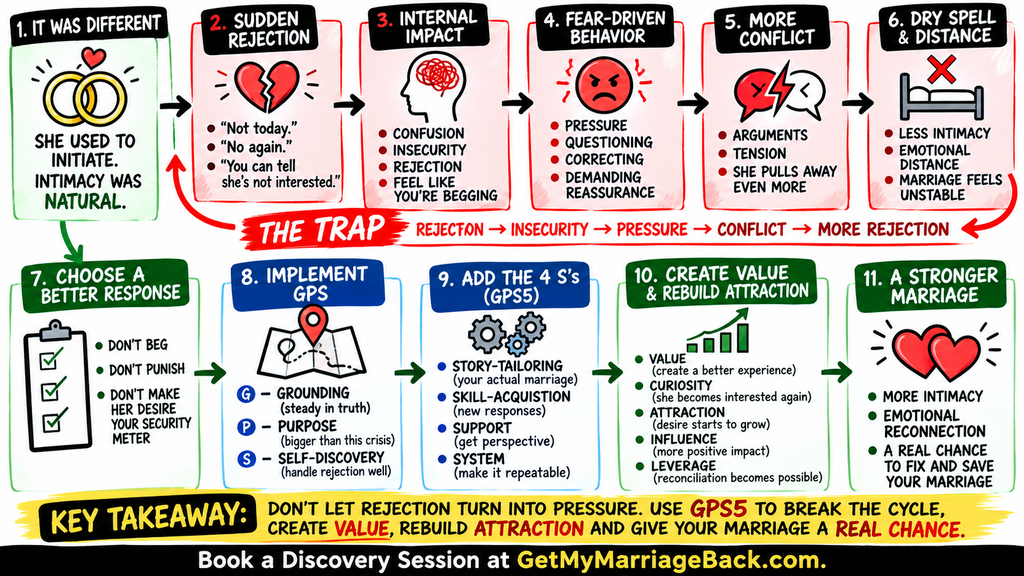
The Dangerous Question Isn’t “Why Doesn’t She Want Sex?”

It’s what you make her rejection mean about you.

At first, you want an explanation.

Soon you may want reassurance.

There’s a significant difference.

You think you’re asking:

“What’s wrong?”

But emotionally, you may really be asking:

“Tell me you still want me.”

“Nobody else?”

“Tell me we’re going to be okay.”

“Prove that I’m still desirable to you.”

That’s when your wife’s sexual desire can become your security meter.

Every “not tonight” becomes a reading.

Sex happens? Marriage must be okay.

She initiates? …still wants me.

She rejects me? Something must be wrong.

She turns away? Maybe there’s somebody else.

Now your emotional stability is being controlled by whether another human being desires sex at a particular moment.

That’s a dangerous position from which to rebuild attraction.

Pressure Can Turn Sexual Rejection Into a Cycle

Here’s the trap.

You feel rejected.

Rejection creates fear.

Fear seeks reassurance.

When reassurance doesn’t arrive, you apply pressure.

Pressure creates conflict.

Conflict can make intimacy less appealing.

Then the resulting lack of intimacy creates even more fear.

You’re attempting to solve rejection with an emotional experience capable of producing more rejection.

Research on couples transitioning to parenthood is particularly relevant here. Researchers found that responsiveness included not only caring about a partner’s desire for sex but also being understanding when a partner didn’t want sex; that understanding was associated with sexual and relationship satisfaction. research on understanding a partner’s need not to have sex

That doesn’t mean pretending you’re happy about rejection.

Emotional intelligence means being able to experience disappointment without immediately converting it into pressure, punishment, interrogation, or panic.

Stop Making Sex Prove Your Marriage Is Okay

Imagine what happens from your wife’s perspective when sex acquires another job.

It isn’t simply intimacy anymore.

…has to reassure you.

It has to demonstrate attraction.

…has to prove fidelity.

It has to confirm the marriage isn’t ending.

That’s a lot of emotional weight to place on intimacy.

And attraction tends to struggle under compulsory emotional labor.

You cannot skillfully rebuild attraction by making your spouse responsible for constantly regulating your insecurity.

This doesn’t require becoming indifferent.

It requires becoming grounded.

Ground Yourself Before Trying to Rebuild Attraction

When your wife stopped initiating intimacy, your first assignment isn’t figuring out the perfect technique for making her desire you again.

Your first assignment is learning to handle what her rejection activates inside you.

I call the beginning of this process GPS: Grounding, Purpose, and Self-Discovery.

Grounding

Ground yourself in a source of truth that doesn’t change every time your wife says “not tonight.”

Your identity cannot rise and fall with her libido.

Grounding allows you to remain emotionally present without pretending you don’t care.

That distinction is attractive because groundedness feels radically different from neediness disguised as authority.

Purpose

Redirect some of that emotional energy toward purpose: your mission, contribution, impact, and legacy beyond the immediate marriage crisis.

This isn’t about becoming busy to make your wife jealous.

It isn’t strategic withdrawal.

Purpose makes your world larger than tonight’s rejection.

A person consumed by obtaining reassurance creates one experience. A person capable of loving deeply while remaining connected to purpose creates another.

Self-Discovery

Now discover your actual capacity.

Can you hear “no” without retaliating?

…experience disappointment without becoming passive-aggressive?

Can you feel uncertainty without interrogating your spouse?

…notice fear without immediately obeying it?

That’s self-discovery.

You aren’t trying to become emotionless.

You’re developing the emotional capacity to experience rejection without allowing rejection to dictate your next move.

Attraction Is an Experience, Not a Reward for Good Behavior

One of the most frustrating beliefs in marriage sounds like this:

“But I’m a good husband.”

Maybe you are.

Being responsible, faithful, hardworking, and committed matters enormously.

But moral value and experiential value aren’t identical.

Someone can respect you without currently experiencing attraction toward you.

That’s why rebuilding attraction isn’t merely a matter of proving that you’re good enough.

You have to pay attention to the experience created in your presence.

Does your presence increasingly communicate pressure?

Anxiety?

Correction?

Monitoring?

Resentment?

Or does your presence communicate groundedness, emotional range, curiosity, purpose, playfulness, confidence, warmth, and genuine connection?

That shift matters.

Research involving more than 1,500 participants found that unmet sexual ideals were associated with poorer sexual satisfaction and relationship quality, while responsiveness to a partner’s sexual needs appeared to buffer some of those associations. PubMed

Attraction can’t be demanded.

But you can become more skillful at creating conditions in which attraction has room to breathe.

Don’t Confuse Seduction With Manipulation

Seduction in a marriage crisis isn’t about tricks.

It’s not withholding affection until your wife chases you.

It’s not manufacturing jealousy.

It isn’t pretending you suddenly don’t care.

Healthy seduction begins with becoming capable of creating an experience that feels better than the cycle you’ve been repeating.

Become curious instead of interrogative.

Be warm without demanding a reward.

Flirt without turning every affectionate interaction into an attempt to get sex.

Create moments that can simply be enjoyable.

Allow tension to breathe instead of demanding immediate resolution.

Most importantly, stop using every interaction to determine whether “it’s working.”

Constantly measuring attraction destroys some of the spontaneity you’re trying to recover.

Stop Testing Whether She’ll Initiate

This is subtle.

You decide you’re not going to initiate anymore.

But internally, you’re watching.

Let’s see how long it takes her.

Day three.

And day five.

Day nine.

Nothing.

Now you’re furious.

Technically, you stopped pursuing.

Emotionally, you never stopped testing.

That’s not detachment from the outcome. It’s a silent experiment your wife doesn’t know she’s participating in.

Real change begins when you stop making every interaction produce a verdict.

“My Wife Never Initiates Intimacy Anymore”—What Should I Watch For?

Look beyond the bedroom.

Did affection disappear too?

Has conflict become chronic?

Does she appear emotionally withdrawn?

Did the change coincide with childbirth, major stress, resentment, illness, medication, exhaustion, or another life transition?

Does she enjoy spending time with you but avoid sexual contact?

Has your communication become primarily logistical or conflict-oriented?

Those patterns don’t automatically tell you why your wife stopped initiating sex.

They help you understand the larger story.

A qualitative study of people in long-term relationships experiencing distressing desire discrepancy identified changes in sexual frequency and desire, barriers to sex, relationship satisfaction, and how couples coped with the discrepancy as important themes. PubMed

Your marriage has its own story.

Treat it accordingly.

The Goal Isn’t to Get Her to Have Sex Tonight

That objective is too small.

If the marriage is in crisis, one successful sexual encounter can temporarily reassure you while leaving the underlying dynamic untouched.

Your bigger objective is to change the experience surrounding the relationship.

Grounding creates stability.

Purpose expands you.

Self-discovery builds emotional capacity.

Those qualities can create greater experiential value.

Value creates room for curiosity.

Curiosity can create room for attraction.

Attraction increases influence.

Influence creates leverage for reconciliation.

None of that requires forcing, convincing, or begging another person into desire.

It requires becoming increasingly capable of responding to the marriage you’re actually in rather than desperately trying to recreate the marriage you remember.

When Something Changed, Get Curious Before You Panic

The disappearance of intimacy is useful information.

Something changed.

Take that seriously without turning it into a catastrophe before you understand it.

Your job isn’t to beg your wife for sex.

It’s also not to punish her for not wanting it.

Don’t immediately turn her rejection into evidence of cheating, divorce, or your inadequacy.

Instead, develop enough emotional stability to study what’s actually happening.

Because when your wife stopped initiating sex, the most important question isn’t simply how to get sex happening again.

It’s this:

What happened to the experience between us—and what kind of experience am I creating now?

That question gives you somewhere productive to begin.

Wife or Husband Denying You Sex? DO THIS!!!

Why has my wife stopped initiating sex?

There isn’t one universal explanation; relationship conflict, stress, parenthood, health factors, resentment, changing desire, and other circumstances can all matter. Look for what changed in the broader relationship rather than diagnosing the cause from rejection alone.

Does my wife not initiating sex mean she isn’t attracted to me?

Not necessarily; sexual initiation and attraction aren’t interchangeable measures. However, a sustained change in intimacy deserves attention as information about the sexual or relational dynamic.

Should I stop initiating if my wife keeps rejecting me?

Don’t turn withdrawal into a hidden test designed to see whether she’ll chase you. Instead, respect sexual boundaries while examining the pattern, your response to rejection, and the broader state of connection.

Can attraction come back in a sexless marriage?

Attraction and desire can change over time, and research shows that sexual desire discrepancies are meaningfully connected with sexual and relationship experiences. Focus on reducing pressure, understanding the actual relationship dynamic, and developing the emotional and relational skills that give desire room to emerge.


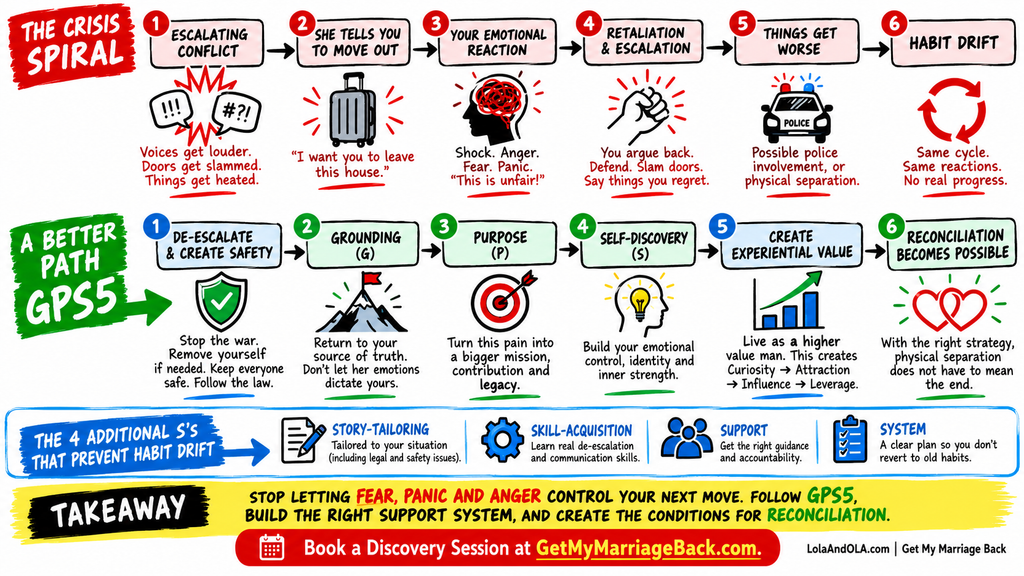
Your Wife Asked You to Move Out? 5 Mistakes That Push Her Further Away

Your wife asked you to move out, and right now leaving your own home can feel exactly like agreeing that your marriage is over.

Take This 2 Minutes Quiz

Question 1 of 15

I understand why your first reaction can be, “Absolutely not.”

This is your house too. You may pay the mortgage or rent. Your children may live there. Your routines, memories, belongings and entire family life are wrapped up in that home.

Then the person you married tells you to leave.

It feels unfair.

And depending on the circumstances, it may genuinely be unfair.

But when your wife asks you to move out during a marriage crisis, the argument about who is right can quickly become less important than what happens next.

Your fear wants immediate action. Your anger wants justice. Your anxiety wants certainty.

None of those emotions should be driving the car.

I know this from more than coaching people through marriage crises. During the darkest period of my own marriage, I packed a small bag and left my house.

Our conflict eventually escalated further. During one argument, I became so frustrated that I picked up a bowl of water from the kitchen countertop and poured it onto the floor.

My logic at that moment was almost comical in hindsight: I was trying to demonstrate that anybody could fly off the handle.

Think about that.

I was demonstrating the problem of losing control by losing control.

Eventually, Lola called the police.

That is why I draw a hard line here. If anybody feels unsafe, safety comes first. If police or emergency assistance is necessary, call them. If there are legal questions about leaving the marital home, custody, property, a protective order or your rights, get qualified legal advice.

Marriage strategy does not override safety or the law.

Once those issues are separated from the reconciliation problem, however, you can ask a much more productive question:

What kind of man are you going to become while your marriage is under this pressure?

Wife Asked Me to Move Out: Does That Mean the Marriage Is Over?

No single request for physical distance can tell you the entire future of your marriage.

Your wife asking you to move out is serious information. Treat it seriously without turning it into a prophecy.

Separation and divorce are not identical.

Physical distance and emotional finality are not identical either.

The danger is that fear collapses all of those distinctions into one terrifying conclusion:

“If I leave, I lose her.”

Once you accept that conclusion as fact, almost anything can feel justified.

You argue.

You refuse.

You explain why she has no right to ask.

You remind her how much you pay.

You demand another conversation.

You send enormous text messages.

You insist that you’re “fighting for your marriage.”

But there is an uncomfortable question underneath all of this:

Are you fighting for your marriage—or is fear fighting through you?

That distinction changes everything.

wife asked me to move out

Mistake #1: Treating Retaliation Like Strength

One client I worked with had lived through years of increasingly heated marital conflict.

Arguments became normal. Doors were slammed. Emotions escalated.

His philosophy was straightforward:

If somebody brings war, retaliate with war. Otherwise, they’ll think you’re weak.

That philosophy felt powerful until his wife told him to move out.

Suddenly, everything he believed about strength was being tested.

This is one of the most seductive mistakes in a marriage crisis because retaliation feels like Personal Power.

It isn’t.

If your wife can raise her voice and automatically make you raise yours, she is influencing your emotional state.

If one sentence about separation makes you lose control, separation is controlling you.

When fear, panic, anger and anxiety determine your next move, those emotions have power over you.

Self-control is not submission. De-escalation is not weakness.

You can be physically strong enough to slam every door in your house and still be emotionally controlled by fear.

wife asked me to move out, not what

Mistake #2: Believing You Must Choose Between Fighting and “Giving Her Space”

Generic marriage advice loves extremes.

“Never leave your house.”

“Fight for your marriage.”

“Don’t let her push you around.”

Then another corner of the internet tells you:

“Just give her space.”

“Do whatever she wants.”

“Don’t contact her.”

“If she loves you, she’ll come back.”

Neither collection of slogans knows your marriage.

There is an enormous difference between fear-driven chasing and dignity-based pursuit.

You can want your wife.

You can want your marriage.

You can make your interest clear.

None of that requires you to beg for reassurance, force conversations, repeatedly ask whether she still loves you, or use every interaction to measure your chances of reconciliation.

Likewise, respecting legitimate distance does not require becoming cold, passive or manipulative.

You are not disappearing to “make her miss you.”

Your objective is much bigger.

Become someone whose emotional center is no longer dependent on what mood your wife is in today.

Mistake #3: Trying to Talk Your Way Back Into Attraction

When your wife wants separation, words become extremely tempting.

You want to explain your intentions.

You want her to understand how much you love her.

Maybe you have finally recognized mistakes that she complained about for years, and now you desperately need her to believe you have changed.

So you talk.

And talk.

And talk.

But attraction is experiential.

Your wife does not experience your transformation because you gave her a PowerPoint presentation about it.

She experiences you.

How do you respond under pressure?

What happens when she disagrees with you?

Can you hear something painful without immediately defending yourself?

Does every warm interaction become an opportunity to ask about reconciliation?

Can you experience rejection without collapsing, exploding or retaliating?

Those experiences communicate far more than another promise.

Why Chasing and Withdrawal Can Make the Crisis Worse

There is useful research behind this dynamic.

A study involving 116 married couples examined what researchers call demand-withdraw communication—a pattern where one spouse pushes for discussion, change or resolution while the other avoids or withdraws.

Both husband-demand/wife-withdraw and wife-demand/husband-withdraw patterns were associated with more negative emotions and tactics and lower conflict resolution. The pattern was not simply a “husband problem” or a “wife problem”; either spouse could occupy either side of the cycle. You can read the research on demand-withdraw patterns in marital conflict.

Look at how easily this can appear after your wife asks you to move out:

Fear → Pursuit → Pressure → Withdrawal → More Fear → More Pursuit

You want reassurance, so you push for a conversation.

She experiences pressure and retreats.

Her retreat frightens you, so you push harder.

Now she wants even more distance.

You interpret that distance as proof that you need to fight harder for the marriage.

The cycle feeds itself.

Breaking that cycle creates emotional breathing room. And emotional breathing room matters when you are trying to rebuild attraction.

Mistake #4: Making Your Wife Responsible for Your Emotional Stability

This is where separation exposes things ordinary married life can hide.

When your wife is warm, you feel powerful.

When she becomes cold, you fall apart.

When she texts you, you see hope.

When she doesn’t, you start imagining divorce.

When she laughs with you, you think reconciliation has started.

Then she mentions separation again and your entire emotional world crashes.

That’s not Personal Power.

Your wife has effectively become the thermostat controlling your emotional temperature.

Attraction struggles under that burden because every interaction acquires a hidden job:

“Please make me feel safe about us.”

Your wife can feel that pressure even when you never say those exact words.

This is why your first job is not making her change her mind.

Your first job is recovering your ability to lead yourself.

Grounding: Stop Letting the Symptom Become Your Identity

The symptom is:

“My wife asked me to move out.”

Grounding does not mean pretending that symptom doesn’t exist.

It means returning to a source of truth higher than the symptom.

Your marriage crisis cannot become your identity.

Your wife’s current emotional state cannot become your definition of your worth.

Her rejection cannot become the authority determining whether today has meaning.

Grounding brings you back to truth and gratitude while allowing you to confront the crisis exactly as it is.

Now you can respond instead of react.

That difference is enormous.

Purpose: Become Bigger Than the Crisis

Pain has a nasty habit of shrinking your entire world.

Suddenly everything becomes about your wife.

What did she mean by that text?

Why didn’t she call?

Is she talking to somebody else?

Does she miss you?

Is she filing?

When is she coming back?

Your marriage matters tremendously, but your purpose must be bigger than any single living human being—including your wife and including you.

Redirect pain into mission.

Reconnect with contribution, impact and legacy.

Build something meaningful enough that your marriage crisis cannot consume every available piece of your identity.

This isn’t a trick for making your wife jealous.

Purpose is attractive because purpose creates life.

A person with direction generates a different experience from a person whose entire existence has become monitoring whether someone else still wants them.

Self-Discovery: Find Out Who You Are Under Pressure

A marriage crisis reveals capacity.

It exposes your beliefs about masculinity, love, conflict, rejection, control, fairness and strength.

Don’t turn that discovery into self-blame.

Use it.

You may discover that what you called “standing up for yourself” was sometimes emotional reactivity.

Perhaps what you called “fighting for the marriage” was occasionally panic.

What looked like communication may have become repeated demands for reassurance.

Self-Discovery means developing enough emotional capacity to see those patterns without needing to declare yourself either the hero or villain.

Then you can change what you actually control.

How Attraction Starts Rebuilding During Separation

Attraction isn’t something you demand from your wife.

It emerges from experience.

I describe the progression this way:

Value → Curiosity → Attraction → Influence → Leverage

Value here does not mean moral worth.

You already have human worth.

I’m talking about experiential value: what does interacting with you feel like?

Are you emotionally exhausting or emotionally engaging?

Predictable or interesting?

Desperate or grounded?

Reactive or responsive?

Consumed by the marriage or connected to a meaningful life?

When your experience changes consistently, curiosity can emerge.

Your wife begins encountering something different instead of hearing another sales pitch about how different you are.

Curiosity gives attraction room to breathe.

Attraction can expand influence.

Influence creates leverage—not leverage to control her, but a stronger relational position from which reconciliation becomes possible.

Mistake #5: Trying to Recreate the Old Marriage

You don’t need the broken marriage back.

Read that again.

The goal is a brand-new marriage with the same person.

Going back to exactly what existed before the separation simply restores the conditions that produced the crisis.

You need a different relational experience.

More emotional intelligence.

Better conflict skills.

Greater self-control.

More curiosity.

Stronger individuality.

More play.

More purpose.

Greater experiential value.

That is how reconciliation becomes something more meaningful than getting your wife physically back inside the same house.

What to Do After Your Wife Asks You to Move Out

Start with reality.

Determine whether there is an immediate safety issue.

Separate legal questions from emotional questions.

Do not make irreversible housing, financial, property or custody decisions based solely on marriage advice from the internet.

Then look directly at your emotional pattern.

What happens inside you when she says, “I want you to leave”?

Does fear become anger?

Do you retaliate?

Do you start proving?

Does panic make you send paragraphs of text?

Do you immediately demand certainty about divorce?

Identify the automatic reaction before trying to perfect your next speech.

From there, rebuild your foundation:

Grounding. Purpose. Self-Discovery.

Create experiential value through the way you live and interact.

Allow curiosity and attraction to emerge from experience rather than pressure.

Develop influence through consistency.

Build leverage through emotional intelligence, dignity and a life that does not collapse every time your wife has a difficult emotion.

This is not passivity.

This is strategic self-leadership.

Physical Separation Does Not Have to Mean Emotional Surrender

I packed a bag and left my house during my own marriage crisis.

I understand the fear attached to that moment.

Walking through a door with luggage can feel like you’re physically acting out the death of your marriage.

But distance itself does not write the ending.

What matters enormously is what happens inside that distance.

You can spend separation obsessing, retaliating, monitoring, begging and waiting.

Or you can use the crisis to become grounded, purposeful, emotionally intelligent and experientially attractive.

You cannot control whether your wife ultimately chooses reconciliation.

But you have tremendous influence over the experience of you that you bring into every interaction from this point forward.

That’s where your Personal Power lives.

Stop trying to win the argument about who has the right to be angry.

Stop allowing fear to masquerade as strength.

Don’t make your wife responsible for regulating your emotions.

Build the man who can experience this crisis without becoming the crisis.

That is where rebuilding your marriage begins.

Wife or Husband Denying You Sex? DO THIS!!!

Frequently Asked Questions

What should I do if my wife asks me to move out?

De-escalate first, address any immediate safety or legal issues appropriately, and avoid making panic-driven decisions. Then identify the fear-driven behaviors you control and begin changing the experience you create in the marriage.

Does moving out mean my marriage is over?

No; physical separation and divorce are different events, although a request to move out should be treated seriously. Focus less on predicting the ending and more on responding with emotional intelligence, dignity and deliberate action.

Should I give my wife space when she wants separation?

Respecting legitimate space can reduce pressure, but don’t use distance as a manipulation tactic to make her miss you. Research on demand-withdraw conflict suggests that cycles of pressure and withdrawal are associated with more negative interactions and poorer conflict resolution.

Can I save my marriage while separated?

You cannot single-handedly dictate reconciliation, but you can change your contribution to destructive patterns and rebuild grounding, purpose, experiential value and emotional intelligence. Those changes create healthier conditions in which curiosity, attraction and reconciliation can develop.

Wife Never Initiates Sex? 7 Traps That Kill Desire—and What Works

When your wife never initiates sex anymore, the rejection can become so personal that every night in bed starts feeling like another verdict on your marriage.

Take This 2 Minutes Quiz

Question 1 of 15

You reach for her. You initiate the kiss. You initiate affection. You try to create sexual intimacy.

Then you stop initiating just to see what happens.

Nothing.

That silence can hurt more than an argument because now you are left trying to interpret it.

Does she still love you? Is your wife still sexually attracted to you? Is somebody else getting her attention? Has the marriage become sexless? Are you becoming roommates? Is separation or divorce coming next?

What you are experiencing is completely unfair.

You married this woman. You have invested years of your life, built memories, carried responsibilities, made sacrifices, and possibly raised children together.

You should not have to pretend that sexual rejection from your own wife does not hurt.

But there is an important distinction between validating the unfairness of the situation and allowing that unfairness to control what you do next.

That distinction can determine whether you become increasingly attractive to experience—or increasingly associated with pressure.

Why Does My Wife Never Initiate Sex?

Your wife’s lack of sexual initiation is a symptom.

It is not automatically the diagnosis.

She may love you and still experience low sexual desire. There may be resentment, chronic stress, exhaustion, unresolved conflict, hormonal or health factors, emotional disconnection, attraction loss, sexual dissatisfaction, routine, or a combination of issues underneath the visible behavior.

Research also suggests that desire naturally changes in long-term relationships. A systematic review of long-term sexual desire describes desire as something that can ebb and flow within individuals and relationships rather than remaining permanently fixed.

That matters because one of the most destructive conclusions you can make is:

“She doesn’t want sex right now, therefore she will never want me again.”

Those are not the same statement.

Your current reality matters.

It just does not have to become your permanent identity.

Trap #1: Turning Her Rejection Into Your Identity

At first, the problem is:

“My wife never initiates sex.”

Eventually, the problem becomes:

“My wife doesn’t desire me.”

Then:

“I am undesirable.”

Notice what happened.

A relationship condition became an identity.

Now her behavior determines how you feel about yourself.

When she kisses you passionately, you feel confident.

When she turns away, you collapse.

When sex happens, you think the marriage is recovering.

Three days without affection and panic returns.

This is where sexual intimacy stops being intimacy and becomes emotional evidence.

You are no longer simply enjoying your wife.

You are using her response to answer a much more frightening question:

“Am I still okay?”

That is too much emotional weight to place on sex.

wife never initiates sex

Trap #2: Begging for Reassurance Instead of Building Attraction

Once rejection starts controlling your emotional state, reassurance becomes addictive.

“Do you still love me?”

“Are you attracted to me?”

“What’s wrong?”

“Are we okay?”

“Why don’t you ever touch me anymore?”

“Is there somebody else?”

You are looking for certainty.

I understand why.

But reassurance and attraction perform completely different jobs.

Reassurance temporarily calms fear.

Attraction creates desire.

You can successfully convince your wife to tell you that she loves you and still have absolutely no improvement in your sex life.

That is because love and sexual attraction are related experiences, but they are not identical experiences.

Two people can care deeply about each other while their romantic marriage slowly becomes a roommate relationship.

Trap #3: Believing “Love Is Give and Take”

You have probably heard this your entire life:

“Marriage is give and take.”

There is truth in reciprocity, but attraction becomes dangerous when you turn that principle into a sexual transaction.

You touched her, therefore she should touch you.

You have been a good husband, therefore she should desire you.

You provided for the family, therefore she should appreciate you sexually.

You planned the date, therefore intimacy should follow.

You helped around the house, therefore she should recognize your effort.

But how is that working?

Desire does not operate like an invoice.

Once your generosity secretly requires sexual repayment, she can experience the expectation even when you never explicitly state it.

Now dinner has an agenda.

Affection has an agenda.

The romantic getaway has an agenda.

Even self-improvement can develop an agenda.

“Did she notice me yet?”

That is not seduction.

That is performance followed by evaluation.

Trap #4: Trying to Communicate Her Into Desire

“Just communicate” has become one of the most repeated pieces of relationship advice on the internet.

Communication matters.

But another emotionally loaded conversation does not automatically manufacture desire.

Your wife probably already knows that you are unhappy about the lack of sex.

She probably knows you want more affection.

Explaining your rejection for the seventh time may give you temporary emotional release while making intimacy feel increasingly connected to obligation, guilt, and pressure for her.

There is also an important difference between quality communication and constant communication.

An honest conversation can increase understanding.

Repeated interrogation can turn the marriage into a permanent relationship meeting.

So communicate when communication actually serves understanding.

Then stop trying to verbally negotiate attraction into existence.

Trap #5: Chasing Harder When She Withdraws

You notice her pulling away.

Fear says:

Close the distance immediately.

So you initiate more.

You become extra affectionate.

You send longer texts.

You apologize for things you have not even decided were wrong.

You explain your intentions.

You become unusually agreeable.

You ask for another conversation.

You pursue reassurance.

She withdraws more.

Now you chase harder.

This is the rejection cycle:

Rejection → Fear → Chasing → Pressure → Withdrawal → More Rejection

Your original desire to save your marriage is not the problem.

The fear-driven execution is.

There is a difference between pursuit and chasing.

Healthy pursuit expresses interest with dignity.

Chasing demands a response because your emotional stability depends on receiving one.

You can desire your wife without begging her to desire you back.

Trap #6: Assuming No Initiation Means No Love

Your wife can love you and not feel strong sexual desire right now.

That reality is painful, but understanding it gives you a much more useful starting point than arguing with it.

Research supports the idea that relationship context matters to desire. For example, research on partner responsiveness and sexual desire found that perceived partner responsiveness—experiencing a partner as understanding, validating, and caring—was associated with sexual desire. The research does not reduce attraction to one factor, but it reinforces an important point: desire exists inside an experience, not merely inside a marriage certificate.

That means being married does not automatically create attraction.

Being responsible does not automatically create attraction.

Having history together does not automatically create attraction.

Love itself does not automatically create attraction.

This is where your opportunity begins.

Instead of demanding:

“Why doesn’t she want me?”

Ask:

“What has it become like to experience this marriage—and what can I control about the experience of me?”

That question takes you somewhere useful.

Trap #7: Making Sex the Only Goal

Of course you want sex.

Let’s not pretend otherwise.

The objective is not to turn you into a man who becomes emotionally comfortable with a permanently sexless roommate marriage.

You want your wife to want you.

You want her reaching for you because she genuinely desires you.

You want her to kiss you because she wants to kiss you.

You want sexual intimacy that does not have to be negotiated, extracted through guilt, or requested repeatedly.

But obsessing over the outcome can sabotage the process.

When every interaction is evaluated according to whether it produced sex, your wife stops being someone you are experiencing and becomes the scoreboard for your recovery.

That creates pressure.

The smarter objective is to build the conditions from which genuine attraction has room to emerge.

How to Rebuild Attraction When Your Wife Never Initiates Sex

Here is what I want you to do.

Stop trying to destroy the symptom directly.

Build your capacity.

I teach this through Grounding, Purpose, and Self-Discovery—GPS.

From there, you develop experiential Value, which creates opportunities for Curiosity, Attraction, Influence, and Leverage.

Grounding: Stop Making Her Desire Your Source of Truth

Your wife can reject sex tonight.

That is real.

The rejection can hurt.

That is real too.

Neither fact gets to become your absolute source of truth about who you are.

Grounding means returning to something deeper than her current response.

Your emotions can give you information without becoming your commander.

Instead of immediately reacting, you regain your center.

That is emotional intelligence.

You are not pretending rejection does not matter.

You are refusing to let rejection decide what version of you shows up next.

Purpose: Become Bigger Than the Crisis

A marriage crisis can consume your identity.

Every morning starts with her.

Every thought revolves around the marriage.

Every interaction gets analyzed.

Every night becomes another intimacy test.

Purpose interrupts that obsession.

Your purpose needs to be bigger than any single living human being—including your wife and including you.

What are you building?

Who are you serving?

What legacy are you creating?

What pain have you survived that can become impact?

What kind of father, leader, creator, friend, businessman, professional, or human being are you becoming?

Purpose is not pretending your marriage does not matter.

Your marriage matters enormously.

It simply cannot become your entire reason for existing.

Self-Discovery: Find the Man Beneath the Panic

Rejection reveals things.

Use that information.

Where do you become approval-seeking?

Where does fear make you controlling?

When do you over-explain?

What makes you abandon your standards?

Where have you become passive?

What parts of your personality disappeared underneath work, parenting, routine, and marriage administration?

This is not self-blame.

Your wife’s choices belong to her.

Self-Discovery is about reclaiming the only capacity you can sustainably develop: your own.

Build Experiential Value Instead of Proving Your Worth

Your human worth is not the issue.

Experiential Value asks a different question:

What is it like to experience you?

Are you grounded under pressure?

Are you interesting?

Can you be playful?

Do you have opinions without needing agreement?

Can you express desire without making rejection catastrophic?

Do you take care of your body?

Do you have meaningful goals?

Can you create an enjoyable experience without demanding that it prove the marriage is recovering?

Are your conversations engaging—or does everything eventually become about the relationship?

Can your wife relax around you without sensing an invisible request for reassurance?

That is experiential Value.

It is not about becoming “good enough” for her.

It is about becoming increasingly compelling to experience.

Value Creates Curiosity

Curiosity disappears when everything becomes predictable.

She already knows the conversation.

She knows the questions.

She knows you are monitoring her affection.

She knows a good date will probably end with you checking whether things are improving.

She knows withdrawal will produce another emotional discussion.

Predictability is not always bad. Stability is essential in marriage.

But romantic attraction also benefits from aliveness.

You have interests again.

Your emotional reactions are no longer automatic.

You are developing.

Your life has movement.

There is something new to experience because you are actually growing—not pretending to grow so she notices.

Curiosity has room to return when your wife stops experiencing you as a completely predictable reaction to her behavior.

Curiosity Gives Attraction Room to Breathe

You cannot command attraction.

You can stop suffocating it.

That distinction changes everything.

Pressure says:

“Feel something for me.”

Seduction says:

“Experience me.”

Pressure needs an immediate answer.

Seduction allows discovery.

Pressure is obsessed with the destination.

Emotional intelligence manages the process.

When you understand this, your goal stops being to manufacture a sexual response tonight.

You start becoming better at creating experiences where genuine desire has room to emerge naturally.

Attraction Creates Influence and Leverage

Influence is not control.

Leverage is not manipulation.

When attraction exists, your marriage has more emotional and romantic energy available to work with.

A warm interaction has more potential.

A date means something different.

Physical closeness becomes less loaded.

Sexual tension can exist without immediately becoming a demand.

Your wife can become curious about you again rather than constantly defending herself from your need for certainty.

That is why attraction matters so much during marriage reconciliation.

You are not merely trying to become emotionally strong while your bedroom remains dead.

You are developing the conditions that give affection, intimacy, and sexual desire their strongest opportunity to return.

Stop Habit Drift Before It Restarts the Cycle

Knowing all of this intellectually is not enough.

Tonight your wife can turn away in bed and trigger the old reaction instantly.

Suddenly you want to ask:

“What’s wrong?”

You want to reach again.

You need reassurance.

You feel compelled to explain.

That is Habit Drift.

Your emotional trigger activates an established response before your better judgment catches up.

This is why information alone rarely fixes a broken marriage.

You need Story-Tailoring because your marriage has its own history.

You need Skill-Acquisition because knowing and executing are different abilities.

You need Support because fear thrives in isolation.

Finally, you need a System because emotional pressure will repeatedly tempt you back toward whatever behavior is most familiar.

What Does Success Actually Look Like?

Success is not learning to tolerate permanent rejection.

It is not convincing yourself that sex does not matter.

Nor is the goal becoming so detached that you no longer care whether your wife desires you.

You want genuine desire.

Not duty sex.

Not pity sex.

Not “fine, if it’ll make you happy” sex.

You want your wife to want to touch you.

You want her to initiate affection because the impulse came from her.

You want a kiss that is not payment for good behavior.

You want sexual intimacy that feels freely chosen rather than negotiated.

Attraction can return.

Desire can return.

Sex and intimacy can become part of a marriage again.

The path is not forcing your wife to change.

It is stopping your participation in patterns that suffocate desire while developing the Grounding, Purpose, Self-Discovery, Value, Curiosity, Attraction, Influence, and Leverage that create a dramatically different experience of you.

Your wife not initiating sex is today’s symptom.

It does not have to become tomorrow’s identity for your marriage.

5 Physical Signs She Just Slept With Someone Else

Frequently Asked Questions

Why does my wife never initiate sex?

Low initiation can reflect attraction loss, stress, resentment, health or hormonal factors, sexual dissatisfaction, emotional disconnection, routine, or differences in how desire develops. Look at the broader pattern rather than treating one behavior as the complete diagnosis.

Does my wife never initiating sex mean she isn’t attracted to me?

Not automatically, although persistent lack of desire can be one sign of attraction loss. Sexual desire can fluctuate, and the relationship context, emotional connection, stress, health, and sexual dynamics can all influence initiation.

Can a wife become sexually attracted to her husband again?

Yes, attraction and desire are dynamic rather than permanently fixed, and long-term relationship research connects desire with factors including responsiveness and relationship context. Rebuilding attraction begins with reducing destructive pressure while strengthening the experiences that give curiosity and desire room to emerge.

What should a husband do when his wife never initiates intimacy?

Stop using every sexual encounter or rejection as a verdict on the marriage, then examine the larger cycle of pressure, withdrawal, resentment, routine, and attraction. Build Grounding, Purpose, Self-Discovery, and experiential Value while expressing interest without begging, coercion, or reassurance-seeking.

How to Save Your Marriage During Separation Without Pushing Your Husband Further Away

Separation creates one of the strangest emotional experiences in marriage.


Take This 2 Minutes Quiz

Question 1 of 15

Your husband can say he needs space and still call you. He can tell you he loves you and still refuse to come home. You can share a warm conversation on Monday, then feel like strangers by Thursday.

That contradiction is where many people lose their emotional footing.

You start wondering what every interaction means. A kind text becomes evidence that reconciliation is close. Silence feels like proof that divorce is coming. One affectionate moment raises your hope, and one cold response sends you back into panic.

When you want to know how to save your marriage during separation, your greatest challenge is not finding the perfect sentence to say to your husband.

Your challenge is learning how to stop fear from turning every remaining connection into pressure.

That distinction matters because connection and separation can exist at the same time.

Your husband can care about you while questioning the marriage. He can miss parts of your relationship while still wanting distance. Remaining affection is meaningful, but affection is not the same thing as commitment.

The opportunity is not to squeeze a promise out of every warm moment.

It is to become increasingly grounded, emotionally intelligent, engaging, and attractive while respecting the reality of the crisis.

Why Saving Your Marriage During Separation Feels So Confusing

Separation creates uncertainty, and uncertainty naturally makes the mind search for certainty.

You want to know:

Does he miss you?

Is he reconsidering?

Should you call him?

Should you give him space?

Does “I still love you” mean he wants to reconcile?

Is he seeing someone else?

Can the marriage still be saved?

Those questions make sense, but living inside them all day creates a serious problem.

You begin treating your husband like a source of emotional regulation.

Instead of observing the overall relationship, you look for individual signals that temporarily make you feel better.

That is how a warm phone call turns into hope.

Then the next cold interaction becomes rejection.

Soon, you are no longer building a better experience. You are reacting to his mood.

That is not attraction.

That is anxiety disguised as relationship work.

save marriage during separation

Mistake #1: Treating “I Love You” Like a Reconciliation Agreement

One of the most dangerous mistakes during marriage separation is turning affection into a verdict.

Your husband says, “I still love you.”

Immediately, your mind wants to finish the sentence:

“So he must want the marriage.”

Not necessarily.

Love is information.

His request for separation is also information.

You do not need to erase one fact to accept the other.

Two things can be true at the same time: he can love you and still feel overwhelmed, resentful, disconnected, unattracted, exhausted, confused, or unwilling to continue the marriage in its current form.

That is emotionally difficult to accept because ambiguity hurts.

Still, emotional intelligence means resisting the urge to turn one sentence into a complete story about the future.

When your husband expresses affection, receive it.

Do not convert it into a contract.

Mistake #2: Talking About the Marriage Until He Wants Even More Distance

“Communication is everything” is one of the most misunderstood pieces of marriage advice.

Communication matters tremendously.

That does not mean more talking is always better.

Imagine that your husband already feels overwhelmed by the relationship. Now every conversation turns into another discussion about the marriage, counseling, separation, reconciliation, the children, what went wrong, what you have changed, and whether he still loves you.

Your intention is connection.

His experience can become pressure.

Those are not the same thing.

Research on married couples has repeatedly identified a pattern called demand-withdraw, where one person pushes for discussion, resolution, or change while the other retreats. In one study of 116 married couples, demand-withdraw interactions were associated with more negative emotion and destructive tactics and with less successful conflict resolution. You can read the research on demand-withdraw patterns in marriage for the underlying findings.

Notice what this does not mean.

It does not mean you should never communicate.

It means timing, emotional state, skill, and the quality of the interaction matter.

If you want to save your marriage while separated, stop measuring communication by how many words you exchange.

Start paying attention to what dealing with you feels like.

save marriage during separation - Making Your Husband the Center of Your Life

Mistake #3: Making Your Husband the Center of Your Life

Separation can consume every available mental space.

You wake up thinking about him.

You check your phone.

Your work suffers.

Your appetite changes.

You replay conversations.

You wonder whether you should text.

You imagine divorce.

Then you imagine reconciliation.

By evening, almost your entire day has been organized around a person who just asked for distance.

That is where attraction starts losing oxygen.

A healthy marriage cannot become your entire identity.

Your purpose has to be greater than the marriage and greater than any individual, including you.

That does not mean pretending you do not care.

Purpose means redirecting emotional energy into your life mission, family responsibilities, career, health, faith, creativity, contribution, learning, and legacy.

Pain can exist while your life continues moving.

In fact, this crisis can reveal parts of you that comfort never forced you to discover.

The First Attraction Shift: Ground Yourself Before You Try to Save Anything

Saving your marriage during separation starts with Grounding.

Grounding is not pretending everything is fine.

It is not suppressing fear.

It is not eliminating uncertainty.

Grounding means returning from uncertainty to your higher self, your source of truth, gratitude, and the present moment.

You stop asking your husband’s next move to tell you who you are.

A cold text no longer means you are worthless.

A warm conversation no longer means you are saved.

His uncertainty does not have to become your instability.

This is where personal power begins.

Your husband is allowed to feel what he feels.

You are responsible for what you do with the feelings his choices trigger inside you.

More Attractive - save marriage during separation

Purpose Makes You More Attractive Because It Makes You Less Consumed

Attraction struggles in an atmosphere of emotional suffocation.

When your entire life revolves around whether your husband comes back, every interaction carries invisible pressure.

Even kindness can begin to feel loaded.

You are not simply asking how his day went.

Underneath it is another question:

“Are we okay yet?”

Purpose changes that energy.

You become engaged with your own life again.

Your days contain meaningful work that has nothing to do with convincing your husband.

There is something psychologically different about interacting with a person who has direction.

Purpose gives you somewhere productive to place the energy that anxiety wants to spend obsessing over your marriage.

That shift matters whether reconciliation takes three weeks, three months, or far longer.

Self-Discovery Is Not Self-Blame

Once you become grounded enough to think clearly, ask a more useful question.

Instead of only asking:

“Why is my husband doing this?”

Ask:

“What is this crisis revealing about my capacity?”

That question changes everything.

Maybe you discover that rejection makes you over-explain.

Perhaps fear turns you controlling.

You may realize that you confuse constant talking with good communication.

Some people discover that they abandoned their identity long before the separation happened.

Others realize they became complacent, defensive, emotionally unavailable, chronically critical, anxious, or increasingly difficult to experience.

None of this requires self-blame.

Your husband owns his choices.

You own your growth.

Self-Discovery is the process of identifying what you have the capacity to improve without carrying responsibility for another adult’s behavior.

That is far more powerful than trying to diagnose him all day.

What “Value” Actually Means in Marriage

When I talk about becoming more valuable, I am not talking about your moral worth.

You are not earning the right to be loved.

Value is experiential.

In other words:

What does being around you feel like?

Can you remain warm when you are disappointed?

Are you able to hear something painful without immediately turning it into an argument?

Can you express interest without making your husband responsible for calming your anxiety?

Do you bring curiosity, humor, emotional presence, confidence, depth, sensuality, intelligence, peace, purpose, and life into an interaction?

That is a different definition of attraction.

Attraction is not only physical appearance.

It is the total experience of you.

Someone can be physically beautiful and emotionally exhausting.

Another person can be objectively accomplished but impossible to relax around.

Marriage attraction is affected by the repeated emotional experience associated with your presence.

That is why repeatedly telling your husband you are a good wife does not create attraction.

Experience creates evidence.

How to Build Attraction During Separation Without Turning It Into a Trick

The fastest way to destroy this process is to make your personal growth another manipulation strategy.

You start exercising because you want him to notice.

You go out because you hope he becomes jealous.

You improve your appearance because you want a reaction.

You stop calling because an internet rule told you he will miss you after 30 days.

Then you watch for signs that your strategy is working.

That is still obsession.

Only the costume changed.

Real development continues whether your husband applauds it or not.

You become grounded because emotional stability serves your life.

Purpose matters because your life has meaning beyond marriage.

Self-Discovery matters because the crisis is exposing capacities you need regardless of the final outcome.

Value matters because you want your presence to become richer, healthier, more engaging, and more attractive.

When those changes are genuine, curiosity can emerge naturally.

Your husband may begin wondering about you because the experience has changed.

That curiosity is attraction beginning to move.

You do not force it.

You do not announce it.

You do not check whether it happened.

Seduction During Marriage Separation Is Not Chasing

There is an important distinction between pursuit and seduction.

Men pursue.

Women seduce.

A woman trying to pull her husband back through constant pursuit often ends up operating against the very attraction dynamic she wants to rebuild.

Seduction does not mean manipulating him sexually.

It means creating an experience that invites interest rather than demanding it.

Warmth can be seductive.

Emotional composure is seductive.

A life with direction is seductive.

Confidence without hostility is seductive.

Playfulness can be seductive.

Looking and feeling good in your own skin matters.

Being interesting again matters.

Having a full life matters.

Knowing when not to force another marriage conversation matters.

The key is that none of these become techniques for monitoring your husband.

You are not performing a routine and checking whether he leaned closer.

You are becoming more capable of creating attractive experiences because that is now part of who you are.

Stop Using Every Interaction as a Reconciliation Scoreboard

One of the strongest skills you can develop during separation is resisting Signal Checking.

Your husband calls.

You wonder whether he misses you.

He laughs with you.

You think reconciliation is close.

He acts cold two days later.

You decide the marriage is dead.

That emotional whiplash keeps you powerless.

Instead, observe the broader experience.

One affectionate moment does not repair years of resentment.

Likewise, one awkward conversation does not erase meaningful progress.

Marriage is an accumulated experience.

Look at patterns over time without turning yourself into an investigator.

More importantly, keep your attention centered on what you control.

You can control your emotional regulation.

Your purpose belongs to you.

Self-Discovery belongs to you.

The value you develop belongs to you.

Your husband decides what he does with the experience.

Why Curiosity Comes Before Attraction

People often think reconciliation begins when someone announces:

“I want the marriage back.”

Usually, something happens before that.

Curiosity.

Your husband starts wondering.

Something feels different.

Perhaps interactions are lighter.

The familiar pressure is missing.

You seem more grounded.

Your life is moving.

There is less emotional grabbing.

Your presence feels different from the version of the relationship he wanted to escape.

Curiosity is powerful because it is voluntary.

Nobody enjoys being commanded to feel attraction.

Interest must emerge inside the person experiencing it.

That is why you cannot talk your husband into attraction.

You create the conditions where curiosity has room to appear.

What Happens When Uncertainty Comes Back?

It will.

That is important to understand.

Your husband can become warmer for several weeks and then pull back.

Separation discussions can return.

Fear can hit you again.

You may feel rejected after believing you had made progress.

That does not automatically mean you failed.

The return of uncertainty is a capacity test.

Can you experience rejection without collapsing into panic?

Will you immediately return to excessive marriage talks?

Do you abandon your purpose the moment your husband becomes cold?

Are you still able to access the person you discovered when the outcome feels uncertain?

Each trip through the process strengthens emotional capacity.

Grounding becomes less forced.

Purpose becomes more natural.

Self-Discovery continues.

Value increasingly becomes part of your normal identity rather than something you switch on around your husband.

That is how emotional intelligence becomes lived experience.

Can You Really Save Your Marriage Alone?

You can change an enormous amount alone.

You cannot create a complete marriage alone.

Those statements are not contradictory.

One person can change the emotional environment, stop feeding destructive patterns, develop communication skills, become more grounded, discover deeper purpose, increase experiential value, and stop reacting from fear.

Your husband still chooses whether he participates.

Do not confuse personal power with total control.

Personal power means maximizing your influence by becoming responsible for the part you actually own.

Trying to control the part you do not own usually weakens your influence.

That is the irony.

What to Do When Your Husband Wants Separation

Take his request seriously without turning it into a prophecy.

A request for separation is information about the present condition of the relationship.

It deserves respect.

At the same time, you do not need to emotionally declare the marriage dead before the future has unfolded.

Focus on the underlying relationship.

Labels such as married, separated, reconciling, and divorcing describe circumstances.

They do not automatically describe the quality of your connection.

People who genuinely enjoy being around each other naturally have more relational possibilities than two people trapped in resentment, pressure, fear, and emotional exhaustion.

So work deeper than the label.

Create a life worth living.

Develop emotional capacity.

Become interesting to yourself again.

Learn better communication.

Build purpose.

Discover the parts of yourself this crisis exposed.

Bring genuine value into the way people experience you.

Then allow your husband the freedom to respond voluntarily.

That is far more seductive than trying to drag reconciliation across the finish line.

5 Physical Signs She Just Slept With Someone Else: The Truth

Frequently Asked Question [FAQ]

Can a marriage be saved during separation?

Yes, separation does not automatically mean divorce. What matters is whether the underlying relationship dynamics change enough for voluntary reconciliation to become desirable.

How do I get my husband back after separation?

Stop making “getting him back” the center of every interaction and focus on Grounding, Purpose, Self-Discovery, and experiential Value. Attraction is more likely to grow from a healthier experience than from pressure, pleading, or constant reassurance-seeking.

Should I give my husband space during separation?

Respect requested space without turning distance into punishment or a manipulation tactic. Appropriate contact depends on your circumstances, but fear-driven over-contact often creates more pressure rather than more connection.

How often do separated couples reconcile?

Reconciliation rates vary widely depending on the population, length of separation, reasons for separating, and whether the couple progresses toward divorce. Treat statistics as context rather than a prediction of your marriage, because the quality of the underlying relationship and what changes during separation matter far more to your next move.

5 Signs Your Husband Doesn’t Find You Attractive: What It Really Means and How to Rebuild Attraction

Few marriage problems cut as deeply as the realization that your husband doesn’t find you attractive.


Take This 2 Minutes Quiz

Question 1 of 15

Sexual rejection has a way of becoming personal very quickly. A declined advance stops feeling like one moment and starts feeling like a verdict. Less touching becomes evidence. A lack of compliments starts sounding like confirmation. Before long, you are no longer asking why intimacy has changed. You are asking whether something is wrong with you.

That is where the real danger begins.

Your husband’s current level of attraction matters, but it should not become the source of your identity. Attraction in a long-term marriage is dynamic. It rises, falls, responds to stress, emotional patterns, familiarity, resentment, novelty, health, personal development, and the experience each person has inside the relationship.

Research supports that distinction. In a study of 1,054 married couples, larger gaps between desired and actual sexual frequency were generally associated with lower relationship satisfaction, lower stability, and more conflict. (PubMed)

So sexual rejection is not “just sex.”

At the same time, the answer is not to panic, interrogate your husband, compete with younger women, obsess over your body, or turn yourself into a project designed to earn his approval.

Your strongest position is learning how attraction works and becoming skillful at creating value, emotional stability, curiosity, and seduction from the inside out.

5 Signs Your Husband May Have Lost Attraction

Not every tired evening or declined sexual advance means attraction is gone. Look for patterns rather than isolated moments.

1. He Regularly Rejects Sexual Intimacy

A husband who occasionally says no to sex is human. Stress, exhaustion, health issues, medication, work pressure, and emotional strain all affect desire.

The concern becomes more serious when sexual rejection becomes the established pattern and there is little evidence of desire coming from his side.

Research on sexual desire discrepancy consistently shows that differences in desire can affect sexual and relationship satisfaction. Importantly, desire mismatch is not automatically a “female low-libido problem”; men can absolutely be the lower-desire person in a marriage. (PubMed)

2. Physical Affection Has Disappeared Too

Sex is only one signal.

You may notice fewer kisses, hugs, playful touches, lingering looks, flirtation, or spontaneous physical closeness. Your husband may recoil from affection, seem irritated by it, or simply stop initiating.

That broader pattern matters because attraction is experiential. Desire does not live only in the bedroom. It is influenced by the entire emotional and relational environment surrounding the bedroom.

3. He Seems Emotionally Detached

Sometimes the sexual problem sits on top of a larger emotional shift.

Your husband may seem less curious about you, less engaged in conversation, more absorbed in work or screens, or emotionally unavailable when you try to connect.

That does not automatically mean he has stopped loving you.

Love and attraction are not identical.

A husband can care deeply about his wife, value the family, remain committed to responsibilities, and still experience diminished attraction. Treating those realities as identical makes the problem harder to diagnose.

4. He Says He “Doesn’t Feel the Same Anymore”

Sometimes you do not have to interpret anything.

He tells you.

Statements such as “I love you, but I’m not in love with you,” “I don’t feel the same,” or “I’m not attracted to you like I used to be” are painful, but they are useful information.

Do not waste your power arguing with his current feeling.

Attraction is not something you debate another person into experiencing.

The more productive question becomes: What conditions created this experience, and what part of those conditions can you influence?

5. Your Marriage Feels Like Roommates

This is one of the clearest descriptions women use.

You manage a home. You discuss bills. You coordinate children. You handle schedules.

Yet romance is gone.

You may feel friend-zoned in your own marriage—technically married, functionally cooperative, but no longer experiencing the polarity, curiosity, playfulness, or sexual energy that once distinguished the marriage from ordinary friendship. That exact progression—from sexual rejection and emotional detachment into roommate status—was a central pattern identified in the teaching behind this framework.

signs my husband is not attracted to me

The Biggest Mistake: Turning His Rejection Into Your Identity

Once your husband’s attraction starts feeling uncertain, your mind naturally wants certainty.

That desire for certainty creates a dangerous loop.

You ask:

“Do you still think I’m attractive?”

“Why don’t you touch me?”

“Is there another woman?”

“Do you still love me?”

“What’s wrong with me?”

The question itself is not the problem. The problem is when repeated questioning becomes testing.

You are no longer simply communicating. You are using his answer to regulate your emotional state.

If he reassures you, you feel better for several hours.

When he is cold tomorrow, you crash again.

Then you ask another question.

Eventually, reassurance stops working altogether.

That is when rejection can become fixation. In the original framework, repeated testing was followed by fixation and eventually defensive coldness—the exact reactions meant to protect you can feed the experience of being unwanted.

signs my husband is not attracted to me - Why Fixating on Your Body Usually Makes Attraction Harder

Why Fixating on Your Body Usually Makes Attraction Harder

When a wife feels sexually rejected, her attention often narrows.

You start looking at your stomach.

Your weight.

And Your age.

May Be Your hair.

Your clothes.

Women your husband might find attractive.

You may begin comparing yourself with photographs from ten years ago or wondering whether every attractive woman who walks past represents a threat.

That mental state is not seductive.

It is fear-driven.

There is nothing wrong with improving your health, fitness, grooming, wardrobe, sensuality, or physical presentation. As a matter of fact, those are legitimate parts of self-care.

The distinction is why you are doing it.

Improving your body because you value your vitality is personal power.

Trying to redesign yourself so your husband will finally validate you puts him in charge of your self-perception.

Attraction grows more effectively when your external improvement reflects an internal expansion rather than desperation.

Do Not Go Cold Just Because You Feel Rejected - signs my husband is not attracted to me

Do Not Go Cold Just Because You Feel Rejected

Eventually, many women get tired of feeling vulnerable.

You decide:

“Fine. I won’t touch him either.”

“I’m done trying.”

“He can come to me.”

You become emotionally colder so he cannot reject you again.

That response makes sense as self-protection, but it often preserves the very environment you want to change. The transcript describes going cold as a short-term coping mechanism that protects you from immediate rejection while potentially creating more relational damage over time.

There is a major difference between dignity and coldness.

Dignity means you stop begging.

Coldness means you punish.

Dignity allows warmth without demand.

Coldness weaponizes withdrawal.

For a woman, seduction does not require pursuit. You can remain warm, feminine, expressive, socially alive, emotionally intelligent, and receptive without trying to force intimacy from a man who is currently withdrawing.

Rebuilding Attraction Starts With Grounding

The first skill is not seduction.

It is emotional grounding.

You need the capacity to experience the symptom—rejection—without automatically allowing it to dictate your behavior.

His mood cannot become your mood.

Distance cannot decide your value.

His rejection cannot automatically become evidence that you are undesirable.

Grounding means returning to your source of truth, gratitude, higher self, faith, and emotional center before deciding what to do next.

This is especially important because attraction requires freedom.

Pressure communicates the opposite.

When every interaction carries the emotional message, “Please prove that I still matter,” your husband does not simply experience your affection. He experiences the weight attached to it.

Build a Purpose Bigger Than Your Husband

One of the most seductive things about a person is aliveness.

A compelling woman has a life.

She has interests.

Has purpose.

She has direction that is not completely dependent on the emotional weather inside her marriage.

Purpose does not mean neglecting your marriage. It means refusing to make your husband the center of your identity.

Your mission might involve your children, career, business, art, faith, health, learning, community, service, creativity, or legacy.

The point is larger than staying busy.

Purpose changes your emotional posture.

Instead of waking up asking, “Does he want me today?” you begin waking up with something meaningful to become, build, serve, or contribute.

That shift matters because desire is connected with novelty and expansion. Research across multiple studies found that self-expanding experiences—activities that create growth, novelty, and a broader sense of self—were associated with greater sexual desire and greater relationship satisfaction in established relationships.

Subsequent research also found that self-expansion can help people see a long-term romantic partner “in a new light,” which was associated with sexual desire. (Sage Journals)

That is a research-backed version of an important attraction principle:

Familiarity without growth can become predictability. Growth creates new information. New information creates curiosity.

Self-Discovery Is Not Self-Blame

When your husband is not attracted to you, self-reflection can easily become self-attack.

Do not confuse the two.

Self-blame asks:

“What is wrong with me?”

Self-discovery asks:

“What is this crisis showing me that I have not developed yet?”

Perhaps you abandoned interests that once made you vibrant.

Maybe resentment has made your energy chronically harsh.

You might have become emotionally dependent on reassurance.

Possibly you stopped taking care of yourself because marriage felt secure.

There may be unresolved conflict, years of criticism, predictable routines, or sexual interactions that became heavy with expectation.

Looking at those possibilities does not mean accepting responsibility for everything happening in your husband.

You are searching for leverage inside your own life.

That is personal power.

Attraction Is About Experiential Value, Not Moral Worth

One of the biggest mistakes in marriage is confusing being a good person with being an engaging experience.

You can be loyal.

Responsible.

Hardworking.

An excellent mother.

Morally decent.

None of those qualities automatically create erotic attraction.

They matter enormously, but attraction asks another question:

What does it feel like to experience you?

Are you emotionally grounded?

Playful?

Interesting?

Warm?

Sensual?

Curious?

Purposeful?

Socially alive?

Capable of handling tension without collapsing?

Able to express desire without demanding validation?

Experiential value is not moral superiority. It is the quality of the emotional, intellectual, social, and sensual experience created around your presence.

Research on sexual communal strength offers an important parallel. Across four studies involving 1,532 participants, unmet sexual ideals were linked with poorer sexual satisfaction and relationship quality; perceived responsiveness to sexual needs helped buffer some of those negative associations.

Notice what that does not mean.

It does not mean sacrificing yourself sexually to keep somebody happy.

Another body of research distinguishes healthy responsiveness from unmitigated sexual communion—prioritizing another person’s needs while excluding your own. The latter has been associated with poorer sexual outcomes.

Seduction requires self-respect.

Curiosity Is the Bridge Back to Attraction

You cannot demand curiosity.

You create the conditions for it.

When you begin changing from the inside out, your husband has new information to experience.

Your emotional reactions change.

Then Your presence changes.

Your priorities become clearer.

And Your confidence grows less dependent on him.

Your life expands.

That does not mean acting mysterious as a manipulation tactic.

Real curiosity happens when the person he thought he completely understood starts growing again.

The transcript describes this constructive progression as developing value that becomes visible and can create curiosity and attraction.

Research on self-expansion provides a useful scientific parallel: novelty and growth in established relationships are associated with increased desire partly because a familiar person can be experienced with fresh attention.

That is why becoming more attractive is bigger than changing your body.

You are becoming less predictable in the healthiest possible way: through continued growth.

You Can Express Desire Without Testing Him

A common question is whether you should stop initiating affection completely.

No universal rule serves every marriage.

What matters is the emotional source of your behavior.

There is a difference between:

“I want to touch you because I feel warm and affectionate.”

and:

“I need to touch you so I can find out whether you still want me.”

One is expression.

The other is testing.

Healthy seduction offers an experience without demanding a predetermined response.

You can flirt because flirting is part of who you are.

Dress beautifully because you enjoy your femininity.

Create sensual energy because you value sensuality.

Bring warmth because warmth reflects your character.

Then allow his response to belong to him.

That emotional separation is difficult when you are desperate to save your marriage, but it is one of the foundations of attractive self-leadership.

Do Not Try to Talk Your Way Into Desire

Communication matters enormously in marriage.

However, conversation cannot directly manufacture attraction.

You cannot logically prove that your husband ought to desire you because you have been married for 15 years.

Explaining that sex is important does not automatically produce sexual energy.

Arguing that a good husband should show affection does not create authentic affection.

Words can clarify problems, establish boundaries, identify health issues, and expose unresolved resentment.

Use them for those purposes.

Do not expect words to perform the job of attraction.

Your husband experiences far more than your sentences: your demeanor, emotional regulation, energy, body language, confidence, lifestyle, resentment, warmth, playfulness, and the emotional meaning attached to interactions all communicate alongside your words.

What If He Truly Does Not Find You Attractive?

Accept reality before trying to influence it.

If he has directly told you that attraction has fallen, do not force him to retract the statement just to make you feel better.

His current feeling is real because it is his current feeling.

It is also not necessarily permanent.

Attraction can fluctuate. The transcript explicitly frames diminished attraction as a condition that can move rather than a permanent identity judgment.

The useful question becomes:

What created the drop?

Physical changes may play a role.

So can resentment.

Stress.

Predictability.

Parenthood.

Depression.

Medication.

Hormonal changes.

Pornography.

Unresolved betrayal.

Lifestyle differences.

Emotional pressure.

Chronic conflict.

Loss of admiration.

A marriage that gradually became all responsibility and no polarity.

Diagnose before reacting.

Your Husband’s Rejection Is a Capacity Test

Attraction recovery is rarely linear.

You may feel grounded for two weeks and then experience another rejection.

Old fear comes back.

That return does not mean you failed.

It shows you where your capacity still needs development.

Can you experience rejection without interrogating?

Will you feel disappointed without becoming cold?

Can you care about your marriage without turning your husband into your emotional oxygen supply?

And can you improve yourself without making every improvement an attempt to earn his reaction?

That is the deeper work.

The goal is not to stop wanting your husband.

The goal is to want him without abandoning yourself.

From that position, you become more capable of offering warmth without pressure, sexuality without desperation, curiosity without games, and love without making another person responsible for your emotional stability.

That is where attraction has room to breathe again.

Sexless Marriage Quiz [2 Minutes Detective]

Frequently Asked Questions

Why doesn’t my husband find me attractive anymore?

Attraction can decline because of emotional disconnection, resentment, stress, routine, health changes, sexual patterns, physical changes, or accumulated relationship dynamics. Do not assume appearance is the only explanation.

Can a husband love his wife but not be sexually attracted to her?

Yes. Love, commitment, attachment, friendship, and sexual attraction overlap but are not identical, so a husband can care deeply while experiencing reduced desire.

Can attraction come back in a marriage?

Yes, attraction is dynamic rather than permanently fixed, and research links novelty, self-expansion, responsiveness, and relationship quality with sexual desire and satisfaction.

What should I do when my husband rejects me sexually?

Do not turn each rejection into a test of your worth; first regulate your emotions, assess the larger pattern, and focus on the areas of your life and relational experience you can actually influence.


What Would Help You Most Right Now?

Choose the option that best matches where you are with your marriage.

I Need Personalized Help

My Marriage Is in Serious Trouble

If you're dealing with separation, divorce, loss of attraction, infidelity, intimacy problems, or a spouse who's pulling away, get help looking at what's happening in your specific situation.

Get Personalized Help →
Get My Marriage Back book cover
I'd Rather Learn What to Do First

Start With Get My Marriage Back

Get the book and start learning the principles for moving your marriage in a better direction.

Get the Free Book →