


Your wife says she only wants to be friends, and suddenly you are married to someone who seems perfectly comfortable receiving friendship from you while you are starving for the romantic marriage you thought you were building.
Take This 2 Minutes Quiz
That sentence—“I think we should just be friends”—can hit harder than an argument about divorce because it creates ambiguity.
You may still live together. You might still raise children, discuss bills, share meals, solve problems, and even laugh occasionally. From the outside, your marriage may look intact.
But you know something fundamental has changed.
She talks to you like a friend. She treats you like a roommate. Affection feels mechanical or disappears altogether. Sexual intimacy may be rare or nonexistent. You sense that she cares about you as a person but no longer experiences you as a romantic partner.
And because you still want your wife, your instinct may be to give her even more.
That is where you need emotional intelligence.
When your wife only wants to be friends, your objective is not to convince her that she should feel attracted to you. Attraction does not respond particularly well to arguments, invoices, pressure, guilt, or demonstrations of how much somebody should appreciate you.
Your first job is to understand what has actually changed.
What Does “My Wife Only Wants to Be Friends” Really Mean?
Take her words seriously without treating them as a prophecy about the rest of your life.
She is describing her present experience of the relationship.
That distinction matters.
“I only want friendship” can mean that romantic attraction has deteriorated. It can reflect accumulated resentment, emotional exhaustion, loss of sexual desire, disconnection, or uncertainty about whether she wants to remain married.
Sometimes a spouse genuinely does not know what she wants.
Don’t immediately translate uncertainty into an affair. Don’t assume “I need space” means another person exists. Equally, don’t dismiss what she is telling you because you believe your history, children, vows, or sacrifices should outweigh her current feelings.
Your history explains why the marriage matters.
It does not manufacture attraction.

1. Stop Trying to Argue Her Back Into Attraction
One of the most predictable responses to romantic rejection is persuasion.
You explain how good the marriage used to be.
You remind her of everything you have survived together. Perhaps you talk about the children, your sacrifices, your future plans, or the promises you made.
None of those things is necessarily false.
The problem is the objective.
When the conversation becomes an attempt to prove that she should choose you, she experiences the emotional pressure behind your words even when your language sounds perfectly reasonable.
Seduction requires space for another human being to have an experience.
Pressure tries to dictate what that experience should be.
There is an enormous difference.
2. Don’t Confuse Rejection-Driven Obsession With Attraction
Here is an uncomfortable question:
Do you want your wife more because you are genuinely attracted to her—or because she no longer wants you?
It can be both.
Someone who was emotionally and physically available yesterday suddenly becoming unavailable today creates psychological tension. You start monitoring every interaction. A pleasant conversation gives you hope. A cold response ruins your day.
Before long, your emotional state revolves around whether she appears one percentage point closer to you.
That isn’t a powerful position from which to rebuild a marriage.
Stress matters here as well. Research has found evidence that stress can bias behavior toward previously learned habitual responses, although later replication work shows that the effect depends on conditions and is not universally reproduced.
That helps explain something many distressed spouses recognize immediately: knowing that chasing isn’t helping doesn’t automatically stop you from chasing.
When rejection hits again, old behavior can return.
3. Respect Her Autonomy Without Surrendering Your Own
Your wife is an adult.
She has autonomy.
So do you.
You cannot force another adult to want a romantic relationship with you, and respecting that reality is not weakness. In fact, trying to control what another person feels usually makes you less emotionally attractive, not more.
Recent relationship research is consistent with the importance of autonomy. Studies examining sexual autonomy support have found associations with greater sexual need fulfillment and sexual and relationship satisfaction.
That doesn’t mean “give your spouse unlimited space and attraction magically returns.”
It means desire and coercion are fundamentally poor partners.
You want your wife to experience you differently because her experience actually changes—not because you pressured her into saying the words you desperately wanted to hear.
4. Stop Feeding the Roommate Limbo
This is where many distressed spouses get stuck.
Your wife says she doesn’t want a romantic relationship, yet you continue supplying extraordinary amounts of romantic attention.
You chase.
You reassure.
You remain perpetually available.
You monitor her mood.
You solve every problem.
You perform increasingly elaborate demonstrations of love.
Underneath all of it may be an unspoken transaction:
If I keep showing you how valuable I am, eventually you will give me attraction in return.
But you cannot emotionally invoice somebody and demand attraction as payment.
That doesn’t mean becoming cold, cruel, vindictive, unavailable, or neglectful.
It means distinguishing responsibility from romantic over-functioning.
Be a responsible parent. Honor legitimate commitments. Treat your spouse with dignity. Participate appropriately in the family you created.
But stop turning endless giving into an indirect negotiation for desire.
If something you repeatedly offer is not being experienced as value, giving more of the same thing does not necessarily make it more valuable.
Sometimes it simply makes it more abundant.
5. Redirect Value Back Into Yourself
A marriage crisis can consume your identity.
You wake up thinking about your wife.
You analyze yesterday’s conversation in the shower. At work, you wonder whether she misses you. At night, you study her tone, body language, phone habits, and willingness to sit near you.
Your entire existence gradually becomes a referendum on whether she wants you.
Redirecting energy toward yourself interrupts that pattern.
This isn’t about pretending not to care.
Reconnect with purpose. Strengthen your physical and emotional health. Become more engaged with meaningful work, fatherhood or motherhood, friendships, contribution, learning, creativity, faith where applicable, and the larger mission of your life.
You are not doing those things as a performance designed to make your wife jealous.
If every improvement is secretly another strategy for obtaining her reaction, she remains the center of your identity.
The deeper shift is becoming grounded enough that rejection no longer dictates every move you make.
That creates something attraction desperately needs:
space.
6. Understand What Actually Creates Romantic Value
Being a good person and being romantically desirable are not identical concepts.
Moral value matters enormously.
Romantic attraction, however, involves experience.
How does someone experience themselves around you?
Do interactions repeatedly feel anxious, heavy, needy, resentful, transactional, interrogative, or emotionally exhausting?
Or does your presence increasingly communicate emotional stability, confidence, curiosity, playfulness, respect, competence, warmth, boundaries, and self-possession?
This is where emotional intelligence and seduction belong in the same conversation.
Seduction in marriage is not manipulation.
At its healthiest, seduction is your ability to participate skillfully in creating an experience where desire has room to emerge voluntarily.
There is research behind the importance of relational experience. A series of studies found that perceived partner responsiveness—feeling that a partner understands, values, and cares for you—was associated with greater sexual desire, with the association particularly strong among women in those studies. You can review the research on partner responsiveness and sexual desire.
Notice what this does not mean.
It doesn’t mean becoming a servant.
Responsiveness isn’t desperate compliance. Understanding someone doesn’t require abandoning yourself, and caring about your spouse doesn’t require removing every boundary.
Healthy responsiveness combines connection with self-respect.
7. Replace “Have You Changed Your Mind?” Energy With Curiosity
Imagine experiencing your spouse as someone who is constantly asking an invisible question:
Do you want me again yet?
Even when the words are never spoken, the energy can become obvious.
Every dinner becomes a test.
Every hug becomes evidence.
Every good weekend becomes proof that reconciliation is happening.
Every bad interaction becomes a catastrophe.
That’s exhausting for both people.
Your goal is to stop treating every interaction as a measurement of the marriage.
When you become less obsessed with extracting certainty, you create room for something different to happen.
Curiosity.
Your spouse notices changes she isn’t being instructed to notice. She encounters emotional responses she didn’t predict. Conversations can stop feeling like disguised marriage negotiations.
Curiosity is not the same thing as attraction.
But attraction rarely grows in an environment where everything about you has become predictable pursuit.
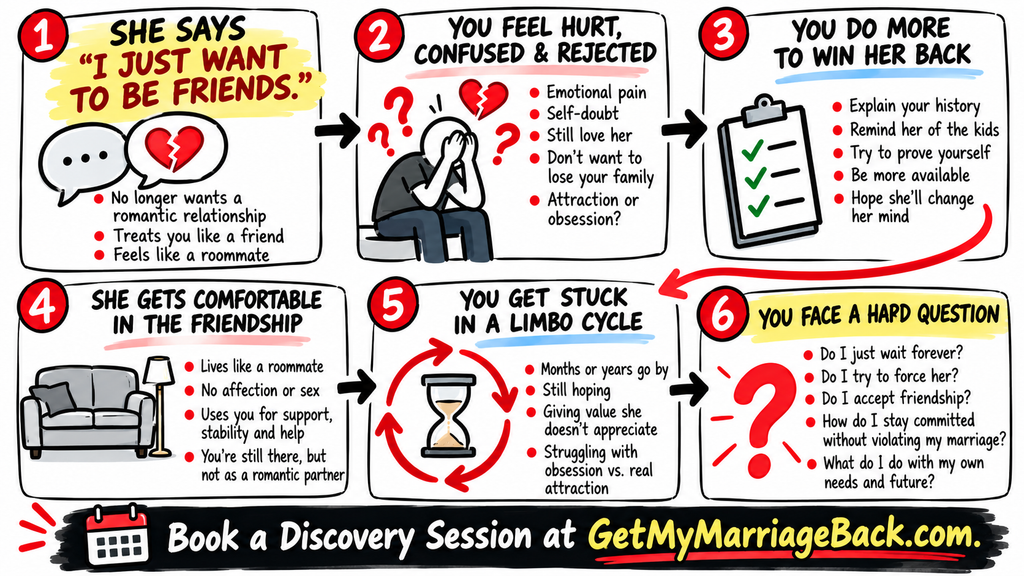
Friendship Is Not the Enemy—Romantic Limbo Is
There is an important distinction here.
Friendship between spouses can be beautiful.
The problem isn’t that your wife enjoys talking with you or considers you a friend. A healthy marriage should contain friendship.
The crisis occurs when friendship replaces romance entirely while one spouse silently accepts an arrangement that is emotionally destroying them because they are terrified that asserting any internal boundary will cause permanent loss.
That creates limbo.
Months become years.
The distressed spouse keeps hoping.
Meanwhile, resentment quietly grows because the relationship continues providing certain comforts of partnership without resolving the central romantic rupture.
You don’t have to announce, “I refuse to be your friend.”
That can easily become another dramatic attempt to provoke a reaction.
Instead, recognize reality.
She has told you what she currently wants.
Respect that information, then take responsibility for what you control.
Don’t Use Distance as a Manipulation Tactic
This point is essential.
Some people hear “stop chasing” and immediately turn it into another technique:
I’ll withdraw so she misses me.
That’s still obsession.
Your behavior remains controlled by the response you hope to extract from her.
Genuine self-redirection is different.
You aren’t punishing her with silence. You’re not manufacturing jealousy, flirting with other people to provoke insecurity, withholding reasonable affection, or becoming deliberately cold.
Those tactics can create anxiety.
Anxiety is not the same thing as attraction.
Your objective is to become increasingly capable of bringing emotional stability, self-respect, boundaries, warmth, mystery, purpose, and genuine relational responsiveness into the marriage without trying to force an outcome from every interaction.
That is much harder than playing games.
It is also much more powerful.
What If Someone Else Eventually Shows Interest in You?
Prolonged roommate marriages create another complication people rarely discuss honestly.
You still have human needs.
You want connection. You want to feel desirable. You want affection and romantic companionship.
After months or years of rejection, attention from somebody new can feel intoxicating.
Suddenly someone laughs at your jokes, notices you, compliments you, or seems genuinely interested.
Be careful.
The existence of another opportunity doesn’t resolve the marriage you’re already in.
Don’t use an outside person as pain medication, leverage, revenge, or proof that you’re still desirable. That creates another crisis instead of solving the first one.
Clarity comes before complication.
Can You Save Your Marriage Alone?
You cannot single-handedly control the final outcome of a relationship involving two autonomous adults.
But you can profoundly change what you contribute to the relational system.
That’s why “save your marriage alone” should never mean doing twice as much relationship labor while your spouse does nothing.
It means beginning with what you actually control.
Your behavior.
Your emotional regulation.
Your purpose.
Your boundaries.
Your responsiveness.
Your attractiveness as an experience.
Your ability to stop turning fear into pressure.
A spouse who wants out may not immediately recognize those changes. That’s fine.
Real change is not a performance scheduled around somebody else’s applause.
Attraction Rebuilding Is a Skill
Most people were never taught how attraction works inside a long-term marriage.
They were taught commitment.
They were taught responsibility.
Some were taught communication.
Very few were taught how familiarity, resentment, autonomy, emotional responsiveness, confidence, novelty, sexuality, boundaries, and self-development interact with romantic desire over many years.
That’s why a marriage crisis can feel so bewildering.
You may be doing what you were taught a “good spouse” should do and still watching attraction disappear.
The answer isn’t becoming a bad spouse.
It is developing a more complete skill set.
You need enough self-awareness to notice when love has turned into chasing.
Enough emotional intelligence to distinguish responsiveness from appeasement.
Enough confidence to respect another person’s autonomy without collapsing.
Enough discipline to stop measuring your worth through your spouse’s immediate reaction.
And enough relational skill to become an increasingly desirable experience without trying to manipulate desire into existence.
Your wife saying she only wants to be friends describes where the relationship is today.
What you do next determines whether you spend your energy arguing with that reality—or developing the person and relational skills capable of creating a different experience tomorrow.
Wife or Husband Denying You Sex? DO THIS!!!
Frequently Asked Questions
It usually means she currently experiences the relationship as more platonic than romantic, although the reasons can include attraction loss, resentment, disconnection, uncertainty, or accumulated relationship problems. Treat the statement seriously without assuming you already know its cause.
Attraction can change because relationship experiences and desire are not necessarily static; research has associated perceived partner responsiveness with sexual desire and relationship quality. Rebuilding attraction, however, requires creating healthier relational conditions rather than demanding a particular emotional response.
Respecting requested space can reduce pressure, but don’t turn distance into punishment or a manipulation designed to make her chase you. Use the space to regulate yourself, clarify boundaries, reconnect with purpose, and stop making every interaction a referendum on reconciliation.
Start by stopping behaviors that convert fear into pressure, over-pursuit, or endless attempts to prove your value. Focus on emotional regulation, autonomy, responsiveness, purpose, boundaries, and the quality of experience you bring into the relationship rather than trying to argue your spouse back into attraction.