Broken Marriage?
Fix it
Here FREE

Get My Marriage Back


Why Is My Husband So Cold Towards Me? 3 Reasons & What to Do

If you’ve been asking yourself, “Why is my husband so cold towards me?”, you’re probably feeling lonely, confused, and emotionally exhausted. One day he seemed engaged, affectionate, and present. Now he barely talks, avoids physical affection, or seems emotionally unavailable.


Take This 2 Minutes Quiz

Question 1 of 15

It’s tempting to jump to the worst conclusionsโ€”that he no longer loves you, that he’s having an affair, or that your marriage is beyond saving. While those possibilities can exist, they are far from the only explanations.

In reality, a husband’s coldness usually falls into one of three categories. Understanding which one you’re dealing with helps you stop guessing and start responding strategically instead of emotionally reacting.

More importantly, regardless of which category your marriage falls into, there is almost always a productive first step that can begin shifting the dynamic back toward connection and attraction.
why is my husband so cold towards me

The 3 Most Common Reasons Your Husband Is So Cold Towards You

1. He’s Overwhelmed by Stress (The Best-Case Scenario)

This is the healthiest explanation because it has little to do with how he feels about you.

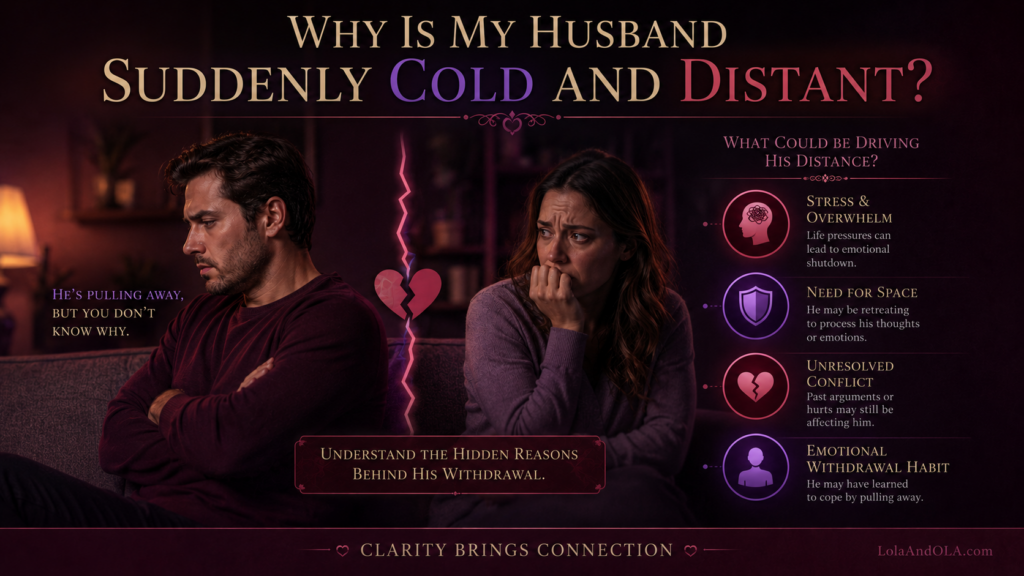
Many men naturally become quieter when they’re under significant pressure. Financial worries, career problems, health concerns, family responsibilities, or burnout can consume so much mental energy that they unintentionally withdraw from everyoneโ€”including their wife.

He may still love you deeply.

He simply doesn’t have the emotional bandwidth to express it the way he normally would.

Common signs include:

  • He’s withdrawn from everyone, not just you.
  • He seems mentally distracted.
  • His energy is consistently low.
  • Conversations revolve around problems rather than connection.
  • He still fulfills responsibilities but lacks emotional presence.

This doesn’t make the situation painless, but it does mean the coldness may be temporary rather than relational.

2. He’s Carrying Deep Resentment

This is more serious.

Sometimes coldness isn’t caused by stressโ€”it’s caused by unresolved emotional injuries.

Repeated criticism, constant conflict, feeling disrespected, unmet expectations, or years of unresolved arguments can gradually harden someone’s heart. Instead of continuing to fight, many people eventually stop trying.

His silence becomes emotional armor.

Instead of expressing hurt, he withdraws.

Instead of arguing, he disconnects.

Instead of pursuing closeness, he protects himself from more emotional pain.

Signs resentment may be involved include:

  • He becomes defensive quickly.
  • Conversations feel tense even when they’re calm.
  • Physical affection has disappeared.
  • He seems irritated by things that never bothered him before.
  • He avoids spending unnecessary time together.

Resentment doesn’t always mean the marriage is over.

It usually means emotional debt has accumulated without being repaid.

3. He’s Become Emotionally Indifferent

This is the hardest possibility to face.

Sometimes a husband has emotionally checked out.

He no longer invests energy into improving the relationship because he no longer believes it matters.

This isn’t necessarily hatred.

In many cases, it’s emotional apathy.

He’s stopped expecting anything, stopped hoping for change, and stopped engaging altogether.

Signs include:

  • Complete emotional detachment.
  • No curiosity about your life.
  • Little effort to communicate.
  • No desire to resolve conflict.
  • He appears unaffected whether you’re happy or upset.

While this is the most difficult situation, even emotional indifference often developed gradually rather than overnight.

Understanding how you arrived here matters far more than assigning blame.

Don’t Rush to Label Him

One of the biggest mistakes people make is trying to diagnose their spouse before understanding them.

Stress can look like resentment.

Resentment can resemble emotional indifference.

Depression can appear identical to emotional coldness.

That’s why assumptions usually make the problem worse.

Curiosity creates better answers than conclusions.

Why is my husband so cold towards me? - The First Step Toward Rebuilding Connection

The First Step Toward Rebuilding Connection

Regardless of which of the three reasons you’re dealing with, there is almost always one place to begin:

Active listening.

Not listening simply to respond.

Listening to discover.

Your goal is to understand the emotional reality driving his behavior.

Ask yourself:

  • What emotions seem to show up repeatedly?
  • When did the coldness begin?
  • What events happened beforehand?
  • Does he withdraw after conflict, during stress, or all the time?
  • What unmet emotional needs might he be trying to protect?

When people feel understood instead of analyzed, defenses often begin to lower.

Listen for the Pattern, Not Just the Words

Many spouses spend years arguing over surface-level issues.

The dishes.

The finances.

The intimacy.

The parenting.

The schedule.

Those are often symptoms rather than causes.

The deeper issues usually involve emotional needs such as:

  • Feeling respected.
  • Feeling appreciated.
  • Feeling significant.
  • Feeling connected.
  • Feeling emotionally safe.

The better you understand the pattern beneath his behavior, the more influence you have to change the atmosphere of your marriage.

Create Value Instead of Chasing Validation

When someone becomes cold, the natural response is often to pursue them harder.

More questions.

More pressure.

More emotional conversations.

More demands for reassurance.

Ironically, this often pushes a withdrawn spouse even further away.

A more emotionally intelligent approach is to begin creating value in the relationship.

That doesn’t mean becoming a doormat or ignoring unhealthy behavior.

It means intentionally becoming someone who contributes peace, emotional safety, respect, warmth, and positive experiences.

People naturally become more curious about relationships that consistently make them feel emotionally better rather than emotionally drained.

Attraction and Coldness Rarely Occupy the Same Space

Attraction isn’t built through pressure.

It’s built through emotional experiences.

When someone consistently associates home with criticism, conflict, shame, or emotional exhaustion, withdrawal often follows.

Conversely, when interactions become calmer, more respectful, and emotionally rewarding, curiosity begins to replace resistance.

Curiosity often becomes conversation.

Conversation becomes connection.

Connection creates opportunities for attraction to grow again.

This doesn’t happen overnight.

But emotional climates can change far faster than most couples expect when one person consistently leads with emotional intelligence instead of emotional reactivity.

Focus on What You Can Control

You cannot force your husband to become warm again.

You cannot argue someone into emotional intimacy.

You cannot control another person’s decisions.

You can control:

  • Your emotional regulation.
  • Your communication style.
  • Your ability to listen.
  • Your willingness to understand before judging.
  • The emotional atmosphere you help create.

Healthy marriages are rarely rebuilt through winning arguments.

They’re rebuilt through restoring trust, lowering defenses, and creating experiences that make connection feel safe again.

When Professional Help May Be Needed

If your husband’s coldness is accompanied by emotional abuse, persistent contempt, addiction, untreated mental health concerns, or complete refusal to engage over an extended period, professional counseling may be appropriate.

Likewise, if either of you feels emotionally unsafe or the relationship has become destructive, seeking help sooner rather than later can prevent further damage.

If you're wondering, "Why is my husband so cold towards me?", remember that coldness is usually a symptom rather than the real problem.

If you’re wondering, “Why is my husband so cold towards me?”, remember that coldness is usually a symptom rather than the real problem.

Most often, it points to one of three realities:

  • He’s overwhelmed by life.
  • He’s carrying unresolved resentment.
  • He’s become emotionally indifferent.

The key is not guessing which one it is but discovering it through patient observation and active listening.

As you better understand the emotions driving his behavior, you’ll be in a stronger position to create the kind of interactions that reduce defensiveness, spark curiosity, and gradually rebuild attraction. While you can’t control his choices, you can become the emotionally intelligent leader of your own responsesโ€”and that often changes far more than people expect.

My Husband Hates Me: 5 Steps to De-escalate Marital Hostility


Frequently Asked Questions

What are some signs that my husband doesn’t value me?

Consistent indifference, chronic disrespect, lack of effort to resolve problems, and showing little interest in your wellbeing can all suggest he no longer values the relationship. However, rule out stress, depression, or unresolved resentment before assuming he no longer cares.

What is the “Silent Husband Syndrome”?

“Silent husband syndrome” is an informal term describing a pattern where a husband withdraws emotionally and communicates very little. It can stem from stress, conflict avoidance, resentment, personality differences, or deeper relationship issues rather than a lack of love alone.

What are the first signs a marriage is ending?

Persistent emotional distance, unresolved resentment, loss of friendship, declining intimacy, and an unwillingness from one or both spouses to repair the relationship are common early warning signs. The earlier these patterns are addressed, the greater the chance of reversing them.

My husband hates me but won’t leave. What should I do?

Don’t assume hatred without evidence, as emotional withdrawal can have many causes. Focus on understanding the underlying issues through calm communication, and if the relationship remains unhealthy or emotionally unsafe, consider seeking guidance from a qualified marriage counselor.

Why Is My Husband Suddenly Cold and Distant? How to Break the Silence

Few things cause more immediate panic than waking up to realize your husband has been cold and distant towards you.

It is an isolating, late-night experience that drives many women to search for answers, trying to decode a sudden shift in their partnerโ€™s behavior.

The confusion multiplies when the change happens without an obvious catalyst.

You find yourself wondering why your husband is suddenly cold and distant but everything on the surfaceโ€”the household chores, the finances, the co-parentingโ€”seems completely fine.

why is my husband suddenly cold and distant

When your husband is distant and moody, the instinctual response is often to treat the distance as a threat to be managed.

This is where fear-based relationship dynamics take root.

When a woman feels her husband is cold and unaffectionate, she may inadvertently step into a control-oriented posture, attempting to force reassurance out of a man who is currently emotionally offline.

To understand why your husband is so distant all of a sudden, we have to look past the surface-level silence and examine the underlying mechanics of how couples handle vulnerability.

The Panic Spiral: “Why Is My Husband Suddenly Cold and Distant?”

When a marriage enters a cold season, modern relationship discourse is quick to hand out viral labels.

Terms like “red flag,” “narcissist,” “simp,” or “pick-me” dominate social media feeds, reducing complex human connections to simple buzzwords.

When a husband becomes cold and emotionless, internet forums often offer scripts for walking away rather than frameworks for understanding.

The irony is that most people weaponizing these labels offer no framework for creating, maintaining, or protecting attraction.

True relationship mastery requires a framework of G.A.M.E.โ€”Giving Authentically and Mindfully with Emotional Intelligence.

It rejects manipulation, performative indifference, or withholding affection to gain leverage.

Instead, it focuses on understanding the dynamics of attraction and participating in them intentionally.

why is my husband suddenly cold and distant [ Emotional Withdrawal ] โ”€โ”€โ–บ [ Wife's Panic/Anxiety ]
              โ–ฒ                               โ”‚
              โ”‚                               โ–ผ
   [ Further Retraction ] โ—„โ”€โ”€ [ Hyper-Vigilant Control ]

When a wife faces a husband who is suddenly cold and distant after an argument, a stressful career shift, or an unexpected life change, she faces a choice between two opposing mindsets: fear management and confident connection.

Meeting his reactive withdrawal with your own reactive panic simply locks both partners into a defensive standoff.

7 Core Differences in Relationship Dynamics That You Can use To Break That Toxic “Cold & Distant” Cycles

By examining the behavioral differences below, we can see why certain relationship styles foster resilient, long-term attraction while others inadvertently lock emotional distance into place.

DynamicThe Control-Oriented Approach (Fear Management)The Connection-Oriented Approach (G.A.M.E.)
1. FocusCharacter Certification (Seeking future guarantees)Relationship Experience (Appreciating current data)
2. FoundationMorality & Rules (“He must fulfill his duties”)Attraction & Compatibility (“We are a team”)
3. AtmospherePressure & Public Contracts (Reputation management)Freedom & Autonomy (Letting the partner choose)
4. MindsetCertainty-Based (“I need to know you won’t change”)Confidence-Based (“I trust us to handle change”)
5. Core TopicTemptation & Prevention (Focus on bad outcomes)Connection & Shared Values (Focus on good outcomes)
6. EnergyReactive Control (Hyper-vigilance and tracking)Proactive Admiration (Gratitude and safety)
7. PostureVulnerability Avoidance (“Don’t let him see you hurt”)Emotional Openness (High emotional intelligence)

1. Character Certification vs. Relationship Experience

There is a massive psychological difference between issuing a “character certificate” for a partner and expressing appreciation for the shared experience.

Declaring that a partner “is incapable of hurting me” is a statement about future behavior that no one can truly guarantee.

When a wife feels her husband has become cold and emotionless, her immediate response may be to look for absolute proof of his character.

G.A.M.E., however, focuses on the present realityโ€”such as compatibility, friendship, and your personal self-respect (and not necessarily mutual respect).

This centers the relationship on active appreciation.

Genuine appreciation is much harder to invalidate because it anchors itself in current data rather than future promises.

2. Morality vs. Attraction

Many relationship conversations revolve strictly around what a partner does not do (e.g., he doesn’t cheat, he doesn’t lie, he provides).

This fixes the conversation entirely on a baseline of morality.

However, basic fidelity and financial support are merely the floor of a relationship, not the ceiling.

Faithfulness is a minimum requirement; the advanced level of a partnership involves maintaining attraction level over time.

When your husband is cold and unaffectionate, the underlying issue is rarely a sudden collapse of his moral character; it is usually a stagnation of the attraction dynamics.

Obsessing over the moral baseline while neglecting the relational skills required to keep an emotional connection alive leaves a relationship vulnerable to a deep, silent freeze.

3. Pressure vs. Freedom

Attempting to force an emotionally withdrawn partner into engaging often feels like a contract or a public challenge.

When a woman panics because her husband is suddenly cold and distant, she may double down on expectations, demanding that he talk.

A more secure approach shifts the responsibility of character back to the individual.

Operating from a place of, “My partner’s emotional choices are ultimately up to him; I do not manage his character,” grants a partner autonomy.

Outside of influence, that responsibility belongs entirely to him.

This creates an atmosphere of freedomโ€”and freedom is fundamentally attractive.

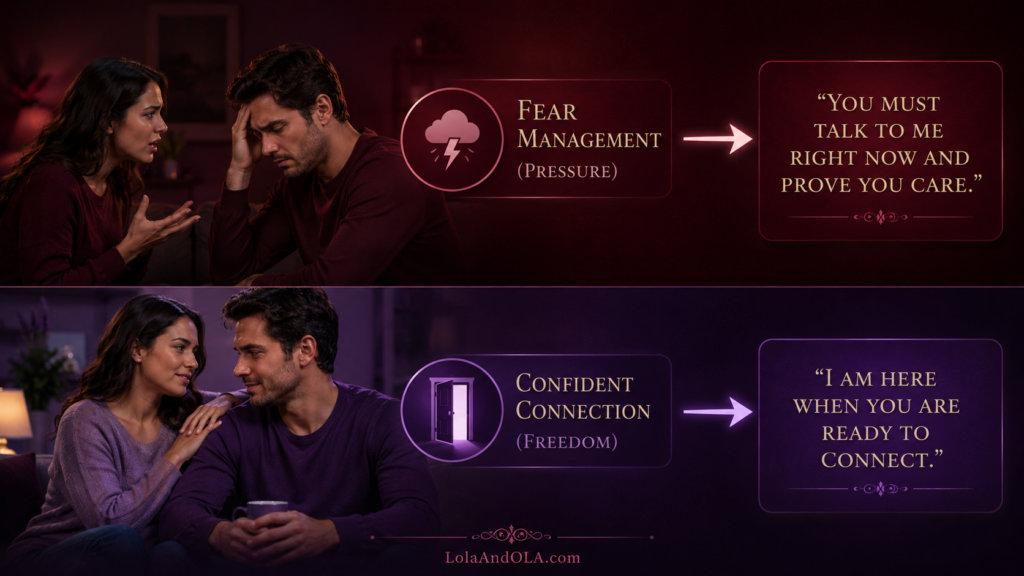
why is my husband suddenly cold and distant - Fear Management (Pressure)  โ”€โ”€โ–บ "You must talk to me right now and prove you care."
Confident Connection (Freedom) โ”€โ”€โ–บ "I am here when you are ready to connect."

4. Certainty-Based vs. Confidence-Based

  • Certainty says: “I know exactly what you will do in the future, and I need proof.”
  • Confidence says: “Based on everything I know today, I trust you and our connection.”

The first mindset attempts to eliminate uncertainty entirely, while the second accepts it as an inescapable reality of human nature.

When a husband shows no emotion when you cry, it can feel like a devastating confirmation that certainty has been lost.

The temptation is to demand an emotional performance to restore that certainty.

True confidence, however, accommodates the moments of emotional offline processing without letting fear dictate a reactive behavior.

5. Temptation vs. Connection

Control-oriented dynamics structure the relationship narrative around feared outcomes, centering the conversation on temptation, infidelity, and emotional abandonment.

Connection-oriented dynamics keep shared values, mutual enjoyment, and partnership at the center.

When a woman finds herself wondering why her husband suddenly cold and distant, her focus often drifts toward worst-case scenarios.

A relationship generally grows where its attention goes.

Focusing on what is missing or what could go wrong builds a vastly different emotional environment than intentionally focusing on creating low-pressure opportunities for connection.

6. Reactive vs. Proactive Energy

Many people mistakenly believe that loyalty testing, suspicion, and tracking emotional shifts protect a marriage.

In reality, these fear-based strategies are reactive attempts to control the uncontrollable.

If your husband is distant and moody, meeting his reactive withdrawal with your own reactive panic simply locks both partners into a defensive standoff.

I’m not judging you if you want to do that but it won’t work out well.

Proactive behaviorsโ€”such as active admiration, gratitude, and clear, calm emotional boundariesโ€”do not eliminate the risk of distance, but they create an emotionally safe environment where attraction actually has room to thaw.

7. The Relationship to Vulnerability

The popular online advice concerning when to leave an emotionally unavailable husband often stems from the critics’ own fears.

Modern culture promotes a hyper-defensive internal narrative:

Never trust someone enough to be embarrassed later.

Never love or care more than the other person.

Never be the vulnerable one.

While these ideas masquerade as self-protective wisdom, they are actually forms of self-sabotage.

When a wife pulls back her warmth because she feels her husband has been cold and distant towards her, she isn’t protecting her relationship (and yes you can argue that he isn’t too)โ€”she is managing her own fear of rejection.

The Illusion of Fear Management

The popular modern advice to “never love or invest more than your partner” is not wisdom; it is fear management.

Healthy relationships are not built by constantly calculating who holds the power, who carries the leverage, or who is more detached.

They are built by people who know how to give authentically and mindfully, without resorting to blind desperation or fear-driven withholding.

When a marriage enters a cold season, the temptation to look for opportunities to compete with your partner is real; avoid it.

Wives typically begin scanning for confirmation of their fears, asking fear-based questions, effectively preparing for a breakup while still living under the same roof.

Can a partner pull away permanently?

Yes. Can a marriage break down? Absolutely.

That possibility exists in every relationship on Earth.

Refusing to offer warmth or celebrate a partner out of fear of looking foolish does not reduce that risk; it simply reduces the amount of appreciation and positive reinforcement available inside the home.

The ultimate goal of a mature partnership is not a guarantee of absolute certainty.

The goal is to cultivate attraction, genuine connection, healthy influence, and emotional intelligenceโ€”creating conditions where positive outcomes are highly likely, without pretending they are guaranteed.

Check this out: How to Save My Marriage

Frequently Asked Questions

What are the first signs a marriage is ending?

The earliest signs that a marriage is structurally deteriorating go beyond simple arguments and instead manifest as chronic emotional detachment, contempt, and the total replacement of vulnerability with defensive stonewalling. When a relationship is ending, partners stop fighting for connection and instead choose quiet coexistence, where appreciation is entirely withheld and both individuals begin living parallel, independent lives under the same roof. This shift from a connection-oriented partnership to a risk-mitigation strategy indicates that the emotional foundation has eroded past the point of simple adjustment.

Why is my husband so distant all of a sudden?

A sudden emotional withdrawal from a husband typically occurs when he feels overwhelmed, misunderstood, or relationally unsafe, causing him to retreat into his internal processing space to handle stress, shame, or perceived failure. Because men frequently lack the relational vocabulary to articulate complex emotional pressuresโ€”whether stemming from career stress, financial anxiety, or marital tensionโ€”they manifest their overwhelm by shutting down entirely, becoming cold and unaffectionate as a primitive form of emotional self-defense rather than a deliberate rejection of their spouse.

What are the three signs a relationship won’t last?

The three definitive signs that a relationship lacks the structural integrity to survive long-term are a complete absence of emotional responsiveness (such as when a partner consistently shows no emotion when you cry), the normalization of chronic contempt over mutual respect, and a protective habit of withholding vulnerability to avoid future embarrassment. When a couple transitions permanently into a certainty-based, control-oriented dynamic where protecting oneself from pain matters more than giving authentically and mindfully, the relationship loses its capacity for attraction and inevitably collapses under the weight of its own emotional defenses.


Broken Marriage?
Fix it
Here FREE

Get My Marriage Back