


Your wife says she’s no longer attracted to you, wants space, or is thinking about divorce—and the harder you try to save your marriage, the further away she seems to move.
Take This 2 Minutes Quiz
I want you to understand something that took me years to appreciate: being committed to your marriage and knowing how to create attraction within that marriage are not necessarily the same skill.
You can work hard, pay the bills, remain faithful, raise your children, and genuinely love your wife. Yet none of those things automatically determines how she experiences you emotionally, romantically, or sexually.
At 30, I believed that enough effort, provision, and commitment would naturally produce a successful marriage. Now, at 47, I understand that marriage also requires emotional intelligence, self-leadership, relational awareness, and the ability to remain attractive through the way you live.
If your wife wants a divorce, the immediate temptation is to do more of whatever you believe should make her appreciate you.
More explanations. More apologies. More conversations. More attempts to convince her that leaving would be a mistake.
Unfortunately, more effort does not always create more attraction. Sometimes it creates more pressure.
Here are seven mistakes worth examining if you want to understand how to save your marriage when your wife wants divorce—and how to develop the emotional and romantic skills that make connection possible.
Why Your Wife May Lose Attraction Even When You Love Her
Before we examine the seven mistakes, I want to distinguish three things: commitment, connection, and attraction.
Commitment is your decision to remain invested in the relationship.
Connection is the experience of being emotionally understood, valued, and engaged with each other.
Attraction is the romantic, emotional, and sometimes sexual pull that makes closeness desirable.
These experiences can influence one another, but they are not interchangeable.
You may be committed while your wife feels emotionally disconnected. She may appreciate your financial contributions without experiencing much romantic desire.
Likewise, a temporary reduction in sexual interest does not necessarily mean the marriage is ending.
Stress, unresolved conflict, resentment, exhaustion, health concerns, and years of negative interaction can all affect intimacy.
The question is not simply whether you are doing enough.
It is whether your presence, habits, communication, and emotional responses are creating an experience that supports closeness.
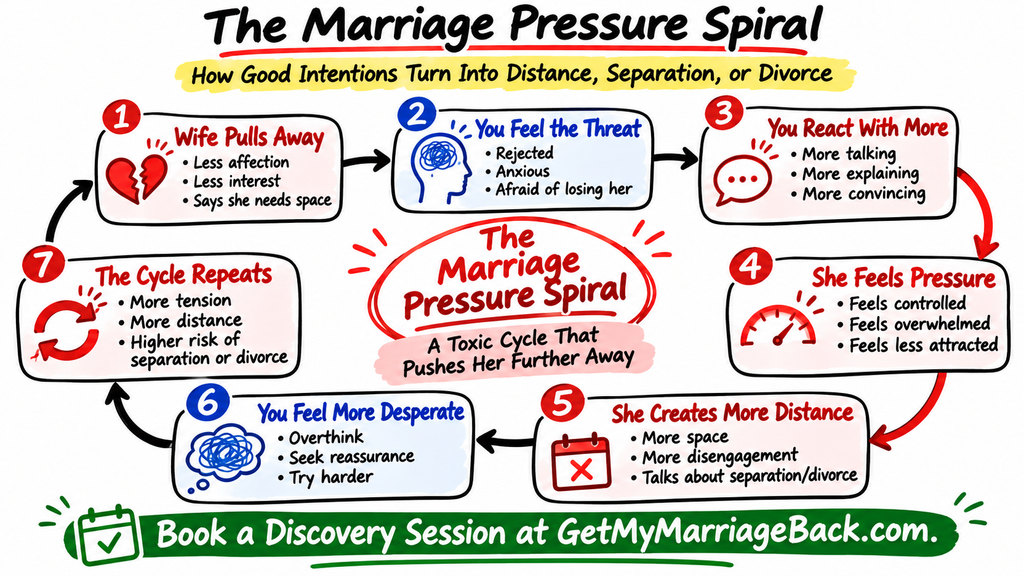
The Marriage Pressure Spiral
Consider a familiar pattern:
Your wife pulls away → You feel threatened → You pursue harder → She experiences pressure → She creates more distance → You become increasingly desperate.
Eventually, both spouses begin reacting to each other’s reactions instead of addressing the original disconnection.
She may experience your pursuit as another demand. Meanwhile, you interpret her distance as proof that you must try even harder.
The pattern reinforces itself.
Breaking that cycle requires more than good intentions. It requires recognizing how your own responses affect the emotional atmosphere of the marriage.
Mistake 1: Trying to Negotiate Attraction Instead of Becoming More Attractive
When your wife says she is no longer attracted to you, your instinct may be to ask what you must change to make her want you again.
You might remind her of your sacrifices, question her fairness, or explain why you deserve another chance.
But attraction is not a debt your spouse owes you.
You cannot negotiate desire by presenting evidence of how much you have contributed.
That does not mean you should change your core identity to please another person. It means developing the qualities that influence how you show up in difficult situations.
Ask yourself:
- Can I manage disappointment without becoming desperate?
- Can I handle disagreement without losing emotional self-control?
- Can I remain purposeful when my wife is not reassuring me?
- Can I communicate confidently without demanding an immediate response?
- Am I still curious, playful, and engaged with life outside this crisis?
These are questions about emotional capacity, not performance.
Attraction grows more naturally around genuine confidence than around a constant need for reassurance.
Confidence is not loudness, dominance, or pretending not to care.
It is the ability to remain grounded when circumstances are uncomfortable.
There is also a seductive quality to someone who is comfortable in their own skin. Their warmth is freely offered rather than used as a bargaining tool.
That distinction matters.
A playful smile, an appropriate compliment, or a moment of affectionate attention feels different when it comes without the expectation that your spouse must respond romantically.
If your wife is uncomfortable with flirting or physical contact, respect that boundary. Emotional intelligence includes knowing when affection is welcome and when space is necessary.
The goal is to become someone whose presence feels more emotionally secure, interesting, and enjoyable—not someone who has mastered techniques for extracting a reaction.
Mistake 2: Refusing to Let Go When Your Wife Wants Space
Your wife asks for space.
Suddenly, you feel compelled to explain everything.
You send another message, then a longer message, then a clarification of the previous message.
Perhaps you try to prove that separation would be a mistake.
I understand that impulse. When the marriage feels threatened, uncertainty can become almost unbearable.
However, there is a difference between fighting for your marriage and fighting to control your wife’s decision.
Letting go does not mean giving up on your marriage. It means releasing the desperation that is making your behavior less effective.
You can release the need for immediate approval without abandoning your values.
You can stop demanding that every disagreement end with your wife acknowledging your perspective.
Most importantly, you can recognize that commitment does not give you ownership of another person’s emotions.
How to Give Space Without Becoming Cold
Giving space is not the silent treatment.
The silent treatment uses withdrawal as punishment. Healthy space creates breathing room while preserving respect.
Suppose your wife says she does not want to discuss the relationship tonight.
An emotionally grounded response might be:
“I understand. We don’t need to force this conversation tonight. I’m willing to talk when we’re both ready.”
Then follow through.
Do not spend the evening sending additional explanations or monitoring whether she has changed her mind.
Continue your responsibilities. Get some rest, take care of your health, and allow the situation to settle.
You can remain warm without being intrusive.
There is quiet strength in communicating that you care about the marriage without requiring your spouse to regulate your emotions every hour.
Mistake 3: Believing Financial Provision Automatically Creates Emotional Connection
At 30, it is easy to believe that if you make enough money and build enough security, everything else will fall into place.
You work harder. Your income increases, and your family enjoys a better lifestyle.
Yet your wife may still say she feels alone.
Why?
Because your wife does not experience your intentions. She experiences your presence.
She experiences your habits, your attention, and the emotional atmosphere around you.
You can provide an incredible lifestyle while becoming emotionally unavailable.
Marriage is not something waiting at home after you finish building your career or accumulating money.
Marriage is part of the life you are building.
Presence Is More Than Being in the Same Room
Imagine coming home after a long workday.
Your spouse wants to share something that happened, but you are mentally occupied with tomorrow’s responsibilities.
You nod without really listening.
Later, you wonder why she says you never connect.
From your perspective, you have been working for the family. From hers, she may have experienced another evening of emotional absence.
Both experiences deserve examination.
Research supports the importance of feeling understood and cared for in romantic relationships. A 2024 study published in Scientific Reports, involving 825 participants, found that perceived partner responsiveness helped explain the association between gratitude and relationship satisfaction.
In practical terms, being appreciated matters, but feeling genuinely understood and emotionally responded to matters too.
Build Attraction Through Intentional Presence
Start paying attention to the experience you create during ordinary interactions.
Put your phone down when a meaningful conversation begins. Notice your spouse’s emotional state without immediately trying to fix it.
Ask thoughtful questions, listen to the answers, and remember details that matter to her.
When the relationship allows it, introduce warmth and lightheartedness into moments that have become overly serious.
Not every interaction needs to become a discussion about the marriage.
Sometimes a relaxed conversation, shared laughter, or sincere appreciation does more for emotional connection than another hour of relationship analysis.
The point is not to manufacture romance.
It is to stop allowing the marriage to receive whatever attention remains after everything else has been served.
Mistake 4: Doing More When Less Would Create More Connection
When your marriage starts falling apart, your instincts may tell you to increase your activity.
More conversations. More gifts. More apologies.
Perhaps you become more assertive, speak louder, or repeatedly defend your intentions.
But more activity does not automatically create more connection.
Sometimes the most productive action is ending an argument before it becomes destructive.
At other times, it is keeping your word without announcing that you kept it.
You may also need to give your wife space without turning that space into a punishment.
Apply the 80/20 Principle to Marriage
The 80/20 principle is a useful way to examine how a small number of repeated behaviors may disproportionately affect your relationship.
Consider whether a few habits are responsible for much of the tension:
- Turning every disagreement into a debate.
- Interrupting your spouse to defend your intentions.
- Asking repeatedly whether she still loves you.
- Making promises without consistent follow-through.
- Bringing relationship anxiety into otherwise peaceful moments.
You do not necessarily need 20 new marriage strategies.
You may need to identify two or three behaviors that repeatedly make the situation worse.
For example, if conversations regularly escalate when you feel criticized, your immediate priority is learning to respond without defensiveness.
That one improvement can influence many different interactions.
Why Emotional Regulation Matters
When people become overwhelmed during conflict, they often lose the ability to listen carefully and respond thoughtfully.
Relationship research has long examined this experience of emotional flooding.
A practical response is to recognize when a conversation has become unproductive, pause respectfully, and return when both people are calmer.
That is different from walking away to punish your spouse.
Emotional control is not the absence of emotion. It is the ability to choose your behavior while experiencing emotion.
Progress will not always be linear.
One good conversation does not erase months of resentment. Likewise, one difficult evening does not invalidate every improvement.
Stop measuring progress by how many arguments you won or how many apologies you received.
Instead, examine whether your behavior is improving the emotional experience of the relationship.
Mistake 5: Neglecting Yourself While Trying to Save Your Marriage
You can become so obsessed with preserving the institution of marriage that you neglect the people the marriage was supposed to support.
That includes you.
Your health suffers, friendships disappear, and your children may begin feeling the tension.
Eventually, your sense of purpose becomes dependent on whether your wife responds positively.
That is not sustainable self-leadership.
Protect Yourself Without Becoming Selfish
Protecting yourself means maintaining the personal foundation that allows you to participate in a healthy relationship.
Continue exercising, sleeping, and eating properly.
Stay engaged with meaningful work, supportive friendships, and your responsibilities as a parent.
Preserve your dignity during disagreements.
You do not need to make your wife the villain to acknowledge your own needs.
Neither should you confuse self-respect with constantly demanding respect from someone else.
Self-respect begins with the standard you maintain in your own conduct.
It is visible when you communicate without humiliating yourself or your spouse.
You can acknowledge mistakes without turning every conversation into self-condemnation.
You can express a need without issuing an ultimatum.
And you can recognize when repeated conflict requires boundaries, outside support, or a more structured conversation.
Why Self-Respect Can Support Attraction
There is a meaningful difference between someone who wants connection and someone who needs constant approval to feel emotionally stable.
The first can express affection with confidence. The second may experience every delayed response as rejection.
When your life retains purpose, your romantic interest becomes an invitation rather than an emotional demand.
That makes room for genuine desire.
It also allows you to remain emotionally available without becoming consumed by your spouse’s every reaction.
Mistake 6: Treating Your Wife as the Enemy Instead of Recognizing Distraction
When your marriage is struggling, it becomes easy to focus entirely on what your wife is doing wrong.
You may analyze her tone, her phone habits, her social interactions, and every moment of withdrawal.
Meanwhile, distractions continue to erode meaningful presence.
Your work, entertainment, social media, and outside attention may consume the emotional energy that your relationship needs.
But not every distraction is destructive.
Sometimes exercising, enjoying a hobby, or stepping away from a heated conversation helps restore emotional balance.
The important question is whether the activity helps you return stronger or helps you avoid reality.
Healthy Space Versus Emotional Avoidance
Consider two people who spend an evening exercising after a difficult conversation.
One uses that time to regulate emotions and returns home more relaxed and willing to connect.
The other uses exercise to avoid discussing a serious relationship problem indefinitely.
The activity is identical. The intention and pattern are different.
That is why self-awareness matters more than simply labeling an activity good or bad.
If your wife feels emotionally distant, disappearing into work will not automatically repair the connection.
Obsessively monitoring her behavior will not repair it either.
You need to develop the judgment to recognize when to engage, when to listen, and when to create breathing room.
Restore the Conditions for Romantic Interest
Romantic attraction benefits from experiences that are not dominated by conflict management.
When appropriate and mutually welcome, introduce moments of playfulness, curiosity, novelty, and genuine appreciation.
A thoughtful compliment can communicate desire without becoming a request for reassurance.
An enjoyable shared activity can remind both spouses that the relationship contains more than unresolved problems.
Affectionate touch can also support closeness when both people welcome it. Research on perceived partner responsiveness has found associations with affectionate touch, while other studies connect responsiveness with more comfortable sexual communication and intimacy.
The lesson is simple: emotional connection and romantic attraction are influenced by how people experience one another, not merely by how often they discuss their problems.
Seduction within marriage is not manipulation.
It is the art of creating genuine, mutual romantic possibility through confidence, attentiveness, emotional awareness, and respect.
Mistake 7: Confusing Emotional Noise With Serious Marriage Signals
Your wife has a bad day.
She does not smile, and her response feels colder than usual.
Suddenly, you interpret that moment as proof that the marriage is over.
This is where emotional intelligence becomes essential.
One emotional fluctuation is not necessarily a permanent decision.
However, repeated withdrawal, explicit separation plans, and consistent refusal of connection deserve serious attention.
You must learn to distinguish between an isolated moment and an established pattern.
Signal Versus Noise in a Marriage Crisis
Emotional noise includes temporary irritation, tiredness, occasional disagreement, and an isolated request for solitude.
More significant signals include repeated statements about wanting divorce, sustained emotional disconnection, concrete separation arrangements, and unresolved patterns that continue despite attempts to address them.
The distinction is not whether a particular interaction hurts.
It is what the broader pattern actually tells you.
If your wife says she feels disconnected, take that information seriously.
But do not automatically conclude that every year of your marriage was a failure.
Look at patterns, context, and consistency before deciding what you are dealing with.
What to Do When Your Wife Becomes Cold or Distant
Suppose your wife seems emotionally withdrawn tonight.
Your first impulse may be to ask whether she still loves you.
You have already asked that question several times this week.
Another interrogation is unlikely to produce the clarity you want.
Instead, relax your shoulders, regulate your breathing, and speak calmly.
If a practical matter needs attention, address it directly and respectfully.
Avoid repeating the same emotional demand when it is clearly not producing a productive conversation.
Give the situation room without using silence as a weapon.
Later, when there is an appropriate opportunity, discuss the underlying pattern rather than treating one evening as the entire marriage.
That is how you begin replacing reactive communication with deliberate emotional leadership.
How to Rebuild Attraction When Your Wife Wants a Divorce
Understanding these mistakes is useful, but the real question is how you apply the lessons.
I would begin by separating what you can influence from what you cannot control.
You cannot dictate your wife’s attraction, feelings, or decisions.
However, you can improve the emotional experience you create through your behavior.
Become Emotionally Grounded Before Pursuing More Intimacy
When your marriage feels threatened, your nervous system may treat every interaction as urgent.
That urgency can lead to excessive reassurance-seeking, repeated conversations, and emotional overreaction.
Start by developing your ability to remain composed.
Take care of your body, maintain your responsibilities, and learn to tolerate uncertainty without immediately acting on it.
This is not about pretending you are unaffected.
It is about refusing to let fear dictate every interaction.
Replace Pressure With Responsive Attention
Being emotionally responsive means noticing what your spouse communicates and responding with care rather than defensiveness.
For example, if your wife says she feels unheard, immediately listing everything you have done for her misses the point.
A more constructive response begins with curiosity.
Ask what she means, listen carefully, and reflect on whether your behavior has contributed to that experience.
Responsiveness does not require agreement with every accusation.
It requires the ability to understand another person’s perspective without losing your own.
Reintroduce Attraction Without Demanding It
As the emotional atmosphere becomes less pressured, look for appropriate opportunities to restore warmth.
Be genuinely interested in your spouse as a person.
Maintain your appearance, health, personal interests, and confidence.
Allow humor and lightness to exist without forcing romantic outcomes.
When affection is mutually welcome, let it be affectionate rather than transactional.
You are not trying to trade a compliment for a kiss or a date for sexual intimacy.
The goal is to create the conditions in which two people can experience each other positively again.
Evaluate Progress Through Patterns, Not Daily Reactions
A spouse may respond warmly one day and remain distant the next.
That fluctuation does not necessarily mean your efforts are failing.
Look instead at whether communication is becoming more respectful, arguments are less destructive, and both people are increasingly willing to engage.
Notice whether you are developing greater emotional stability regardless of the immediate response.
Attraction is not something you can force on a deadline.
You can, however, become more skillful in the way you participate in your marriage.
What If Your Wife Has Already Asked for Separation?
A request for separation changes the practical situation.
You should take it seriously rather than assuming it is simply an emotional test.
Ask for clarity about immediate responsibilities, living arrangements, children, finances, and the communication that remains appropriate.
Avoid treating the separation as an invitation to intensify romantic pursuit.
Repeated persuasion can reinforce the very pressure your spouse is trying to escape.
At the same time, you do not have to become cold, hostile, or emotionally unavailable.
You can remain respectful, dependable, and clear about your desire to repair the relationship.
If both spouses are willing, structured marriage counseling or another mutually agreed process can help address the patterns behind the disconnection.
Where one spouse is unwilling to participate, your work begins with your own conduct, emotional regulation, and decisions.
That is still meaningful work.
The Real Difference Between Chasing Attraction and Building It
At 30, I thought marriage would naturally reflect the effort I invested in it.
At 47, I understand that effort must be accompanied by awareness.
You can work harder without becoming more emotionally available.
You can communicate more without becoming easier to understand.
And you can pursue your spouse more intensely while making closeness feel increasingly difficult.
The better question is not, “How do I make my wife want me again?”
It is, “What kind of emotional and relational experience am I consistently creating?”
That question changes your focus.
Instead of obsessing over every response, you begin developing the qualities that make you a stronger partner: confidence, emotional stability, attentiveness, integrity, warmth, and self-respect.
Instead of trying to win every argument, you learn to recognize what actually improves connection.
Rather than treating romance as a reward for sacrifice, you begin understanding attraction as part of a living relationship that requires attention and skill.
You can love your wife deeply and still have important things to learn about attraction.
That realization is not a defeat.
It is the beginning of a more mature way to approach marriage.
11 Physical Attraction Signs That Reveal Real Desire
Frequently Asked Questions
Take her concerns seriously, reduce pressure, and identify the recurring behaviors contributing to disconnection. Focus on emotionally responsible communication and practical changes while respecting her right to make her own decisions.
Attraction can change as emotional connection, responsiveness, and relationship experiences change. Rebuilding it involves addressing the underlying disconnection rather than demanding reassurance or immediate intimacy.
Respect her request for space while maintaining necessary communication about children, finances, and shared responsibilities. Space should reduce emotional pressure, not become punishment or a strategy for provoking a reaction.
Avoid repeated pleading, emotional interrogation, defensiveness, and attempts to control her decisions. Pay attention to consistent patterns, regulate your reactions, and communicate with clarity and self-respect.