

Your wife wants separation, and suddenly the woman you built your life with is asking for a future that might not include you.
Take This 2 Minutes Quiz
Yesterday, you were her husband. Today, you feel like you’re auditioning for a position you already had.
She says she needs space. Maybe she isn’t sure about the marriage anymore. Perhaps she’s already mentioned divorce, moving out, or living separately while she figures out what she wants.
Now every unanswered text feels suspicious. Every conversation seems like a test. Your friends are telling you there’s probably another man, and you’re wondering whether giving her space means giving up on your marriage.
I want you to understand something important: Your wife asking for separation is a serious marriage crisis, but separation and divorce are not the same decision.
What you do during this period matters. And some of the most natural reactions to losing your wife can create exactly the kind of pressure that makes reconciliation harder.
Why Your Wife Wants Separation When You Still Love Her
When your wife wants separation, the announcement can seem to come out of nowhere.
You remember the last argument. Maybe you said something you regret. Perhaps she got upset over something you considered minor.
Now you’re wondering how one disagreement became a threat to everything you’ve built.
But the argument that triggers a separation conversation isn’t necessarily the problem that created the crisis.
Sometimes resentment has been accumulating for years.
Your wife may have experienced repeated disappointment, emotional disconnection, unresolved conflict, or declining attraction long before she mentioned leaving.
That doesn’t make every accusation against you accurate. It means the announcement and the emotional process behind it are two different things.
The marriage crisis that changed my perspective
Years into my own marriage, my wife told me she didn’t want to be married anymore.
I initially thought she was joking.
We had two boys together. We had built a family, and I couldn’t understand how an argument could suddenly put our marriage in jeopardy.
Then she repeated herself.
The reality became impossible to ignore.
For months, our marriage was in crisis. Eventually, I began accepting that divorce might become part of my story.
Yet my wife and I recently celebrated nineteen years of marriage.
That experience changed how I understand saving a marriage when one spouse wants out.
The biggest mistake is believing your wife must first change her mind before you can change the direction of your own life.

The 5 Mistakes That Push Your Wife Further Away During Separation
1. Begging Her to Reconsider Before She Has Space to Think
Your wife says she needs time, and you immediately want another conversation.
You explain how much you love her. You remind her about your wedding vows, the children, the sacrifices, and everything you’ve survived together.
When that doesn’t work, you try again.
Here’s the problem.
You cannot negotiate somebody into wanting you.
Your explanations may be sincere, but when every interaction becomes an attempt to reverse her decision, your wife starts associating contact with emotional pressure.
Relationship researchers call one version of this the demand-withdraw pattern: one spouse increasingly presses for discussion or change while the other retreats.
A study of 116 couples examining marital conflict at home found that these patterns were associated with more negative interactions and less conflict resolution. The findings help explain why pursuing another conversation isn’t always the same as making progress.
The research on demand-withdraw patterns in marital conflict reinforces an important distinction: pressure and productive engagement are not interchangeable.
Giving your wife space doesn’t require pretending you don’t care.
It means refusing to make every interaction another campaign to change her mind.
2. Assuming She Wants Separation Because There’s Another Man
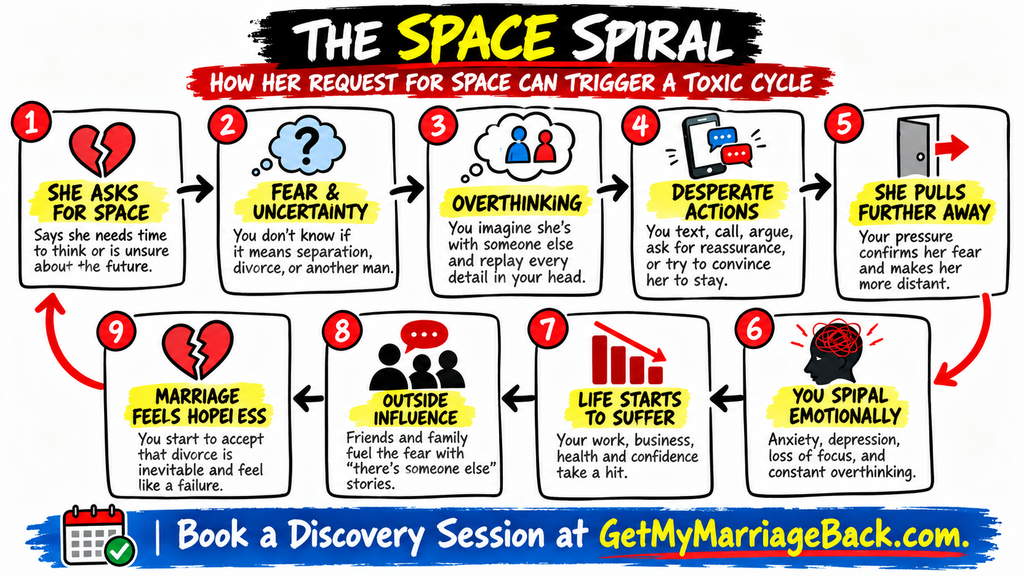
When your wife becomes emotionally distant, your imagination starts filling in the missing information.
She’s protecting her phone.
She doesn’t respond as quickly.
Her tone has changed.
Now your friends are telling you she must be interested in somebody else.
I worked with a man whose wife wanted divorce and was threatening to take much of what he had built financially.
But money wasn’t his deepest fear.
His parents had experienced multiple divorces. He had promised himself that his family would be different.
When his wife began questioning their future, he felt as though he was becoming the very story he’d spent his life trying to escape.
People around him became convinced another man was involved.
That possibility started dominating his thinking.
But suspicion isn’t evidence.
When you turn uncertainty into a conclusion, your behavior starts responding to a story you haven’t established as fact.
You become defensive, accusatory, controlling, or desperate for reassurance.
If there is evidence of infidelity, address the reality and protect your boundaries. But don’t manufacture certainty simply because uncertainty is painful.
Your fear of being replaced must not become the force controlling your behavior.
3. Letting the Separation Destroy Your Identity
One of the most painful consequences of a marriage crisis is how quickly it can consume everything else.
Your business suffers.
You lose focus at work.
Sleep becomes difficult, and the activities that once gave your life meaning disappear.
I saw this happen with the client whose wife wanted divorce.
His emotional deterioration began affecting his business and everyday functioning.
Eventually, his wife pointed to those changes as additional reasons she no longer recognized the person she had married.
Think about that contradiction.
He was falling apart because he desperately wanted to save his family.
Yet the deterioration was making it harder for him to show up as the person he wanted to be.
This is where self-leadership becomes essential.
You don’t reclaim your identity by pretending the marriage doesn’t matter.
You reclaim it by refusing to make your wife’s immediate response the only measure of whether your life has value.
Your health, responsibilities, friendships, children, professional commitments, and personal mission still deserve your attention.
Those aren’t distractions from saving your marriage.
They’re part of rebuilding the stability that allows you to navigate the crisis intelligently.
4. Confusing Chasing With Genuine Pursuit
There’s a meaningful difference between pursuing your wife and chasing her.
Pursuit communicates interest with dignity.
Chasing demands reassurance because fear has taken control.
A thoughtful expression of love is different from sending six unanswered messages.
Respecting her request for space is different from disappearing to punish her.
Maintaining warmth when appropriate is different from manufacturing jealousy to make her react.
Attraction isn’t built by demonstrating how helpless you become when someone withdraws.
It’s influenced by the experience you create through your presence, emotional regulation, confidence, and behavior.
That is what I mean by experiential value.
I’m not talking about proving you’re morally superior or reminding your wife how good a husband you’ve been.
I’m talking about becoming someone whose presence creates a different emotional experience from the pressure and conflict she has come to expect.
You can be caring without being desperate.
You can remain interested without demanding access.
And you can respect distance without turning it into a manipulation tactic.
5. Treating Every Interaction as a Verdict on Your Marriage
Your wife responds warmly to a message.
You immediately think reconciliation is beginning.
The following day, she’s distant again.
Now you’re convinced divorce is inevitable.
That emotional roller coaster can turn every interaction into a test.
A short reply becomes rejection. A smile becomes proof of attraction. Silence becomes evidence of another man.
Eventually, your emotional stability depends on interpreting signals that may have several explanations.
One good conversation doesn’t mean your marriage is saved. One difficult conversation doesn’t mean it’s finished.
Instead of chasing individual signals, pay attention to patterns over time.
Is there less hostility?
Are your interactions becoming more respectful?
Are you responding differently when disappointment occurs?
Most importantly, are you becoming more capable of handling uncertainty without surrendering your judgment?
That is progress you can actually influence.
How to Save Your Marriage When Your Wife Wants Separation
Saving your marriage while separated begins with understanding the difference between control and influence.
You cannot control your wife’s feelings, attraction, or final decision.
But you can change the experience of interacting with you.
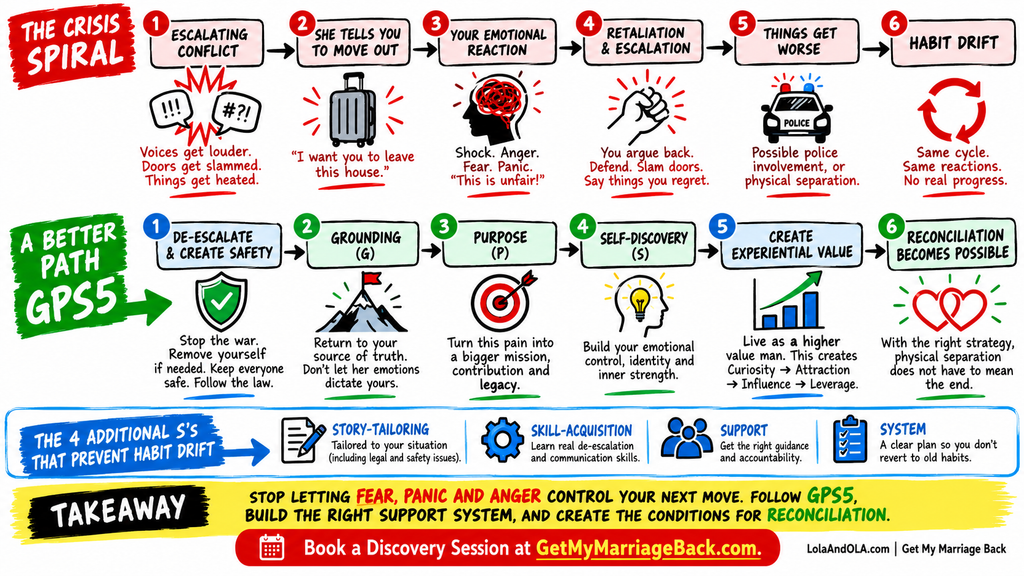
I teach a progression that begins with GPS: Grounding, Purpose, and Self-Discovery.
Grounding: Stop Letting Her Reactions Define Reality
Grounding means returning to a source of truth that remains stable even when your wife is uncertain about you.
Her emotional withdrawal is real.
Your marriage crisis is real.
But neither determines your entire identity or future.
When fear rises, acknowledge the situation without letting your imagination become your authority.
Purpose: Rebuild a Life Bigger Than This Crisis
Your marriage matters, but your purpose cannot depend entirely on another person’s decision.
Reconnect with your responsibilities, contribution, mission, and legacy.
This is particularly important when you’re trying to save your marriage alone.
You still have a life to lead while the future of your marriage remains unresolved.
Self-Discovery: Reclaim Your Capacity to Influence
Self-discovery isn’t an invitation to blame yourself for everything that went wrong.
It’s an opportunity to recognize the patterns you can change.
Perhaps you become defensive when criticized.
Maybe rejection triggers excessive reassurance-seeking.
You may have allowed years of disappointment to replace confidence with resentment.
Recognizing these behaviors gives you something practical to work on.
Rebuilding Attraction During Marriage Separation
The next progression is experiential value, curiosity, attraction, influence, and leverage.
Experiential value concerns what it is like to experience you.
When your behavior becomes more grounded, emotionally intelligent, and engaging, interactions can begin to feel different.
That difference creates room for curiosity.
Curiosity matters because attraction is difficult to nurture when every conversation feels predictable, pressured, or emotionally exhausting.
Your wife doesn’t need another performance designed to convince her you’ve changed.
She needs the freedom to observe whether your behavior actually changes.
That means demonstrating emotional intelligence in ordinary moments.
Respond without immediately defending yourself.
Respect reasonable boundaries without turning cold.
Maintain your responsibilities without demanding recognition.
Express interest without making every interaction a referendum on reconciliation.
This is how you begin changing your contribution to the relational dynamic.
Not by forcing attraction, but by becoming more capable of creating the conditions in which attraction can develop naturally.
Why Understanding Isn’t Enough: The Habit Drift Problem
You can understand everything I’ve explained and still repeat the same mistake tonight.
Your wife ignores your message.
Fear returns.
Suddenly, you’re writing another long paragraph explaining why she shouldn’t leave.
This is Habit Drift: returning to familiar reactions when emotional pressure rises.
Research into stress and decision-making has examined how stress can affect the balance between deliberate action and habitual responding, although findings are mixed and not every person responds the same way.
The practical lesson is straightforward.
Insight needs implementation.
In my GPS5 approach, the additional four S’s help turn understanding into sustained behavior:
- Story-Tailoring: Understand the circumstances and history of your particular marriage.
- Skill-Acquisition: Practice emotional intelligence until it becomes part of how you respond.
- Support: Maintain perspective when fear and rejection distort your thinking.
- System: Establish a consistent approach to difficult moments rather than improvising under emotional pressure.
The objective isn’t to become emotionally detached from your wife.
It’s to remain capable of making intelligent decisions even when your marriage is under threat.
Can Marriage Be Saved When Your Wife Wants Out?
A wife asking for separation is not automatically announcing an irreversible divorce.
Some marriages reconcile after significant emotional distance. Others move toward divorce despite sincere efforts to repair the relationship.
The distinction matters because you need to respond to the situation you’re actually facing, not the outcome you’re most afraid of.
When my own marriage reached a breaking point, I couldn’t see a path back.
Today, our history includes both that crisis and nineteen years of marriage.
What changed my perspective was recognizing that saving a marriage cannot require abandoning yourself.
Wanting your family is not weakness.
Loving your wife is not weakness.
Trying to save a broken marriage is not weakness.
But making your wife’s decision the sole source of your stability leaves you vulnerable to every change in her mood.
Your responsibility is to become grounded, emotionally intelligent, purposeful, and capable of creating a healthier relational experience.
Giving her space doesn’t have to mean giving up on your marriage. But saving your marriage cannot require losing yourself.
Wife or Husband Denying You Sex? DO THIS!!!
Frequently Asked Questions
Respect her request for reasonable space, avoid pressuring her for immediate reassurance, and focus on maintaining your emotional stability and responsibilities. Pay attention to the actual circumstances rather than assuming separation automatically means divorce.
Not necessarily; separation can reflect uncertainty, emotional exhaustion, or a decision to move toward divorce. Her stated intentions and consistent actions provide more reliable information than speculation.
Focus on the behaviors you control, including emotional regulation, respectful communication, personal stability, and addressing destructive relationship patterns. Sustainable reconciliation requires more than repeatedly convincing your wife to reconsider.
Follow the boundaries and practical arrangements that apply to your separation, especially regarding children and shared responsibilities. Avoid using necessary contact as an excuse to pressure her into discussing reconciliation.