


Your wife used to initiate affection, welcome your touch, and make you feel wanted—but now you reach for her and feel her pulling away.
Take This 2 Minutes Quiz
Few changes inside a marriage feel as personal as this one.
Maybe your wife never initiates affection anymore. Perhaps she rarely initiates sex, seems uncomfortable when you touch her, or gives you the feeling that physical closeness has become something she tolerates rather than desires.
That can mess with your head.
You start wondering:
“Is my wife still attracted to me?”
“Is there someone else?”
“Why does she never initiate intimacy?”
“What happened to the woman who used to want me?”
And underneath those questions is often an even more painful one:
“What does this say about me?”
I want you to be careful here, because the explanation you create for her withdrawal can become more destructive than the withdrawal itself.
Your goal is not to become indifferent to rejection.
Your goal is to become emotionally intelligent enough that rejection does not control your next move.
When Your Wife Never Initiates Affection, Don’t Turn Pain Into a Verdict
Physical rejection hurts.
I am not going to tell you to pretend otherwise.
When someone who once welcomed your touch begins pulling away, your nervous system naturally notices the contrast. The problem begins when you convert that contrast into certainty.
“She doesn’t love me.”
“She must be cheating.”
“She lied to me.”
“Our marriage is over.”
“I’m not attractive anymore.”
Those are interpretations.
They may feel like facts because rejection is emotionally intense, but intensity does not automatically make an interpretation accurate.
This distinction matters because your interpretation determines your behavior.
If you decide her withdrawal means betrayal, you may interrogate.
When you decide it means you are undesirable, you may start fishing for reassurance.
Once you decide she owes you affection because you are married, you may pressure her.
Each reaction can make an already fragile attraction dynamic heavier.

The Dangerous Marriage Equation: “I’m Good, So You Should Desire Me”
One of the fastest ways to make romance feel less romantic is to moralize attraction.
You may have been faithful.
You may provide.
Perhaps you kept your vows, sacrificed for your family, remained committed during difficult seasons, and genuinely tried to be a good spouse.
Those things matter.
But they do not create an invoice for attraction.
You cannot say, in effect:
“I fulfilled my responsibilities, therefore you should desire me.”
Desire does not respond particularly well to prosecution.
Think about what happens when affection becomes evidence in a courtroom.
Every rejected touch becomes Exhibit A.
Every night without sex becomes Exhibit B.
Every moment when your wife does not initiate becomes another argument proving that something is wrong with her, you, or the marriage.
Now your wife is no longer experiencing your affection simply as affection.
She may experience it as a test.
Will she respond correctly?
Will she initiate enough?
Will she prove that she still desires you?
That pressure can make physical closeness increasingly difficult.
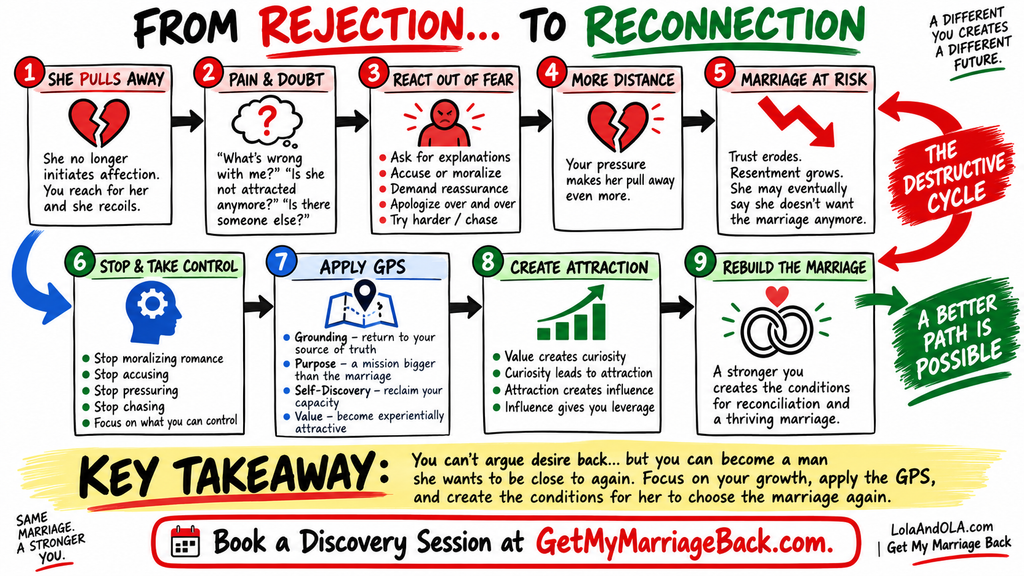
A Crisis of Attraction Can Become a Moral Prosecution
I have seen this dynamic become especially destructive when someone believes they did everything “right” before marriage.
Imagine a husband who married his wife as a virgin after practicing celibacy himself.
They intentionally entered marriage believing their choices gave them a strong foundation.
Years later, she stops initiating sex and affection.
He cannot reconcile her lack of desire with what he believes about their beginning.
So he develops an explanation:
“She must have lied.”
Now the attraction problem has become an integrity problem.
He confronts her.
She denies lying.
Instead of resolving his fear, her denial makes him push harder because he still needs an explanation for why she no longer seems to want him.
Eventually, the marriage is no longer primarily dealing with lost attraction.
It is dealing with suspicion, defensiveness, pressure, resentment, and repeated prosecution.
That is how a painful symptom can become an even bigger marriage crisis.
What Does It Really Mean When Your Wife Doesn’t Want Affection?
There is no single explanation.
Attraction can be affected by unresolved conflict, chronic stress, resentment, relational dynamics, health issues, sexual difficulties, emotional disconnection, life transitions, exhaustion, familiarity, pressure, or changes in how two people experience each other.
That is why Story-Tailoring matters.
You cannot safely take one explanation from another marriage and automatically paste it onto yours.
Still, there is an important principle you can use immediately:
Stop treating every instance of rejection as a complete diagnosis of your marriage.
Your wife pulling away tonight tells you something about what she is experiencing tonight.
It does not automatically tell you everything about tomorrow.
Shift #1: Stop Chasing Reassurance
When affection disappears, reassurance becomes incredibly tempting.
“Do you still love me?”
“Are you attracted to me?”
“Why don’t you ever touch me?”
“Are we okay?”
One conversation may be reasonable. Repeatedly needing your wife to regulate your fear is something different.
The more desperately you need reassurance, the more every interaction becomes loaded with expectation.
You are no longer simply connecting.
You are checking.
That difference can be felt.
Seduction requires enough emotional space for curiosity, anticipation, individuality, and voluntary movement toward another person.
Constant reassurance-seeking tends to collapse that space.
Shift #2: Stop Confusing Begging With Pursuit
Pursuit and chasing are not the same thing.
Healthy pursuit can communicate interest, confidence, warmth, playfulness, intention, and desire.
Chasing says:
“Please respond so I can feel okay.”
Begging says:
“Please give me affection so I can stop feeling rejected.”
Pressure says:
“You should respond because I am your spouse.”
Those behaviors may look superficially similar because they all involve reaching toward someone.
Emotionally, however, they come from very different places.
The objective is not to become cold or perform indifference.
It is to express interest without making your emotional stability dependent on the response.
Shift #3: Build G.A.M.E.—Not Manipulation
When I talk about GAME, I mean:
Giving Authentically but Mindfully with Emotional intelligence.
GAME is skill.
You are authentic because you are not pretending that you have no desires.
You are mindful because you pay attention to timing, context, emotional climate, and the other person’s experience.
Emotional intelligence allows you to notice your own fear without immediately making your spouse responsible for soothing it.
That is dramatically different from using tactics to trick someone into wanting you.
Real seduction is not coercion.
It creates an experience in which attraction has room to emerge voluntarily.
Shift #4: Start With GPS Before Trying to Rebuild Attraction
Before you obsess over getting your wife to initiate affection again, strengthen your internal position.
I call this GPS:
Grounding. Purpose. Self-Discovery.
Grounding
Ground yourself in a source of truth bigger than whether your wife accepts your touch tonight.
Without grounding, her response becomes your emotional weather report.
She welcomes you, and you feel powerful.
She pulls away, and you collapse.
That volatility makes skillful behavior difficult.
Purpose
Redirect emotional energy toward a mission, contribution, impact, and legacy bigger than any single human being.
Purpose does not mean neglecting your marriage.
It means your marriage is important without becoming the sole source of your identity.
That distinction creates emotional stability.
Self-Discovery
Use the crisis to discover capacity rather than manufacture self-blame.
Ask better questions.
Where have you become predictable?
Where did confidence become approval-seeking?
Where have resentment or fear changed your energy?
Which relational skills have you never actually learned?
Self-Discovery turns the crisis into information you can use.
Shift #5: Build Experiential Value, Not Just Moral Value
Being a good person matters morally.
Attraction, however, is experiential.
That distinction is crucial.
Your spouse experiences your energy, emotional regulation, presence, confidence, playfulness, social intelligence, purpose, boundaries, conversation, sexuality, decisiveness, warmth, and the emotional atmosphere created around you.
Those experiences contribute to how the relationship feels.
Research provides an interesting parallel. In studies of long-term relationships, perceived partner responsiveness—feeling that a partner understands, values, and cares for you—has been associated with greater sexual desire, with particularly strong effects observed among women in that research. You can review the research on partner responsiveness and sexual desire.
That does not mean becoming endlessly agreeable.
Responsiveness and neediness are not synonyms.
The larger point is that attraction lives inside experience.
You cannot substitute a résumé of marital virtues for the experience of being with you.
Shift #6: Create the Conditions for Curiosity
Familiarity is inevitable in marriage.
Over-familiarity does not have to be.
When your entire emotional world becomes organized around whether your spouse is responding, you can become increasingly predictable.
She knows what happens if she pulls away.
You ask why.
Then you become upset.
Next comes the relationship conversation.
Afterward, you seek reassurance.
Eventually she can anticipate the whole sequence before it starts.
Curiosity disappears when every interaction has an obvious ending.
Your job is not to manufacture mystery through games.
Instead, continue becoming a person with depth, direction, emotional range, independent thought, interests, purpose, standards, and a life that continues developing.
Experiential Value can create Curiosity.
Curiosity gives Attraction room to emerge.
Attraction increases Influence.
Influence can eventually create Leverage for building a different marriage.
Value → Curiosity → Attraction → Influence → Leverage.
Notice what is missing from that sequence.
Begging.
Shift #7: Prepare for Habit Drift
Understanding all of this while calmly reading an article is one thing.
Remembering it when your wife physically recoils from your touch is another.
Stress can pull people toward previously learned habitual responses rather than deliberate goal-directed behavior. In marriage, that can look like knowing exactly how you intended to respond and then hearing yourself say:
“What’s wrong with you?”
“Are you cheating?”
“Why don’t you ever want me?”
“I’m your husband!”
Your old pattern fires before your better judgment catches up.
I call that Habit Drift.
This is why insight alone rarely creates lasting change.
GPS5: Why Information Isn’t Enough
GPS gives you Grounding, Purpose, and Self-Discovery.
But sustainable execution requires four additional S’s:
Story-Tailoring
Your marriage has its own history, personalities, injuries, dynamics, circumstances, and attraction patterns.
Generic advice can become dangerous when you apply the right principle to the wrong problem.
Skill-Acquisition
Emotional intelligence is trainable.
So are conversation, boundaries, self-regulation, attraction dynamics, calibrated pursuit, conflict management, and relational awareness.
Knowing what not to do is only the beginning.
You need replacement skills.
Support
Rejection can make fear sound remarkably convincing.
Support gives you somewhere to process the emotional charge without repeatedly dumping it into the marriage.
System
You cannot rebuild attraction by improvising every time your spouse pulls away.
A system keeps your actions aligned with the marriage you are trying to create rather than the panic you are feeling today.
Your Wife’s Rejection Is Not Your Permission to Lose Yourself
Your wife never initiating affection can become one of the most painful experiences in your marriage.
It can also expose exactly where your emotional power has become dependent on another person’s response.
Your job is not to force your wife to accept your touch.
Neither should you pretend rejection does not hurt.
The answer is not making her feel guilty enough to give you affection.
Regain control over what you can control.
Build experiential value.
Create room for curiosity.
Develop attraction skills without coercion.
Strengthen your emotional intelligence.
Learn to pursue without begging.
Become responsive without becoming needy.
And build enough Grounding, Purpose, and Self-Discovery that your wife’s reaction tonight does not determine who you become tomorrow.
Attraction is not an invoice.
It is an experience.
Change the experience.
5 Physical Signs She Just Slept With Someone Else: The Truth
Frequently Asked Questions
There is no universal cause; stress, resentment, relational patterns, health factors, sexual difficulties, pressure, or attraction changes can all contribute. Look for the pattern and context rather than assuming one rejected touch explains the entire marriage.
Not necessarily; initiation and attraction overlap, but they are not identical, and desire can be affected by many individual and relationship factors. Research also connects perceived partner responsiveness with sexual desire, suggesting that the relational experience surrounding intimacy matters.
Stop using initiation as a test of your worth or as pressure for reassurance, and respect physical boundaries when affection is unwelcome. The larger objective is understanding the dynamic and rebuilding the conditions in which voluntary closeness can become possible.
Attraction and sexual satisfaction are not necessarily static; longitudinal research has found reciprocal associations between marital and sexual satisfaction over time. Focus on changing controllable relational patterns rather than trying to argue or guilt your spouse into desire.