


Your wife kisses you goodbye in the morning, texts you to make sure you’ve eaten, and tells you she loves you—but when you reach for her in bed, suddenly she’s too tired.
Take This 2 Minutes Quiz
How does that make sense?
You’re receiving just enough affection to believe your marriage is fine and enough sexual rejection to feel completely unwanted.
What makes this experience particularly frustrating is that you don’t necessarily have a wife who wants a divorce.
She still cares about your well-being, remembers your appointments, and talks about your future together.
Yet the woman who once couldn’t keep her hands off you barely initiates physical intimacy anymore.
Before you conclude that your wife is no longer sexually attracted to you, I want you to understand something fundamental:
Loving you, finding you attractive, and wanting sex with you are three different experiences.
Understanding how these experiences interact changes how you approach attraction loss, emotional disconnection, and sexual rejection in your marriage.
Why Does My Wife Love Me but Not Want Sex?
Sexual desire isn’t an automatic consequence of love or marital commitment.
Your wife can genuinely love you while experiencing circumstances that interfere with her desire for intimacy. Alternatively, she can appreciate everything you contribute to the marriage without experiencing the romantic attraction she once felt.
These explanations require different responses.
A 2018 systematic review of sexual desire in long-term relationships by Kristen Mark and Julie Lasslo examined 64 research articles and identified individual, interpersonal, and societal factors that influence sexual desire.
In other words, declining sexual intimacy cannot always be explained by a single relationship problem.
The mistake I frequently warn against is attempting to rebuild attraction without understanding what’s interfering with desire in the first place.
There are five major possibilities you need to recognize.

1. Your Wife Is Mentally and Physically Exhausted
Your wife tells you she’s too tired for sex, but somehow she manages to spend another 40 minutes scrolling through her phone.
Apparently, she has energy for everything except you.
That is frustrating, particularly when you’ve spent the entire day looking forward to connecting with her.
However, scrolling through a phone requires a different level of emotional engagement than sexual intimacy.
One activity offers relatively effortless distraction, while the other involves physical presence, vulnerability, attention, and interpersonal engagement.
When Mental Overload Interferes With Sexual Desire
Think about what was happening in your marriage when the frequency of sexual intimacy started declining.
Did you recently have children?
Were there financial difficulties, increased professional responsibilities, family problems, or significant lifestyle changes?
Chronic stress can make it difficult for someone to transition from managing responsibilities into experiencing pleasure.
Even when your wife is physically available, her attention can remain occupied by everything she believes needs to be accomplished.
That doesn’t automatically mean she has stopped finding you attractive.
Don’t Turn Your Responsibilities Into a Sexual Transaction
One predictable reaction is to start doing more around the house with the expectation that your wife will become more sexually available.
You complete additional chores, take care of the children, purchase dinner, and wait for your efforts to produce a romantic reward.
When nothing happens, resentment builds.
Handle your responsibilities because they belong to the life you’ve chosen, not because you’re secretly negotiating for sexual access.
Your contribution to the marriage is not a down payment on sex.
Reducing unnecessary stress is constructive, but turning every act of support into an expectation introduces another form of pressure.
2. Your Wife Is Carrying Unresolved Resentment
Your wife brings up something that happened three years ago, and you’re wondering why you’re still paying for something you’ve already apologized for countless times.
From your perspective, the issue should have been resolved.
However, her recurring complaints suggest that the emotional experience remains relevant to her.
This becomes particularly confusing when sexual intimacy has occasionally continued despite the conflict.
Having Sex Doesn’t Mean the Conflict Is Resolved
Imagine your wife agreeing to sex after a significant argument.
You experience that intimacy as confirmation that everything is fine again.
Two weeks later, she brings up the same disagreement, and you accuse her of refusing to move on.
What visibly happened?
She participated in sexual intimacy and subsequently expressed dissatisfaction about an unresolved issue.
Her participation didn’t necessarily mean the emotional injury had disappeared.
Sexual intimacy and emotional reconciliation are not interchangeable.
Recognize the Complaints You’ve Stopped Listening To
Pay attention to recurring patterns rather than focusing exclusively on the most recent sexual rejection.
Has your wife repeatedly expressed disappointment about your behavior?
Does she become defensive whenever certain subjects arise?
Have her affectionate gestures declined alongside the unresolved disagreements?
These patterns provide information about the emotional environment surrounding your marriage.
I am not suggesting that every accusation against you is objectively accurate or that you should accept responsibility for everything that has gone wrong.
Accountability means becoming responsible for your contribution and the quality of your future decisions.
Self-accountability is not self-blame.
You reclaim personal power when you stop defending every past mistake and start identifying the behavior you can improve.
3. Sex Has Become an Obligation Rather Than an Enjoyable Experience
This possibility is uncomfortable because your wife still agrees to have sex with you occasionally.
Nevertheless, she rarely initiates, barely participates, and appears relieved when it’s over.
You’re celebrating the frequency while overlooking the quality of the experience.
What you need to know is whether your wife participates because she genuinely welcomes intimacy or because refusing creates another difficult evening.
Never Confuse Sexual Compliance With Sexual Attraction
A 2014 study published in the Journal of Sexual Medicine by Debby Herbenick, Margo Mullinax, and Kristen Mark surveyed 179 women in long-term relationships.
Participants described several ways they attempted to manage differences in sexual desire, including participating in sex without initially experiencing desire. Many reported that their attempts had not resolved the underlying problem.
This matters because sexual participation alone doesn’t tell you everything about your wife’s romantic or emotional experience.
Desire can naturally emerge during mutually welcome intimacy, but that is different from participating reluctantly because declining feels difficult.
You deserve to experience genuine desire, and your wife deserves the freedom to decline without punishment.
Has Your Reaction to Rejection Become Part of the Problem?
Consider what typically happens when your wife says no.
Do you turn away angrily?
Does the remainder of the evening become uncomfortable?
Have you stopped expressing ordinary affection because she rejected your sexual advances?
Perhaps you deliver another lengthy speech about how unfair the marriage has become.
Your frustration is understandable, but these reactions can make intimacy feel increasingly consequential for the wrong reasons.
Eventually, your wife can begin associating even ordinary affection with expectations she would rather avoid.
A kiss becomes a negotiation. Holding hands becomes a potential sexual advance, and a romantic evening becomes another opportunity to disappoint you.
That isn’t the emotional environment in which seductive energy thrives.
Seduction Is an Invitation, Not Persuasion
Skillful seduction involves creating an enjoyable experience in which romantic interest can develop naturally.
Encouraging affection without automatically escalating it into sex gives that affection room to exist on its own.
When intimacy is mutually welcome, your attention belongs on mutual enjoyment rather than proving your desirability or achieving a particular outcome.
Being genuinely desirable is a different objective from securing sexual access.
4. Your Wife’s Capacity for Sexual Desire Has Changed
Your wife used to initiate intimacy regularly, and you barely had to make an effort.
Something changed after childbirth, a difficult period in her life, a new medication, or the beginning of menopause.
Because the change directly affects your relationship, you naturally interpret it through the lens of your marriage.
However, changes in sexual functioning are not always caused by relationship dissatisfaction.
Physical and Psychological Factors That Affect Sex Drive
Several circumstances can influence sexual desire:
- Hormonal changes during pregnancy, postpartum recovery, perimenopause, and menopause.
- Depression, anxiety, and persistent emotional distress.
- Physical discomfort or pain during intercourse.
- Side effects associated with certain medications, including some antidepressants.
- Sleep deprivation and chronic exhaustion.
- Illness, body-image concerns, and changes in physical health.
These experiences can affect sexual interest even when emotional love and romantic attraction remain present.
The important question is whether your wife’s declining desire appears alongside other changes in her life.
Has she stopped enjoying activities she previously loved?
Does she frequently mention discomfort during intimacy?
Did her sex drive change significantly after beginning a particular medication or experiencing a health concern?
A persistent or painful change in sexual functioning deserves appropriate medical attention if she is willing to pursue it.
Stop Interpreting Every Change as a Threat to Your Masculinity
Repeated sexual rejection naturally creates doubt about your desirability.
Nevertheless, turning every change in your wife’s sex drive into evidence of infidelity, personal inadequacy, or attraction loss creates additional emotional pressure.
Her health is not a referendum on your masculinity.
Recognizing possible medical or psychological factors allows you to approach the situation with emotional intelligence rather than unnecessary accusations.
You can remain confident in your identity while acknowledging that something outside your immediate control is affecting your marriage.
5. Your Wife Loves You but No Longer Experiences You Romantically
This is the possibility many people overlook because love, loyalty, and commitment are still present.
Your wife appreciates your reliability.
She trusts you to provide stability and knows you’re unlikely to abandon your responsibilities.
Unfortunately, she rarely experiences excitement, anticipation, or romantic curiosity when interacting with you.
Somewhere along the way, your marriage became functional rather than seductive.
The Parent-Child Relationship Dynamic
Imagine your wife constantly reminding you about appointments, telling you what to wear, monitoring your workout routine, and checking whether you’ve completed basic responsibilities.
Alternatively, you’ve become the person monitoring her every decision, questioning her whereabouts, and examining every change in her mood.
That’s an adult marriage increasingly operating like a parent-child relationship.
Responsibility is present, but romantic tension has diminished.
Your wife can care deeply about you without experiencing you as an engaging romantic partner.
What you need to know is whether your interactions still contain the ingredients that made your relationship enjoyable before the marriage became dominated by responsibilities.
Where Did the Romantic Curiosity Go?
When was the last time your wife discovered something interesting about you?
Have your conversations become almost entirely predictable?
Do you still pursue meaningful interests without constantly monitoring her reaction?
Where is the humor, adventure, personal space, and playfulness that once made your presence exciting?
These questions aren’t an invitation to manufacture jealousy or pretend you’re losing interest in your marriage.
They’re an invitation to recognize whether your personality has become overshadowed by your responsibilities and marital anxieties.
Research by psychologist Arthur Aron and colleagues, published in 2000, demonstrated short-term improvements in perceived relationship quality when couples participated in novel, exciting activities compared with mundane activities.
Novelty isn’t about constantly purchasing entertainment or organizing elaborate romantic experiences.
It begins with remaining a curious, engaged, evolving individual.
You can be a dependable husband without becoming a predictable lover.
How to Tell Whether Your Wife Has Lost Sexual Attraction or Simply Has Low Desire
One of the biggest mistakes you can make is interpreting the absence of sexual intimacy as definitive proof that your wife no longer finds you attractive.
Although attraction loss is a genuine possibility, sexual rejection can result from different circumstances.
Start observing the broader patterns surrounding your marriage.
| What You’re Experiencing | Possible Underlying Explanation |
|---|---|
| She avoids sex during particularly demanding periods. | Stress, exhaustion, or mental overload. |
| She repeatedly raises unresolved disagreements. | Resentment or emotional disconnection. |
| She participates in sex but appears reluctant. | Pressure, obligation, discomfort, or diminished enjoyment. |
| Her sex drive changed following medication or childbirth. | Physical, hormonal, or psychological factors. |
| She remains loving but rarely flirts or expresses romantic curiosity. | Diminished attraction or relationship predictability. |
| She avoids physical affection that previously felt natural. | Attraction loss, pressure, resentment, or other emotional barriers. |
These observations are useful clues, not definitive conclusions about your wife’s internal experience.
The timing of the changes matters.
So does the broader emotional history of your marriage.
Before determining your next move, identify which patterns consistently resemble your situation and which assumptions remain unsupported.
Why Begging for Intimacy Makes Attraction Problems Worse
When your wife repeatedly rejects sexual intimacy, your instinct is often to increase your efforts.
You initiate more frequently, seek reassurance, purchase gifts, or attempt to explain why sex is essential to a healthy marriage.
The more she withdraws, the harder you try.
Eventually, your emotional stability becomes dependent on whether she responds positively.
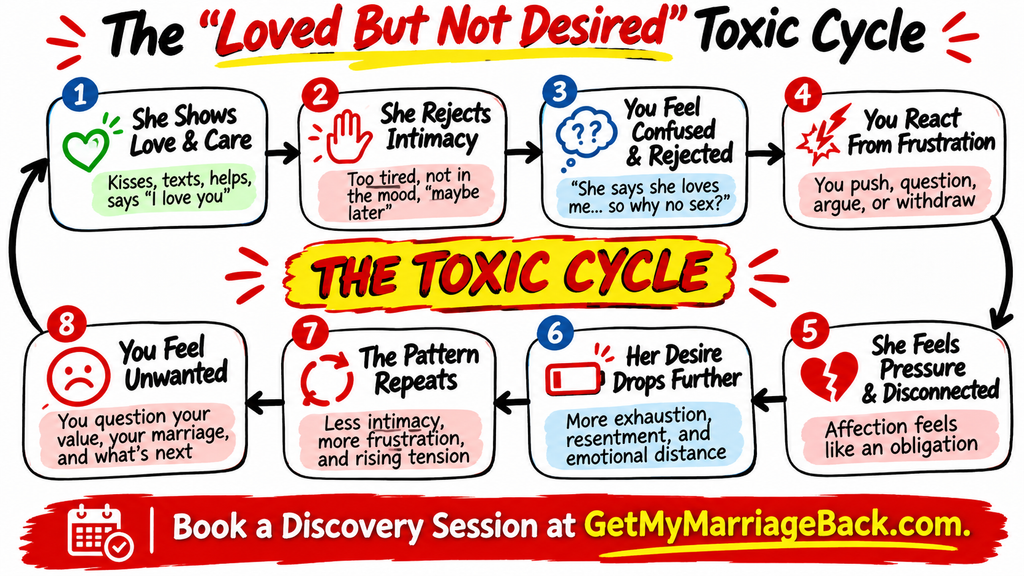
This produces a destructive cycle:
Sexual rejection → Personal insecurity → Reassurance-seeking → Increased pressure → Emotional withdrawal → More sexual rejection.
At this point, you aren’t simply dealing with the original barrier to sexual desire.
You’re introducing another problem through your reaction to it.
I’ve learned through my own marriage experience and coaching that understanding this cycle is fundamental to developing personal power.
The objective isn’t to become indifferent to your wife’s affection.
It’s to stop making her affection the deciding factor in how you carry yourself.
How to Nurture Sexual Attraction in Marriage With GPS5
My wife Lola and I recently celebrated 19 years of marriage.
We’ve experienced versions of these challenges ourselves, and I developed the GPS5 framework to navigate marriage crises through self-leadership, emotional intelligence, and strategic personal growth.
Instead of directing all your energy toward changing your wife, you develop the capacity to contribute constructively to the relationship.
Grounding: Stop Allowing Rejection to Define Your Reality
Grounding means redirecting your attention toward your higher self, your source of truth, and gratitude.
Your wife rejecting sex is an observable event.
Concluding that you’ve become undesirable, that your marriage is over, or that she must be interested in someone else involves additional interpretations.
Those conclusions require additional information.
When you’re grounded, your emotions don’t automatically become the evidence upon which you base your next decision.
You acknowledge the pain without allowing it to dictate your behavior.
Purpose: Give Your Pain Somewhere Productive to Go
When sexual rejection becomes the central problem in your life, everything else can gradually lose its importance.
Your ambitions become secondary.
Meaningful interests disappear, and your attention remains fixed on whether your wife will finally initiate intimacy.
Purpose redirects that emotional energy toward your calling, mission, contribution, and legacy.
I’m referring to something greater than yourself, your wife, and your marriage.
Having a meaningful life outside your immediate marital struggle restores important dimensions of your identity.
Self: Become a Sustainable Source of Love
Self is about developing your personal capacity for love, accountability, emotional stability, and growth.
You become responsible for your conduct without accepting blame for every problem in the relationship.
Your ability to remain affectionate doesn’t have to depend on receiving immediate affection in return.
Likewise, confidence doesn’t require constant reassurance.
This is how you develop sustainable emotional intelligence rather than temporarily performing confidence whenever you’re attempting to rebuild attraction.
Value: Improve the Experience of Interacting With You
Experiential value is not your moral worth as a human being.
It’s the quality of the experience another person has when interacting with you.
Are you engaging, playful, emotionally composed, curious, and genuinely enjoyable to be around?
Or has your presence become associated primarily with expectations, complaints, interrogations, and disappointment?
Developing experiential value changes the quality of your contribution to the marriage.
Curiosity: Allow Attraction to Develop Naturally
Romantic curiosity emerges when another person experiences something interesting, unexpected, or emotionally engaging about you.
Personal growth gives you new experiences, perspectives, and dimensions of your personality to express naturally.
You don’t need to deliberately confuse your wife, withhold affection, or manufacture emotional insecurity to generate curiosity.
Genuine attraction is nurtured through authentic experiences rather than strategic dishonesty.
Influence: Develop Personal Power Without Control
Attraction and emotional connection create opportunities for constructive influence within a relationship.
Influence isn’t the authority to determine your wife’s feelings or decisions.
It’s the capacity to contribute positively to the romantic environment through your skills, conduct, emotional intelligence, and personal presence.
The constructive progression is:
Grounding → Purpose → Self → Experiential Value → Curiosity and Attraction → Influence.
This is how you move away from fear-driven chasing and toward dignified romantic pursuit.
What to Do Tonight When Your Wife Rejects Sex Again
When your wife rejects your advances tonight, resist the urge to ask whether she still loves you.
That question generally seeks immediate emotional reassurance rather than useful information about the underlying problem.
Relax your shoulders, respect her space, and continue your evening without sulking or withdrawing kindness.
You don’t need another argument about your sexual needs in the immediate aftermath of rejection.
Neither do you need to pretend that the situation doesn’t hurt.
Confidence is always sexy when it emerges from genuine emotional stability rather than a performance designed to provoke a reaction.
Removing pressure interrupts the destructive cycle, but rebuilding attraction requires understanding and addressing the deeper patterns.
Why Emotional Intelligence Requires More Than Understanding the Problem
It’s relatively easy to recognize constructive relationship advice while you’re emotionally calm.
The difficulty begins when your wife rejects you again and all your familiar insecurities return.
Research published by Lars Schwabe and Oliver Wolf in the Journal of Neuroscience in 2009 found that acute stress can shift behavior toward established habits rather than intentional, goal-directed decisions.
That helps explain why you can understand the importance of emotional composure and still find yourself seeking reassurance during another painful interaction.
Developing consistency requires what I call the three S’s:
- Skills: The ability to respond constructively under emotional pressure.
- Support: Access to objective perspectives that challenge fear-driven interpretations.
- System: A consistent structure for practicing emotional intelligence and personal accountability.
Understanding attraction intellectually is valuable.
Developing the capacity to nurture it through your everyday behavior is what makes that knowledge useful.
Can a Loving Marriage Become Passionate Again?
A marriage doesn’t necessarily become loveless simply because sexual intimacy has declined.
Love can remain present while exhaustion, resentment, obligation, health concerns, or romantic stagnation interfere with desire.
Your responsibility isn’t to force your wife to experience attraction.
It’s to understand the relationship dynamics accurately, remove counterproductive behavior, and develop the personal capacity to nurture romantic connection.
You can be loving without begging.
Expressing genuine sexual desire doesn’t require demanding sexual access.
Being a committed husband doesn’t mean abandoning your individuality, purpose, confidence, or emotional independence.
The objective is to become a more skillful lover without losing yourself in the process.
My Wife Loves Me But Doesn’t Desire Me | 5 Signs | 5 Tips
Frequently Asked Questions
Your wife can genuinely love you while experiencing stress, exhaustion, unresolved resentment, hormonal changes, sexual pressure, or diminished romantic attraction. Identifying when the decline began and what else changed in your marriage helps you understand the underlying problem.
Low libido involves reduced sexual interest, while attraction loss can involve diminished romantic or sexual interest in a particular partner. Her broader behavior, health changes, and relationship history provide useful clues, but sexual rejection alone cannot establish which explanation applies.
Some people experience sexual desire more responsively than spontaneously, so rarely initiating intimacy doesn’t automatically indicate attraction loss. A persistent change in initiation, enjoyment, or affectionate behavior deserves attention when it causes distress in your marriage.
Focus on reducing pressure, developing genuine confidence, restoring romantic curiosity, and understanding the circumstances interfering with intimacy. Nurture mutually enjoyable experiences while respecting her boundaries and maintaining your own meaningful life.