
What Would Help You Most Right Now?

Choose the option that best matches where you are with your marriage.

I Need Personalized Help

My Marriage Is in Serious Trouble

If you're dealing with separation, divorce, loss of attraction, infidelity, intimacy problems, or a spouse who's pulling away, get help looking at what's happening in your specific situation.

Get Personalized Help →
Get My Marriage Back book cover
I'd Rather Learn What to Do First

Start With Get My Marriage Back

Get the book and start learning the principles for moving your marriage in a better direction.

Get the Free Book →

Your Wife Only Wants to Be Friends? 7 Ways to Rebuild Attraction

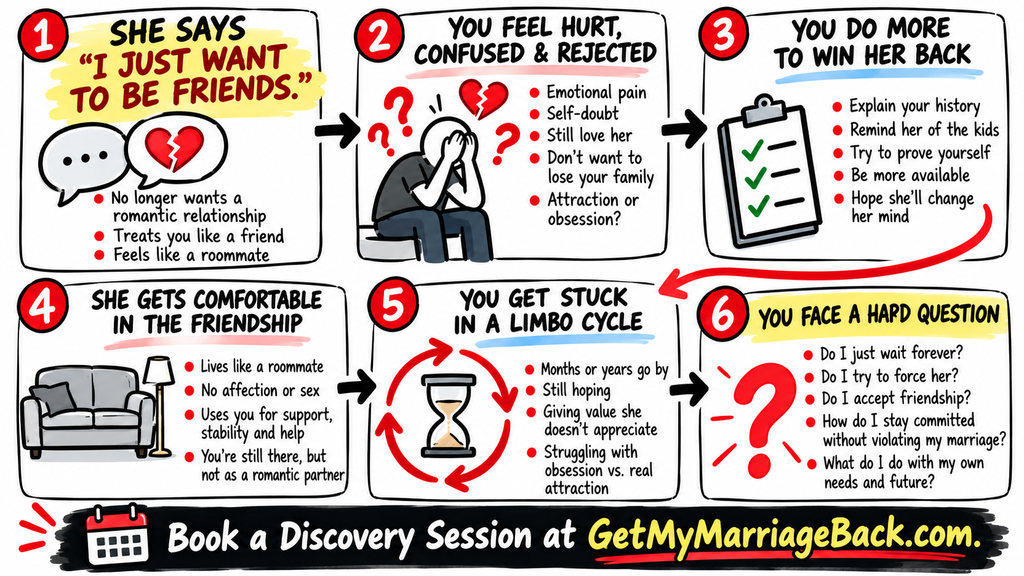
Your wife says she only wants to be friends, and suddenly you are married to someone who seems perfectly comfortable receiving friendship from you while you are starving for the romantic marriage you thought you were building.

Take This 2 Minutes Quiz

Question 1 of 15

That sentence—“I think we should just be friends”—can hit harder than an argument about divorce because it creates ambiguity.

You may still live together. You might still raise children, discuss bills, share meals, solve problems, and even laugh occasionally. From the outside, your marriage may look intact.

But you know something fundamental has changed.

She talks to you like a friend. She treats you like a roommate. Affection feels mechanical or disappears altogether. Sexual intimacy may be rare or nonexistent. You sense that she cares about you as a person but no longer experiences you as a romantic partner.

And because you still want your wife, your instinct may be to give her even more.

That is where you need emotional intelligence.

When your wife only wants to be friends, your objective is not to convince her that she should feel attracted to you. Attraction does not respond particularly well to arguments, invoices, pressure, guilt, or demonstrations of how much somebody should appreciate you.

Your first job is to understand what has actually changed.

What Does “My Wife Only Wants to Be Friends” Really Mean?

Take her words seriously without treating them as a prophecy about the rest of your life.

She is describing her present experience of the relationship.

That distinction matters.

“I only want friendship” can mean that romantic attraction has deteriorated. It can reflect accumulated resentment, emotional exhaustion, loss of sexual desire, disconnection, or uncertainty about whether she wants to remain married.

Sometimes a spouse genuinely does not know what she wants.

Don’t immediately translate uncertainty into an affair. Don’t assume “I need space” means another person exists. Equally, don’t dismiss what she is telling you because you believe your history, children, vows, or sacrifices should outweigh her current feelings.

Your history explains why the marriage matters.

It does not manufacture attraction.

my wife only wants to be friends

1. Stop Trying to Argue Her Back Into Attraction

One of the most predictable responses to romantic rejection is persuasion.

You explain how good the marriage used to be.

You remind her of everything you have survived together. Perhaps you talk about the children, your sacrifices, your future plans, or the promises you made.

None of those things is necessarily false.

The problem is the objective.

When the conversation becomes an attempt to prove that she should choose you, she experiences the emotional pressure behind your words even when your language sounds perfectly reasonable.

Seduction requires space for another human being to have an experience.

Pressure tries to dictate what that experience should be.

There is an enormous difference.

2. Don’t Confuse Rejection-Driven Obsession With Attraction

Here is an uncomfortable question:

Do you want your wife more because you are genuinely attracted to her—or because she no longer wants you?

It can be both.

Someone who was emotionally and physically available yesterday suddenly becoming unavailable today creates psychological tension. You start monitoring every interaction. A pleasant conversation gives you hope. A cold response ruins your day.

Before long, your emotional state revolves around whether she appears one percentage point closer to you.

That isn’t a powerful position from which to rebuild a marriage.

Stress matters here as well. Research has found evidence that stress can bias behavior toward previously learned habitual responses, although later replication work shows that the effect depends on conditions and is not universally reproduced.

That helps explain something many distressed spouses recognize immediately: knowing that chasing isn’t helping doesn’t automatically stop you from chasing.

When rejection hits again, old behavior can return.

3. Respect Her Autonomy Without Surrendering Your Own

Your wife is an adult.

She has autonomy.

So do you.

You cannot force another adult to want a romantic relationship with you, and respecting that reality is not weakness. In fact, trying to control what another person feels usually makes you less emotionally attractive, not more.

Recent relationship research is consistent with the importance of autonomy. Studies examining sexual autonomy support have found associations with greater sexual need fulfillment and sexual and relationship satisfaction.

That doesn’t mean “give your spouse unlimited space and attraction magically returns.”

It means desire and coercion are fundamentally poor partners.

You want your wife to experience you differently because her experience actually changes—not because you pressured her into saying the words you desperately wanted to hear.

4. Stop Feeding the Roommate Limbo

This is where many distressed spouses get stuck.

Your wife says she doesn’t want a romantic relationship, yet you continue supplying extraordinary amounts of romantic attention.

You chase.

You reassure.

You remain perpetually available.

You monitor her mood.

You solve every problem.

You perform increasingly elaborate demonstrations of love.

Underneath all of it may be an unspoken transaction:

If I keep showing you how valuable I am, eventually you will give me attraction in return.

But you cannot emotionally invoice somebody and demand attraction as payment.

That doesn’t mean becoming cold, cruel, vindictive, unavailable, or neglectful.

It means distinguishing responsibility from romantic over-functioning.

Be a responsible parent. Honor legitimate commitments. Treat your spouse with dignity. Participate appropriately in the family you created.

But stop turning endless giving into an indirect negotiation for desire.

If something you repeatedly offer is not being experienced as value, giving more of the same thing does not necessarily make it more valuable.

Sometimes it simply makes it more abundant.

5. Redirect Value Back Into Yourself

A marriage crisis can consume your identity.

You wake up thinking about your wife.

You analyze yesterday’s conversation in the shower. At work, you wonder whether she misses you. At night, you study her tone, body language, phone habits, and willingness to sit near you.

Your entire existence gradually becomes a referendum on whether she wants you.

Redirecting energy toward yourself interrupts that pattern.

This isn’t about pretending not to care.

Reconnect with purpose. Strengthen your physical and emotional health. Become more engaged with meaningful work, fatherhood or motherhood, friendships, contribution, learning, creativity, faith where applicable, and the larger mission of your life.

You are not doing those things as a performance designed to make your wife jealous.

If every improvement is secretly another strategy for obtaining her reaction, she remains the center of your identity.

The deeper shift is becoming grounded enough that rejection no longer dictates every move you make.

That creates something attraction desperately needs:

space.

6. Understand What Actually Creates Romantic Value

Being a good person and being romantically desirable are not identical concepts.

Moral value matters enormously.

Romantic attraction, however, involves experience.

How does someone experience themselves around you?

Do interactions repeatedly feel anxious, heavy, needy, resentful, transactional, interrogative, or emotionally exhausting?

Or does your presence increasingly communicate emotional stability, confidence, curiosity, playfulness, respect, competence, warmth, boundaries, and self-possession?

This is where emotional intelligence and seduction belong in the same conversation.

Seduction in marriage is not manipulation.

At its healthiest, seduction is your ability to participate skillfully in creating an experience where desire has room to emerge voluntarily.

There is research behind the importance of relational experience. A series of studies found that perceived partner responsiveness—feeling that a partner understands, values, and cares for you—was associated with greater sexual desire, with the association particularly strong among women in those studies. You can review the research on partner responsiveness and sexual desire.

Notice what this does not mean.

It doesn’t mean becoming a servant.

Responsiveness isn’t desperate compliance. Understanding someone doesn’t require abandoning yourself, and caring about your spouse doesn’t require removing every boundary.

Healthy responsiveness combines connection with self-respect.

7. Replace “Have You Changed Your Mind?” Energy With Curiosity

Imagine experiencing your spouse as someone who is constantly asking an invisible question:

Do you want me again yet?

Even when the words are never spoken, the energy can become obvious.

Every dinner becomes a test.

Every hug becomes evidence.

Every good weekend becomes proof that reconciliation is happening.

Every bad interaction becomes a catastrophe.

That’s exhausting for both people.

Your goal is to stop treating every interaction as a measurement of the marriage.

When you become less obsessed with extracting certainty, you create room for something different to happen.

Curiosity.

Your spouse notices changes she isn’t being instructed to notice. She encounters emotional responses she didn’t predict. Conversations can stop feeling like disguised marriage negotiations.

Curiosity is not the same thing as attraction.

But attraction rarely grows in an environment where everything about you has become predictable pursuit.
my wife only wants to be friends -friendship is not the enemy

Friendship Is Not the Enemy—Romantic Limbo Is

There is an important distinction here.

Friendship between spouses can be beautiful.

The problem isn’t that your wife enjoys talking with you or considers you a friend. A healthy marriage should contain friendship.

The crisis occurs when friendship replaces romance entirely while one spouse silently accepts an arrangement that is emotionally destroying them because they are terrified that asserting any internal boundary will cause permanent loss.

That creates limbo.

Months become years.

The distressed spouse keeps hoping.

Meanwhile, resentment quietly grows because the relationship continues providing certain comforts of partnership without resolving the central romantic rupture.

You don’t have to announce, “I refuse to be your friend.”

That can easily become another dramatic attempt to provoke a reaction.

Instead, recognize reality.

She has told you what she currently wants.

Respect that information, then take responsibility for what you control.

Don’t Use Distance as a Manipulation Tactic

This point is essential.

Some people hear “stop chasing” and immediately turn it into another technique:

I’ll withdraw so she misses me.

That’s still obsession.

Your behavior remains controlled by the response you hope to extract from her.

Genuine self-redirection is different.

You aren’t punishing her with silence. You’re not manufacturing jealousy, flirting with other people to provoke insecurity, withholding reasonable affection, or becoming deliberately cold.

Those tactics can create anxiety.

Anxiety is not the same thing as attraction.

Your objective is to become increasingly capable of bringing emotional stability, self-respect, boundaries, warmth, mystery, purpose, and genuine relational responsiveness into the marriage without trying to force an outcome from every interaction.

That is much harder than playing games.

It is also much more powerful.

What If Someone Else Eventually Shows Interest in You?

Prolonged roommate marriages create another complication people rarely discuss honestly.

You still have human needs.

You want connection. You want to feel desirable. You want affection and romantic companionship.

After months or years of rejection, attention from somebody new can feel intoxicating.

Suddenly someone laughs at your jokes, notices you, compliments you, or seems genuinely interested.

Be careful.

The existence of another opportunity doesn’t resolve the marriage you’re already in.

Don’t use an outside person as pain medication, leverage, revenge, or proof that you’re still desirable. That creates another crisis instead of solving the first one.

Clarity comes before complication.

Can You Save Your Marriage Alone?

You cannot single-handedly control the final outcome of a relationship involving two autonomous adults.

But you can profoundly change what you contribute to the relational system.

That’s why “save your marriage alone” should never mean doing twice as much relationship labor while your spouse does nothing.

It means beginning with what you actually control.

Your behavior.

Your emotional regulation.

Your purpose.

Your boundaries.

Your responsiveness.

Your attractiveness as an experience.

Your ability to stop turning fear into pressure.

A spouse who wants out may not immediately recognize those changes. That’s fine.

Real change is not a performance scheduled around somebody else’s applause.

Attraction Rebuilding Is a Skill

Most people were never taught how attraction works inside a long-term marriage.

They were taught commitment.

They were taught responsibility.

Some were taught communication.

Very few were taught how familiarity, resentment, autonomy, emotional responsiveness, confidence, novelty, sexuality, boundaries, and self-development interact with romantic desire over many years.

That’s why a marriage crisis can feel so bewildering.

You may be doing what you were taught a “good spouse” should do and still watching attraction disappear.

The answer isn’t becoming a bad spouse.

It is developing a more complete skill set.

You need enough self-awareness to notice when love has turned into chasing.

Enough emotional intelligence to distinguish responsiveness from appeasement.

Enough confidence to respect another person’s autonomy without collapsing.

Enough discipline to stop measuring your worth through your spouse’s immediate reaction.

And enough relational skill to become an increasingly desirable experience without trying to manipulate desire into existence.

Your wife saying she only wants to be friends describes where the relationship is today.

What you do next determines whether you spend your energy arguing with that reality—or developing the person and relational skills capable of creating a different experience tomorrow.

Wife or Husband Denying You Sex? DO THIS!!!

Frequently Asked Questions

What does it mean when my wife says she only wants to be friends?

It usually means she currently experiences the relationship as more platonic than romantic, although the reasons can include attraction loss, resentment, disconnection, uncertainty, or accumulated relationship problems. Treat the statement seriously without assuming you already know its cause.

Can my wife become attracted to me again after saying she only wants friendship?

Attraction can change because relationship experiences and desire are not necessarily static; research has associated perceived partner responsiveness with sexual desire and relationship quality. Rebuilding attraction, however, requires creating healthier relational conditions rather than demanding a particular emotional response.

Should I give my wife space if she says she just wants to be friends?

Respecting requested space can reduce pressure, but don’t turn distance into punishment or a manipulation designed to make her chase you. Use the space to regulate yourself, clarify boundaries, reconnect with purpose, and stop making every interaction a referendum on reconciliation.

How do I save my marriage when my wife isn’t attracted to me?

Start by stopping behaviors that convert fear into pressure, over-pursuit, or endless attempts to prove your value. Focus on emotional regulation, autonomy, responsiveness, purpose, boundaries, and the quality of experience you bring into the relationship rather than trying to argue your spouse back into attraction.


Your Wife Asked You to Move Out? 5 Mistakes That Push Her Further Away

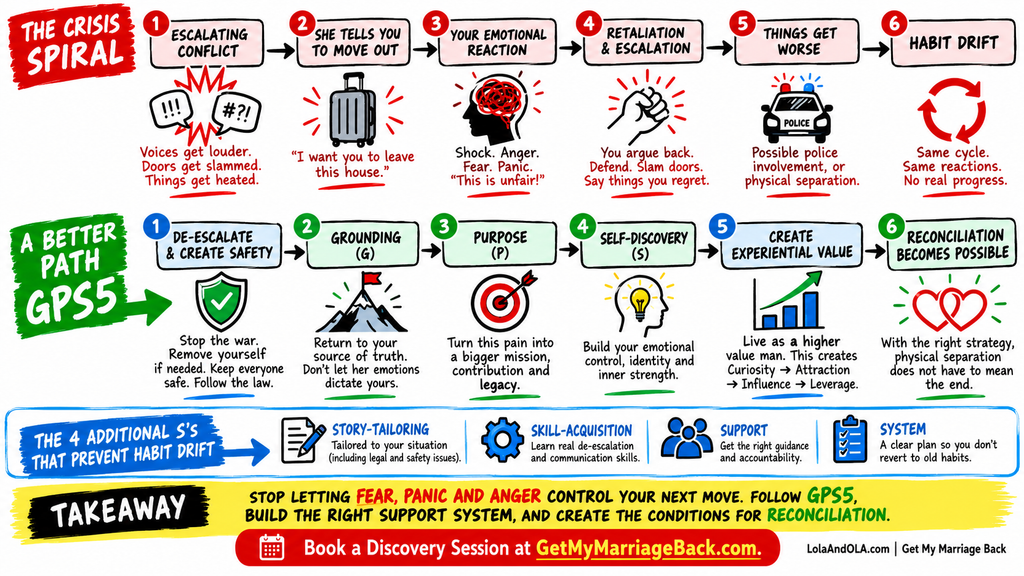
Your wife asked you to move out, and right now leaving your own home can feel exactly like agreeing that your marriage is over.

Take This 2 Minutes Quiz

Question 1 of 15

I understand why your first reaction can be, “Absolutely not.”

This is your house too. You may pay the mortgage or rent. Your children may live there. Your routines, memories, belongings and entire family life are wrapped up in that home.

Then the person you married tells you to leave.

It feels unfair.

And depending on the circumstances, it may genuinely be unfair.

But when your wife asks you to move out during a marriage crisis, the argument about who is right can quickly become less important than what happens next.

Your fear wants immediate action. Your anger wants justice. Your anxiety wants certainty.

None of those emotions should be driving the car.

I know this from more than coaching people through marriage crises. During the darkest period of my own marriage, I packed a small bag and left my house.

Our conflict eventually escalated further. During one argument, I became so frustrated that I picked up a bowl of water from the kitchen countertop and poured it onto the floor.

My logic at that moment was almost comical in hindsight: I was trying to demonstrate that anybody could fly off the handle.

Think about that.

I was demonstrating the problem of losing control by losing control.

Eventually, Lola called the police.

That is why I draw a hard line here. If anybody feels unsafe, safety comes first. If police or emergency assistance is necessary, call them. If there are legal questions about leaving the marital home, custody, property, a protective order or your rights, get qualified legal advice.

Marriage strategy does not override safety or the law.

Once those issues are separated from the reconciliation problem, however, you can ask a much more productive question:

What kind of man are you going to become while your marriage is under this pressure?

Wife Asked Me to Move Out: Does That Mean the Marriage Is Over?

No single request for physical distance can tell you the entire future of your marriage.

Your wife asking you to move out is serious information. Treat it seriously without turning it into a prophecy.

Separation and divorce are not identical.

Physical distance and emotional finality are not identical either.

The danger is that fear collapses all of those distinctions into one terrifying conclusion:

“If I leave, I lose her.”

Once you accept that conclusion as fact, almost anything can feel justified.

You argue.

You refuse.

You explain why she has no right to ask.

You remind her how much you pay.

You demand another conversation.

You send enormous text messages.

You insist that you’re “fighting for your marriage.”

But there is an uncomfortable question underneath all of this:

Are you fighting for your marriage—or is fear fighting through you?

That distinction changes everything.

wife asked me to move out

Mistake #1: Treating Retaliation Like Strength

One client I worked with had lived through years of increasingly heated marital conflict.

Arguments became normal. Doors were slammed. Emotions escalated.

His philosophy was straightforward:

If somebody brings war, retaliate with war. Otherwise, they’ll think you’re weak.

That philosophy felt powerful until his wife told him to move out.

Suddenly, everything he believed about strength was being tested.

This is one of the most seductive mistakes in a marriage crisis because retaliation feels like Personal Power.

It isn’t.

If your wife can raise her voice and automatically make you raise yours, she is influencing your emotional state.

If one sentence about separation makes you lose control, separation is controlling you.

When fear, panic, anger and anxiety determine your next move, those emotions have power over you.

Self-control is not submission. De-escalation is not weakness.

You can be physically strong enough to slam every door in your house and still be emotionally controlled by fear.

wife asked me to move out, not what

Mistake #2: Believing You Must Choose Between Fighting and “Giving Her Space”

Generic marriage advice loves extremes.

“Never leave your house.”

“Fight for your marriage.”

“Don’t let her push you around.”

Then another corner of the internet tells you:

“Just give her space.”

“Do whatever she wants.”

“Don’t contact her.”

“If she loves you, she’ll come back.”

Neither collection of slogans knows your marriage.

There is an enormous difference between fear-driven chasing and dignity-based pursuit.

You can want your wife.

You can want your marriage.

You can make your interest clear.

None of that requires you to beg for reassurance, force conversations, repeatedly ask whether she still loves you, or use every interaction to measure your chances of reconciliation.

Likewise, respecting legitimate distance does not require becoming cold, passive or manipulative.

You are not disappearing to “make her miss you.”

Your objective is much bigger.

Become someone whose emotional center is no longer dependent on what mood your wife is in today.

Mistake #3: Trying to Talk Your Way Back Into Attraction

When your wife wants separation, words become extremely tempting.

You want to explain your intentions.

You want her to understand how much you love her.

Maybe you have finally recognized mistakes that she complained about for years, and now you desperately need her to believe you have changed.

So you talk.

And talk.

And talk.

But attraction is experiential.

Your wife does not experience your transformation because you gave her a PowerPoint presentation about it.

She experiences you.

How do you respond under pressure?

What happens when she disagrees with you?

Can you hear something painful without immediately defending yourself?

Does every warm interaction become an opportunity to ask about reconciliation?

Can you experience rejection without collapsing, exploding or retaliating?

Those experiences communicate far more than another promise.

Why Chasing and Withdrawal Can Make the Crisis Worse

There is useful research behind this dynamic.

A study involving 116 married couples examined what researchers call demand-withdraw communication—a pattern where one spouse pushes for discussion, change or resolution while the other avoids or withdraws.

Both husband-demand/wife-withdraw and wife-demand/husband-withdraw patterns were associated with more negative emotions and tactics and lower conflict resolution. The pattern was not simply a “husband problem” or a “wife problem”; either spouse could occupy either side of the cycle. You can read the research on demand-withdraw patterns in marital conflict.

Look at how easily this can appear after your wife asks you to move out:

Fear → Pursuit → Pressure → Withdrawal → More Fear → More Pursuit

You want reassurance, so you push for a conversation.

She experiences pressure and retreats.

Her retreat frightens you, so you push harder.

Now she wants even more distance.

You interpret that distance as proof that you need to fight harder for the marriage.

The cycle feeds itself.

Breaking that cycle creates emotional breathing room. And emotional breathing room matters when you are trying to rebuild attraction.

Mistake #4: Making Your Wife Responsible for Your Emotional Stability

This is where separation exposes things ordinary married life can hide.

When your wife is warm, you feel powerful.

When she becomes cold, you fall apart.

When she texts you, you see hope.

When she doesn’t, you start imagining divorce.

When she laughs with you, you think reconciliation has started.

Then she mentions separation again and your entire emotional world crashes.

That’s not Personal Power.

Your wife has effectively become the thermostat controlling your emotional temperature.

Attraction struggles under that burden because every interaction acquires a hidden job:

“Please make me feel safe about us.”

Your wife can feel that pressure even when you never say those exact words.

This is why your first job is not making her change her mind.

Your first job is recovering your ability to lead yourself.

Grounding: Stop Letting the Symptom Become Your Identity

The symptom is:

“My wife asked me to move out.”

Grounding does not mean pretending that symptom doesn’t exist.

It means returning to a source of truth higher than the symptom.

Your marriage crisis cannot become your identity.

Your wife’s current emotional state cannot become your definition of your worth.

Her rejection cannot become the authority determining whether today has meaning.

Grounding brings you back to truth and gratitude while allowing you to confront the crisis exactly as it is.

Now you can respond instead of react.

That difference is enormous.

Purpose: Become Bigger Than the Crisis

Pain has a nasty habit of shrinking your entire world.

Suddenly everything becomes about your wife.

What did she mean by that text?

Why didn’t she call?

Is she talking to somebody else?

Does she miss you?

Is she filing?

When is she coming back?

Your marriage matters tremendously, but your purpose must be bigger than any single living human being—including your wife and including you.

Redirect pain into mission.

Reconnect with contribution, impact and legacy.

Build something meaningful enough that your marriage crisis cannot consume every available piece of your identity.

This isn’t a trick for making your wife jealous.

Purpose is attractive because purpose creates life.

A person with direction generates a different experience from a person whose entire existence has become monitoring whether someone else still wants them.

Self-Discovery: Find Out Who You Are Under Pressure

A marriage crisis reveals capacity.

It exposes your beliefs about masculinity, love, conflict, rejection, control, fairness and strength.

Don’t turn that discovery into self-blame.

Use it.

You may discover that what you called “standing up for yourself” was sometimes emotional reactivity.

Perhaps what you called “fighting for the marriage” was occasionally panic.

What looked like communication may have become repeated demands for reassurance.

Self-Discovery means developing enough emotional capacity to see those patterns without needing to declare yourself either the hero or villain.

Then you can change what you actually control.

How Attraction Starts Rebuilding During Separation

Attraction isn’t something you demand from your wife.

It emerges from experience.

I describe the progression this way:

Value → Curiosity → Attraction → Influence → Leverage

Value here does not mean moral worth.

You already have human worth.

I’m talking about experiential value: what does interacting with you feel like?

Are you emotionally exhausting or emotionally engaging?

Predictable or interesting?

Desperate or grounded?

Reactive or responsive?

Consumed by the marriage or connected to a meaningful life?

When your experience changes consistently, curiosity can emerge.

Your wife begins encountering something different instead of hearing another sales pitch about how different you are.

Curiosity gives attraction room to breathe.

Attraction can expand influence.

Influence creates leverage—not leverage to control her, but a stronger relational position from which reconciliation becomes possible.

Mistake #5: Trying to Recreate the Old Marriage

You don’t need the broken marriage back.

Read that again.

The goal is a brand-new marriage with the same person.

Going back to exactly what existed before the separation simply restores the conditions that produced the crisis.

You need a different relational experience.

More emotional intelligence.

Better conflict skills.

Greater self-control.

More curiosity.

Stronger individuality.

More play.

More purpose.

Greater experiential value.

That is how reconciliation becomes something more meaningful than getting your wife physically back inside the same house.

What to Do After Your Wife Asks You to Move Out

Start with reality.

Determine whether there is an immediate safety issue.

Separate legal questions from emotional questions.

Do not make irreversible housing, financial, property or custody decisions based solely on marriage advice from the internet.

Then look directly at your emotional pattern.

What happens inside you when she says, “I want you to leave”?

Does fear become anger?

Do you retaliate?

Do you start proving?

Does panic make you send paragraphs of text?

Do you immediately demand certainty about divorce?

Identify the automatic reaction before trying to perfect your next speech.

From there, rebuild your foundation:

Grounding. Purpose. Self-Discovery.

Create experiential value through the way you live and interact.

Allow curiosity and attraction to emerge from experience rather than pressure.

Develop influence through consistency.

Build leverage through emotional intelligence, dignity and a life that does not collapse every time your wife has a difficult emotion.

This is not passivity.

This is strategic self-leadership.

Physical Separation Does Not Have to Mean Emotional Surrender

I packed a bag and left my house during my own marriage crisis.

I understand the fear attached to that moment.

Walking through a door with luggage can feel like you’re physically acting out the death of your marriage.

But distance itself does not write the ending.

What matters enormously is what happens inside that distance.

You can spend separation obsessing, retaliating, monitoring, begging and waiting.

Or you can use the crisis to become grounded, purposeful, emotionally intelligent and experientially attractive.

You cannot control whether your wife ultimately chooses reconciliation.

But you have tremendous influence over the experience of you that you bring into every interaction from this point forward.

That’s where your Personal Power lives.

Stop trying to win the argument about who has the right to be angry.

Stop allowing fear to masquerade as strength.

Don’t make your wife responsible for regulating your emotions.

Build the man who can experience this crisis without becoming the crisis.

That is where rebuilding your marriage begins.

Wife or Husband Denying You Sex? DO THIS!!!

Frequently Asked Questions

What should I do if my wife asks me to move out?

De-escalate first, address any immediate safety or legal issues appropriately, and avoid making panic-driven decisions. Then identify the fear-driven behaviors you control and begin changing the experience you create in the marriage.

Does moving out mean my marriage is over?

No; physical separation and divorce are different events, although a request to move out should be treated seriously. Focus less on predicting the ending and more on responding with emotional intelligence, dignity and deliberate action.

Should I give my wife space when she wants separation?

Respecting legitimate space can reduce pressure, but don’t use distance as a manipulation tactic to make her miss you. Research on demand-withdraw conflict suggests that cycles of pressure and withdrawal are associated with more negative interactions and poorer conflict resolution.

Can I save my marriage while separated?

You cannot single-handedly dictate reconciliation, but you can change your contribution to destructive patterns and rebuild grounding, purpose, experiential value and emotional intelligence. Those changes create healthier conditions in which curiosity, attraction and reconciliation can develop.

Your Wife Is Cold and Distant: What Her Withdrawal Really Means

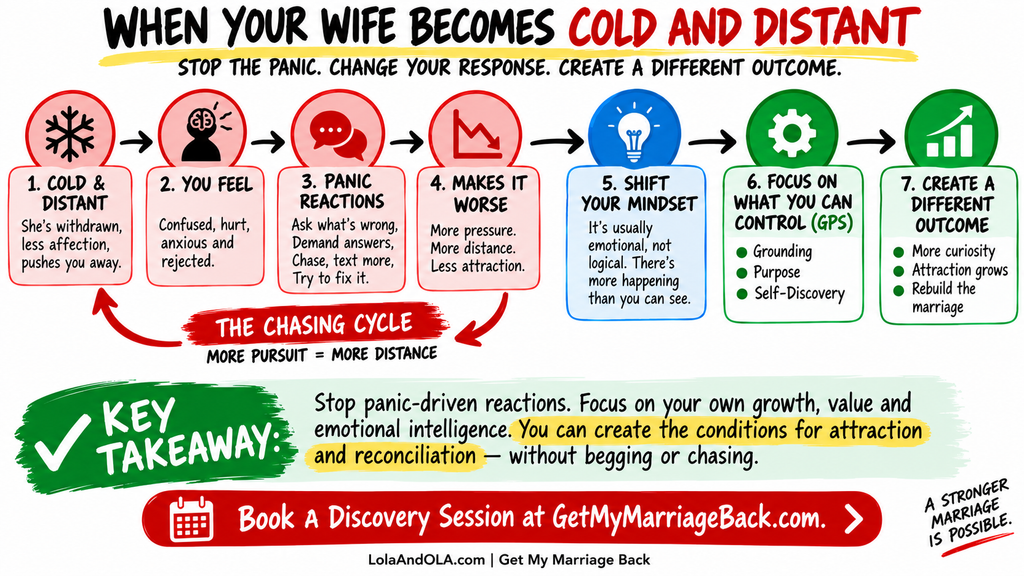
Your wife is cold and distant, and every attempt you make to get closer seems to push her even further away.

Take This 2 Minutes Quiz

Question 1 of 15

You can feel the change before you can explain it.

Her warmth is different. Conversations are shorter. Affection has disappeared or feels forced. You reach for her and she pulls away. Maybe she gives you the cold shoulder, spends more time alone, or treats you more like a roommate than the man she once desired.

You want answers because uncertainty is brutal.

“What happened?”

“Why are you acting like this?”

“Do you even want this marriage anymore?”

Those are reasonable questions. But when your wife is emotionally withdrawing, your desperation for clarity can become the pressure that makes her retreat even further.

That is where many husbands accidentally turn an attraction problem into a much bigger marriage crisis.

Why Is My Wife Cold and Distant Towards Me?

Start with something that sounds simple but changes everything:

There is probably more happening internally than you can currently see.

That doesn’t excuse cruelty, betrayal, contempt, or disrespect. Nor does it require you to tolerate unacceptable behavior.

It means you should resist the temptation to interpret every cold response as a complete explanation of what is happening inside her.

A cold wife can be angry.

She can be disappointed.

She can be overwhelmed.

There may be accumulated resentment, lost attraction, unresolved conflict, stress, exhaustion, broken trust, or an emotional disconnection neither of you properly addressed when it was smaller.

Sometimes she doesn’t completely understand what she is experiencing herself.

That ambiguity matters because the wrong diagnosis produces the wrong response.

When you immediately decide, “She doesn’t care about me anymore,” you naturally start reacting to that conclusion. Fear takes over, and suddenly you are chasing reassurance, monitoring her mood, demanding answers, or desperately trying to make her feel differently.

Now the original problem has company.

my wife is cold and distant

Mistake #1: Turning Her Emotional Distance Into a Court Case

When your wife becomes cold, you want to appeal to logic.

“You’re my wife.”

“We made vows.”

“You need to communicate.”

“At least treat me with respect.”

“We can’t fix this if you won’t talk.”

On paper, some of those statements sound perfectly reasonable.

But your marriage isn’t a courtroom, and your wife isn’t a defendant.

You cannot cross-examine someone back into attraction.

You also cannot produce enough evidence to force another human being to feel warmth, curiosity, desire, or emotional connection.

This is especially important when a demand-withdraw cycle has developed. In research involving 116 married couples reporting conflicts at home, both husband-demand/wife-withdraw and wife-demand/husband-withdraw patterns were associated with more negative emotions and tactics and lower conflict resolution. The researchers also found these patterns were especially likely around marital issues. You can read the research on demand-withdraw patterns in marital conflict.

Think about what that can look like in your house.

You feel her withdrawing, so you pursue an explanation.

She experiences more pressure, so she withdraws further.

Her withdrawal scares you, so you pursue harder.

Soon you are no longer solving the original issue. You are feeding a cycle.

Mistake #2: Making Her Mood the Source of Your Emotional Stability

Your wife is warm this morning, and you feel hopeful.

She is distant tonight, and suddenly you believe the marriage is doomed.

She laughs at something you say, and you think attraction is returning.

Tomorrow she barely speaks, and your stomach drops again.

That’s exhausting.

More importantly, you have allowed your wife’s current emotional temperature to control yours.

This is where self-leadership becomes critical.

Your wife can matter tremendously to you without becoming the source of your identity.

Her attraction matters. Your marriage matters. Saving your marriage can matter enormously.

But when your emotional stability requires constant reassurance from the very person who is currently withdrawing, you create pressure precisely where you need room.

You begin watching every facial expression.

Every text becomes evidence.

Every quiet evening becomes a verdict.

That isn’t personal power. It’s emotional dependence disguised as vigilance.

Mistake #3: Believing You Must Fix Her Coldness

When you desperately want to save your marriage, your instinct is to fix the obvious symptom.

You want her to talk again.

You want affection back.

You want sex again.

You want her to stop pushing you away.

Naturally, your attention goes directly toward changing her.

That’s the trap.

You cannot sustainably build attraction by managing another adult’s emotional state.

Your power starts with changing what you can actually control: your emotional regulation, reactions, purpose, presence, habits, communication, social intelligence, and the experience of being around you.

This distinction is enormous.

You are not trying to manipulate your wife into becoming warm.

You are becoming capable of creating a different relational experience without requiring an immediate reward from her.

when your wife becomes cold and distant

Attraction Is an Experience, Not an Obligation

A lot of people approach marriage as though attraction should automatically survive because the marriage exists.

I used to see marriage heavily through the lens of duty myself.

You’re married. You’re building a life. You have responsibilities. You manage whatever comes with it.

But duty and desire aren’t identical.

A person can fulfill responsibilities while the relationship becomes emotionally flat.

You can pay every bill and still become roommates.

Both people can remain technically married while curiosity, playfulness, admiration, emotional engagement, and sexual attraction quietly disappear.

This is why keeping score is dangerous.

“I’ve been trying.”

“I’ve been affectionate.”

“I’ve provided.”

“I apologized.”

“Now she needs to do her part.”

That’s not attraction.

That’s an invoice.

Value inside an intimate relationship isn’t merely about moral worth or proving that you’re a good person. Experiential value is about what another person experiences around you.

Are interactions consistently tense?

Does every conversation become a marriage summit?

Are you interesting beyond this crisis?

Can you tolerate uncertainty without collapsing?

Do you bring purpose, emotional intelligence, curiosity, confidence, playfulness, and grounded energy into your life?

Attraction has room to grow when being around you becomes an experience rather than an obligation.

Mistake #4: Chasing Harder Because She Is Pulling Away

There is an important difference between pursuit and chasing.

Pursuit can come from dignity, genuine interest, confidence, and desire.

Chasing comes from fear.

Chasing says:

“Please tell me we’re okay.”

“Why haven’t you answered?”

“Do you still love me?”

“Are you attracted to me?”

“Are you leaving?”

“What can I do to make you happy?”

The words aren’t always the problem. The emotional dependency underneath them is.

Your wife can feel when every interaction carries an invisible demand: Make me feel safe about this marriage right now.

That is an enormous job to place on someone who is already emotionally withdrawing.

So don’t confuse “stop chasing” with pretending you don’t care.

Coldness isn’t attractive either.

Playing games isn’t self-leadership.

Manufacturing jealousy isn’t confidence.

The objective is not to punish her withdrawal with your own withdrawal. Your objective is to stop fear from dictating your behavior.

When Your Wife Pushes You Away, Stop Trying to Win the Moment

One of the hardest skills in a marriage crisis is learning not to treat every bad interaction as an emergency.

She walks past you without speaking.

Your nervous system wants resolution now.

She gives you a cold response.

You want to confront it now.

She sleeps facing the other direction.

Your mind wants to know what it means now.

That urgency makes you vulnerable to bad decisions.

Instead of asking, “How do I make her stop being cold tonight?” ask a better question:

“Who am I becoming while this marriage is under pressure?”

That shifts you from reaction to leadership.

Mistake #5: Becoming the Victim of Every Rejection

It is possible for your wife’s behavior to be unfair.

You can be genuinely hurt.

You can disagree strongly with how she is handling the marriage.

Self-leadership does not require pretending otherwise.

But victimhood becomes dangerous when it convinces you that your only path forward is waiting for her to change first.

If she must apologize before you grow, you’re stuck.

When she must communicate before you become emotionally disciplined, you’re stuck.

If she must become affectionate before you reclaim your confidence and purpose, you’re stuck.

Your ability to lead yourself cannot depend on another person’s cooperation.

That doesn’t mean one person can single-handedly maintain a healthy marriage forever. Ultimately, a marriage involves two people.

But you don’t need two people to stop contributing to a destructive cycle.

You need one.

Start with the person you control.

Ground Yourself Before You Try to Rebuild Attraction

When your marriage feels like it is collapsing, grounding means returning to a source of truth larger than the symptom in front of you.

The symptom is:

“My wife is cold.”

“My wife isn’t attracted to me.”

“She keeps pushing me away.”

“She wants separation.”

“She might want a divorce.”

Those circumstances matter, but they cannot become your entire identity.

Grounding gives you enough emotional distance from the immediate panic to choose your response instead of being dragged around by fear.

This is where gratitude also matters.

Not gratitude as denial.

You don’t pretend your marriage is fine.

Instead, you reconnect with what remains true and valuable in your life while confronting the crisis honestly.

A grounded person becomes harder to emotionally destabilize.

That quality matters tremendously when you are trying to rebuild attraction.

Reclaim a Purpose Bigger Than Your Marriage Crisis

Pain narrows your vision.

Suddenly everything becomes your marriage.

You wake up thinking about her.

You check your phone thinking about her.

At work, you’re analyzing last night’s conversation.

At home, you’re watching her face for clues.

Before sleeping, you’re replaying everything again.

That obsession doesn’t make you more committed. Eventually, it can make you less interesting, less stable, and less capable of handling the very crisis you desperately want to solve.

Purpose redirects pain into something larger.

What impact are you here to create?

What legacy are you building?

Who needs the strongest version of you?

What work would still matter if nobody applauded you?

Your purpose must be bigger than any single living human being—including your wife and including yourself.

This isn’t abandoning your marriage.

It is refusing to abandon yourself while saving it.

Use Self-Discovery Without Turning It Into Self-Blame

There is another extreme you need to avoid.

Once you realize that you can only control yourself, you can start blaming yourself for everything.

Don’t.

Self-discovery isn’t self-condemnation.

Ask useful questions instead.

What have you failed to notice?

Where have you become predictable?

Have you become chronically reactive?

Did marriage turn into duty instead of an engaging relationship?

Are you communicating because you have something meaningful to share—or because you need reassurance?

Has your entire identity narrowed into provider, parent, problem-solver, or rejected spouse?

What patterns do you bring into conflict?

These questions restore power because they reveal capacity.

You cannot change what you refuse to examine.

Build Value Before Demanding Attraction

This is where the work becomes practical.

Experiential value is the quality of the experience someone has around you.

It isn’t perfection.

It isn’t money.

Nor is it performing tricks to win your wife back.

Value can show up as emotional steadiness when you used to panic.

It can be listening without immediately defending yourself.

Sometimes it means bringing energy, purpose, humor, curiosity, social connection, competence, or playfulness back into a life that became consumed by marital problems.

You are creating contrast between the person fear was turning you into and the person you are capable of becoming.

That contrast can create something important:

Curiosity.

She starts noticing that something feels different.

Curiosity creates room for renewed attraction because she is no longer interacting with exactly the same predictable pattern.

Attraction can then create influence.

Influence creates leverage—not leverage for controlling her, but relational leverage for building a different experience between you.

That sequence cannot be bullied into existence.

It has to be experienced.

Stop Making Every Interaction About Saving the Marriage

Imagine living with someone who turns every dinner, car ride, text message, bedtime, or quiet moment into a referendum on the relationship.

That’s exhausting.

You desperately want to save your marriage, so everything starts becoming about saving the marriage.

Ironically, that can remove the very qualities that make marriage enjoyable.

There is no curiosity.

No play.

No discovery.

Every interaction carries emotional weight.

Give the relationship room to contain experiences that aren’t negotiations about its survival.

This doesn’t mean avoiding important issues indefinitely. It means understanding that connection needs oxygen.

What If She Says She Wants Separation or Divorce?

Now the stakes are higher, but the fundamental principle doesn’t change.

Don’t beg.

Don’t threaten.

Avoid writing an emotional dissertation trying to convince her that she’s wrong.

Don’t make promises you invented five minutes after hearing the word “divorce.”

Listen carefully to what is actually being communicated.

A spouse wants out for reasons that developed within a larger relationship history. Your panic response cannot erase that history overnight.

Separation can make your fear scream that you must do something dramatic immediately.

Choose deliberate action instead.

Saving your marriage while separated still begins with emotional intelligence, self-leadership, understanding your contribution to the dynamic, and rebuilding the qualities that make connection possible.

Can Marriage Be Saved When Your Wife Is Emotionally Checked Out?

Emotional withdrawal is serious.

Treat it seriously before paperwork makes the seriousness obvious.

At the same time, don’t automatically interpret distance as proof that every feeling she ever had for you has disappeared.

Research on demand-withdraw behavior is useful here because it shows that withdrawal exists inside relational patterns—not merely inside one “bad” spouse. Context matters, who wants change matters, and both husbands and wives can occupy either role.

That gives you somewhere productive to look.

Instead of obsessing over “How do I make her change?” examine the cycle.

What happens immediately before she withdraws?

How do you respond?

What happens next?

Where does the pattern repeat?

That is far more useful than simply labeling your wife cold and waiting for her to become warm again.

How to Save Your Marriage Without Begging for Love

Your marriage crisis presents you with two paths.

Fear tells you to chase certainty.

Self-leadership tells you to build capacity.

Fear wants reassurance tonight.

Purpose prepares you to behave differently tomorrow.

Fear watches her.

Grounding watches you.

Fear demands attraction.

Value creates conditions where attraction can breathe.

That is the shift.

You are not becoming indifferent to your wife. You are learning how to care deeply without allowing fear to turn care into pressure.

Nor are you surrendering the marriage.

You are becoming more skillful about how you fight for it.

When your wife is cold and distant, your strongest move isn’t forcing warmth out of her.

It’s becoming grounded enough to understand the dynamic, disciplined enough to stop feeding it, curious enough to discover your blind spots, and valuable enough to create a different experience.

That’s how you give curiosity room to return.

That’s how attraction gets oxygen.

And that’s how you begin creating the influence and leverage required for genuine marriage reconciliation.

5 Physical Signs She Just Slept With Someone Else: The Truth

Frequently Asked Questions

Why is my wife cold and distant towards me?

Coldness can reflect unresolved resentment, stress, attraction loss, disappointment, conflict, or a demand-withdraw cycle; the behavior alone cannot tell you which explanation applies. Look for the repeating interaction pattern rather than assuming one cold response explains her entire emotional state.

What should I do when my wife is emotionally distant?

Stop trying to force immediate reassurance and examine what you can control: your reactions, emotional regulation, communication, purpose, and contribution to the relationship dynamic. Pressure can intensify withdrawal, especially when a demand-withdraw pattern has already formed.

Does a distant wife mean she doesn’t love me anymore?

Not necessarily; emotional distance is a behavior, not a definitive measurement of love, attraction, or future intentions. Persistent withdrawal is still worth taking seriously because unresolved patterns can deepen marital distress.

Can I save my marriage if my wife is pushing me away?

One person can begin changing their contribution to a destructive pattern, although a sustainable marriage ultimately requires participation from both spouses. Focus first on stopping fear-driven chasing and rebuilding emotional stability, experiential value, curiosity, and healthier influence.

My Wife Wants to Move Out? Do This Without Pushing Her Away

Your wife wants to move out, and every instinct in your body is screaming at you to stop her before physical separation turns into divorce.

Take This 2 Minutes Quiz

Question 1 of 15

You want to explain why leaving is a mistake.

You want to remind her about everything you built together, the family, the memories, the promises, the sacrifices and the future you planned.

Maybe you want to tell her you finally understand what went wrong. Maybe you are ready to promise that everything will change. You may even feel willing to pay almost any price to keep her from walking through that door.

I understand that instinct because I lived it.

Months before my wife moved out, she told me she did not want to be in our marriage anymore. I flew off the handle.

There were arguments, defensiveness and begging. I was trying to fight the reality in front of me because I desperately did not want that reality.

Later, while I was away on business, my wife and I spoke on the phone and things seemed relatively normal.

I came home to crickets.

The closets were clean.

When I called her, it became obvious that this wasn’t a weekend away. My wife was making a move completely away from our marriage.

Something had changed in me by then.

I still wanted my marriage. Secretly, I hoped we would find our way back to each other.

But I finally started learning one of the hardest skills you will ever need when your wife wants separation:

Letting go without giving up.

Those are not the same thing.

When Your Wife Wants to Move Out, Don’t Fight the Suitcase

The suitcase is a symptom.

The apartment is a symptom.

The physical separation is the visible manifestation of something that probably started much earlier.

That matters because when you concentrate exclusively on stopping your wife from moving out, you can miss the actual marriage crisis.

You are trying to prevent the physical distance while ignoring the emotional distance that preceded it.

Imagine she has felt unheard, disconnected, chronically frustrated or emotionally exhausted for months. Perhaps conflict became constant. Maybe attraction deteriorated until you felt more like roommates than lovers.

Then she finally says:

“I need to leave.”

From your perspective, everything suddenly changed.

From hers, leaving may feel like the culmination of a much longer process.

That does not make her decision fair.

It does not mean you agree with it.

And understanding why somebody reached a decision is not the same as endorsing that decision.

This distinction gives you Personal Power.

my wife wants to move out

Why Begging Your Wife to Stay Can Push Her Further Away

Your intention and her experience are two different things.

You intend to communicate love.

She can experience pressure.

You intend to demonstrate commitment.

She can experience desperation.

You intend to prove that you are finally serious about saving your marriage.

She can experience another demand to manage your fear.

That’s why the popular advice to “fight for your marriage” can become dangerous when nobody defines what fighting actually means.

Does fighting mean begging?

Does it mean sending a 1,500-word text at midnight?

Does it mean following her around the house while she packs?

Does it mean repeatedly explaining why she is wrong?

Does it mean using your children, vows or history as reasons she should reconsider?

That’s not the kind of pursuit that builds attraction.

That’s fear trying to regain control.

You can want your wife.

You can pursue reconciliation.

You can make it clear that you remain interested in saving the marriage.

But pursuit based on dignity is radically different from chasing based on fear.

My Wife Wants to Separate: What Should I Actually Say?

Keep it simple.

Tell her you understand.

Your emotions may immediately object:

“How can I tell her I understand when I don’t want her to leave?”

Because understanding is not agreement.

You understand that this did not start overnight.

You understand that something in the marriage brought the relationship to this point.

You understand that she currently believes distance is necessary.

None of those statements require you to declare the marriage dead.

Then let her know that if she changes her mind, she can let you know.

Stop there.

That statement does not mean:

“I’ll wait forever.”

It does not mean:

“You can do anything you want and I’ll always be here.”

And it certainly does not mean putting your life on layaway until your wife decides what happens next.

Now the real work begins.

Saving Your Marriage Alone Does Not Mean Controlling Her

There is a popular statement that “it takes two to save a marriage.”

Ultimately, two people choose whether they participate in a marriage.

But that does not mean two people must simultaneously become motivated before anything can change.

You control your contribution to the emotional system.

You control whether disagreement turns into combat.

You control whether rejection sends you into begging.

You control whether uncertainty turns you into an investigator.

You control whether your entire identity collapses because your wife wants separation.

Most importantly, you control what it feels like to experience you from this point forward.

That is where attraction starts becoming relevant again.

Attraction Is an Experience, Not an Argument

You cannot logically persuade your wife into attraction.

Think about how strange that proposition really is.

“Here are twelve excellent reasons you should desire me again.”

Attraction doesn’t work like that.

You create an experience.

When your wife experiences you as chronically anxious, argumentative, controlling, needy or emotionally dependent on her responses, the experience matters regardless of your good intentions.

The opposite is also true.

When you become grounded, emotionally intelligent, purposeful, interesting, responsive and capable of tolerating discomfort without dumping it onto her, interacting with you begins to feel different.

That does not mean performing confidence.

Fake indifference is still fixation.

Posting pictures to make her jealous is still fixation.

Ignoring her because some internet advisers told you “no contact makes women chase” is still allowing her behavior to control yours.

Real grounding is different.

You care without collapsing.

You remain interested without begging.

You can feel tremendous pain without making your wife responsible for regulating it.

That is attractive because it is sustainable.

Rebuild Value Before Demanding Reconciliation

Your wife has probably already heard promises.

“I’ll change.”

“I’ll do anything.”

“I finally get it.”

“Just give me another chance.”

Words have limited power when the existing experience contradicts them.

Experiential Value means she encounters something different rather than receiving another presentation about how different you are going to become.

If anger damaged the marriage, learn to experience frustration without turning the environment hostile.

If you became emotionally absent, develop your capacity to be present without demanding immediate credit for it.

When your life lost direction, rebuild purpose that exists beyond getting your wife back.

If every interaction became serious and heavy, stop turning every decent conversation into a marriage summit.

Changed behavior creates evidence.

Repeated promises create expectations.

The first can generate Curiosity.

Why Curiosity Matters When Your Wife Wants Separation

Attraction needs room.

Suppose your wife believes she already knows exactly how you will respond.

She pulls away.

You panic.

She becomes colder.

You explain.

She asks for space.

You chase.

She gives you a little warmth.

You immediately ask whether that means she wants to come home.

There is no mystery in that cycle.

Your emotional state is entirely predictable because she controls it without even trying.

Now imagine something genuinely changes.

She expects an argument, but you remain grounded.

She anticipates another desperate relationship conversation, but you don’t initiate one.

Your wife expects you to spend the entire separation monitoring her, yet she discovers you are becoming more engaged with your health, children, career, friendships, mission and emotional development.

You aren’t trying to make her curious.

You have become worth becoming curious about.

That’s different.

Curiosity can create room for attraction.

Attraction can create Influence.

Influence can create Leverage.

None of it requires manipulating your wife.

Ground Yourself Before You Try to Get Your Wife Back

The first part of our GPS framework is Grounding.

Grounding means returning to your higher self, source of truth and gratitude instead of allowing the symptom—your wife moving out—to become the source of your identity.

The pain remains real.

You simply stop allowing pain to issue commands.

Ask yourself:

What do I know to be true regardless of what she decides today?

What am I grateful for even in this painful season?

Which reactions have repeatedly made this marriage worse?

What would my highest self do with the next 24 hours?

These questions move you away from panic and toward intention.

Build a Purpose Bigger Than Your Marriage

This sounds counterintuitive when you desperately want to save your marriage.

It isn’t.

Your wife cannot sustainably function as your entire purpose.

Neither can reconciliation.

Purpose redirects pain toward the impact, legacy and mission your life is supposed to create beyond any single person.

That does not diminish marriage.

It makes you stronger inside it.

A person with meaningful direction carries a different emotional presence from somebody waiting beside the phone for one text to determine whether the day is worth living.

Purpose restores movement.

And movement creates aliveness.

Use Self-Discovery Without Turning It Into Self-Blame

Self-Discovery asks:

“What capacity do I need to develop?”

It does not ask:

“How do I prove everything was my fault?”

Those are radically different questions.

You may have made serious mistakes.

Own them.

Your wife may have made serious mistakes too.

Her mistakes do not eliminate your opportunity to grow.

You are looking for capacity: emotional regulation, communication, boundaries, conflict skills, presence, playfulness, purpose, confidence and the ability to remain grounded when another person disappoints you.

That development has value regardless of what she does next.

Ironically, that is exactly why it can become attractive.

Don’t Let Acute Stress Put Your Old Marriage Back in Charge

Here is where execution gets difficult.

Tonight, your wife may send a cold text.

Tomorrow, she may pack another box.

Next week, she may tell you she still needs space.

Your intellectual understanding can disappear quickly when fear gets activated.

Research has found circumstances in which acute stress can shift behavior away from deliberate, goal-directed responding toward established habitual responses, although later replication research suggests that this effect has important boundary conditions rather than occurring universally. You can review the underlying research on stress and habitual behavior directly.

That is particularly useful to understand during a marriage crisis.

Your old reaction is waiting.

Beg.

Argue.

Explain.

Check her phone.

Demand certainty.

Send another text.

Promise more.

Call again.

Your work is to recognize that reaction before you obey it.

Letting Go Is Not Giving Up on Marriage Reconciliation

Letting go means releasing your attempt to control an outcome that another human being participates in creating.

Giving up means abandoning what matters to you.

You can release control without abandoning your desire to save your marriage.

In fact, your desperation to control the outcome can prevent you from developing the very qualities that make reconciliation more attractive.

Let her experience your interest without your panic.

Let her experience your growth without your sales pitch.

Allow a pleasant interaction to remain pleasant without immediately asking, “So what does this mean for us?”

Let change accumulate.

Your objective is not to restore the exact marriage she wanted to leave.

Why would either of you want that?

The objective is to become capable of participating in a marriage that feels fundamentally different.

That means more emotional intelligence.

More Personal Power.

More Value.

More Curiosity.

More Attraction.

More Influence.

And eventually, enough Leverage to create the conditions in which rebuilding the marriage becomes a compelling possibility rather than another obligation.

What If She Has Already Moved Out?

The front door closing does not change the principles.

Do not transform separation into surveillance.

Don’t count every day apart as evidence that divorce is inevitable.

Avoid treating every friendly interaction as proof that reconciliation is imminent.

And stop trying to manufacture missing you through manipulative silence.

Build a life worth returning to—and more importantly, a self worth bringing into any future marriage.

Take responsibility for practical matters.

Remain dignified in necessary communication.

Respect legitimate boundaries.

Become more emotionally skilled.

Develop your purpose.

Create experiences that feel different when natural opportunities for interaction arise.

Your wife does not need another speech about the new you.

She needs the opportunity to encounter you.

The Real Goal When Your Wife Wants to Move Out

The goal is not to trick her into staying.

It is not to become emotionally cold enough that you stop caring.

And it is not to beg so convincingly that she postpones leaving.

Your goal is to stop making fear the leader of your marriage.

Understand what she is telling you.

Let go of your attempt to overpower her decision.

Then engage in the serious self-work required to rebuild Grounding, Purpose, Self-Discovery and experiential Value.

Value creates the possibility of Curiosity.

Curiosity gives Attraction room to breathe.

Attraction creates the conditions for Influence.

Influence creates Leverage.

That is a far more powerful position than sitting beside an unpacked suitcase begging your wife to choose you.

You still want your marriage.

Now you’re learning how to want it without losing yourself.

5 Physical Signs She Just Slept With Someone Else: The Truth

Frequently Asked Questions

What should I do when my wife wants to move out?

Stay grounded, understand that her decision probably developed before the physical move, and avoid turning fear into begging, arguing or repeated pressure. Make your interest in reconciliation clear without trying to overpower her freedom to decide.

Should I let my wife leave if she wants separation?

Understanding her desire to leave is not the same as agreeing that the marriage should end. Focus on what you control: your reactions, development, responsibilities, boundaries and the emotional experience you create.

Can I save my marriage after my wife moves out?

Physical separation does not by itself answer whether marriage reconciliation will occur. Use the separation to interrupt destructive patterns and build genuine, observable change instead of trying to force certainty.

How do I rebuild attraction while separated from my wife?

Reduce fear-driven chasing and strengthen Grounding, Purpose, emotional intelligence, self-respect and experiential Value. Give genuine change enough room to create Curiosity and Attraction instead of repeatedly asking your wife whether your efforts are working.

Wife Never Initiates Sex? 7 Traps That Kill Desire—and What Works

When your wife never initiates sex anymore, the rejection can become so personal that every night in bed starts feeling like another verdict on your marriage.

Take This 2 Minutes Quiz

Question 1 of 15

You reach for her. You initiate the kiss. You initiate affection. You try to create sexual intimacy.

Then you stop initiating just to see what happens.

Nothing.

That silence can hurt more than an argument because now you are left trying to interpret it.

Does she still love you? Is your wife still sexually attracted to you? Is somebody else getting her attention? Has the marriage become sexless? Are you becoming roommates? Is separation or divorce coming next?

What you are experiencing is completely unfair.

You married this woman. You have invested years of your life, built memories, carried responsibilities, made sacrifices, and possibly raised children together.

You should not have to pretend that sexual rejection from your own wife does not hurt.

But there is an important distinction between validating the unfairness of the situation and allowing that unfairness to control what you do next.

That distinction can determine whether you become increasingly attractive to experience—or increasingly associated with pressure.

Why Does My Wife Never Initiate Sex?

Your wife’s lack of sexual initiation is a symptom.

It is not automatically the diagnosis.

She may love you and still experience low sexual desire. There may be resentment, chronic stress, exhaustion, unresolved conflict, hormonal or health factors, emotional disconnection, attraction loss, sexual dissatisfaction, routine, or a combination of issues underneath the visible behavior.

Research also suggests that desire naturally changes in long-term relationships. A systematic review of long-term sexual desire describes desire as something that can ebb and flow within individuals and relationships rather than remaining permanently fixed.

That matters because one of the most destructive conclusions you can make is:

“She doesn’t want sex right now, therefore she will never want me again.”

Those are not the same statement.

Your current reality matters.

It just does not have to become your permanent identity.

Trap #1: Turning Her Rejection Into Your Identity

At first, the problem is:

“My wife never initiates sex.”

Eventually, the problem becomes:

“My wife doesn’t desire me.”

Then:

“I am undesirable.”

Notice what happened.

A relationship condition became an identity.

Now her behavior determines how you feel about yourself.

When she kisses you passionately, you feel confident.

When she turns away, you collapse.

When sex happens, you think the marriage is recovering.

Three days without affection and panic returns.

This is where sexual intimacy stops being intimacy and becomes emotional evidence.

You are no longer simply enjoying your wife.

You are using her response to answer a much more frightening question:

“Am I still okay?”

That is too much emotional weight to place on sex.

wife never initiates sex

Trap #2: Begging for Reassurance Instead of Building Attraction

Once rejection starts controlling your emotional state, reassurance becomes addictive.

“Do you still love me?”

“Are you attracted to me?”

“What’s wrong?”

“Are we okay?”

“Why don’t you ever touch me anymore?”

“Is there somebody else?”

You are looking for certainty.

I understand why.

But reassurance and attraction perform completely different jobs.

Reassurance temporarily calms fear.

Attraction creates desire.

You can successfully convince your wife to tell you that she loves you and still have absolutely no improvement in your sex life.

That is because love and sexual attraction are related experiences, but they are not identical experiences.

Two people can care deeply about each other while their romantic marriage slowly becomes a roommate relationship.

Trap #3: Believing “Love Is Give and Take”

You have probably heard this your entire life:

“Marriage is give and take.”

There is truth in reciprocity, but attraction becomes dangerous when you turn that principle into a sexual transaction.

You touched her, therefore she should touch you.

You have been a good husband, therefore she should desire you.

You provided for the family, therefore she should appreciate you sexually.

You planned the date, therefore intimacy should follow.

You helped around the house, therefore she should recognize your effort.

But how is that working?

Desire does not operate like an invoice.

Once your generosity secretly requires sexual repayment, she can experience the expectation even when you never explicitly state it.

Now dinner has an agenda.

Affection has an agenda.

The romantic getaway has an agenda.

Even self-improvement can develop an agenda.

“Did she notice me yet?”

That is not seduction.

That is performance followed by evaluation.

Trap #4: Trying to Communicate Her Into Desire

“Just communicate” has become one of the most repeated pieces of relationship advice on the internet.

Communication matters.

But another emotionally loaded conversation does not automatically manufacture desire.

Your wife probably already knows that you are unhappy about the lack of sex.

She probably knows you want more affection.

Explaining your rejection for the seventh time may give you temporary emotional release while making intimacy feel increasingly connected to obligation, guilt, and pressure for her.

There is also an important difference between quality communication and constant communication.

An honest conversation can increase understanding.

Repeated interrogation can turn the marriage into a permanent relationship meeting.

So communicate when communication actually serves understanding.

Then stop trying to verbally negotiate attraction into existence.

Trap #5: Chasing Harder When She Withdraws

You notice her pulling away.

Fear says:

Close the distance immediately.

So you initiate more.

You become extra affectionate.

You send longer texts.

You apologize for things you have not even decided were wrong.

You explain your intentions.

You become unusually agreeable.

You ask for another conversation.

You pursue reassurance.

She withdraws more.

Now you chase harder.

This is the rejection cycle:

Rejection → Fear → Chasing → Pressure → Withdrawal → More Rejection

Your original desire to save your marriage is not the problem.

The fear-driven execution is.

There is a difference between pursuit and chasing.

Healthy pursuit expresses interest with dignity.

Chasing demands a response because your emotional stability depends on receiving one.

You can desire your wife without begging her to desire you back.

Trap #6: Assuming No Initiation Means No Love

Your wife can love you and not feel strong sexual desire right now.

That reality is painful, but understanding it gives you a much more useful starting point than arguing with it.

Research supports the idea that relationship context matters to desire. For example, research on partner responsiveness and sexual desire found that perceived partner responsiveness—experiencing a partner as understanding, validating, and caring—was associated with sexual desire. The research does not reduce attraction to one factor, but it reinforces an important point: desire exists inside an experience, not merely inside a marriage certificate.

That means being married does not automatically create attraction.

Being responsible does not automatically create attraction.

Having history together does not automatically create attraction.

Love itself does not automatically create attraction.

This is where your opportunity begins.

Instead of demanding:

“Why doesn’t she want me?”

Ask:

“What has it become like to experience this marriage—and what can I control about the experience of me?”

That question takes you somewhere useful.

Trap #7: Making Sex the Only Goal

Of course you want sex.

Let’s not pretend otherwise.

The objective is not to turn you into a man who becomes emotionally comfortable with a permanently sexless roommate marriage.

You want your wife to want you.

You want her reaching for you because she genuinely desires you.

You want her to kiss you because she wants to kiss you.

You want sexual intimacy that does not have to be negotiated, extracted through guilt, or requested repeatedly.

But obsessing over the outcome can sabotage the process.

When every interaction is evaluated according to whether it produced sex, your wife stops being someone you are experiencing and becomes the scoreboard for your recovery.

That creates pressure.

The smarter objective is to build the conditions from which genuine attraction has room to emerge.

How to Rebuild Attraction When Your Wife Never Initiates Sex

Here is what I want you to do.

Stop trying to destroy the symptom directly.

Build your capacity.

I teach this through Grounding, Purpose, and Self-Discovery—GPS.

From there, you develop experiential Value, which creates opportunities for Curiosity, Attraction, Influence, and Leverage.

Grounding: Stop Making Her Desire Your Source of Truth

Your wife can reject sex tonight.

That is real.

The rejection can hurt.

That is real too.

Neither fact gets to become your absolute source of truth about who you are.

Grounding means returning to something deeper than her current response.

Your emotions can give you information without becoming your commander.

Instead of immediately reacting, you regain your center.

That is emotional intelligence.

You are not pretending rejection does not matter.

You are refusing to let rejection decide what version of you shows up next.

Purpose: Become Bigger Than the Crisis

A marriage crisis can consume your identity.

Every morning starts with her.

Every thought revolves around the marriage.

Every interaction gets analyzed.

Every night becomes another intimacy test.

Purpose interrupts that obsession.

Your purpose needs to be bigger than any single living human being—including your wife and including you.

What are you building?

Who are you serving?

What legacy are you creating?

What pain have you survived that can become impact?

What kind of father, leader, creator, friend, businessman, professional, or human being are you becoming?

Purpose is not pretending your marriage does not matter.

Your marriage matters enormously.

It simply cannot become your entire reason for existing.

Self-Discovery: Find the Man Beneath the Panic

Rejection reveals things.

Use that information.

Where do you become approval-seeking?

Where does fear make you controlling?

When do you over-explain?

What makes you abandon your standards?

Where have you become passive?

What parts of your personality disappeared underneath work, parenting, routine, and marriage administration?

This is not self-blame.

Your wife’s choices belong to her.

Self-Discovery is about reclaiming the only capacity you can sustainably develop: your own.

Build Experiential Value Instead of Proving Your Worth

Your human worth is not the issue.

Experiential Value asks a different question:

What is it like to experience you?

Are you grounded under pressure?

Are you interesting?

Can you be playful?

Do you have opinions without needing agreement?

Can you express desire without making rejection catastrophic?

Do you take care of your body?

Do you have meaningful goals?

Can you create an enjoyable experience without demanding that it prove the marriage is recovering?

Are your conversations engaging—or does everything eventually become about the relationship?

Can your wife relax around you without sensing an invisible request for reassurance?

That is experiential Value.

It is not about becoming “good enough” for her.

It is about becoming increasingly compelling to experience.

Value Creates Curiosity

Curiosity disappears when everything becomes predictable.

She already knows the conversation.

She knows the questions.

She knows you are monitoring her affection.

She knows a good date will probably end with you checking whether things are improving.

She knows withdrawal will produce another emotional discussion.

Predictability is not always bad. Stability is essential in marriage.

But romantic attraction also benefits from aliveness.

You have interests again.

Your emotional reactions are no longer automatic.

You are developing.

Your life has movement.

There is something new to experience because you are actually growing—not pretending to grow so she notices.

Curiosity has room to return when your wife stops experiencing you as a completely predictable reaction to her behavior.

Curiosity Gives Attraction Room to Breathe

You cannot command attraction.

You can stop suffocating it.

That distinction changes everything.

Pressure says:

“Feel something for me.”

Seduction says:

“Experience me.”

Pressure needs an immediate answer.

Seduction allows discovery.

Pressure is obsessed with the destination.

Emotional intelligence manages the process.

When you understand this, your goal stops being to manufacture a sexual response tonight.

You start becoming better at creating experiences where genuine desire has room to emerge naturally.

Attraction Creates Influence and Leverage

Influence is not control.

Leverage is not manipulation.

When attraction exists, your marriage has more emotional and romantic energy available to work with.

A warm interaction has more potential.

A date means something different.

Physical closeness becomes less loaded.

Sexual tension can exist without immediately becoming a demand.

Your wife can become curious about you again rather than constantly defending herself from your need for certainty.

That is why attraction matters so much during marriage reconciliation.

You are not merely trying to become emotionally strong while your bedroom remains dead.

You are developing the conditions that give affection, intimacy, and sexual desire their strongest opportunity to return.

Stop Habit Drift Before It Restarts the Cycle

Knowing all of this intellectually is not enough.

Tonight your wife can turn away in bed and trigger the old reaction instantly.

Suddenly you want to ask:

“What’s wrong?”

You want to reach again.

You need reassurance.

You feel compelled to explain.

That is Habit Drift.

Your emotional trigger activates an established response before your better judgment catches up.

This is why information alone rarely fixes a broken marriage.

You need Story-Tailoring because your marriage has its own history.

You need Skill-Acquisition because knowing and executing are different abilities.

You need Support because fear thrives in isolation.

Finally, you need a System because emotional pressure will repeatedly tempt you back toward whatever behavior is most familiar.

What Does Success Actually Look Like?

Success is not learning to tolerate permanent rejection.

It is not convincing yourself that sex does not matter.

Nor is the goal becoming so detached that you no longer care whether your wife desires you.

You want genuine desire.

Not duty sex.

Not pity sex.

Not “fine, if it’ll make you happy” sex.

You want your wife to want to touch you.

You want her to initiate affection because the impulse came from her.

You want a kiss that is not payment for good behavior.

You want sexual intimacy that feels freely chosen rather than negotiated.

Attraction can return.

Desire can return.

Sex and intimacy can become part of a marriage again.

The path is not forcing your wife to change.

It is stopping your participation in patterns that suffocate desire while developing the Grounding, Purpose, Self-Discovery, Value, Curiosity, Attraction, Influence, and Leverage that create a dramatically different experience of you.

Your wife not initiating sex is today’s symptom.

It does not have to become tomorrow’s identity for your marriage.

5 Physical Signs She Just Slept With Someone Else

Frequently Asked Questions

Why does my wife never initiate sex?

Low initiation can reflect attraction loss, stress, resentment, health or hormonal factors, sexual dissatisfaction, emotional disconnection, routine, or differences in how desire develops. Look at the broader pattern rather than treating one behavior as the complete diagnosis.

Does my wife never initiating sex mean she isn’t attracted to me?

Not automatically, although persistent lack of desire can be one sign of attraction loss. Sexual desire can fluctuate, and the relationship context, emotional connection, stress, health, and sexual dynamics can all influence initiation.

Can a wife become sexually attracted to her husband again?

Yes, attraction and desire are dynamic rather than permanently fixed, and long-term relationship research connects desire with factors including responsiveness and relationship context. Rebuilding attraction begins with reducing destructive pressure while strengthening the experiences that give curiosity and desire room to emerge.

What should a husband do when his wife never initiates intimacy?

Stop using every sexual encounter or rejection as a verdict on the marriage, then examine the larger cycle of pressure, withdrawal, resentment, routine, and attraction. Build Grounding, Purpose, Self-Discovery, and experiential Value while expressing interest without begging, coercion, or reassurance-seeking.


What Would Help You Most Right Now?

Choose the option that best matches where you are with your marriage.

I Need Personalized Help

My Marriage Is in Serious Trouble

If you're dealing with separation, divorce, loss of attraction, infidelity, intimacy problems, or a spouse who's pulling away, get help looking at what's happening in your specific situation.

Get Personalized Help →
Get My Marriage Back book cover
I'd Rather Learn What to Do First

Start With Get My Marriage Back

Get the book and start learning the principles for moving your marriage in a better direction.

Get the Free Book →