
What Would Help You Most Right Now?

Choose the option that best matches where you are with your marriage.

I Need Personalized Help

My Marriage Is in Serious Trouble

If you're dealing with separation, divorce, loss of attraction, infidelity, intimacy problems, or a spouse who's pulling away, get help looking at what's happening in your specific situation.

Get Personalized Help →
Get My Marriage Back book cover
I'd Rather Learn What to Do First

Start With Get My Marriage Back

Get the book and start learning the principles for moving your marriage in a better direction.

Get the Free Book →

Wife Wants Divorce But Still Sleeps With You? 4 Signs to Examine

Your wife tells you she wants a divorce, yet she still reaches for you in bed—and the next morning, you’re left wondering how someone can desire you physically while questioning your entire future together.

Take This 2 Minutes Quiz

Question 1 of 15

One night, you feel wanted. The next morning, she is distant, uncertain, or talking about separation again.

You remember your wedding vows, the years you’ve invested, and the promises you made to each other. Marriage was supposed to mean loyalty, security, belonging, and a shared future.

Now you’re experiencing physical acceptance alongside emotional uncertainty.

Naturally, questions start racing through your mind.

Does she still love me? Is she manipulating me with sex? Does she secretly want to save our marriage? Or is she keeping me emotionally attached while preparing to leave?

I want you to understand something that can change how you navigate this crisis:

Your wife choosing intimacy with you is not the same thing as your wife choosing a future with you.

Confusing those two decisions can turn moments of closeness into painful cycles of hope, disappointment, resentment, and emotional pressure.

The opportunity is to understand what is happening without allowing fear to dictate how you respond.

Why Would Your Wife Want a Divorce but Still Sleep With You?

Physical desire and marital commitment are related, but they are not identical.

Your wife can still experience sexual attraction toward you while doubting whether your marriage can continue.

She may enjoy the familiarity of your body, the comfort of your presence, or the emotional connection that physical intimacy provides.

None of those experiences automatically resolves whatever caused her to consider divorce.

Consider this situation.

Your wife initiates intimacy on Saturday night. You enjoy the experience and begin imagining that perhaps the divorce conversation is finally behind you.

By Sunday afternoon, she mentions wanting space.

Suddenly, the intimacy that made you feel secure becomes the very thing making you feel rejected.

You start asking yourself what the previous night meant.

But the more important question is whether you’re using one intimate experience to interpret an entire relationship.

Sexual intimacy tells you something about that moment. Her behavior across the relationship tells you more about her willingness to remain married.

That distinction is essential when you’re trying to save your marriage from divorce.

wife wants divorce but still sleeps with me

1. She Still Desires You Physically but Questions the Marriage

One possibility is that your wife remains sexually attracted to you.

Perhaps the chemistry is still present. Your touch still feels familiar, and the physical connection remains enjoyable.

However, she may be struggling with unresolved disappointment, emotional disconnection, recurring arguments, or uncertainty about your future.

This is where many husbands make a costly interpretation.

They assume that because sexual attraction exists, reconciliation must already be happening.

Then they become frustrated when their wives continue expressing doubts about the marriage.

I want you to separate two questions:

Does she desire physical closeness with me?

Does she believe we can build a satisfying future together?

The answers can be different.

Rather than using intimacy as proof that the marriage has been repaired, observe whether she is becoming more open to spending time together, communicating, and discussing the future.

You are looking for patterns of voluntary connection beyond the bedroom.

Attraction Is More Than Sexual Availability

Sustainable attraction involves more than physical chemistry.

It also includes emotional responsiveness, curiosity, mutual respect, and the experience of feeling valued.

A 2016 study by Birnbaum and colleagues examined partner responsiveness across three studies and found that responsiveness was associated with increased sexual desire, particularly among women.

The researchers identified feeling special and perceiving a partner as desirable as important parts of that association.

This supports a valuable principle: how someone experiences you emotionally can influence how they experience you romantically.

Attraction is not simply something you demand because you’re married.

It is something that can be nurtured through the quality of your interactions.
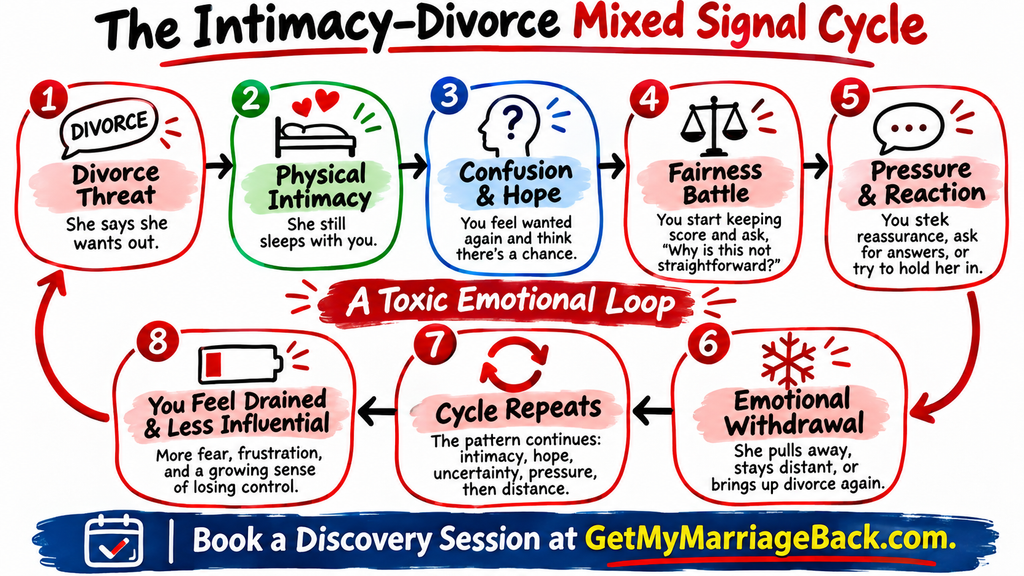
wife wants divorce but still sleeps with me - intimacy-divorce cycle

2. She Wants the Comfort of Intimacy Without Having Resolved Her Decision

Years of marriage create familiarity.

You have shared routines, private experiences, responsibilities, memories, and perhaps children.

Physical intimacy can remain comforting even when the relationship is under significant stress.

Your wife may not be ready to abandon that closeness.

At the same time, she may not be ready to recommit.

This is ambivalence.

She experiences competing feelings about the marriage, and those feelings may appear contradictory from the outside.

One day, she seems affectionate. Another day, she pulls away.

You may interpret this as a calculated strategy to keep you emotionally available.

Sometimes, however, the inconsistency reflects genuine uncertainty.

How to Recognize Emotional Ambivalence

Look beyond individual moments.

Does your wife express affection but avoid discussing the future?

Is she comfortable spending time with you while remaining uncertain about reconciliation?

Does she occasionally initiate connection without following through on broader relationship conversations?

These behaviors can indicate that attachment remains even though commitment is unresolved.

The important distinction is between recognizing an emotional connection and assuming that connection has already become a decision.

Ambivalence is not reconciliation, but neither is it necessarily the absence of attraction.

This is why emotional intelligence matters.

You need enough self-control to observe the situation without turning every affectionate moment into a demand for reassurance.

3. Is Your Wife Using Physical Intimacy to Manipulate You?

Let’s address the uncomfortable possibility.

Manipulation can exist in marriage.

A spouse may use affection, rejection, or threats of divorce to influence the other’s decisions.

However, contradictory behavior alone does not establish manipulation.

You need to distinguish observable patterns from assumptions about intention.

For example, consider whether your wife repeatedly threatens divorce immediately before demanding that you surrender a boundary.

Does affection disappear as punishment whenever you disagree?

Is intimacy restored specifically after you provide money, abandon an important concern, or comply with a demand?

Those patterns deserve attention.

They are different from a spouse who feels attracted to you but remains uncertain about the relationship.

The Difference Between Manipulation and Mixed Signals

Suppose your wife is affectionate on Friday but distant on Saturday.

That inconsistency may hurt, but it does not tell you why her feelings changed.

Now suppose she repeatedly says she will divorce you unless you meet an unrelated demand, then withdraws affection until you comply.

The second situation provides more specific evidence of coercive behavior.

Your responsibility is to examine what actually happens rather than immediately assigning motives.

You can acknowledge the emotional impact of her behavior without pretending to know everything she is thinking.

And you can establish boundaries without retaliating, threatening, or using intimacy as leverage yourself.

Marriage Does Not Make Sexual Desire an Obligation

You may believe your wedding vows established a lifelong commitment to love, loyalty, and physical intimacy.

Those expectations matter.

However, marital commitment does not remove either partner’s ability to choose whether to engage in sex.

Desire that is freely expressed is fundamentally different from intimacy obtained through guilt, fear, or pressure.

Research published in Personality and Social Psychology Bulletin examined sexual autonomy support across three studies involving 786 participants.

The researchers found associations between feeling supported in one’s sexual choices and greater sexual need fulfillment and relationship satisfaction for both partners.

You can explore the research on sexual autonomy and relationship satisfaction to understand why freedom of choice matters within intimate relationships.

The practical lesson is straightforward.

You want your wife to desire you willingly, not simply comply with your expectations.

That difference matters when your goal is rebuilding genuine attraction.

4. Your Fear of Divorce Is Changing How You Respond to Intimacy

Here is where I want you to examine your own behavior.

When your wife welcomes physical intimacy, do you feel temporarily secure?

Afterward, when she becomes distant, do you immediately question her intentions?

Perhaps you ask whether she still wants a divorce.

Maybe you demand an explanation for why she slept with you if she doesn’t want the marriage.

Your fear is understandable.

But your reaction can create a second relationship problem.

Instead of experiencing intimacy as mutual connection, you begin treating it as evidence in an argument.

Your wife becomes the person who must explain herself.

You become the person demanding certainty.

Before long, your marriage starts resembling a courtroom.

The Fairness Trap That Makes Reconciliation Harder

You remember everything you’ve contributed.

The financial sacrifices, emotional investments, compromises, and years of commitment begin running through your mind.

You think about what she promised.

Then you compare those promises with her present behavior.

It feels unfair.

And perhaps some aspects of the situation genuinely are unfair.

But I want you to notice what happens when fairness becomes your primary strategy for restoring attraction.

You start keeping score.

Every disagreement becomes another opportunity to demonstrate why your spouse is wrong.

Each affectionate gesture becomes something you believe you are entitled to interpret as commitment.

Eventually, the relationship becomes a contest over who owes whom.

You cannot argue someone into freely desiring a future with you.

You can insist on honesty, express your needs, and maintain boundaries.

What you cannot do is use the strength of your argument to manufacture genuine romantic desire.

That is the difference between demanding fairness and exercising personal influence.

How to Rebuild Attraction When Your Wife Wants Out

If you’re trying to save your marriage while your spouse remains uncertain, your greatest opportunity is not to control her feelings.

It is to improve how you show up in the relationship.

That begins with emotional regulation.

Your wife should be able to experience your presence without every interaction becoming a referendum on whether she will stay.

This doesn’t mean suppressing your concerns.

It means choosing the appropriate time, setting, and emotional state for important conversations.

Stop Turning Intimacy Into an Interrogation

Imagine two different reactions.

In the first situation, your wife initiates sex.

Afterward, you immediately ask whether this means she has changed her mind about divorce.

When she cannot provide the reassurance you want, you become upset.

The intimate experience ends in emotional pressure.

In the second situation, both of you freely enjoy the closeness.

You remain present rather than using the moment to obtain promises.

Later, when you are both available for a meaningful conversation, you calmly explain that ongoing uncertainty matters to you.

You can ask what she believes needs to change without treating the previous night’s intimacy as evidence against her.

The second response creates more room for honest communication.

It also demonstrates that you can manage difficult emotions without making your spouse responsible for regulating every moment of your anxiety.

Build Emotional Safety Without Becoming Passive

Emotional safety does not mean agreeing with everything your wife says.

You can disagree respectfully.

You can express disappointment.

You can decline physical intimacy when the surrounding uncertainty makes it emotionally uncomfortable for you.

What matters is that your behavior remains intentional rather than retaliatory.

A responsive partner listens, recognizes the other’s experience, and respects boundaries.

Research involving 305 participants examining sexual need responsiveness identified listening, communicating, accommodating needs when possible, and respecting autonomy as central elements.

These qualities support an environment where attraction can be expressed without pressure.

Being emotionally intelligent is not the same as becoming agreeable at all costs.

It is the ability to remain grounded while addressing real problems.

Use Grounding, Purpose, and Self-Discovery to Strengthen Your Influence

I teach the importance of Grounding, Purpose, and Self-Discovery because relationship uncertainty can easily consume your identity.

When your entire emotional state depends on whether your wife is affectionate today, you become vulnerable to every change in her mood.

Your confidence rises when she welcomes you.

It collapses when she mentions divorce.

That cycle can make your behavior increasingly unpredictable.

Grounding: Stop Allowing Panic to Make Your Decisions

Grounding means returning to your values and choosing your conduct deliberately.

You may feel afraid of divorce.

That fear does not have to determine what you say next.

Before reacting, identify what you’re experiencing.

Are you angry, frightened, disappointed, or desperate for reassurance?

Once you recognize the emotion, you have more opportunity to choose a response that reflects your values.

Purpose: Maintain a Life Beyond the Marriage Crisis

Your marriage matters, but it cannot become the only source of meaning in your life.

Continue showing up for your responsibilities, personal development, friendships, work, and long-term goals.

Purpose helps prevent relationship uncertainty from consuming every hour of your day.

It also allows your spouse to experience you as a complete person rather than someone whose entire identity depends on her next decision.

A fulfilling personal life is not a performance designed to make your wife jealous.

It is part of maintaining your own emotional stability and relational capacity.

Self-Discovery: Identify the Reaction That Keeps Repeating

Notice what happens whenever your wife mentions divorce.

Do you argue?

Do you plead?

Do you become defensive or withdraw emotionally?

Perhaps you start explaining your worth or listing everything you’ve done for the marriage.

Those reactions may feel protective, but they can reinforce the very disconnection you’re trying to overcome.

Self-discovery means recognizing your patterns before they become automatic.

You can then develop better communication, patience, and emotional resilience.

This is how personal influence becomes more meaningful.

The Seductive Power of Emotional Confidence

Attraction is not simply about looking desirable or saying the right romantic words.

It is also about how someone feels in your presence.

Are conversations consistently tense?

Does affection create an expectation of immediate commitment?

Can your spouse disagree with you without every difference becoming an argument?

These questions matter because romantic curiosity struggles when every interaction carries emotional pressure.

Confidence creates a different experience.

You can be warm without begging for affection.

You can express attraction without demanding reciprocation.

You can remain playful without pretending the marriage crisis does not exist.

A gentle compliment, relaxed conversation, shared laughter, or affectionate touch can become meaningful when both partners welcome it.

The key is mutuality.

Seduction in a struggling marriage should be an invitation to connection, not a technique for overcoming someone’s resistance.

Allow your spouse the freedom to respond authentically.

When connection is mutual, enjoy it without immediately asking what it means for the divorce.

This is how you begin separating attraction from desperation.

What to Do When She Becomes Distant After Sex

Suppose your wife is affectionate tonight.

Tomorrow, she seems emotionally withdrawn.

Your instinct may be to confront the contradiction immediately.

Instead, examine whether the moment actually requires a conversation.

You do not have to chase her around the house seeking reassurance.

Neither do you have to pretend that repeated uncertainty is acceptable indefinitely.

Maintain your composure, continue your responsibilities, and choose an appropriate time to address the broader issue.

You might say:

“I value the closeness we share, but I’m also aware that we’re uncertain about our future. I’d like us to understand what each of us wants and what needs attention in our marriage.”

That statement communicates your concern without turning intimacy into an obligation.

If physical closeness repeatedly leaves you feeling emotionally distressed, you can also establish a boundary around your own participation.

Your willingness to have sex matters just as much as hers.

Watch What Happens Outside the Bedroom

When assessing whether reconciliation is developing, pay attention to everyday interactions.

Does your wife voluntarily initiate conversations?

Is she interested in spending time together?

Does she demonstrate curiosity about your experiences?

Are difficult conversations becoming more constructive?

Does she show increasing willingness to discuss what rebuilding the marriage would involve?

These patterns provide a broader picture of the relationship.

One night of intimacy may reflect attraction.

Consistent voluntary engagement offers more information about the possibility of renewed partnership.

Can You Save Your Marriage When Your Wife Still Wants a Divorce?

The desire to save your marriage is understandable.

You want the person you love to choose you again, not because she feels obligated, but because she genuinely wants to share a future with you.

That is a different objective from merely preventing divorce.

Preventing an immediate argument is not the same as restoring emotional connection.

Obtaining reassurance is not the same as rebuilding commitment.

And continuing to have sex is not necessarily the same as achieving marriage reconciliation.

If your wife remains uncertain, focus on understanding the relationship dynamic rather than trying to force a decision.

Look at your communication patterns, emotional reactions, mutual attraction, unresolved disagreements, and the quality of everyday connection.

You can improve your contribution to the marriage even while your spouse is uncertain.

At the same time, genuine reconciliation requires both people to participate willingly.

The most meaningful progress is not simply hearing your wife say she will stay.

It is developing a relationship in which both of you increasingly want to remain.

The Real Meaning of Physical Intimacy During a Divorce Crisis

When your wife wants a divorce but still sleeps with you, the most important question is not whether you can use that intimacy to convince her to stay.

The better question is what the relationship is communicating through its patterns.

Physical attraction may still exist.

Emotional attachment may remain strong.

Uncertainty may be preventing commitment.

In some marriages, manipulative patterns may also need to be addressed.

Your responsibility is to distinguish these possibilities without allowing fear to dominate your behavior.

You do not have to surrender your standards, ignore your needs, or accept ongoing coercion.

But you also do not have to turn every affectionate moment into a demand for certainty.

The kind of attraction worth rebuilding is attraction that can be expressed freely, confidently, and consistently within a relationship both people genuinely want.

That begins with the quality of connection you cultivate and the emotional intelligence you bring into the marriage.

11 Physical Attraction Signs That Reveal Real Desire

Frequently Asked Questions

Why does my wife still sleep with me if she wants a divorce?

She may still experience sexual attraction, emotional attachment, familiarity, or uncertainty about leaving. Physical intimacy alone does not establish whether she intends to reconcile.

Does my wife still love me if she wants a divorce but has sex with me?

Continued intimacy may reflect affection or attraction, but it cannot independently establish love or long-term commitment. Look at her voluntary emotional engagement and behavior outside the bedroom.

Is my wife manipulating me by having sex while threatening divorce?

Not necessarily, because conflicting feelings and intentional manipulation are different. Repeatedly using divorce threats or affection to demand compliance provides more meaningful evidence of coercive behavior.

Can I save my marriage if my wife wants a divorce but still sleeps with me?

You can work on emotional regulation, communication, attraction, and the relationship patterns within your influence. Lasting reconciliation also requires your wife’s willing participation in rebuilding the marriage.


Wife Wants Separation? Why Your Apologies Push Her Away

Your wife wants separation, and the more desperately you try to convince her to stay, the more determined she seems to become about leaving.

Take This 2 Minutes Quiz

Question 1 of 15

She told you to pack a bag and leave the house while she figures out whether she still wants this marriage.

You are staring at a suitcase, wondering how years of building a life together have reached this moment.

Your instinct is to fix everything immediately.

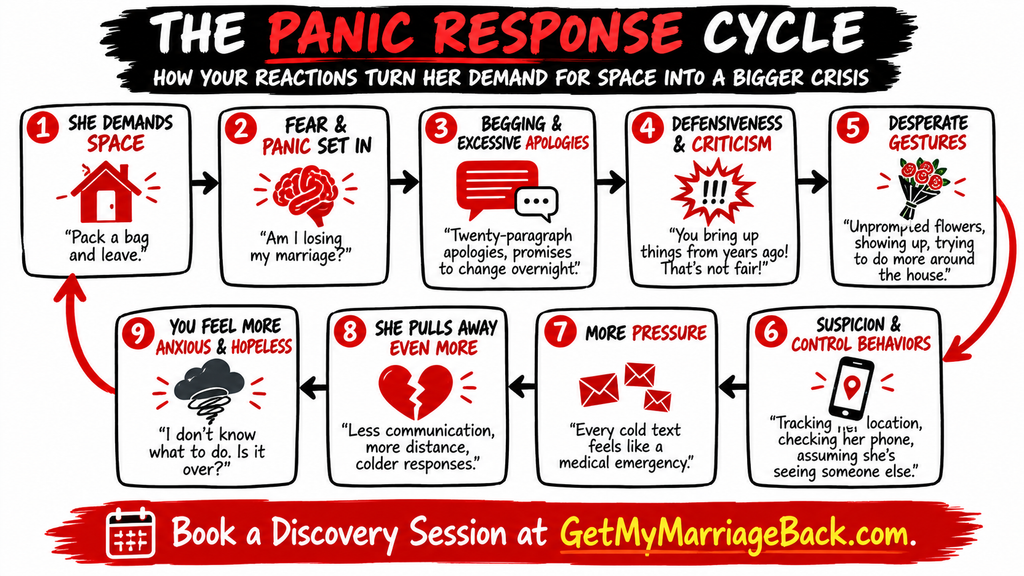
You apologize for something that happened six years ago. Then you apologize again, sending twenty paragraphs explaining how much you’ve changed and promising to become a different husband overnight.

She doesn’t respond the way you hoped.

Now you’re angry because she refuses to forgive you.

You start doing more around the house, bring flowers she never requested, and listen to friends who insist she must be seeing someone else.

Before long, you’re checking her location and treating every cold text like a medical emergency.

The problem is no longer just that your wife wants separation. Your reaction to the separation has become another source of pressure inside an already struggling marriage.

And if your objective is marriage reconciliation, you need to understand that distinction before doing anything else.

Why Your Wife Wants Separation May Not Be What You Think

When your wife tells you to move out, you immediately want an explanation.

Is she cheating?

Has she stopped loving you?

Does she want a divorce?

Is she deliberately trying to hurt you?

Or is she genuinely afraid that remaining in the same environment will create more conflict?

These possibilities are not interchangeable.

A demand for physical distance often reflects some kind of perceived threat or unresolved problem.

That threat can involve emotional pressure, recurring arguments, resentment, broken trust, or genuine concerns about physical safety.

Sometimes the demand itself is unfair or controlling.

Your first responsibility is to distinguish what actually happened from the meaning you’re assigning to it.

For example, suppose your wife says, “You’ve never cared about me.”

That statement tells you something important about her emotional experience. It doesn’t establish that you’ve literally never cared.

She can genuinely feel neglected while overlooking meaningful ways you’ve contributed to the marriage.

Likewise, you can sincerely believe you’ve been a good husband while failing to recognize how certain behaviors have affected her.

The purpose of emotional intelligence isn’t to automatically agree with her interpretation.

It’s to recognize the legitimate concerns without treating every emotionally charged accusation as an objective description of your entire marriage.

If violence, intimidation, or credible safety concerns are involved, respect physical separation and prioritize safety. That situation must not become an attraction exercise.

wife wants separation

1. You Keep Apologizing Because You Want an Immediate Result

Let’s examine the twenty-paragraph apology.

You describe everything you’ve done wrong.

You promise to change.

You explain your intentions.

Then you wait for forgiveness.

When forgiveness doesn’t arrive, you become frustrated.

Here’s the contradiction.

You’re presenting your apology as accountability while expecting an emotional reward for giving it.

An apology acknowledges harm. It doesn’t purchase forgiveness.

The distinction becomes obvious when you examine what happens after she refuses to reassure you.

Do you become defensive?

Do you remind her how much you’ve sacrificed?

Do you demand recognition for everything you’ve started doing differently?

If so, the apology has become part of a negotiation.

You’re effectively communicating that your willingness to take responsibility depends on whether she gives you the response you want.

That isn’t the emotional experience that makes reconciliation attractive.

Genuine accountability means acknowledging specific behavior, accepting appropriate responsibility, and demonstrating change without demanding immediate emotional payment.

It also means refusing responsibility for things you didn’t do simply because you’re afraid of losing the marriage.

Unwarranted apologies are not humility.

They’re often fear disguised as agreement.

wife wants separation - the panic response cycle

2. You Confuse Emergency Performance With Lasting Change

After your wife announces separation, you suddenly become exceptionally helpful.

You wash dishes.

You clean the house.

You offer to handle responsibilities you’ve previously neglected.

These can be constructive actions when they reflect genuine responsibility.

But consider your motivation.

Are you contributing because you’ve recognized a legitimate problem?

Or are you performing household duties in the hope that she’ll reverse her separation decision by Friday?

Your wife can experience the difference between sustained character and emergency performance.

When every good deed comes with an invisible request for reassurance, ordinary responsibility becomes another source of pressure.

And the same problem appears with grand romantic gestures.

You arrive at her workplace with flowers she never requested.

You send affectionate messages despite her asking for distance.

You try to manufacture a romantic moment before the underlying conflict has been addressed.

That’s not skillful seduction.

Attraction cannot be demanded as compensation for effort.

Romantic pursuit expresses interest while respecting another person’s autonomy.

Chasing attempts to escape rejection by increasing pressure.

The distinction is not whether you love your wife.

It’s whether your behavior communicates grounded interest or emotional desperation.

3. Your Wife Keeps Bringing Up Something From Six Years Ago

Your wife mentions an old grievance.

You become furious.

You’ve already apologized, and you believe you’ve paid for that mistake.

Why can’t she move forward?

Because six years on the calendar doesn’t necessarily mean six years of repair.

The original issue may have been discussed without being resolved.

Perhaps a promise was broken repeatedly.

Maybe the behavior stopped, but its emotional consequences were never meaningfully addressed.

It’s also possible that you’ve made genuine, sustained changes while your wife continues using an old grievance unfairly.

Those are different marriage dynamics.

One involves unresolved injury.

Another involves recurring behavior.

A third raises legitimate questions about fairness and accountability.

You cannot diagnose them simply by counting the years that have passed.

Ask yourself what actually changed.

Did you acknowledge the impact of your actions, or spend years defending your intentions?

Has the same pattern appeared in different forms?

What evidence demonstrates that the original problem was repaired rather than merely abandoned as a conversation?

And has your wife recognized meaningful improvements, or does every disagreement return to the same accusation regardless of your conduct?

These questions matter because good intentions do not erase real damage, and genuine pain does not make every accusation accurate.

When you become obsessed with proving you’re the good person, you stop examining the actual relationship problem.

That defensiveness can make marriage reconciliation considerably more difficult.

4. Your Fear Turns Into Suspicion and Control

Your wife asks for space.

A friend suggests she’s probably seeing another man.

Social media reinforces the suspicion.

Now you’re checking her movements, analyzing her messages, and interpreting every unexplained absence as evidence of an affair.

But suspicion is not proof.

The fact that your wife wants separation doesn’t establish that she’s cheating.

And if she is involved with someone else, monitoring her location won’t create the trust, emotional connection, or personal power required to make wise decisions.

You need facts, not a story constructed from fear.

Tracking her location without permission, appearing uninvited, and bombarding her phone can violate boundaries and intensify the very conflict you’re trying to resolve.

The underlying pattern is straightforward.

You experience uncertainty.

Uncertainty produces fear.

Fear drives monitoring, confrontation, and repeated reassurance-seeking.

Those behaviors increase pressure.

She becomes more distant.

Her distance increases your fear.

The cycle repeats.

This resembles the demand-withdraw relationship pattern studied in marriage research, where one partner’s pursuit of engagement and the other’s withdrawal can reinforce each other.

The central issue is not which spouse deserves all the blame.

It’s recognizing when your own response is contributing to the interaction you desperately want to change.

How to Save Your Marriage While Separated Without Begging

When your wife wants separation, you still have influence over your marriage.

But influence and control are not the same thing.

Your wife controls her decisions.

You control your behavior, your emotional responses, your personal development, and the quality of your interactions.

Your conduct helps shape the emotional environment in which future interactions occur.

That is where your personal power begins.

You don’t need to beg for permission to remain emotionally invested in your marriage.

Nor do you need to pretend you no longer care.

The objective is to become someone who can express genuine interest without emotional coercion, demonstrate accountability without self-erasure, and handle uncertainty without turning every interaction into a crisis.

This is the foundation of rebuilding attraction intelligently.

Grounding: Stop Making Every Feeling an Emergency

Grounding means returning to your higher self, your source of truth, and gratitude while the marriage crisis remains unresolved.

It doesn’t mean pretending you’re unaffected.

You can feel frightened, rejected, angry, and disappointed without allowing those feelings to dictate your next action.

Before responding to a cold message, identify what actually happened.

Did she ask a practical question?

Did she communicate a boundary?

Or did she simply take longer than expected to reply?

Respond to the reality, not the catastrophic interpretation.

Purpose: Reconnect With a Life Greater Than the Crisis

Your marriage matters.

But your purpose cannot be reduced to obtaining your wife’s approval.

Reconnect with your responsibilities, meaningful work, physical well-being, friendships, personal development, and the legacy you’re building.

This isn’t a performance designed to make your wife jealous.

It’s a commitment to living with direction regardless of the uncertainty surrounding your relationship.

A life organized entirely around another person’s reactions becomes emotionally exhausting for everyone involved.

Purpose restores perspective.

Self-Discovery: Recognize Your Patterns Without Self-Blame

Self-discovery requires examining your actual capacity.

Where do you become defensive?

What situations trigger excessive apologizing?

When do you confuse reassurance with connection?

Which behaviors reflect your values, and which are reactions to fear?

The goal isn’t to label yourself as the villain.

It’s to identify the patterns you can change.

From this foundation, you begin developing genuine experiential value through consistency, emotional steadiness, engaging conversation, healthy boundaries, and personal responsibility.

Curiosity and attraction can develop when the experience of interacting with you becomes different.

But they must emerge voluntarily.

You cannot force your wife to become curious, attracted, or interested in reconciliation.

Your influence comes from credible conduct, not emotional pressure.

Why Attraction Requires More Than Giving Her Space

Many people interpret separation advice as a choice between chasing their spouse and disappearing completely.

That’s a false choice.

You can respect distance while remaining emotionally mature, responsible, and open to appropriate connection.

You can communicate about necessary responsibilities without turning every exchange into a relationship negotiation.

And you can demonstrate growth without announcing that you’ve changed every twenty-four hours.

The deeper challenge is consistency.

Research on stress and decision-making has examined how pressure affects goal-directed behavior and habitual responses. Some studies have found shifts toward habitual responding under stress, while later research has produced mixed results.

A useful review of this research is available in Stress-Induced Modulation of Instrumental Behavior.

The practical lesson is that recognizing a destructive reaction doesn’t automatically eliminate it.

You can understand why begging is ineffective and still feel an overwhelming urge to send another apology tonight.

That’s why lasting development requires practicing different responses repeatedly rather than relying on one moment of inspiration.

What to Do Tonight When Your Wife Wants You to Leave

Suppose your wife gives you another cold response.

Your instinct is to demand an explanation.

You want to ask whether she still loves you, whether there’s someone else, or whether separation means divorce.

Instead, stop turning that moment into an emergency.

Put your phone down.

Don’t send another twenty-paragraph apology.

Don’t follow her around the house demanding reassurance.

Maintain your composure, respect her boundaries, and attend to your responsibilities.

If she has asked for physical separation because of safety concerns, respect that boundary and handle practical arrangements appropriately. Where housing, children, or legal obligations are involved, obtain appropriate professional guidance rather than escalating a confrontation.

The immediate objective is to stop feeding the conflict.

Removing pressure creates breathing room.

But breathing room alone doesn’t repair years of resentment, restore trust, or rebuild attraction.

Those outcomes depend on the actual problems within your marriage and the quality of the changes that follow.

Can Your Marriage Be Saved When Your Wife Wants Separation?

Your wife’s demand for separation is a serious development, but it doesn’t automatically tell you what the final outcome will be.

She may be overwhelmed by conflict.

She may have lost attraction.

She may be responding to legitimate safety concerns.

She may be emotionally disengaged or actively considering divorce.

And she may be interpreting the relationship through unresolved resentment that neither of you has adequately understood.

Your task isn’t to invent a reassuring explanation.

It’s to examine the facts, recognize your own contribution, and respond with dignity and emotional intelligence.

You cannot control whether your wife chooses reconciliation. You can stop making your fear the most powerful influence on your behavior.

That’s where rebuilding your personal power begins.

And that’s where the possibility of a different experience of you becomes real.

5 Physical Signs She Just Slept With Someone Else: The Truth

Frequently Asked Questions

What should I do when my wife wants separation?

Respect legitimate boundaries, avoid begging or repeated confrontations, and identify the underlying marriage problems before deciding your next steps. If safety concerns are involved, prioritize safety and appropriate arrangements.

Does separation mean my wife wants a divorce?

Not necessarily; separation and divorce are different decisions, although separation can precede divorce. Examine what your wife has actually communicated rather than treating fear as evidence of her final intentions.

How do I save my marriage when my wife wants to separate?

Focus on consistent accountability, emotional steadiness, respecting boundaries, and addressing the specific patterns contributing to the crisis. Marriage reconciliation depends on more than persuading your wife to reverse her decision.

Can my wife fall back in love after separation?

Attraction and emotional connection can change as relationship experiences change, but renewed feelings cannot be forced. Your strongest contribution is becoming consistently responsible, emotionally grounded, and genuinely engaging without making her response the measure of your progress.

Your Wife Argues With You About Everything: 5 Attraction Killers

You can be completely right about what happened yesterday and still be destroying the attraction, emotional connection, and marriage you’re desperately trying to save today.

Take This 2 Minutes Quiz

Question 1 of 15

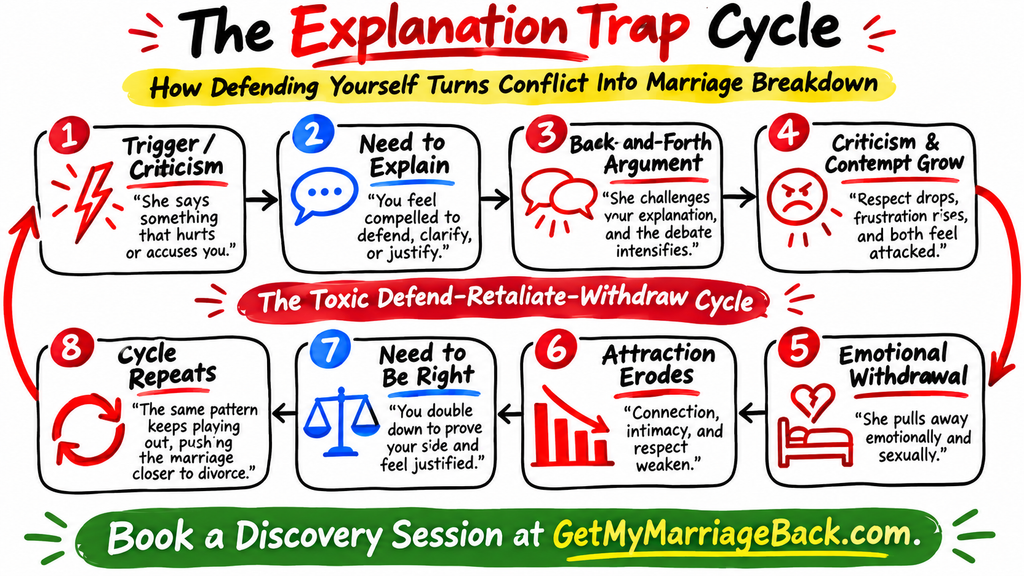
When your wife argues with you about everything, it’s tempting to believe that the problem is simply her attitude. She criticizes, you explain. She questions your intentions, you defend yourself. Then she brings up something from three years ago, and suddenly you’re having another exhausting conversation about who was right.

You’re not necessarily lying, manipulating, or trying to hurt her. In fact, you may genuinely believe you’re protecting your dignity by refusing to let an unfair accusation go unanswered.

But I want you to consider something.

What if your constant need to explain yourself is helping destroy the very attraction you’re trying to rebuild?

This is one of the most painful contradictions in a marriage crisis. You want your wife to feel closer to you, but the way you’re interacting makes closeness increasingly difficult.

And the more she withdraws, the harder you fight to be understood.

Let’s examine five attraction killers that can hide inside this pattern—and what you can begin changing without begging, chasing, or abandoning your self-respect.

Why Does My Wife Argue With Me About Everything?

First, understand that not every disagreement is evidence of a failing marriage.

Healthy couples disagree. They have different perspectives, misunderstand each other, and sometimes experience frustration.

The real problem begins when disagreement becomes the dominant emotional experience of the relationship.

Your wife may be carrying unresolved resentment. Perhaps she feels misunderstood, disappointed, emotionally disconnected, or unheard.

You may be experiencing those same feelings.

When criticism, defensiveness, and contempt become habitual, both spouses can begin anticipating conflict before anyone speaks.

Marriage researchers have extensively examined these patterns. A meta-analysis involving 74 studies and 14,255 participants found a meaningful association between demand-withdraw communication patterns and relationship difficulties.

This research on marital demand-withdraw communication helps explain why repeated cycles of pressure, criticism, defensiveness, and withdrawal are associated with relationship dissatisfaction.

Here’s the important distinction: the person who starts the argument isn’t necessarily the only person sustaining it.

Your wife is responsible for her actions.

You are responsible for yours.

And understanding that distinction is where emotional self-leadership begins.

my wife argues with me about everything

Attraction Killer #1: Explaining Yourself Until Every Conversation Becomes an Argument

During my own marriage crisis with Lola, I wanted to explain everything.

My intentions.

My decisions.

My side of the story.

Whenever somebody said something I considered unfair, I felt compelled to correct it.

Eventually, my mother told me something simple:

“Don’t be talking all the time.”

My uncle reinforced that lesson.

They weren’t telling me to become weak, tolerate mistreatment, or pretend that every accusation was true.

They were challenging my belief that every accusation required an immediate response.

And that lesson changed the direction of how I approached my marriage.

The explanation trap

Imagine your wife says, “You never listen to me.”

You immediately respond, “That’s not true. I listened to you yesterday, and I remember exactly what you said.”

She brings up another example.

Now you produce evidence.

Before long, you’re discussing conversations from several years ago.

The original emotional concern has disappeared beneath competing versions of history.

What started as a complaint has become a courtroom.

Here’s what I want you to recognize:

Being able to explain your behavior doesn’t mean another explanation is helping your marriage.

Sometimes your spouse needs clarification. Other times, she needs to feel that you’ve understood the concern beneath her words.

The emotional intelligence is knowing the difference.

A grounded response might sound like:

“I understand that you’ve been feeling unheard. I don’t agree with everything you said, but I want to understand what happened.”

That response doesn’t require you to confess to something you didn’t do.

It simply refuses to turn every complaint into another battle.

my wife argues with me about everything - the explanation trap

Attraction Killer #2: Confusing Defensiveness With Self-Respect

One of the most dangerous beliefs in a distressed marriage is that refusing to defend yourself means accepting disrespect.

I worked with a gentleman who struggled tremendously with this.

He wanted to save his marriage, but whenever his wife said something hurtful, he felt compelled to respond.

His objective was to feel justified.

He wanted to demonstrate that his actions were reasonable and that her accusations were unfair.

People around him encouraged him to match her energy.

If she criticized him, criticize her.

If she disrespected him, return the disrespect.

It sounded fair.

But those advisers didn’t have to live with the consequences inside his marriage.

You can protect your dignity without winning every exchange

I remember coaching him through a particularly painful situation.

His wife had said something that deeply upset him. He wanted to respond immediately.

I encouraged him not to engage in that particular argument.

He tried, but sustaining that restraint became difficult.

He feared that if he didn’t correct the narrative, his wife’s version of events would become the accepted truth.

That’s where the real issue emerged.

He wasn’t simply protecting a boundary. He was struggling with the possibility that somebody might believe something negative about him.

Ask yourself:

Am I responding because something genuinely needs to be addressed, or because I cannot tolerate being misunderstood?

Your answer matters.

Self-respect doesn’t require universal agreement with your version of events.

A confident person can disagree without becoming consumed by the disagreement.

That kind of emotional steadiness is far more attractive than constantly demanding acknowledgment.

Attraction Killer #3: Matching Your Wife’s Negative Energy

There’s a popular relationship philosophy that sounds empowering:

Match people’s energy.

If they give you attitude, give them attitude.

If they withdraw, withdraw harder.

If they hurt you, make sure they understand how it feels.

But marriage isn’t a competition to determine who can deliver the most convincing retaliation.

Matching negative energy can turn a temporary disagreement into a permanent relationship atmosphere.

Consider how the cycle develops:

Your wife criticizes you.

You defend yourself.

She becomes more contemptuous.

You retaliate.

Now she uses your retaliation to justify her next reaction.

And you use her reaction to justify yours.

Both spouses have evidence. Both can point to something the other person did.

Nobody wants to interrupt the cycle because everyone believes their reaction was justified.

How far backward should we investigate?

Last night?

Last month?

Three years ago?

The beginning of the marriage?

At some point, the search for the original offender becomes less useful than recognizing the destructive interaction happening right now.

A reaction is still an action.

That doesn’t erase the original offense. It means your spouse’s behavior doesn’t automatically determine how you must behave.

This is especially important when you’re trying to save your marriage alone.

You cannot force your wife to participate in reconciliation. However, you can stop contributing your own criticism, contempt, and retaliation.

That isn’t passive.

It’s emotional independence.

Attraction Killer #4: Winning Arguments While Losing Romantic Attraction

This is where the consequences become especially painful.

The gentleman I mentioned earlier eventually experienced serious problems with physical intimacy.

He believed his wife was weaponizing sex.

But consider the emotional environment surrounding their relationship.

When he wasn’t withdrawing or sulking, he was criticizing.

When she criticized him, he defended himself.

Their conversations became opportunities to settle scores.

Neither person was enjoying the relationship.

Now, sexual withdrawal can have several explanations.

Resentment is one possibility. Loss of attraction is another. Stress, emotional exhaustion, health concerns, and unresolved relationship injuries can also influence desire.

You cannot determine somebody’s sexual motivation simply because intimacy has disappeared.

But here’s something worth understanding.

It’s difficult to cultivate romantic desire when your relationship has become emotionally exhausting.

Attraction needs a different emotional atmosphere

Think about the experiences that make romantic connection enjoyable.

Playfulness.

Warmth.

Curiosity.

Feeling appreciated.

Emotional safety.

The freedom to relax around your partner.

Now compare those experiences with constant criticism, defensiveness, and arguments about the past.

Which environment makes affection feel more inviting?

Which one makes somebody look forward to spending time together?

Romantic attraction is more complex than communication alone, but the emotional atmosphere matters.

Research examining couples’ communication during sexual conflict has also connected demand-withdraw patterns with sexual and relationship difficulties.

The lesson isn’t that you should become agreeable to obtain sex.

That’s simply another form of pressure.

Instead, recognize that building attraction requires becoming someone who can participate in emotionally enjoyable interactions without turning every disagreement into a struggle for control.

Seduction in a long-term marriage isn’t merely about sexual technique.

It’s also about emotional presence, confidence, anticipation, warmth, and the ability to create enjoyable experiences together.

Your spouse should be able to experience your personality without constantly encountering your defenses.

Attraction Killer #5: Taking the Higher Road Temporarily, Then Exploding

This is where many people undermine their own progress.

They recognize the destructive pattern and decide to change.

For two days, they’re calm.

They don’t argue.

They refuse to take the bait.

Then something especially painful happens on the third day.

They explode.

Every accusation they’ve been holding back suddenly comes pouring out.

Now the relationship returns to the same destructive cycle, sometimes with even greater intensity.

Consistency is more important than a temporary performance

Emotional self-leadership isn’t pretending you don’t feel anger.

It’s developing the ability to experience anger without allowing it to dictate your behavior.

And that requires sustained practice.

You can maintain boundaries.

Serious problems can still be addressed.

Disrespectful interactions can be interrupted.

But you don’t need to turn every disagreement into an emotional war.

The distinction is between suppressing your feelings and regulating your response.

Suppression builds pressure when you never address the underlying issue.

Regulation allows you to choose an appropriate time, tone, and approach.

For example:

“I want to discuss this, but I’m getting frustrated. Let’s return to it when we can both have a productive conversation.”

Then follow through.

Don’t use the pause as punishment, and don’t disappear indefinitely.

Your emotional steadiness becomes meaningful when it remains consistent under pressure.

How to Rebuild Attraction When Your Wife Keeps Arguing With You

The objective isn’t to become somebody your wife can control.

It’s to become somebody who can control himself.

That difference changes everything.

When you stop treating every accusation as a threat to your identity, you create space for a different kind of interaction.

You become less predictable in the destructive sense.

Instead of automatically defending yourself, you can listen.

Rather than retaliating, you can establish a boundary.

When an argument no longer serves a constructive purpose, you can disengage respectfully.

And when your wife is open to connection, you can participate without dragging yesterday’s conflict into today’s experience.

Make emotional connection enjoyable again

Attraction often deteriorates when spouses begin associating each other primarily with stress.

Changing that association requires more than avoiding arguments.

You also need positive experiences.

Be genuinely interested in your wife’s thoughts without turning every conversation into a relationship evaluation.

Bring humor into ordinary moments when it’s welcome.

Express appreciation without attaching a demand for reciprocation.

Create opportunities for shared enjoyment that aren’t disguised attempts to negotiate affection.

Flirt when the interaction is receptive, and respect her response when it isn’t.

Confidence becomes attractive when it is paired with emotional awareness rather than entitlement.

The objective is not to manufacture a reaction from your wife.

It’s to become more grounded, enjoyable, and emotionally available while respecting her freedom to choose how she responds.

The GPS-V Approach to Emotional Self-Leadership

I teach a framework called GPS-V because changing relationship behavior requires more than memorizing communication techniques.

It begins with how you relate to yourself.

Grounding

Return to your emotional center before responding.

An accusation may upset you, but it doesn’t have to control your next action.

Purpose

Remember the larger life you’re building.

Your marriage, family, character, and long-term direction deserve more consideration than winning today’s argument.

Self-Discovery

Examine why certain accusations trigger such intense reactions.

Sometimes the accusation hurts because you fear your spouse believes something negative about you.

Other times, it touches an insecurity you already carry.

Understanding the trigger gives you more freedom in how you respond.

Value

Develop the qualities that make your presence meaningful.

Emotional stability, discipline, reliability, warmth, and personal direction contribute to the experience of being in a relationship with you.

Curiosity and Attraction

Allow your spouse to encounter a version of you that isn’t constantly explaining, chasing, criticizing, or demanding reassurance.

Curiosity becomes possible when interactions stop following the same exhausting script.

Influence and Leverage

Influence grows through consistent behavior, not pressure.

Your most dependable leverage begins with your ability to choose your own actions and maintain your boundaries.

You don’t need to control your wife to become more emotionally powerful.

What If Your Wife Wants a Divorce or Separation?

When your wife wants a divorce, the instinct to explain yourself can become even stronger.

You may believe that one perfect conversation will make her understand your intentions and reconsider leaving.

So you send longer messages.

You revisit old disagreements.

Every interaction becomes another attempt to convince her that the marriage deserves a second chance.

But marriage reconciliation isn’t a courtroom appeal.

Your wife may have genuine grievances, just as you may have legitimate concerns about her behavior.

Those concerns deserve attention.

However, repeated persuasion can increase pressure when your spouse is already emotionally withdrawn.

If you’re trying to save marriage from divorce, begin by distinguishing practical conversations from emotional negotiations.

Discuss necessary decisions clearly.

Address important responsibilities.

Respect reasonable requests for space.

Avoid using every interaction to demand reassurance about the future.

You can communicate your desire to preserve the marriage without repeatedly arguing for it.

That distinction matters whether you’re living together, experiencing emotional separation, or already physically separated.

The Difference Between Being Right and Being Effective

I want to leave you with a question.

What exactly are you trying to win?

If your wife argues with you about everything, it’s understandable that you want your perspective acknowledged.

Nobody enjoys feeling falsely accused.

But being right about an individual disagreement doesn’t automatically mean your response is helping the relationship.

You can prove that something happened exactly as you remember it and still leave the conversation more disconnected than before.

You can win the last word and lose another opportunity for emotional closeness.

And you can demand fairness so aggressively that the relationship becomes a continuous competition over who has suffered more.

The goal isn’t to surrender your truth. It’s to stop sacrificing your emotional stability in the pursuit of agreement.

You don’t have to explain yourself every time somebody gives you the opportunity.

You don’t have to retaliate to establish dignity.

And you don’t have to beg for attraction.

The more effectively you lead yourself, the more room you create for warmth, respect, playfulness, and romantic connection.

That’s where rebuilding attraction begins.

Not with another closing argument.

With a different experience of being together.

“I Feel Disgusted When My Husband Touches Me” – [5 Solutions]

Frequently Asked Questions

Why does my wife argue with me about everything?

Frequent arguments can reflect unresolved resentment, unmet emotional needs, communication habits, or deeper dissatisfaction. The pattern becomes especially destructive when both spouses repeatedly respond with criticism, defensiveness, or retaliation.

How do I stop arguing with my wife all the time?

Stop treating every accusation as something that requires an immediate defense, and focus on understanding the concern before responding. Maintain clear boundaries while refusing to escalate conversations that have become unproductive.

Can constant arguing make my wife lose attraction?

Yes, persistent conflict can contribute to emotional exhaustion, resentment, and reduced romantic interest. Attraction is influenced by several factors, but repeated contempt and defensiveness can make closeness less enjoyable.

Can I save my marriage if my wife wants a divorce?

Marriage reconciliation remains possible in some relationships, but it requires respecting your spouse’s choices while changing the behaviors you control. Focus on sustained emotional maturity, constructive communication, and rebuilding a healthier relationship dynamic rather than trying to argue your spouse into staying.

Wife Wants to Separate? 4 Signs Her Distance Could Become Divorce

Your wife wants to separate, and the most frightening part isn’t the word separation—it’s watching her gradually build a life that seems to have less and less room for you.

Take This 2 Minutes Quiz

Question 1 of 15

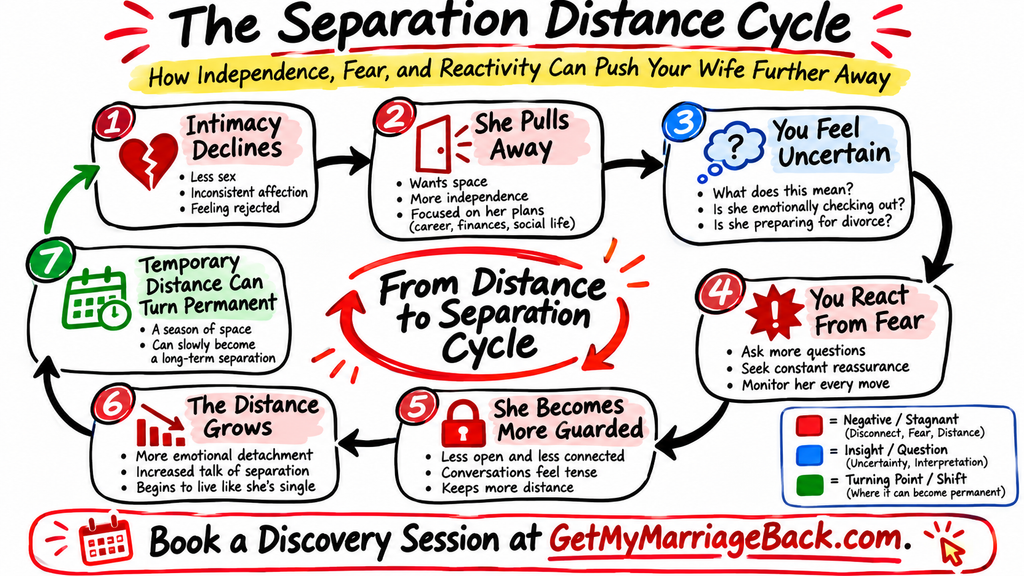
Maybe she stopped initiating sex months ago. Affection became inconsistent, conversations grew tense, and now she wants more personal space.

Her career, finances, friendships, and future plans increasingly seem to operate independently of your marriage.

You still love your wife. You want to understand what’s happening, but every attempt to get reassurance seems to push her further away.

Here’s the distinction I want you to understand:

Your wife’s independence doesn’t automatically mean she’s leaving your marriage. But temporary emotional distance can become permanent when the patterns surrounding it continue.

Understanding those patterns is the beginning of responding with emotional intelligence rather than fear.

Why Does My Wife Want to Separate When We’re Still Married?

When a wife wants to separate, her husband often assumes she’s already made a final decision.

That’s understandable, especially when the separation request follows months of sexual rejection, reduced affection, and emotional withdrawal.

However, wanting independence and deciding to divorce are not identical.

Your wife might be experiencing several competing emotions:

  • She feels overwhelmed by the demands of marriage, work, or family.
  • She wants more control over her personal decisions.
  • She has unresolved resentment toward you.
  • She misses the independence she experienced before marriage.
  • She is uncertain whether she still feels romantic attraction.
  • She has begun imagining what life would look like without the relationship.

These possibilities can overlap.

A woman can feel overwhelmed and emotionally detached at the same time. She can want space without knowing whether she wants divorce.

The mistake is assuming that one explanation automatically eliminates every other possibility.

I want you to recognize the difference between what your wife has actually communicated and what your anxiety is telling you her behavior means.

That distinction matters because your interpretation influences your next move.

wife wants to separate

When Your Wife Starts Acting Single While Still Married

Consider a marriage where physical intimacy has gradually disappeared.

The husband notices that his wife rarely initiates affection. Sometimes she compares him to other husbands, mentioning what her friends’ spouses are doing differently.

He begins questioning whether she’s still attracted to him.

Meanwhile, she’s experiencing perimenopause, financial pressure, and uncertainty about her career.

Her stress is real. His frustration is also real.

Then the relationship changes again.

She wants more independence, spends less time with him, and becomes increasingly focused on her own plans.

Eventually, she mentions separation.

What began as a concern about sex has become a much bigger question:

Is she trying to rediscover herself, or is she discovering that she prefers a life without her husband?

This is where many distressed spouses make a costly mistake.

They begin interpreting every independent decision as evidence of rejection.

A career opportunity becomes proof that she’s planning to leave. Spending time with friends becomes suspicious, and her desire for privacy starts looking like a secret divorce strategy.

You cannot understand the direction of your marriage by investigating isolated behaviors.

Instead, examine the relationship patterns surrounding those behaviors.

wife wants to separate emotional distance signs

4 Signs Your Wife’s Emotional Distance Could Be Becoming Permanent

1. Her Independence Is Replacing Your Shared Future

Healthy independence and marital commitment can coexist.

Your wife can pursue career opportunities, develop friendships, manage finances, and maintain personal interests while remaining emotionally invested in the marriage.

The concern begins when independence consistently replaces partnership.

Perhaps she no longer includes you in important discussions. Shared plans become increasingly rare, and conversations about the future focus almost entirely on her individual life.

Notice the distinction.

Having separate interests isn’t emotional abandonment.

However, consistently excluding the marriage from major future decisions can indicate a deeper change in how she understands the relationship.

Ask yourself whether she still demonstrates interest in building anything together.

Does she occasionally initiate meaningful conversations? Is she willing to discuss shared responsibilities or consider your perspective when decisions affect both of you?

A spouse who needs breathing room may still preserve a sense of partnership.

Growing detachment becomes more concerning when that shared identity repeatedly disappears.

2. Physical Withdrawal Is Becoming Emotional Withdrawal

A wife who stops initiating sex isn’t automatically preparing for divorce.

Sexual desire is influenced by physical health, emotional stress, relationship satisfaction, and hormonal changes.

Perimenopause, for example, can affect sleep, mood, comfort during intimacy, and sexual desire.

That context matters.

Nevertheless, a marriage can experience more than a temporary reduction in sexual activity.

Perhaps your wife no longer initiates affection, avoids meaningful conversations, and shows little curiosity about your emotional experience.

Now the issue extends beyond sex.

You’re experiencing a broader loss of connection.

Sexual rejection and emotional detachment are related concerns, but they are not interchangeable.

A wife can have reduced sexual desire while still feeling deeply connected to her husband.

Conversely, physical intimacy can occasionally continue even when emotional investment has weakened.

Rather than treating sex as the only measurement of attraction, pay attention to warmth, openness, curiosity, affection, and the overall quality of your interactions.

These provide a more complete picture of your marriage.

3. She Seems Increasingly Comfortable Imagining Life Without You

One of the most unsettling experiences in marriage separation is watching your spouse become comfortable with the idea of living independently.

She might talk about where she would live, how she would manage her finances, or what her daily routine might look like.

Sometimes these conversations are practical preparations.

Other times, they are expressions of frustration, uncertainty, or a desire to escape emotional pressure.

The important distinction is between imagining an alternative and making a definite decision.

A fantasy about independence isn’t the same as filing for divorce.

However, repeatedly imagining a future without the marriage can gradually make that future feel more familiar.

You should take explicit separation plans seriously without treating every hypothetical statement as a final decision.

Pay attention to what she communicates consistently, what practical steps she takes, and whether she remains willing to discuss the relationship.

Your objective isn’t to police her imagination.

It’s to understand the actual direction of the marriage.

4. Your Conversations Are Becoming a Pursuit-and-Withdrawal Cycle

This is one of the most important signs because it involves something you can directly influence.

Your wife pulls away.

You feel anxious and begin asking questions.

Does she still love you? Is there another man? Does she want a divorce? Why doesn’t she want to spend time with you?

You’re looking for reassurance.

But she experiences the repeated questioning as pressure and becomes more guarded.

Her withdrawal increases your suspicion, so you ask even more questions.

Now both of you are contributing to an escalating cycle.

Relationship researchers call this a demand-withdraw pattern.

In a study involving 55 couples, researchers observed connections between one partner’s demanding behavior, the other’s withdrawal, and their emotional reactions during conflict.

The research on demand-withdraw behavior helps explain why repeated pursuit and emotional withdrawal can reinforce each other rather than resolve the underlying disagreement.

Here’s what I want you to recognize:

The more you pursue reassurance through pressure, the more threatening ordinary conversations can become.

This pattern isn’t limited to husbands pursuing wives. Either spouse can occupy either role.

When fear begins directing your communication, even reasonable questions can become part of an unhealthy interaction.

Breaking that pattern requires more than finding better words.

It requires developing a different emotional response.

Bad Signs During Separation: What Actually Deserves Your Attention?

When your wife wants to separate, it’s tempting to search for definitive signs that she’s never coming back.

But no single behavior can tell you everything about another person’s intentions.

Look for repeated patterns rather than isolated moments.

Some developments deserve particular attention:

  • She explicitly communicates that she no longer wants the marriage.
  • She consistently avoids discussions about shared responsibilities or the relationship’s future.
  • She begins making concrete plans for a separate household.
  • She shows sustained disinterest in repairing unresolved conflicts.
  • She establishes financial or legal arrangements for separation.
  • She repeatedly describes the relationship as something she no longer wants to participate in.

These are more consequential than whether she went out with friends or seemed emotionally distant after a difficult day.

At the same time, don’t confuse a calm separation with a successful reconciliation.

Reduced conflict can mean that emotional pressure has decreased.

It can also mean that one spouse has stopped engaging.

The meaning depends on the larger pattern.

Can You Save Your Marriage While Separated?

Marriage reconciliation begins with understanding the difference between influence and control.

You cannot force your wife to feel attraction.

Neither can you argue her into emotional intimacy or persuade her to experience desire through repeated explanations.

However, your behavior still influences the emotional environment of the relationship.

You can change how you communicate, manage anxiety, maintain boundaries, and show up in difficult conversations.

Those changes matter because attraction isn’t only about physical appearance.

Romantic attraction can also involve emotional safety, curiosity, confidence, warmth, respect, and the experience of being with someone who has a meaningful life.

When your entire identity becomes centered on whether your wife still wants you, your interactions can become dominated by insecurity.

You stop relating to her as a complete person and begin treating every conversation as a test of whether you’re still desirable.

That pressure rarely creates the emotional atmosphere you’re seeking.

Building attraction requires becoming someone who can offer connection without demanding constant validation in return.

This isn’t about pretending you don’t care.

It’s about caring without allowing desperation to determine your behavior.

How to Rebuild Attraction When Your Wife Wants Space

Stop Turning Every Interaction Into a Marriage Status Report

Your wife already knows you’re concerned about the relationship.

Repeating the same questions every evening doesn’t necessarily create more clarity.

Sometimes it creates emotional exhaustion.

There is a difference between having an intentional conversation about the marriage and repeatedly asking your spouse to regulate your anxiety.

You can express your desire to reconcile while respecting her need for space.

For example:

“I care about our marriage, and I’m interested in understanding what has changed between us. I also recognize that repeating the same conversation under pressure isn’t helping either of us.”

That statement communicates commitment without demanding an immediate declaration of love.

Then allow your behavior to support your words.

Replace Emotional Pursuit With Emotional Presence

Emotional presence is different from emotional pursuit.

Pursuit driven by fear seeks immediate relief.

Presence involves remaining grounded enough to listen, communicate, and tolerate uncertainty without escalating the situation.

You don’t need to disappear to demonstrate independence.

Instead, develop the ability to participate in interactions without constantly trying to control their outcome.

Listen without preparing a defensive argument.

Acknowledge what your wife says without automatically agreeing with every interpretation.

Express your own feelings without using guilt to secure affection.

These skills make difficult conversations less threatening.

They also allow your personality, warmth, and confidence to become visible again.

Rebuild Your Personal Identity

One of the most damaging consequences of marriage anxiety is losing your sense of self.

Your mood begins depending on your wife’s behavior.

When she’s affectionate, you feel hopeful. When she’s distant, you feel defeated.

Eventually, your entire day revolves around interpreting her reactions.

That’s not the emotional foundation from which healthy attraction develops.

Reconnect with meaningful responsibilities, friendships, physical well-being, interests, and personal ambitions.

Develop a life that remains purposeful even during uncertainty.

This doesn’t mean acting single to provoke jealousy.

It means becoming emotionally grounded enough to remain yourself while navigating a difficult marriage.

Confidence becomes more compelling when it’s supported by consistent behavior rather than performed for attention.

Create Room for Curiosity and Natural Attraction

Attraction grows through experiences, not interrogation.

When every interaction centers on separation, rejection, or divorce, the relationship can become emotionally predictable.

Your wife may begin anticipating another difficult conversation before you even speak.

Changing that atmosphere requires patience and discernment.

Not every moment needs to become an opportunity to discuss the marriage.

Appropriate humor, shared interests, respectful conversation, and genuine curiosity can create a different emotional experience.

Don’t use kindness as a transaction.

Affection offered with the expectation of immediate reciprocation can become another form of pressure.

Instead, practice warmth because it reflects the person you’re choosing to become.

Respect physical and emotional boundaries, particularly when your wife has clearly requested space.

Seduction within marriage is most meaningful when it involves mutual desire, emotional responsiveness, and the freedom to choose connection.

The goal is to become more engaging and emotionally available—not to manufacture attraction through manipulation.

The GPS5 Approach to Saving Your Marriage Alone

When your spouse wants out, your first responsibility is to regain emotional direction.

I begin with three elements of the GPS5 framework: Grounding, Purpose, and Self-Discovery.

Grounding: Separate Facts From Fear

Grounding means learning to recognize what you actually know.

Your wife asking for space is a fact.

Concluding that she’s secretly preparing to divorce you may be an interpretation.

Her reduced interest in sex is observable.

Assuming that another man must be responsible is speculation unless you have evidence.

This distinction protects you from reacting to imagined threats as though they’re established realities.

Purpose: Stop Making Your Marriage Crisis Your Entire Identity

Your marriage matters.

However, your value as a person cannot depend entirely on your spouse’s current feelings.

Reconnect with the responsibilities and aspirations that give your life direction.

A grounded sense of purpose allows you to remain emotionally available without becoming dependent on constant reassurance.

It also makes your presence more stable and engaging.

Self-Discovery: Identify the Patterns You’re Bringing Into the Marriage

Ask yourself difficult questions.

Do you become controlling when you feel rejected?

Are you repeatedly demanding affection because you’re afraid of abandonment?

Have you neglected your own development while focusing entirely on your spouse?

Perhaps you withdraw, criticize, or become defensive when conversations don’t go your way.

Self-discovery requires recognizing these behaviors without making your spouse responsible for changing them.

The purpose isn’t to blame yourself for the entire marriage crisis.

It’s to identify the patterns within your control.

What About the 3 S’s: Skills, Support, and System?

Understanding your marriage intellectually is different from behaving differently when emotions become intense.

You might recognize the pursuit-and-withdrawal cycle today, then repeat it tomorrow when your wife declines an invitation or avoids a conversation.

That’s why personal transformation requires more than motivation.

Skills help you communicate, regulate emotions, establish boundaries, and respond constructively.

Support helps you examine blind spots and maintain perspective when fear distorts your judgment.

System means developing consistent habits rather than relying on occasional moments of clarity.

Together, these elements help turn emotional intelligence into repeatable behavior.

The objective is not to become indifferent to your wife.

It’s to become someone capable of handling uncertainty, rejection, and difficult conversations without abandoning personal dignity.

When Temporary Separation Starts Feeling Permanent

The most dangerous assumption is that time alone will solve the problem.

Sometimes space allows both spouses to recover from emotional exhaustion.

In other situations, prolonged distance becomes the new normal because the underlying issues remain unresolved.

That’s why you need to pay attention to the direction of the relationship.

Are conversations becoming less defensive?

Is there more mutual understanding?

Does either spouse demonstrate interest in addressing the problems that contributed to separation?

Are shared responsibilities being handled respectfully?

These questions reveal more than simply counting how many days you’ve spent apart.

Reconciliation is not measured by whether your wife sends an affectionate text.

It’s reflected in the development of a healthier relationship pattern.

You can contribute to that pattern even before your spouse decides what she wants.

The Truth About Your Wife Wanting to Separate

Your wife may be overwhelmed.

She may be emotionally detached.

She may be imagining an independent future without you.

Several of these things can be true simultaneously.

The important question isn’t whether you can decode every thought in her mind.

It’s whether you can recognize the patterns unfolding in your marriage and respond with emotional intelligence.

Fear encourages interrogation, suspicion, and emotional pursuit.

Grounded confidence allows you to maintain boundaries, communicate clearly, and remain open to connection without surrendering your identity.

Your wife’s independence isn’t automatically the end of your marriage. But the emotional patterns you continue during this season can influence what happens next.

And that is where your personal development becomes essential.

“I Feel Disgusted When My Husband Touches Me” – [5 Solutions]

Frequently Asked Questions

Why does my wife want to separate but not divorce?

She may want relief from conflict, personal independence, or time to evaluate the relationship without making a final decision. Her willingness to discuss the marriage and her practical plans provide more context than the separation request alone.

What are the signs my wife is not coming back after separation?

Consistent rejection of reconciliation, concrete divorce preparations, and sustained unwillingness to discuss a shared future are more concerning than temporary emotional distance. Look at repeated behavior and explicit communication rather than isolated incidents.

How do I win my wife back during separation?

Focus on emotional regulation, respectful communication, personal development, and addressing the relationship patterns that contributed to separation. Attraction and reconciliation require voluntary participation rather than pressure or constant reassurance-seeking.

Can a marriage be saved when only one spouse is trying?

One spouse can improve personal behavior, reduce destructive interaction patterns, and create better conditions for communication. Rebuilding a mutually committed marriage ultimately requires both spouses to participate.

Your Wife Loves You But Is Not in Love With You? 5 Hard Truths

Your wife says she loves you but is not in love with you anymore, and suddenly everything you thought made you a good husband feels insufficient.

Take This 2 Minutes Quiz

Question 1 of 15

Maybe she still cares about you. Perhaps she appreciates your commitment, respects your responsibilities, or acknowledges everything you’ve done for the family. Yet something has changed in the way she experiences you romantically.

She may no longer initiate affection. Conversations feel mechanical, intimacy has become strained, and the friendship that once made your marriage enjoyable seems to be disappearing.

Now you’re wondering whether your wife has fallen out of love, whether attraction can return, and what you should do before the marriage ends.

I want you to understand something important: Being a good person and being someone your spouse experiences as romantically attractive are related, but they are not identical skills.

That distinction can change how you approach your marriage crisis.

What Does It Mean When Your Wife Loves You But Is Not in Love With You?

When your wife says, “I love you, but I’m not in love with you,” she may be distinguishing emotional attachment from romantic attraction.

She can care about your well-being while feeling disconnected from the romantic relationship. Your shared history may still matter to her, even when the excitement, admiration, emotional intimacy, or desire she once experienced has weakened.

However, those words do not automatically explain why her feelings changed.

Perhaps unresolved conflict has accumulated. Maybe emotional withdrawal has replaced friendship, or repeated disappointments have changed the atmosphere of your relationship.

In some marriages, the couple has become so focused on responsibilities that they have forgotten how to enjoy each other.

The mistake is treating her statement as a complete diagnosis.

Her feelings tell you something about her current experience. They do not tell you everything about the relationship patterns that produced it.

Before deciding what to do when your wife doesn’t love you romantically anymore, you need to examine those patterns.

my wife loves me but is not in love with me

1. Being a Faithful Husband Does Not Automatically Create Romantic Attraction

Consider a man who entered marriage with extraordinary personal discipline.

His first wife was the only woman who had ever seen him naked. He valued commitment, remained sexually abstinent during separation and divorce, and took his marital vows seriously.

After that marriage ended, he believed his greatest mistake was failing to investigate his first wife’s character thoroughly enough.

Eventually, he married again.

Now his second wife says she loves him but is no longer in love with him. After five months of begging her to stay, he faces the possibility of another divorce.

How does a man who takes commitment so seriously find himself in the same painful situation twice?

The answer begins with a distinction many people overlook.

Personal discipline is not the same as relationship competence.

Fidelity demonstrates commitment. Sexual restraint can demonstrate self-control, and providing for your household demonstrates responsibility.

These are meaningful qualities.

But none automatically establishes your ability to manage conflict, remain emotionally available, create romantic friendship, or adapt when your relationship changes.

You can be faithful and emotionally distant.

You can pay every bill while your spouse feels increasingly alone.

It’s possible to believe you’re protecting the marriage while your defensive reactions are weakening the connection.

This is not an invitation to blame yourself for everything. Your spouse has responsibility for their own choices and behavior.

I’m asking you to examine something more useful than blame:

Outside of being responsible and faithful, what does your wife actually experience when she’s with you?

Does she experience curiosity, warmth, emotional steadiness, playfulness, and genuine interest?

Or has your relationship become a place where both people anticipate criticism, withdrawal, and disappointment?

Romantic attraction is influenced by the quality of those repeated experiences.

my wife loves me but is not in love with me ~ the Good Man

2. Your First Marriage May Be Influencing Your Second More Than You Realize

One of the most dangerous consequences of relationship pain is turning a painful experience into a universal belief.

After his first divorce, the man in our example developed strong assumptions about women.

He believed women were naturally disloyal, driven primarily by emotion, and likely to betray their husbands.

To protect himself, he decided to remain guarded.

He called those defenses boundaries.

But there’s a difference between a healthy boundary and a belief system that automatically treats your spouse as a threat.

A boundary protects your values while allowing you to respond to the person in front of you.

Emotional defensiveness interprets new situations through old fears.

Imagine how this plays out in an ordinary marriage.

Your wife expresses disappointment, and you interpret it as irrational emotion.

She challenges your behavior, but you experience her words as disrespect.

When she asks for more emotional engagement, you assume she’s trying to control you.

Now you’re no longer responding only to the conversation happening today.

You’re responding to the pain of yesterday.

One failed marriage cannot establish the character of every woman, just as one painful relationship cannot establish the character of every man.

Your experiences deserve to be taken seriously. However, your conclusions about those experiences still need to be examined.

Ask yourself:

When my spouse disagrees with me, am I responding to what they actually said or to what a previous relationship taught me to fear?

That question becomes particularly important when you’re trying to save a second marriage.

Without examining the beliefs carried from your first marriage, you may reproduce familiar defensive habits in an entirely different relationship.

The people change, but the emotional pattern remains.

3. Your Silence May Be Destroying the Friendship That Supports Attraction

Silence is not automatically unhealthy.

Sometimes taking a pause prevents an argument from becoming destructive. Emotional regulation can be one of the most mature decisions you make during conflict.

However, taking time to calm yourself is different from making emotional withdrawal your permanent response.

Picture a familiar sequence.

Your wife raises a concern.

You shut down.

Later, she brings it up again, and you refuse to engage because you believe talking will only make things worse.

Eventually, she stops bringing up the issue.

You interpret the silence as peace.

Meanwhile, she may experience the marriage as increasingly disconnected.

What feels like conflict avoidance to one spouse can feel like abandonment to the other.

Of course, you shouldn’t assume this is happening simply because your wife has become quiet. Examine what she has actually communicated and how both of you have behaved over time.

Did she describe feeling alone?

Has she mentioned specific moments when you refused to engage?

Was the emotional distance growing long before physical affection disappeared?

Those details matter.

Research on romantic relationships consistently identifies perceived partner responsiveness—the experience of feeling understood, validated, and cared for—as an important element of intimacy.

A daily-diary study of couples found associations between perceived responsiveness and relationship satisfaction, while research on couples adjusting to parenthood has also examined how responsiveness relates to satisfaction over time.

The practical lesson is straightforward: Emotional connection grows through repeated experiences of being heard and understood, not simply through the absence of arguments.

You don’t have to agree with everything your wife says.

Instead, learn to remain curious without immediately defending yourself.

Try responding with:

“I want to understand what that experience was like for you.”

Then listen long enough to understand her perspective before explaining yours.

That’s emotional intelligence in action.

Rebuild Friendship Before Demanding Romance

When your wife is not in love with you anymore, demanding affection often makes the relationship feel even more pressured.

Friendship offers a healthier starting point.

Learn what matters to her today, not merely what mattered when you first met.

Create opportunities for relaxed conversation. Notice the small moments when your spouse reaches toward you emotionally, and respond with genuine attention.

Marriage researchers have described these small attempts to connect as bids for connection. Responding to them helps couples build the everyday emotional foundation that supports closeness.

But don’t turn friendship into a disguised transaction.

If every kind gesture carries the expectation of affection or sex in return, your spouse may experience your attention as another demand.

Be someone who genuinely enjoys connecting, not someone performing connection to collect a romantic reward.

4. Five Months of Begging Cannot Rebuild Romantic Attraction

Let’s address one of the most painful parts of this situation.

Your wife says she loves you but isn’t in love anymore. She may be considering separation or telling you she wants a divorce.

You panic.

Suddenly, every conversation feels like your last opportunity to save the marriage.

You remind her that you’re a good husband. Promises become more urgent, explanations grow longer, and you repeatedly ask for another chance.

Perhaps you’ve been doing this for months.

I understand the fear behind that behavior.

When you believe you’re losing someone you love, pleading can feel like the only remaining option.

But notice the contradiction.

You may have spent years protecting yourself through emotional distance, only to respond to the threat of divorce with emotional desperation.

Neither extreme creates the steady, engaging presence that supports healthy attraction.

Begging focuses the relationship on your fear.

Romantic connection requires something different: curiosity, mutual respect, emotional steadiness, and experiences that both people genuinely want to share.

You cannot negotiate someone into romantic desire.

Neither can you manufacture attraction by repeatedly reminding your spouse of your sacrifices.

Stop Using Her Reassurance as Your Measure of Progress

One day she smiles at you, and you feel hopeful.

The next day she’s distant, and your anxiety returns.

Now your entire emotional state depends on whether she offers reassurance.

That’s an exhausting way to live, and it can make every interaction feel loaded with pressure.

Instead, evaluate what you can actually influence.

Are you becoming less reactive?

Can you tolerate an uncomfortable conversation without withdrawing or pleading?

Have you developed the ability to express your needs calmly and respect hers?

Do you have meaningful goals, friendships, interests, and responsibilities beyond trying to persuade your wife to stay?

Those changes matter for your life, regardless of what she decides.

Attraction is not rebuilt by making your spouse responsible for regulating your fear.

5. Rebuilding Attraction Requires a Different Relationship Experience

If your goal is to rebuild attraction in marriage, stop thinking exclusively about what to say to convince your wife.

Begin examining what it feels like to be in a relationship with you.

Romantic attraction is not merely a reward for moral goodness. It’s influenced by the emotional and relational experiences two people create together.

This is where self-leadership becomes essential.

Ground Yourself Before You React

When your wife withdraws, your nervous system may interpret the moment as an emergency.

You feel compelled to demand an explanation, seek reassurance, or start another conversation about the future.

Don’t allow every wave of fear to determine your next action.

Pause, identify what you’re feeling, and reconnect with your higher values.

A grounded response might sound like:

“I’m feeling afraid right now, but I don’t need to turn that fear into pressure.”

Emotional steadiness creates room for better decisions.

Develop a Life That Is Genuinely Engaging

One overlooked element of romantic attraction is the experience of being with someone who remains interested in life.

When your entire identity becomes organized around preventing divorce, your conversations can become repetitive and emotionally heavy.

Reconnect with meaningful work, personal growth, friendships, health, creativity, and purpose.

Not as a performance designed to make your wife jealous.

Do it because your life deserves direction and depth.

A person who is genuinely engaged with life has more curiosity, perspective, and emotional energy to bring into a relationship.

Practice Responsive, Emotionally Intelligent Communication

Listening isn’t simply waiting for your turn to defend yourself.

Learn to recognize what your spouse is communicating beneath the immediate complaint.

If she says, “You never listen to me,” avoid starting with a list of occasions when you did.

You might respond:

“I hear that you’ve felt dismissed. What happens in our conversations that leaves you feeling that way?”

Her answer may reveal something important.

You can acknowledge an emotional experience without accepting an inaccurate accusation.

That combination of empathy and self-respect is much more effective than defensiveness or submission.

A research review on responsiveness in romantic relationships explains how feeling understood, validated, and cared for contributes to the development and maintenance of intimacy.

The principle matters because emotional attraction isn’t sustained through impressive declarations alone. It grows through the quality of ordinary interactions.

Bring Back Playfulness and Romantic Curiosity

Many marriages become dominated by logistics.

Bills, children, responsibilities, and disagreements consume every conversation.

Eventually, the relationship becomes efficient but emotionally uninspiring.

Romantic connection needs room for enjoyment.

That may involve humor, thoughtful surprises, shared experiences, affectionate attention, or conversations that have nothing to do with problems.

A sincere compliment can feel more intimate than a rehearsed romantic speech.

An unexpected moment of laughter may create more warmth than another exhausting discussion about the marriage.

When affection is welcome, small gestures can help restore tenderness. Respect her comfort and boundaries rather than treating physical closeness as something she owes you.

Seduction within marriage is not about manipulation.

It’s about cultivating a relationship experience where emotional safety, admiration, curiosity, playfulness, and mutual desire have room to grow.

What to Do When Your Wife Wants a Divorce but You Still Love Her

When your wife wants a divorce but you still love her, your immediate temptation may be to fight harder for the relationship.

However, fighting harder isn’t always the same as relating more skillfully.

Start with five practical priorities:

  1. Acknowledge the seriousness of her feelings. Don’t dismiss her statement or argue that she shouldn’t feel that way.
  2. Investigate the relationship history. Look for repeated patterns of disconnection, defensiveness, resentment, and unmet emotional needs.
  3. Stop the cycle of begging. Express your desire for reconciliation without turning every conversation into a plea.
  4. Develop relationship competence. Strengthen your emotional intelligence, communication, self-regulation, and ability to maintain friendship.
  5. Create consistent experiences of change. Let your behavior demonstrate growth rather than repeatedly announcing that you’ve changed.

Be particularly careful about confusing influence with control.

You can influence the emotional quality of your interactions. Your spouse still has the freedom to make her own decisions.

That distinction allows you to approach marriage reconciliation with maturity instead of desperation.

The Real Difference Between Being a Good Spouse and Being an Attractive Partner

I want to return to the man whose second marriage is in crisis.

His commitment was real. His sexual discipline was meaningful, and his desire to preserve marriage deserves respect.

Yet the qualities that made him proud of his character did not automatically give him every skill needed to sustain romantic connection.

He had learned how to remain faithful.

The deeper challenge was learning how to remain emotionally available, adaptable, curious, and engaged while navigating disappointment.

That is a different kind of discipline.

You don’t need to abandon your values to become more attractive to your spouse.

Instead, develop the relationship skills that allow those values to be experienced as love, respect, emotional security, and friendship.

Being a good person is a foundation.

Becoming someone who knows how to create and sustain a compelling romantic relationship is an ongoing practice.

“I Feel Disgusted When My Husband Touches Me” – [5 Solutions]

Frequently Asked Questions

What does it mean when my wife says she loves me but is not in love with me?

It often means she still feels care or attachment but no longer experiences the same romantic connection or attraction. Her statement describes her current feelings, while the reasons behind those feelings require a closer look at your relationship.

Can my wife fall back in love with me after losing feelings?

Romantic feelings can change as the emotional quality of a relationship changes. Rebuilding friendship, responsiveness, trust, and enjoyable shared experiences creates a healthier environment for connection.

How do I save my marriage when my wife wants a divorce?

Begin by taking her concerns seriously, ending repeated pleading, and examining the patterns that have weakened your connection. Focus on emotional steadiness, communication, and consistent personal growth while respecting her decisions.

How can I rebuild attraction in my marriage without begging?

Develop a more emotionally engaging relationship experience through self-leadership, genuine curiosity, healthy boundaries, and enjoyable connection. Let consistent behavior replace pressure, promises, and desperate attempts to secure reassurance.


What Would Help You Most Right Now?

Choose the option that best matches where you are with your marriage.

I Need Personalized Help

My Marriage Is in Serious Trouble

If you're dealing with separation, divorce, loss of attraction, infidelity, intimacy problems, or a spouse who's pulling away, get help looking at what's happening in your specific situation.

Get Personalized Help →
Get My Marriage Back book cover
I'd Rather Learn What to Do First

Start With Get My Marriage Back

Get the book and start learning the principles for moving your marriage in a better direction.

Get the Free Book →