


Your wife is going out with her friends, making plans without you, and becoming increasingly comfortable living independently—but she hasn’t filed for divorce, and you can’t shake the fear that you’re losing your family.
Take This 2 Minutes Quiz
The woman who used to be your best friend barely wants to have a conversation with you anymore.
She still participates in family responsibilities. Sometimes, she even sleeps with you. Yet the emotional connection, laughter, friendship, and affection that once defined your marriage seem to have disappeared.
Now you’re wondering whether your wife wants to separate, whether she’s preparing for divorce, or whether there’s still something you can do to rebuild attraction.
Here’s what I need you to understand:
Your wife’s growing independence is not automatically proof that she’s preparing for divorce. But your fear of losing her can create the very pressure that makes emotional distance feel more attractive.
That’s the painful contradiction many spouses fail to recognize.
You love your wife. You want to save your marriage. However, the harder you try to pull her back, the more she seems to withdraw.
Let’s examine four important signs that your reactions may be contributing to that distance—and what it takes to create an environment where emotional intimacy, trust, and attraction can begin developing again.
1. You’re Treating Her Independence Like a Divorce Announcement
When your wife wants to separate emotionally, her behavior may change before any formal decision about the marriage.
She might start spending more weekends with friends, making independent plans, or investing more time in activities that don’t include you.
Perhaps some of those friends are divorced.
Suddenly, every girls’ night feels threatening. Every new friendship becomes suspicious, and every independent decision looks like another step toward leaving you.
Your imagination begins constructing a future you desperately want to prevent.
But independence and the intention to divorce are not the same thing.
Your wife may be seeking several different things:
- Relief from emotional pressure inside the marriage.
- Space to rediscover her identity.
- Independence after years of feeling overwhelmed.
- Distance from repeated arguments.
- Protection from unresolved emotional pain.
- Time to evaluate whether she wants reconciliation.
- Preparation for a possible separation or divorce.
These possibilities require different interpretations.
A spouse seeking personal space is not necessarily announcing the end of the marriage.
Likewise, remaining legally married doesn’t automatically establish a desire to reconcile.

How to Recognize the Difference
Instead of treating her social calendar as evidence, look at the broader pattern of her behavior.
Has she directly communicated that she wants a divorce?
Is she making concrete plans to separate finances or living arrangements?
Does she continue participating in shared family responsibilities?
Has she stopped communicating about the future altogether?
Is she withdrawing specifically from emotionally exhausting interactions while maintaining other forms of cooperation?
These distinctions matter.
When you confuse independence with abandonment, you begin responding to a future catastrophe that hasn’t actually happened.
That fear can transform ordinary interactions into unnecessary confrontations.
And those confrontations can make the relationship feel increasingly unsafe.
2. Your Fear of Losing Her Is Turning Into Suspicion
I worked with a husband whose marriage illustrates this problem.
He had a history of inappropriate conversations with women from his past.
Some were former romantic connections. Others were women he had met while traveling for work.
He insisted that nothing physical happened.
However, there was evidence of emotional cheating, and his wife struggled to move past those conversations.
Eventually, she told him she was no longer interested in continuing the marriage.
Over approximately seven months, she became increasingly emotionally disconnected.
They had three children together. She hadn’t initiated divorce proceedings, and they continued sharing family responsibilities.
But their friendship was disappearing.
The woman who had once been his closest companion became indifferent.
Their conversations frequently turned into arguments. When he pushed those arguments far enough, she would bring up leaving.
Meanwhile, she spent time with divorced friends.
And that terrified him.
He became convinced that their influence might encourage her to embrace single life.
Here’s what I had to help him understand.
His fear was real. But his suspicion was not evidence.
He had crossed emotional boundaries in his own marriage.
Now he was interpreting his wife’s independence through the lens of his previous behavior.
In other words, he was projecting his experiences onto her.
That distinction changed how we examined his marriage.
Rejection Can Breed Obsession
When your spouse becomes emotionally unavailable, you may begin seeking reassurance compulsively.
You question her movements.
Her facial expressions become clues.
A delayed response feels suspicious.
Even an argument can begin to feel preferable to indifference because at least she’s engaging with you.
Eventually, every conversation becomes another opportunity to demand reassurance.
This is where a painful relationship pattern develops:
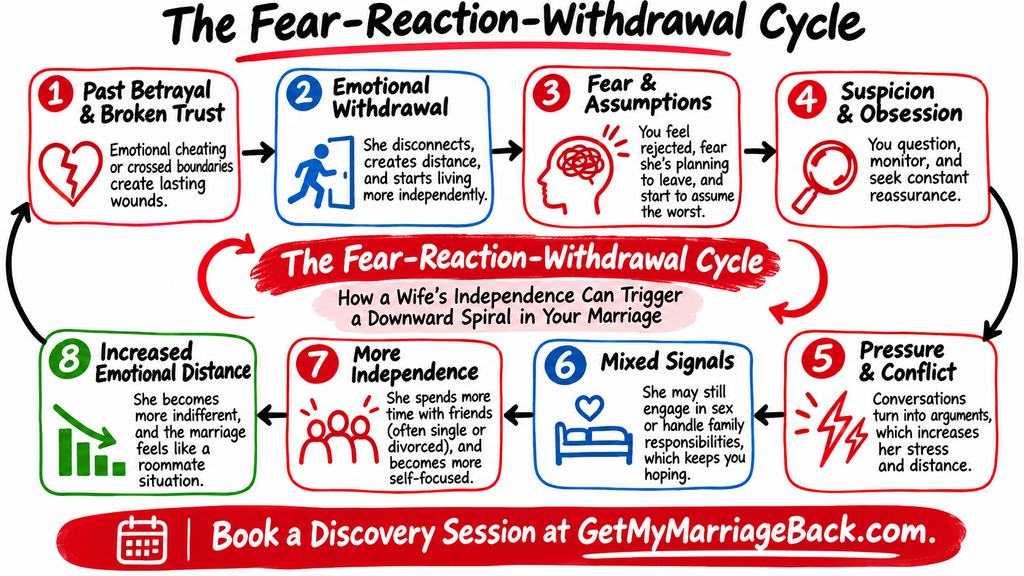
Fear → Suspicion → Questioning → Pressure → Withdrawal → More Fear
Relationship researchers describe a related interaction as the demand-withdraw pattern.
In a study involving 116 married couples, researchers found that when one spouse pressured for discussion or resolution while the other withdrew, these interactions were associated with more negative emotions, less constructive behavior, and poorer conflict resolution.
The findings, published in research on demand-withdraw patterns in marital conflict, also showed that both husbands and wives could occupy either role.
The problem isn’t simply that one spouse wants to talk.
It’s the interaction between pressure and withdrawal.
One person demands reassurance. The other seeks distance, and that distance intensifies the first person’s anxiety.
Obsession doesn’t rebuild trust. It increases pressure.
The Emotional Intelligence Shift
Learn to distinguish what you know from what you fear.
If your wife says she’s going out with friends, that is information.
If you immediately conclude she’s planning to abandon the family, that is an interpretation.
Those are not interchangeable.
Emotional intelligence begins when you stop treating every frightening thought as an established fact.
You can acknowledge your concerns, maintain appropriate marital boundaries, and discuss legitimate problems without making your spouse responsible for regulating every moment of your anxiety.
That is a different kind of strength.
3. You’re Mistaking Physical Intimacy for Emotional Reconciliation
One of the most confusing situations occurs when your wife continues having sex with you while remaining emotionally distant.
You may be thinking:
If she doesn’t want this marriage anymore, why does she still sleep with me?
Or perhaps the opposite:
If we’re still physically intimate, why does she act like she doesn’t love me?
My client experienced this contradiction.
His wife would occasionally engage in physical intimacy with him.
But he could feel the emotional disconnect.
They were physically together without the friendship, warmth, and closeness they once shared.
Instead of reassuring him, those encounters sometimes intensified his sense of rejection.
He wanted sex to mean that she was coming back emotionally.
But physical intimacy and emotional reconciliation are not necessarily the same thing.
What Does Sex During Separation Actually Mean?
Physical intimacy can occur for different reasons.
Sometimes it reflects genuine desire.
Other times, familiarity, comfort, habit, loneliness, or an attempt to preserve connection may play a role.
A spouse might also participate because of perceived obligation rather than freely expressed enthusiasm.
The existence of sex alone doesn’t establish which explanation applies.
You need to understand the larger emotional environment.
Does she voluntarily seek connection outside the bedroom?
Does she enjoy spending time with you?
Is there affection without an expectation of sex?
Can you share meaningful conversations without conflict?
Does she initiate moments of closeness, or does emotional distance return immediately afterward?
These questions help you recognize the quality of the connection rather than relying on isolated experiences.
Attraction Is More Than Physical Access
When you’re trying to save your marriage from divorce, it’s tempting to use physical intimacy as a relationship scoreboard.
You may feel hopeful after sex and devastated when affection disappears again.
That emotional roller coaster can make you increasingly dependent on your wife’s behavior for reassurance.
But attraction involves more than physical contact.
It includes emotional safety, freedom, curiosity, affection, trust, and the quality of the experience two people share.
I call this your experiential value.
I’m not talking about your moral worth as a person.
I’m talking about what it actually feels like to interact with you.
Does your spouse experience calm or constant interrogation?
Warmth or resentment?
Confidence or desperation?
Meaningful engagement or emotional pressure?
These experiences shape the emotional atmosphere of your marriage.
You cannot demand desire. You can become more intentional about the emotional experience you create.
And that begins long before you enter the bedroom.
4. You’re Holding On So Tightly That You’re Creating Resistance
One of the hardest lessons I’ve had to learn in loving my wife, Lola, is that loving someone deeply includes the willingness to let go.
I understand why that sounds frightening.
When you’ve invested years in building a family, the idea of letting go can feel like surrendering everything you love.
Your marriage represents shared memories, children, commitments, identity, and dreams for the future.
Losing that relationship can feel like losing an entire version of your life.
But here’s something I want you to consider.
When you’re pulling against someone who doesn’t want to move toward you, increasing the force doesn’t create desire. It creates resistance.
Think about the difference between an invitation and a demand.
An invitation allows someone to choose closeness.
A demand attempts to manufacture it.
And attraction doesn’t respond to those experiences in the same way.
Letting Go Is Not Abandoning Your Marriage
I’m not telling you to stop loving your wife.
Nor am I suggesting that you ignore infidelity, disrespect, broken commitments, or serious relationship problems.
Letting go means releasing the belief that you can control another person’s feelings through pressure.
You stop chasing reassurance.
Instead of monitoring every emotional movement, you begin taking responsibility for your own behavior.
You respect her autonomy while maintaining your standards.
Most importantly, you stop allowing the fear of divorce to dictate your personality.
This creates a different relational experience.
Your spouse can encounter you without anticipating another interrogation.
Conversations have room to become conversations again.
Affection can be expressed without immediately becoming a test of commitment.
That’s where emotional safety and attraction have more room to develop.
How to Rebuild Attraction When Your Wife Wants to Separate
When your marriage feels threatened, your instincts may tell you to do more.
Talk more.
Explain more.
Convince more.
Ask more questions.
But sometimes the most important change is not doing more.
It’s learning to respond differently.
I teach a framework called GPS5 that helps you return to emotional steadiness rather than allowing fear to dominate your interactions.
Grounding: Stop Reacting to Every Frightening Symptom
When your wife becomes distant, your nervous system may interpret that withdrawal as an immediate threat.
You feel compelled to fix the situation before it gets worse.
Grounding interrupts that automatic reaction.
Before confronting her, notice your emotional state.
Are you responding to an actual problem, or are you trying to escape the discomfort of uncertainty?
Give yourself room to think before acting.
A calm response doesn’t mean you don’t care.
It means your fear no longer has unlimited authority over your behavior.
Purpose: Become More Than Your Marriage Crisis
A marriage crisis can consume your identity.
You stop enjoying your interests, neglect responsibilities, and organize your entire emotional life around your spouse’s mood.
That makes every interaction feel unusually consequential.
Purpose helps restore perspective.
Reconnect with your responsibilities, personal mission, family leadership, health, and meaningful goals.
Your marriage remains important, but it no longer becomes the only source of meaning in your life.
This is not about pretending to be unavailable to manipulate attraction.
It’s about becoming emotionally grounded in a life you can lead responsibly.
Self-Discovery: Understand Your Relationship Patterns
Ask yourself some difficult questions.
Do you become controlling when you feel rejected?
Are you projecting your own past behavior onto your spouse?
Does emotional distance trigger unresolved insecurity?
Have you confused being needed with being desired?
Do you use arguments to force emotional engagement?
These questions reveal patterns you can change.
Self-discovery isn’t an exercise in condemning yourself.
It’s an opportunity to recognize how your reactions influence the emotional atmosphere of your marriage.
Skills, Support, and System
Understanding your behavior intellectually is only the beginning.
Under stress, old habits can return quickly.
You may promise yourself that you’ll stop interrogating your wife, only to repeat the same behavior when she announces another weekend outing.
That’s why practical relationship skills matter.
You need to develop the ability to regulate emotional reactions, communicate concerns without accusations, and navigate difficult conversations with greater confidence.
Support provides perspective when your fear makes objective thinking difficult.
A consistent system helps you practice those skills instead of depending on temporary motivation.
Together, these elements help transform emotional intelligence from an idea into everyday behavior.
What to Do When Your Wife Goes Out Without You
Imagine your wife announces that she’s spending Saturday evening with friends.
You know some of them are divorced.
Immediately, your imagination starts predicting the worst.
She might meet someone.
Perhaps she’s enjoying being single.
Maybe she’s planning to leave.
Before you respond, recognize what’s happening.
Your fear is trying to convert uncertainty into certainty.
Rather than interrogating her, return to what you actually know.
If there are legitimate concerns about agreed marital boundaries, address them directly and respectfully at an appropriate time.
Otherwise, allow her ordinary social activities to remain ordinary social activities.
You don’t need to punish her with silence.
There’s no reason to manufacture indifference.
And you certainly don’t need to beg for affection.
Speak calmly. Maintain your responsibilities, and continue participating meaningfully in your own life.
When appropriate, create opportunities for relaxed interaction without demanding an immediate emotional outcome.
Remove unnecessary pressure without pretending the underlying marriage problems don’t exist.
That’s the balance.
Can You Save Your Marriage Alone When Your Wife Wants Out?
You can begin changing your contribution to the relationship dynamic even when your spouse isn’t participating in reconciliation.
That is the practical meaning of working to save your marriage alone.
You can stop repeating destructive reactions.
Your communication can become more thoughtful.
You can repair your own breaches of trust through accountability and consistent behavior.
The atmosphere you create can become less threatening and more emotionally inviting.
However, reconciliation ultimately involves two people making choices about the relationship.
Your responsibility is to become someone capable of participating in a healthier marriage—not to force another person into one.
A Marriage That Changed After Emotional Withdrawal
Remember the husband whose wife had emotionally disconnected after discovering inappropriate conversations?
His fear of losing the marriage had become the center of nearly every interaction.
He was constantly interpreting her independence as a threat.
The important shift came when he began recognizing that his suspicion was not evidence and that his fear-driven reactions were increasing pressure.
He had to stop making every conversation about his need for reassurance.
He also needed to understand that reducing pressure was not a substitute for repairing the trust damaged by his earlier behavior.
Over time, the relationship dynamic changed.
Three years later, they were doing well.
The lesson is not that ignoring problems restores marriages.
It’s that emotional steadiness creates better conditions for addressing the problems that actually exist.
The Real Secret to Rebuilding Desire During Separation
When your wife wants to separate, the instinct to hold on more tightly can become overwhelming.
But holding on through fear is different from loving through emotional strength.
One approach attempts to control the outcome.
The other changes how you participate in the relationship.
Your spouse needs the freedom to make her own choices.
You need the emotional discipline to make yours.
Attraction is not a reward you extract through persistence, persuasion, or pressure.
It’s a relational experience that can develop where trust, emotional safety, respect, curiosity, and authentic connection have room to exist.
That means your next step isn’t necessarily another conversation about whether she’s leaving.
Sometimes your next step is learning how to stop making every interaction feel like a fight over the future of your marriage.
You can love your wife deeply without chasing her. You can respect her independence without abandoning your marriage. And you can rebuild your emotional strength without surrendering your desire for reconciliation.
That’s where the work begins.
5 Physical Signs She Just Slept With Someone Else: The Truth
Frequently Asked Questions
She may be seeking emotional relief, independence, time to evaluate the relationship, or a path toward divorce. Her stated intentions and consistent actions provide more useful information than assumptions about her social activities.
A marriage can recover from separation when both spouses eventually become willing to address the problems that damaged the relationship. You can begin by changing your own reactions, rebuilding trust, and reducing destructive communication patterns.
You cannot manufacture genuine longing through manipulation, jealousy, or constant pursuit. Giving her appropriate space while developing emotional steadiness and respectful communication allows any renewed interest to emerge voluntarily.
Physical intimacy can reflect desire, familiarity, comfort, emotional ambivalence, or other motivations without necessarily indicating reconciliation. Look at the broader pattern of affection, communication, trust, and freely chosen connection outside the bedroom.