


Your wife is cold and distant, and every attempt you make to get closer seems to push her even further away.
Take This 2 Minutes Quiz
You can feel the change before you can explain it.
Her warmth is different. Conversations are shorter. Affection has disappeared or feels forced. You reach for her and she pulls away. Maybe she gives you the cold shoulder, spends more time alone, or treats you more like a roommate than the man she once desired.
You want answers because uncertainty is brutal.
“What happened?”
“Why are you acting like this?”
“Do you even want this marriage anymore?”
Those are reasonable questions. But when your wife is emotionally withdrawing, your desperation for clarity can become the pressure that makes her retreat even further.
That is where many husbands accidentally turn an attraction problem into a much bigger marriage crisis.
Why Is My Wife Cold and Distant Towards Me?
Start with something that sounds simple but changes everything:
There is probably more happening internally than you can currently see.
That doesn’t excuse cruelty, betrayal, contempt, or disrespect. Nor does it require you to tolerate unacceptable behavior.
It means you should resist the temptation to interpret every cold response as a complete explanation of what is happening inside her.
A cold wife can be angry.
She can be disappointed.
She can be overwhelmed.
There may be accumulated resentment, lost attraction, unresolved conflict, stress, exhaustion, broken trust, or an emotional disconnection neither of you properly addressed when it was smaller.
Sometimes she doesn’t completely understand what she is experiencing herself.
That ambiguity matters because the wrong diagnosis produces the wrong response.
When you immediately decide, “She doesn’t care about me anymore,” you naturally start reacting to that conclusion. Fear takes over, and suddenly you are chasing reassurance, monitoring her mood, demanding answers, or desperately trying to make her feel differently.
Now the original problem has company.
Mistake #1: Turning Her Emotional Distance Into a Court Case
When your wife becomes cold, you want to appeal to logic.
“You’re my wife.”
“We made vows.”
“You need to communicate.”
“At least treat me with respect.”
“We can’t fix this if you won’t talk.”
On paper, some of those statements sound perfectly reasonable.
But your marriage isn’t a courtroom, and your wife isn’t a defendant.
You cannot cross-examine someone back into attraction.
You also cannot produce enough evidence to force another human being to feel warmth, curiosity, desire, or emotional connection.
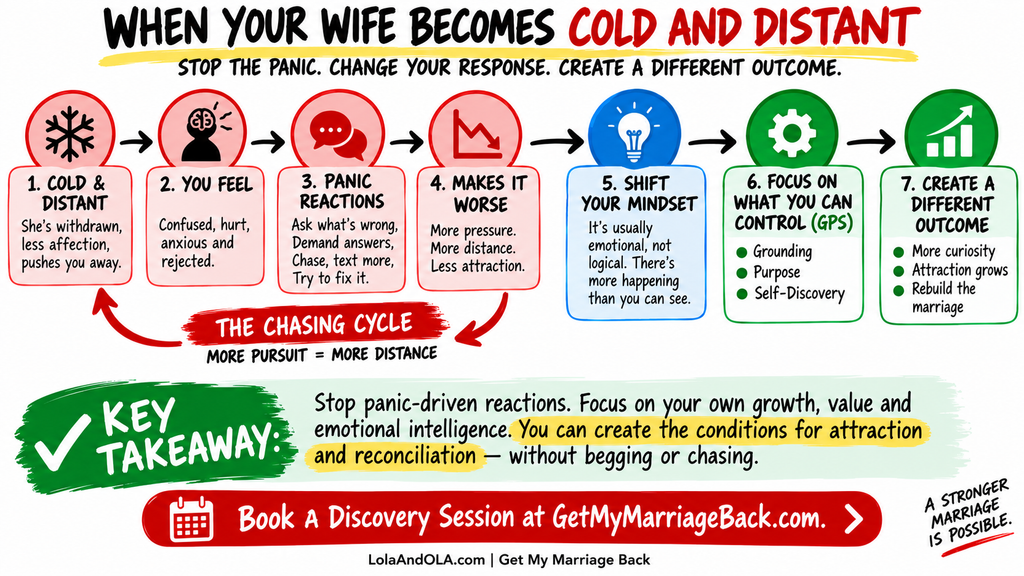
This is especially important when a demand-withdraw cycle has developed. In research involving 116 married couples reporting conflicts at home, both husband-demand/wife-withdraw and wife-demand/husband-withdraw patterns were associated with more negative emotions and tactics and lower conflict resolution. The researchers also found these patterns were especially likely around marital issues. You can read the research on demand-withdraw patterns in marital conflict.
Think about what that can look like in your house.
You feel her withdrawing, so you pursue an explanation.
She experiences more pressure, so she withdraws further.
Her withdrawal scares you, so you pursue harder.
Soon you are no longer solving the original issue. You are feeding a cycle.
Mistake #2: Making Her Mood the Source of Your Emotional Stability
Your wife is warm this morning, and you feel hopeful.
She is distant tonight, and suddenly you believe the marriage is doomed.
She laughs at something you say, and you think attraction is returning.
Tomorrow she barely speaks, and your stomach drops again.
That’s exhausting.
More importantly, you have allowed your wife’s current emotional temperature to control yours.
This is where self-leadership becomes critical.
Your wife can matter tremendously to you without becoming the source of your identity.
Her attraction matters. Your marriage matters. Saving your marriage can matter enormously.
But when your emotional stability requires constant reassurance from the very person who is currently withdrawing, you create pressure precisely where you need room.
You begin watching every facial expression.
Every text becomes evidence.
Every quiet evening becomes a verdict.
That isn’t personal power. It’s emotional dependence disguised as vigilance.
Mistake #3: Believing You Must Fix Her Coldness
When you desperately want to save your marriage, your instinct is to fix the obvious symptom.
You want her to talk again.
You want affection back.
You want sex again.
You want her to stop pushing you away.
Naturally, your attention goes directly toward changing her.
That’s the trap.
You cannot sustainably build attraction by managing another adult’s emotional state.
Your power starts with changing what you can actually control: your emotional regulation, reactions, purpose, presence, habits, communication, social intelligence, and the experience of being around you.
This distinction is enormous.
You are not trying to manipulate your wife into becoming warm.
You are becoming capable of creating a different relational experience without requiring an immediate reward from her.
Attraction Is an Experience, Not an Obligation
A lot of people approach marriage as though attraction should automatically survive because the marriage exists.
I used to see marriage heavily through the lens of duty myself.
You’re married. You’re building a life. You have responsibilities. You manage whatever comes with it.
But duty and desire aren’t identical.
A person can fulfill responsibilities while the relationship becomes emotionally flat.
You can pay every bill and still become roommates.
Both people can remain technically married while curiosity, playfulness, admiration, emotional engagement, and sexual attraction quietly disappear.
This is why keeping score is dangerous.
“I’ve been trying.”
“I’ve been affectionate.”
“I’ve provided.”
“I apologized.”
“Now she needs to do her part.”
That’s not attraction.
That’s an invoice.
Value inside an intimate relationship isn’t merely about moral worth or proving that you’re a good person. Experiential value is about what another person experiences around you.
Are interactions consistently tense?
Does every conversation become a marriage summit?
Are you interesting beyond this crisis?
Can you tolerate uncertainty without collapsing?
Do you bring purpose, emotional intelligence, curiosity, confidence, playfulness, and grounded energy into your life?
Attraction has room to grow when being around you becomes an experience rather than an obligation.
Mistake #4: Chasing Harder Because She Is Pulling Away
There is an important difference between pursuit and chasing.
Pursuit can come from dignity, genuine interest, confidence, and desire.
Chasing comes from fear.
Chasing says:
“Please tell me we’re okay.”
“Why haven’t you answered?”
“Do you still love me?”
“Are you attracted to me?”
“Are you leaving?”
“What can I do to make you happy?”
The words aren’t always the problem. The emotional dependency underneath them is.
Your wife can feel when every interaction carries an invisible demand: Make me feel safe about this marriage right now.
That is an enormous job to place on someone who is already emotionally withdrawing.
So don’t confuse “stop chasing” with pretending you don’t care.
Coldness isn’t attractive either.
Playing games isn’t self-leadership.
Manufacturing jealousy isn’t confidence.
The objective is not to punish her withdrawal with your own withdrawal. Your objective is to stop fear from dictating your behavior.
When Your Wife Pushes You Away, Stop Trying to Win the Moment
One of the hardest skills in a marriage crisis is learning not to treat every bad interaction as an emergency.
She walks past you without speaking.
Your nervous system wants resolution now.
She gives you a cold response.
You want to confront it now.
She sleeps facing the other direction.
Your mind wants to know what it means now.
That urgency makes you vulnerable to bad decisions.
Instead of asking, “How do I make her stop being cold tonight?” ask a better question:
“Who am I becoming while this marriage is under pressure?”
That shifts you from reaction to leadership.
Mistake #5: Becoming the Victim of Every Rejection
It is possible for your wife’s behavior to be unfair.
You can be genuinely hurt.
You can disagree strongly with how she is handling the marriage.
Self-leadership does not require pretending otherwise.
But victimhood becomes dangerous when it convinces you that your only path forward is waiting for her to change first.
If she must apologize before you grow, you’re stuck.
When she must communicate before you become emotionally disciplined, you’re stuck.
If she must become affectionate before you reclaim your confidence and purpose, you’re stuck.
Your ability to lead yourself cannot depend on another person’s cooperation.
That doesn’t mean one person can single-handedly maintain a healthy marriage forever. Ultimately, a marriage involves two people.
But you don’t need two people to stop contributing to a destructive cycle.
You need one.
Start with the person you control.
Ground Yourself Before You Try to Rebuild Attraction
When your marriage feels like it is collapsing, grounding means returning to a source of truth larger than the symptom in front of you.
The symptom is:
“My wife is cold.”
“My wife isn’t attracted to me.”
“She keeps pushing me away.”
“She wants separation.”
“She might want a divorce.”
Those circumstances matter, but they cannot become your entire identity.
Grounding gives you enough emotional distance from the immediate panic to choose your response instead of being dragged around by fear.
This is where gratitude also matters.
Not gratitude as denial.
You don’t pretend your marriage is fine.
Instead, you reconnect with what remains true and valuable in your life while confronting the crisis honestly.
A grounded person becomes harder to emotionally destabilize.
That quality matters tremendously when you are trying to rebuild attraction.
Reclaim a Purpose Bigger Than Your Marriage Crisis
Pain narrows your vision.
Suddenly everything becomes your marriage.
You wake up thinking about her.
You check your phone thinking about her.
At work, you’re analyzing last night’s conversation.
At home, you’re watching her face for clues.
Before sleeping, you’re replaying everything again.
That obsession doesn’t make you more committed. Eventually, it can make you less interesting, less stable, and less capable of handling the very crisis you desperately want to solve.
Purpose redirects pain into something larger.
What impact are you here to create?
What legacy are you building?
Who needs the strongest version of you?
What work would still matter if nobody applauded you?
Your purpose must be bigger than any single living human being—including your wife and including yourself.
This isn’t abandoning your marriage.
It is refusing to abandon yourself while saving it.
Use Self-Discovery Without Turning It Into Self-Blame
There is another extreme you need to avoid.
Once you realize that you can only control yourself, you can start blaming yourself for everything.
Don’t.
Self-discovery isn’t self-condemnation.
Ask useful questions instead.
What have you failed to notice?
Where have you become predictable?
Have you become chronically reactive?
Did marriage turn into duty instead of an engaging relationship?
Are you communicating because you have something meaningful to share—or because you need reassurance?
Has your entire identity narrowed into provider, parent, problem-solver, or rejected spouse?
What patterns do you bring into conflict?
These questions restore power because they reveal capacity.
You cannot change what you refuse to examine.
Build Value Before Demanding Attraction
This is where the work becomes practical.
Experiential value is the quality of the experience someone has around you.
It isn’t perfection.
It isn’t money.
Nor is it performing tricks to win your wife back.
Value can show up as emotional steadiness when you used to panic.
It can be listening without immediately defending yourself.
Sometimes it means bringing energy, purpose, humor, curiosity, social connection, competence, or playfulness back into a life that became consumed by marital problems.
You are creating contrast between the person fear was turning you into and the person you are capable of becoming.
That contrast can create something important:
Curiosity.
She starts noticing that something feels different.
Curiosity creates room for renewed attraction because she is no longer interacting with exactly the same predictable pattern.
Attraction can then create influence.
Influence creates leverage—not leverage for controlling her, but relational leverage for building a different experience between you.
That sequence cannot be bullied into existence.
It has to be experienced.
Stop Making Every Interaction About Saving the Marriage
Imagine living with someone who turns every dinner, car ride, text message, bedtime, or quiet moment into a referendum on the relationship.
That’s exhausting.
You desperately want to save your marriage, so everything starts becoming about saving the marriage.
Ironically, that can remove the very qualities that make marriage enjoyable.
There is no curiosity.
No play.
No discovery.
Every interaction carries emotional weight.
Give the relationship room to contain experiences that aren’t negotiations about its survival.
This doesn’t mean avoiding important issues indefinitely. It means understanding that connection needs oxygen.
What If She Says She Wants Separation or Divorce?
Now the stakes are higher, but the fundamental principle doesn’t change.
Don’t beg.
Don’t threaten.
Avoid writing an emotional dissertation trying to convince her that she’s wrong.
Don’t make promises you invented five minutes after hearing the word “divorce.”
Listen carefully to what is actually being communicated.
A spouse wants out for reasons that developed within a larger relationship history. Your panic response cannot erase that history overnight.
Separation can make your fear scream that you must do something dramatic immediately.
Choose deliberate action instead.
Saving your marriage while separated still begins with emotional intelligence, self-leadership, understanding your contribution to the dynamic, and rebuilding the qualities that make connection possible.
Can Marriage Be Saved When Your Wife Is Emotionally Checked Out?
Emotional withdrawal is serious.
Treat it seriously before paperwork makes the seriousness obvious.
At the same time, don’t automatically interpret distance as proof that every feeling she ever had for you has disappeared.
Research on demand-withdraw behavior is useful here because it shows that withdrawal exists inside relational patterns—not merely inside one “bad” spouse. Context matters, who wants change matters, and both husbands and wives can occupy either role.
That gives you somewhere productive to look.
Instead of obsessing over “How do I make her change?” examine the cycle.
What happens immediately before she withdraws?
How do you respond?
What happens next?
Where does the pattern repeat?
That is far more useful than simply labeling your wife cold and waiting for her to become warm again.
How to Save Your Marriage Without Begging for Love
Your marriage crisis presents you with two paths.
Fear tells you to chase certainty.
Self-leadership tells you to build capacity.
Fear wants reassurance tonight.
Purpose prepares you to behave differently tomorrow.
Fear watches her.
Grounding watches you.
Fear demands attraction.
Value creates conditions where attraction can breathe.
That is the shift.
You are not becoming indifferent to your wife. You are learning how to care deeply without allowing fear to turn care into pressure.
Nor are you surrendering the marriage.
You are becoming more skillful about how you fight for it.
When your wife is cold and distant, your strongest move isn’t forcing warmth out of her.
It’s becoming grounded enough to understand the dynamic, disciplined enough to stop feeding it, curious enough to discover your blind spots, and valuable enough to create a different experience.
That’s how you give curiosity room to return.
That’s how attraction gets oxygen.
And that’s how you begin creating the influence and leverage required for genuine marriage reconciliation.
5 Physical Signs She Just Slept With Someone Else: The Truth
Frequently Asked Questions
Coldness can reflect unresolved resentment, stress, attraction loss, disappointment, conflict, or a demand-withdraw cycle; the behavior alone cannot tell you which explanation applies. Look for the repeating interaction pattern rather than assuming one cold response explains her entire emotional state.
Stop trying to force immediate reassurance and examine what you can control: your reactions, emotional regulation, communication, purpose, and contribution to the relationship dynamic. Pressure can intensify withdrawal, especially when a demand-withdraw pattern has already formed.
Not necessarily; emotional distance is a behavior, not a definitive measurement of love, attraction, or future intentions. Persistent withdrawal is still worth taking seriously because unresolved patterns can deepen marital distress.
One person can begin changing their contribution to a destructive pattern, although a sustainable marriage ultimately requires participation from both spouses. Focus first on stopping fear-driven chasing and rebuilding emotional stability, experiential value, curiosity, and healthier influence.