


Your wife is making plans without you, treating you like a roommate, and acting as though your marriage barely matters—but the most dangerous part may be how you’re responding to her distance.
Take This 2 Minutes Quiz
You remember when your presence mattered to her. There was affection, curiosity, shared decision-making, and a sense that you were building something together.
Now, she barely acknowledges you when you enter the room. She makes decisions without consulting you, and when you express concern, you’re accused of being controlling, insecure, or overly emotional.
That’s painful, especially when you’ve invested years in building a life together.
But here’s what I want you to understand: Bad signs during separation are information, not a verdict.
A change in behavior tells you something about the present condition of your relationship. It doesn’t automatically tell you why the change happened, whether your wife has stopped loving you, or whether attraction can return.
Your responsibility is to recognize the patterns accurately, stop reacting from fear, and develop the emotional intelligence to make your next move more attractive rather than more desperate.
Let’s talk about seven warning signs that deserve your attention.
1. Sudden Male Friendships With Changing Boundaries
Your wife suddenly starts mentioning a male coworker you’ve never met.
His name comes up frequently. She’s texting him late at night, sharing personal experiences, and appearing emotionally engaged in conversations that don’t include you.
When you express discomfort, she says you’re insecure.
Naturally, that hurts.
You remember when you were the person receiving that attention, curiosity, and emotional openness.
However, having male friends doesn’t automatically establish infidelity.
What you need to know is whether the emotional boundaries have changed.
Ask yourself:
- Has she become secretive about interactions that were previously transparent?
- Is she sharing intimate concerns with someone else while withdrawing emotionally from you?
- Have previously established relationship boundaries been abandoned?
- Does she respond to reasonable concerns with honest conversation or repeated dismissal?
A friendship and an emotional affair are two different realities.
Don’t turn your imagination into evidence. At the same time, don’t pretend that repeated secrecy and broken agreements are meaningless.
The attractive response isn’t surveillance, interrogation, or competing with another man.
It’s emotional steadiness, clear boundaries, and enough self-respect to address observable behavior without losing control of yourself.

2. Sudden Girls’ Trips That Exclude You From Her Life
Your wife used to discuss vacations and weekend plans with you.
Now, she announces trips after everything has already been arranged.
You find yourself asking questions that once would have been part of a normal conversation.
Where is she going? When is she returning? What happens to the household responsibilities while she’s away?
Suddenly, you’re told she doesn’t need your permission.
But perhaps you weren’t demanding permission in the first place. You wanted consideration.
There’s an important difference between healthy independence and repeated exclusion from shared responsibilities.
A spouse can enjoy friendships, travel, and personal freedom without disregarding the practical commitments of marriage.
Consider the pattern rather than obsessing over the destination.
Does she coordinate responsibilities fairly? Is she becoming more independent while remaining respectful, or increasingly treating your shared life as an inconvenience?
Here’s another uncomfortable question: When you previously discussed her plans, did your conversations feel collaborative or interrogative?
That isn’t an invitation to blame yourself. It’s an opportunity to recognize whether your approach contributed to the tension.
Attraction becomes easier to nurture when your presence feels emotionally safe rather than controlling.
You can communicate expectations clearly without making your spouse feel that every independent decision requires a courtroom defense.
3. Selfish Decisions That Ignore Shared Responsibilities
Your wife changes financial arrangements, household expectations, or family schedules without discussing the consequences with you.
When you object, she explains that she’s finally doing what’s best for herself.
You experience that as abandonment.
And when her choices directly affect shared commitments, your concerns are legitimate.
Still, independence isn’t automatically selfishness.
A spouse establishing reasonable autonomy is different from someone repeatedly breaking agreements and expecting you to absorb the consequences.
The issue is not whether she makes decisions independently. It’s whether those decisions violate commitments, disregard practical responsibilities, or create an unfair burden.
Pay attention to repeatable behavior instead of treating every disagreement as proof that the marriage is finished.
Then respond with clarity.
You might say, “I respect your ability to make your own decisions. When those decisions affect our shared finances or responsibilities, we need a workable agreement.”
Notice what’s missing from that statement.
There’s no begging, character attack, or emotional threat.
You’re communicating a boundary without surrendering your composure.
That combination of self-respect and emotional maturity is far more compelling than trying to win every argument.
4. Indifference Replaces Emotional Engagement
This is one of the most painful bad signs during separation.
Your wife no longer argues with you.
When you tell her you’re struggling, she barely responds. You enter the room, and her expression doesn’t change.
Even conflict once felt like evidence that she cared enough to engage.
Now, you’re facing silence.
It’s tempting to conclude that she’s emotionally checked out of the marriage forever.
But indifference can have several explanations.
She may be emotionally exhausted from repeated conflict, protecting herself from another painful interaction, or actively disengaging from the relationship.
What you need to know is whether her withdrawal happens primarily during conflict or consistently across everyday interactions.
Someone overwhelmed by arguments may still demonstrate kindness, practical concern, or warmth in calmer moments.
Persistent emotional disengagement across different situations deserves closer attention.
Relationship research supports the importance of emotional responsiveness. A daily-diary study involving 99 couples found that perceived partner responsiveness was associated with relationship satisfaction.
That matters because emotional connection isn’t simply about how often you communicate. It’s also about whether interactions feel understanding, considerate, and responsive.
If your wife has become indifferent, demanding an emotional reaction can make your presence feel like another obligation.
Instead, focus on becoming someone who can remain grounded, listen without immediately defending himself, and participate in conversations without turning every interaction into a referendum on the marriage.
That doesn’t mean accepting endless indifference.
It means recognizing that emotional safety creates better conditions for connection than emotional pressure.
5. You’ve Become a Friend-Zoned Husband or Roommate
You still share a home, bills, schedules, and responsibilities.
She may even describe you as a good father, reliable provider, or wonderful friend.
Yet the romantic connection has disappeared.
There’s little affection, playful interaction, sexual curiosity, or excitement about spending time together.
You feel appreciated for what you provide but no longer desired for who you are.
This is where many husbands make a critical mistake.
They assume that if they become more helpful, more agreeable, or more persistent about intimacy, attraction will eventually return.
But attraction isn’t restored by demanding affection or accumulating favors.
What matters is the emotional experience of being around you.
I call this experiential value.
It involves how someone feels in your presence: relaxed or pressured, respected or judged, curious or exhausted, emotionally safe or constantly evaluated.
Your integrity, loyalty, and responsibilities matter. However, those qualities don’t automatically create romantic desire.
A marriage can have excellent logistical cooperation while suffering from a serious shortage of emotional and romantic energy.
Start paying attention to when the connection changed.
Did affection decline after unresolved resentment? Did your conversations become exclusively about bills, children, and schedules?
Have you stopped bringing playfulness, personal ambition, curiosity, and emotional presence into the relationship?
Research on sexual autonomy support and relationship satisfaction examined 786 participants across three studies and found positive associations between feeling supported in sexual autonomy, sexual need fulfillment, and relationship satisfaction.
The practical implication is important: Desire thrives more naturally when intimacy feels freely chosen rather than demanded.
You cannot force your wife to desire you.
What you can do is cultivate the personal confidence, emotional maturity, and enjoyable interactions that make genuine curiosity more possible.
Seduction in a marriage isn’t manipulation.
It’s the art of making connection feel inviting again, while respecting the other person’s freedom to respond.
6. Disrespectful Words Become Normal
Your wife dismisses your concerns, mocks your emotions, or repeatedly speaks to you with contempt.
Conversations that once felt respectful now leave you feeling small.
Perhaps she rolls her eyes, ridicules your intentions, or attacks your character whenever you disagree.
Disrespect matters.
However, not every disagreement is contempt, and not every frustrated statement means your spouse has lost all respect for you.
What you need to recognize is the difference between an isolated disagreement and a recurring pattern of humiliation.
Relationship researcher John Gottman’s work identifies criticism, contempt, defensiveness, and stonewalling as destructive patterns in distressed relationships.
Contempt is particularly concerning because it communicates superiority or disgust rather than a willingness to address the problem together.
Your response matters, too.
Are you retaliating with insults? Do you plead for approval, or abandon your boundaries to prevent another argument?
Neither aggression nor desperation creates genuine respect.
A grounded response might sound like this:
“I want to understand your concerns, but I’m not continuing a conversation where we’re insulting each other. We can discuss this respectfully.”
Then follow through calmly.
Your dignity doesn’t depend on winning the argument.
In fact, one of the most attractive qualities you can develop is the ability to maintain your standards without becoming emotionally volatile.
7. Your Anxiety Starts Controlling Your Behavior
This final warning sign isn’t necessarily about your wife’s behavior.
It’s about yours.
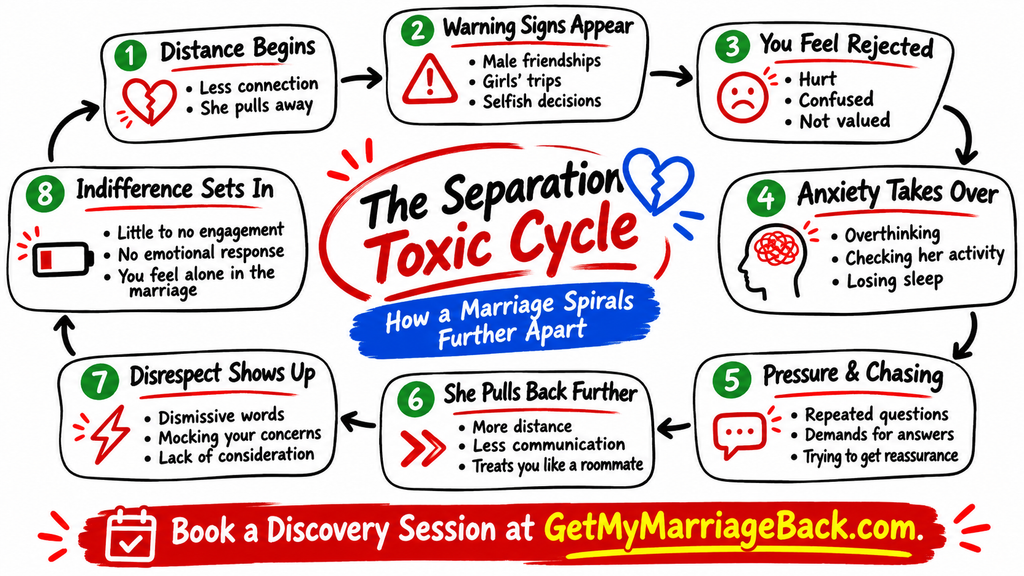
You’re checking her online status, rereading old messages, monitoring her mood, and struggling to sleep.
Every interaction feels like a test.
If she smiles, you feel hopeful. When she becomes distant, your entire day falls apart.
Her emotional availability has become the center of your existence.
I understand why that happens.
When your marriage feels threatened, your nervous system can start treating every unanswered message or cold response as an emergency.
But anxiety isn’t evidence that your marriage is beyond repair.
It tells you fear is beginning to direct your decisions.
And fear-driven behavior often creates additional pressure in an already strained relationship.
Repeated reassurance-seeking, emotional interrogation, and constant monitoring can make even ordinary conversations feel exhausting.
You need to stop treating every symptom as an emergency demanding an immediate reaction.
That shift begins with emotional self-leadership.
How to Rebuild Attraction During Separation Without Chasing
Recognizing the signs is only half the work.
The bigger question is what you do next.
If your wife has become distant, you may feel compelled to explain yourself repeatedly, convince her of your value, or make grand gestures to prove your commitment.
But attraction doesn’t respond well to pressure.
What you need is a more grounded way of showing up.
Ground Yourself Before Responding
In my GPS5 framework, the first principle is Grounding.
Instead of allowing every change in your wife’s mood to determine your emotional state, reconnect with your values, gratitude, and a perspective bigger than the immediate conflict.
When she gives you the cold shoulder, you don’t have to follow her around demanding an explanation.
Put your phone down. Relax your shoulders.
Give yourself enough space to respond thoughtfully rather than impulsively.
You’re not pretending the problem doesn’t exist. You’re refusing to let fear make your decisions.
Reconnect With Your Purpose
The second principle is Purpose.
Your marriage matters, but your entire identity cannot depend on your spouse’s current feelings.
Reconnect with your health, meaningful work, responsibilities, friendships, personal development, and long-term mission.
This isn’t about acting unavailable to provoke jealousy.
It’s about becoming a person whose life contains meaning beyond the relationship crisis.
Someone with a genuine sense of purpose often brings a different energy into conversations: less desperation, more steadiness, and greater capacity to be present.
Strengthen Your Sense of Self
The third principle is Self.
Develop accountability, emotional capacity, and personal responsibility without confusing those qualities with self-blame.
You can acknowledge your mistakes without accepting responsibility for every problem in the marriage.
Practice communicating your needs directly, maintaining boundaries respectfully, and listening without immediately defending yourself.
Research on self-determination and romantic conflict has found associations between autonomy and less defensive, more understanding responses during disagreements.
That makes emotional self-control more than a motivational slogan. It’s a practical relationship skill.
Develop the Skills, Support, and Systems to Sustain Change
A single calm response is valuable, but lasting change requires repetition.
That’s where the remaining elements of GPS5—Skills, Support, and Systems—become important.
Build the communication skills needed to de-escalate conflict. Surround yourself with constructive support, and establish routines that prevent anxious habits from controlling your day.
For example, stop checking your spouse’s online activity whenever you feel uncertain.
Replace that habit with a deliberate pause, physical movement, or a meaningful task.
When a conversation becomes heated, practice taking a respectful break rather than forcing immediate resolution.
Over time, these behaviors change the experience of interacting with you.
You become less reactive, more emotionally available, and more capable of genuine connection.
The Attraction Shift Most People Miss During Separation
Here’s the paradox.
The more desperately you try to secure your wife’s attraction, the more pressure she may experience.
Yet when you become emotionally grounded, maintain your dignity, and create more positive experiences, you stop making every interaction about what you need from her.
That changes the emotional atmosphere.
You can become playful without demanding affection, attentive without monitoring, and confident without becoming arrogant.
A warm smile, a thoughtful conversation, or a moment of genuine humor can feel more inviting than another intense discussion about whether the marriage will survive.
This isn’t about hiding your concerns or ignoring broken agreements.
It’s about understanding that repairing practical problems and rebuilding romantic attraction are related but different tasks.
You still need honesty, accountability, mutual respect, and workable agreements.
At the same time, emotional connection benefits from freedom, curiosity, and interactions that feel good rather than obligatory.
Confidence is always sexy.
Confidence isn’t the absence of fear. It’s the ability to act according to your values even when the outcome feels uncertain.
And that kind of confidence becomes especially powerful when it is combined with empathy.
What These Seven Warning Signs Really Mean for Your Marriage
The most important lesson isn’t that sudden male friendships, girls’ trips, selfish decisions, indifference, roommate dynamics, disrespect, or anxiety automatically predict divorce.
It’s that these patterns reveal where your marriage may be losing trust, cooperation, emotional safety, or attraction.
Some changes reflect healthy independence. Others reveal unresolved resentment, neglected boundaries, or serious emotional disengagement.
Your job is to differentiate those realities instead of allowing fear to decide what every behavior means.
When you recognize the pattern accurately, you can respond with more intelligence.
You stop chasing every emotional signal and start developing the qualities that support a healthier connection.
The goal isn’t to control your wife’s choices.
It’s to become a more grounded, self-respecting, emotionally compelling person while addressing the actual problems in your marriage.
That’s how you move from reacting to separation toward creating better conditions for trust, curiosity, and attraction to grow again.
5 Physical Signs She Just Slept With Someone Else: The Truth
Frequently Asked Questions
Persistent emotional indifference, repeated boundary violations, contempt, exclusion from shared responsibilities, and disappearing romantic connection are important warning signs. Look for consistent patterns rather than treating one incident as a final verdict.
She may show little interest in emotional connection, avoid meaningful conversations, and remain disengaged even when there is no conflict. Emotional exhaustion can look similar, so pay attention to whether warmth and consideration still appear in calmer situations.
Yes, attraction can return when emotional safety, mutual respect, curiosity, and positive experiences begin to develop again. Pressuring your spouse for affection is less constructive than addressing resentment and creating space for genuine connection.
Avoid constant monitoring, repeated reassurance demands, emotional interrogation, retaliation, and treating every interaction as an emergency. Focus instead on clear boundaries, emotional self-control, respectful communication, and personal growth.