


Your wife tells you she wants a divorce, yet she still reaches for you in bed—and the next morning, you’re left wondering how someone can desire you physically while questioning your entire future together.
Take This 2 Minutes Quiz
One night, you feel wanted. The next morning, she is distant, uncertain, or talking about separation again.
You remember your wedding vows, the years you’ve invested, and the promises you made to each other. Marriage was supposed to mean loyalty, security, belonging, and a shared future.
Now you’re experiencing physical acceptance alongside emotional uncertainty.
Naturally, questions start racing through your mind.
Does she still love me? Is she manipulating me with sex? Does she secretly want to save our marriage? Or is she keeping me emotionally attached while preparing to leave?
I want you to understand something that can change how you navigate this crisis:
Your wife choosing intimacy with you is not the same thing as your wife choosing a future with you.
Confusing those two decisions can turn moments of closeness into painful cycles of hope, disappointment, resentment, and emotional pressure.
The opportunity is to understand what is happening without allowing fear to dictate how you respond.
Why Would Your Wife Want a Divorce but Still Sleep With You?
Physical desire and marital commitment are related, but they are not identical.
Your wife can still experience sexual attraction toward you while doubting whether your marriage can continue.
She may enjoy the familiarity of your body, the comfort of your presence, or the emotional connection that physical intimacy provides.
None of those experiences automatically resolves whatever caused her to consider divorce.
Consider this situation.
Your wife initiates intimacy on Saturday night. You enjoy the experience and begin imagining that perhaps the divorce conversation is finally behind you.
By Sunday afternoon, she mentions wanting space.
Suddenly, the intimacy that made you feel secure becomes the very thing making you feel rejected.
You start asking yourself what the previous night meant.
But the more important question is whether you’re using one intimate experience to interpret an entire relationship.
Sexual intimacy tells you something about that moment. Her behavior across the relationship tells you more about her willingness to remain married.
That distinction is essential when you’re trying to save your marriage from divorce.

1. She Still Desires You Physically but Questions the Marriage
One possibility is that your wife remains sexually attracted to you.
Perhaps the chemistry is still present. Your touch still feels familiar, and the physical connection remains enjoyable.
However, she may be struggling with unresolved disappointment, emotional disconnection, recurring arguments, or uncertainty about your future.
This is where many husbands make a costly interpretation.
They assume that because sexual attraction exists, reconciliation must already be happening.
Then they become frustrated when their wives continue expressing doubts about the marriage.
I want you to separate two questions:
Does she desire physical closeness with me?
Does she believe we can build a satisfying future together?
The answers can be different.
Rather than using intimacy as proof that the marriage has been repaired, observe whether she is becoming more open to spending time together, communicating, and discussing the future.
You are looking for patterns of voluntary connection beyond the bedroom.
Attraction Is More Than Sexual Availability
Sustainable attraction involves more than physical chemistry.
It also includes emotional responsiveness, curiosity, mutual respect, and the experience of feeling valued.
A 2016 study by Birnbaum and colleagues examined partner responsiveness across three studies and found that responsiveness was associated with increased sexual desire, particularly among women.
The researchers identified feeling special and perceiving a partner as desirable as important parts of that association.
This supports a valuable principle: how someone experiences you emotionally can influence how they experience you romantically.
Attraction is not simply something you demand because you’re married.
It is something that can be nurtured through the quality of your interactions.
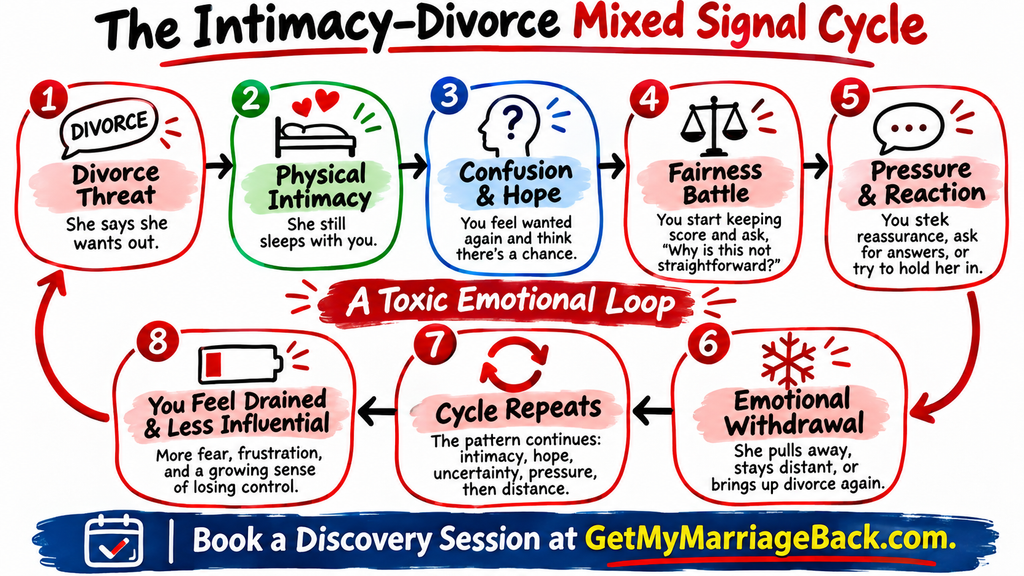
2. She Wants the Comfort of Intimacy Without Having Resolved Her Decision
Years of marriage create familiarity.
You have shared routines, private experiences, responsibilities, memories, and perhaps children.
Physical intimacy can remain comforting even when the relationship is under significant stress.
Your wife may not be ready to abandon that closeness.
At the same time, she may not be ready to recommit.
This is ambivalence.
She experiences competing feelings about the marriage, and those feelings may appear contradictory from the outside.
One day, she seems affectionate. Another day, she pulls away.
You may interpret this as a calculated strategy to keep you emotionally available.
Sometimes, however, the inconsistency reflects genuine uncertainty.
How to Recognize Emotional Ambivalence
Look beyond individual moments.
Does your wife express affection but avoid discussing the future?
Is she comfortable spending time with you while remaining uncertain about reconciliation?
Does she occasionally initiate connection without following through on broader relationship conversations?
These behaviors can indicate that attachment remains even though commitment is unresolved.
The important distinction is between recognizing an emotional connection and assuming that connection has already become a decision.
Ambivalence is not reconciliation, but neither is it necessarily the absence of attraction.
This is why emotional intelligence matters.
You need enough self-control to observe the situation without turning every affectionate moment into a demand for reassurance.
3. Is Your Wife Using Physical Intimacy to Manipulate You?
Let’s address the uncomfortable possibility.
Manipulation can exist in marriage.
A spouse may use affection, rejection, or threats of divorce to influence the other’s decisions.
However, contradictory behavior alone does not establish manipulation.
You need to distinguish observable patterns from assumptions about intention.
For example, consider whether your wife repeatedly threatens divorce immediately before demanding that you surrender a boundary.
Does affection disappear as punishment whenever you disagree?
Is intimacy restored specifically after you provide money, abandon an important concern, or comply with a demand?
Those patterns deserve attention.
They are different from a spouse who feels attracted to you but remains uncertain about the relationship.
The Difference Between Manipulation and Mixed Signals
Suppose your wife is affectionate on Friday but distant on Saturday.
That inconsistency may hurt, but it does not tell you why her feelings changed.
Now suppose she repeatedly says she will divorce you unless you meet an unrelated demand, then withdraws affection until you comply.
The second situation provides more specific evidence of coercive behavior.
Your responsibility is to examine what actually happens rather than immediately assigning motives.
You can acknowledge the emotional impact of her behavior without pretending to know everything she is thinking.
And you can establish boundaries without retaliating, threatening, or using intimacy as leverage yourself.
Marriage Does Not Make Sexual Desire an Obligation
You may believe your wedding vows established a lifelong commitment to love, loyalty, and physical intimacy.
Those expectations matter.
However, marital commitment does not remove either partner’s ability to choose whether to engage in sex.
Desire that is freely expressed is fundamentally different from intimacy obtained through guilt, fear, or pressure.
Research published in Personality and Social Psychology Bulletin examined sexual autonomy support across three studies involving 786 participants.
The researchers found associations between feeling supported in one’s sexual choices and greater sexual need fulfillment and relationship satisfaction for both partners.
You can explore the research on sexual autonomy and relationship satisfaction to understand why freedom of choice matters within intimate relationships.
The practical lesson is straightforward.
You want your wife to desire you willingly, not simply comply with your expectations.
That difference matters when your goal is rebuilding genuine attraction.
4. Your Fear of Divorce Is Changing How You Respond to Intimacy
Here is where I want you to examine your own behavior.
When your wife welcomes physical intimacy, do you feel temporarily secure?
Afterward, when she becomes distant, do you immediately question her intentions?
Perhaps you ask whether she still wants a divorce.
Maybe you demand an explanation for why she slept with you if she doesn’t want the marriage.
Your fear is understandable.
But your reaction can create a second relationship problem.
Instead of experiencing intimacy as mutual connection, you begin treating it as evidence in an argument.
Your wife becomes the person who must explain herself.
You become the person demanding certainty.
Before long, your marriage starts resembling a courtroom.
The Fairness Trap That Makes Reconciliation Harder
You remember everything you’ve contributed.
The financial sacrifices, emotional investments, compromises, and years of commitment begin running through your mind.
You think about what she promised.
Then you compare those promises with her present behavior.
It feels unfair.
And perhaps some aspects of the situation genuinely are unfair.
But I want you to notice what happens when fairness becomes your primary strategy for restoring attraction.
You start keeping score.
Every disagreement becomes another opportunity to demonstrate why your spouse is wrong.
Each affectionate gesture becomes something you believe you are entitled to interpret as commitment.
Eventually, the relationship becomes a contest over who owes whom.
You cannot argue someone into freely desiring a future with you.
You can insist on honesty, express your needs, and maintain boundaries.
What you cannot do is use the strength of your argument to manufacture genuine romantic desire.
That is the difference between demanding fairness and exercising personal influence.
How to Rebuild Attraction When Your Wife Wants Out
If you’re trying to save your marriage while your spouse remains uncertain, your greatest opportunity is not to control her feelings.
It is to improve how you show up in the relationship.
That begins with emotional regulation.
Your wife should be able to experience your presence without every interaction becoming a referendum on whether she will stay.
This doesn’t mean suppressing your concerns.
It means choosing the appropriate time, setting, and emotional state for important conversations.
Stop Turning Intimacy Into an Interrogation
Imagine two different reactions.
In the first situation, your wife initiates sex.
Afterward, you immediately ask whether this means she has changed her mind about divorce.
When she cannot provide the reassurance you want, you become upset.
The intimate experience ends in emotional pressure.
In the second situation, both of you freely enjoy the closeness.
You remain present rather than using the moment to obtain promises.
Later, when you are both available for a meaningful conversation, you calmly explain that ongoing uncertainty matters to you.
You can ask what she believes needs to change without treating the previous night’s intimacy as evidence against her.
The second response creates more room for honest communication.
It also demonstrates that you can manage difficult emotions without making your spouse responsible for regulating every moment of your anxiety.
Build Emotional Safety Without Becoming Passive
Emotional safety does not mean agreeing with everything your wife says.
You can disagree respectfully.
You can express disappointment.
You can decline physical intimacy when the surrounding uncertainty makes it emotionally uncomfortable for you.
What matters is that your behavior remains intentional rather than retaliatory.
A responsive partner listens, recognizes the other’s experience, and respects boundaries.
Research involving 305 participants examining sexual need responsiveness identified listening, communicating, accommodating needs when possible, and respecting autonomy as central elements.
These qualities support an environment where attraction can be expressed without pressure.
Being emotionally intelligent is not the same as becoming agreeable at all costs.
It is the ability to remain grounded while addressing real problems.
Use Grounding, Purpose, and Self-Discovery to Strengthen Your Influence
I teach the importance of Grounding, Purpose, and Self-Discovery because relationship uncertainty can easily consume your identity.
When your entire emotional state depends on whether your wife is affectionate today, you become vulnerable to every change in her mood.
Your confidence rises when she welcomes you.
It collapses when she mentions divorce.
That cycle can make your behavior increasingly unpredictable.
Grounding: Stop Allowing Panic to Make Your Decisions
Grounding means returning to your values and choosing your conduct deliberately.
You may feel afraid of divorce.
That fear does not have to determine what you say next.
Before reacting, identify what you’re experiencing.
Are you angry, frightened, disappointed, or desperate for reassurance?
Once you recognize the emotion, you have more opportunity to choose a response that reflects your values.
Purpose: Maintain a Life Beyond the Marriage Crisis
Your marriage matters, but it cannot become the only source of meaning in your life.
Continue showing up for your responsibilities, personal development, friendships, work, and long-term goals.
Purpose helps prevent relationship uncertainty from consuming every hour of your day.
It also allows your spouse to experience you as a complete person rather than someone whose entire identity depends on her next decision.
A fulfilling personal life is not a performance designed to make your wife jealous.
It is part of maintaining your own emotional stability and relational capacity.
Self-Discovery: Identify the Reaction That Keeps Repeating
Notice what happens whenever your wife mentions divorce.
Do you argue?
Do you plead?
Do you become defensive or withdraw emotionally?
Perhaps you start explaining your worth or listing everything you’ve done for the marriage.
Those reactions may feel protective, but they can reinforce the very disconnection you’re trying to overcome.
Self-discovery means recognizing your patterns before they become automatic.
You can then develop better communication, patience, and emotional resilience.
This is how personal influence becomes more meaningful.
The Seductive Power of Emotional Confidence
Attraction is not simply about looking desirable or saying the right romantic words.
It is also about how someone feels in your presence.
Are conversations consistently tense?
Does affection create an expectation of immediate commitment?
Can your spouse disagree with you without every difference becoming an argument?
These questions matter because romantic curiosity struggles when every interaction carries emotional pressure.
Confidence creates a different experience.
You can be warm without begging for affection.
You can express attraction without demanding reciprocation.
You can remain playful without pretending the marriage crisis does not exist.
A gentle compliment, relaxed conversation, shared laughter, or affectionate touch can become meaningful when both partners welcome it.
The key is mutuality.
Seduction in a struggling marriage should be an invitation to connection, not a technique for overcoming someone’s resistance.
Allow your spouse the freedom to respond authentically.
When connection is mutual, enjoy it without immediately asking what it means for the divorce.
This is how you begin separating attraction from desperation.
What to Do When She Becomes Distant After Sex
Suppose your wife is affectionate tonight.
Tomorrow, she seems emotionally withdrawn.
Your instinct may be to confront the contradiction immediately.
Instead, examine whether the moment actually requires a conversation.
You do not have to chase her around the house seeking reassurance.
Neither do you have to pretend that repeated uncertainty is acceptable indefinitely.
Maintain your composure, continue your responsibilities, and choose an appropriate time to address the broader issue.
You might say:
“I value the closeness we share, but I’m also aware that we’re uncertain about our future. I’d like us to understand what each of us wants and what needs attention in our marriage.”
That statement communicates your concern without turning intimacy into an obligation.
If physical closeness repeatedly leaves you feeling emotionally distressed, you can also establish a boundary around your own participation.
Your willingness to have sex matters just as much as hers.
Watch What Happens Outside the Bedroom
When assessing whether reconciliation is developing, pay attention to everyday interactions.
Does your wife voluntarily initiate conversations?
Is she interested in spending time together?
Does she demonstrate curiosity about your experiences?
Are difficult conversations becoming more constructive?
Does she show increasing willingness to discuss what rebuilding the marriage would involve?
These patterns provide a broader picture of the relationship.
One night of intimacy may reflect attraction.
Consistent voluntary engagement offers more information about the possibility of renewed partnership.
Can You Save Your Marriage When Your Wife Still Wants a Divorce?
The desire to save your marriage is understandable.
You want the person you love to choose you again, not because she feels obligated, but because she genuinely wants to share a future with you.
That is a different objective from merely preventing divorce.
Preventing an immediate argument is not the same as restoring emotional connection.
Obtaining reassurance is not the same as rebuilding commitment.
And continuing to have sex is not necessarily the same as achieving marriage reconciliation.
If your wife remains uncertain, focus on understanding the relationship dynamic rather than trying to force a decision.
Look at your communication patterns, emotional reactions, mutual attraction, unresolved disagreements, and the quality of everyday connection.
You can improve your contribution to the marriage even while your spouse is uncertain.
At the same time, genuine reconciliation requires both people to participate willingly.
The most meaningful progress is not simply hearing your wife say she will stay.
It is developing a relationship in which both of you increasingly want to remain.
The Real Meaning of Physical Intimacy During a Divorce Crisis
When your wife wants a divorce but still sleeps with you, the most important question is not whether you can use that intimacy to convince her to stay.
The better question is what the relationship is communicating through its patterns.
Physical attraction may still exist.
Emotional attachment may remain strong.
Uncertainty may be preventing commitment.
In some marriages, manipulative patterns may also need to be addressed.
Your responsibility is to distinguish these possibilities without allowing fear to dominate your behavior.
You do not have to surrender your standards, ignore your needs, or accept ongoing coercion.
But you also do not have to turn every affectionate moment into a demand for certainty.
The kind of attraction worth rebuilding is attraction that can be expressed freely, confidently, and consistently within a relationship both people genuinely want.
That begins with the quality of connection you cultivate and the emotional intelligence you bring into the marriage.
11 Physical Attraction Signs That Reveal Real Desire
Frequently Asked Questions
She may still experience sexual attraction, emotional attachment, familiarity, or uncertainty about leaving. Physical intimacy alone does not establish whether she intends to reconcile.
Continued intimacy may reflect affection or attraction, but it cannot independently establish love or long-term commitment. Look at her voluntary emotional engagement and behavior outside the bedroom.
Not necessarily, because conflicting feelings and intentional manipulation are different. Repeatedly using divorce threats or affection to demand compliance provides more meaningful evidence of coercive behavior.
You can work on emotional regulation, communication, attraction, and the relationship patterns within your influence. Lasting reconciliation also requires your wife’s willing participation in rebuilding the marriage.