


Your wife says she loves you but is not in love with you anymore, and suddenly everything you thought made you a good husband feels insufficient.
Take This 2 Minutes Quiz
Maybe she still cares about you. Perhaps she appreciates your commitment, respects your responsibilities, or acknowledges everything you’ve done for the family. Yet something has changed in the way she experiences you romantically.
She may no longer initiate affection. Conversations feel mechanical, intimacy has become strained, and the friendship that once made your marriage enjoyable seems to be disappearing.
Now you’re wondering whether your wife has fallen out of love, whether attraction can return, and what you should do before the marriage ends.
I want you to understand something important: Being a good person and being someone your spouse experiences as romantically attractive are related, but they are not identical skills.
That distinction can change how you approach your marriage crisis.
What Does It Mean When Your Wife Loves You But Is Not in Love With You?
When your wife says, “I love you, but I’m not in love with you,” she may be distinguishing emotional attachment from romantic attraction.
She can care about your well-being while feeling disconnected from the romantic relationship. Your shared history may still matter to her, even when the excitement, admiration, emotional intimacy, or desire she once experienced has weakened.
However, those words do not automatically explain why her feelings changed.
Perhaps unresolved conflict has accumulated. Maybe emotional withdrawal has replaced friendship, or repeated disappointments have changed the atmosphere of your relationship.
In some marriages, the couple has become so focused on responsibilities that they have forgotten how to enjoy each other.
The mistake is treating her statement as a complete diagnosis.
Her feelings tell you something about her current experience. They do not tell you everything about the relationship patterns that produced it.
Before deciding what to do when your wife doesn’t love you romantically anymore, you need to examine those patterns.
1. Being a Faithful Husband Does Not Automatically Create Romantic Attraction
Consider a man who entered marriage with extraordinary personal discipline.
His first wife was the only woman who had ever seen him naked. He valued commitment, remained sexually abstinent during separation and divorce, and took his marital vows seriously.
After that marriage ended, he believed his greatest mistake was failing to investigate his first wife’s character thoroughly enough.
Eventually, he married again.
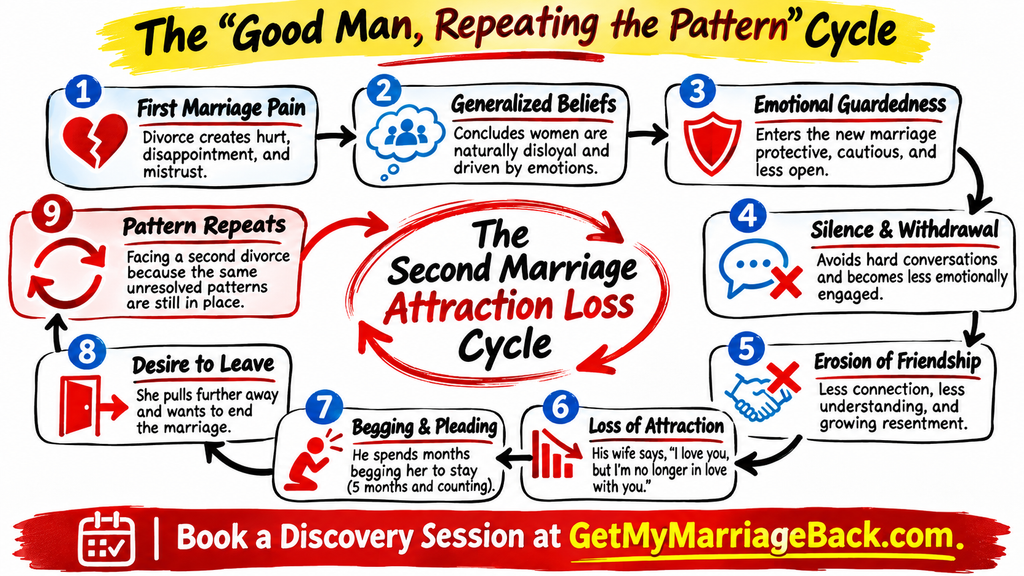
Now his second wife says she loves him but is no longer in love with him. After five months of begging her to stay, he faces the possibility of another divorce.
How does a man who takes commitment so seriously find himself in the same painful situation twice?
The answer begins with a distinction many people overlook.
Personal discipline is not the same as relationship competence.
Fidelity demonstrates commitment. Sexual restraint can demonstrate self-control, and providing for your household demonstrates responsibility.
These are meaningful qualities.
But none automatically establishes your ability to manage conflict, remain emotionally available, create romantic friendship, or adapt when your relationship changes.
You can be faithful and emotionally distant.
You can pay every bill while your spouse feels increasingly alone.
It’s possible to believe you’re protecting the marriage while your defensive reactions are weakening the connection.
This is not an invitation to blame yourself for everything. Your spouse has responsibility for their own choices and behavior.
I’m asking you to examine something more useful than blame:
Outside of being responsible and faithful, what does your wife actually experience when she’s with you?
Does she experience curiosity, warmth, emotional steadiness, playfulness, and genuine interest?
Or has your relationship become a place where both people anticipate criticism, withdrawal, and disappointment?
Romantic attraction is influenced by the quality of those repeated experiences.
2. Your First Marriage May Be Influencing Your Second More Than You Realize
One of the most dangerous consequences of relationship pain is turning a painful experience into a universal belief.
After his first divorce, the man in our example developed strong assumptions about women.
He believed women were naturally disloyal, driven primarily by emotion, and likely to betray their husbands.
To protect himself, he decided to remain guarded.
He called those defenses boundaries.
But there’s a difference between a healthy boundary and a belief system that automatically treats your spouse as a threat.
A boundary protects your values while allowing you to respond to the person in front of you.
Emotional defensiveness interprets new situations through old fears.
Imagine how this plays out in an ordinary marriage.
Your wife expresses disappointment, and you interpret it as irrational emotion.
She challenges your behavior, but you experience her words as disrespect.
When she asks for more emotional engagement, you assume she’s trying to control you.
Now you’re no longer responding only to the conversation happening today.
You’re responding to the pain of yesterday.
One failed marriage cannot establish the character of every woman, just as one painful relationship cannot establish the character of every man.
Your experiences deserve to be taken seriously. However, your conclusions about those experiences still need to be examined.
Ask yourself:
When my spouse disagrees with me, am I responding to what they actually said or to what a previous relationship taught me to fear?
That question becomes particularly important when you’re trying to save a second marriage.
Without examining the beliefs carried from your first marriage, you may reproduce familiar defensive habits in an entirely different relationship.
The people change, but the emotional pattern remains.
3. Your Silence May Be Destroying the Friendship That Supports Attraction
Silence is not automatically unhealthy.
Sometimes taking a pause prevents an argument from becoming destructive. Emotional regulation can be one of the most mature decisions you make during conflict.
However, taking time to calm yourself is different from making emotional withdrawal your permanent response.
Picture a familiar sequence.
Your wife raises a concern.
You shut down.
Later, she brings it up again, and you refuse to engage because you believe talking will only make things worse.
Eventually, she stops bringing up the issue.
You interpret the silence as peace.
Meanwhile, she may experience the marriage as increasingly disconnected.
What feels like conflict avoidance to one spouse can feel like abandonment to the other.
Of course, you shouldn’t assume this is happening simply because your wife has become quiet. Examine what she has actually communicated and how both of you have behaved over time.
Did she describe feeling alone?
Has she mentioned specific moments when you refused to engage?
Was the emotional distance growing long before physical affection disappeared?
Those details matter.
Research on romantic relationships consistently identifies perceived partner responsiveness—the experience of feeling understood, validated, and cared for—as an important element of intimacy.
A daily-diary study of couples found associations between perceived responsiveness and relationship satisfaction, while research on couples adjusting to parenthood has also examined how responsiveness relates to satisfaction over time.
The practical lesson is straightforward: Emotional connection grows through repeated experiences of being heard and understood, not simply through the absence of arguments.
You don’t have to agree with everything your wife says.
Instead, learn to remain curious without immediately defending yourself.
Try responding with:
“I want to understand what that experience was like for you.”
Then listen long enough to understand her perspective before explaining yours.
That’s emotional intelligence in action.
Rebuild Friendship Before Demanding Romance
When your wife is not in love with you anymore, demanding affection often makes the relationship feel even more pressured.
Friendship offers a healthier starting point.
Learn what matters to her today, not merely what mattered when you first met.
Create opportunities for relaxed conversation. Notice the small moments when your spouse reaches toward you emotionally, and respond with genuine attention.
Marriage researchers have described these small attempts to connect as bids for connection. Responding to them helps couples build the everyday emotional foundation that supports closeness.
But don’t turn friendship into a disguised transaction.
If every kind gesture carries the expectation of affection or sex in return, your spouse may experience your attention as another demand.
Be someone who genuinely enjoys connecting, not someone performing connection to collect a romantic reward.
4. Five Months of Begging Cannot Rebuild Romantic Attraction
Let’s address one of the most painful parts of this situation.
Your wife says she loves you but isn’t in love anymore. She may be considering separation or telling you she wants a divorce.
You panic.
Suddenly, every conversation feels like your last opportunity to save the marriage.
You remind her that you’re a good husband. Promises become more urgent, explanations grow longer, and you repeatedly ask for another chance.
Perhaps you’ve been doing this for months.
I understand the fear behind that behavior.
When you believe you’re losing someone you love, pleading can feel like the only remaining option.
But notice the contradiction.
You may have spent years protecting yourself through emotional distance, only to respond to the threat of divorce with emotional desperation.
Neither extreme creates the steady, engaging presence that supports healthy attraction.
Begging focuses the relationship on your fear.
Romantic connection requires something different: curiosity, mutual respect, emotional steadiness, and experiences that both people genuinely want to share.
You cannot negotiate someone into romantic desire.
Neither can you manufacture attraction by repeatedly reminding your spouse of your sacrifices.
Stop Using Her Reassurance as Your Measure of Progress
One day she smiles at you, and you feel hopeful.
The next day she’s distant, and your anxiety returns.
Now your entire emotional state depends on whether she offers reassurance.
That’s an exhausting way to live, and it can make every interaction feel loaded with pressure.
Instead, evaluate what you can actually influence.
Are you becoming less reactive?
Can you tolerate an uncomfortable conversation without withdrawing or pleading?
Have you developed the ability to express your needs calmly and respect hers?
Do you have meaningful goals, friendships, interests, and responsibilities beyond trying to persuade your wife to stay?
Those changes matter for your life, regardless of what she decides.
Attraction is not rebuilt by making your spouse responsible for regulating your fear.
5. Rebuilding Attraction Requires a Different Relationship Experience
If your goal is to rebuild attraction in marriage, stop thinking exclusively about what to say to convince your wife.
Begin examining what it feels like to be in a relationship with you.
Romantic attraction is not merely a reward for moral goodness. It’s influenced by the emotional and relational experiences two people create together.
This is where self-leadership becomes essential.
Ground Yourself Before You React
When your wife withdraws, your nervous system may interpret the moment as an emergency.
You feel compelled to demand an explanation, seek reassurance, or start another conversation about the future.
Don’t allow every wave of fear to determine your next action.
Pause, identify what you’re feeling, and reconnect with your higher values.
A grounded response might sound like:
“I’m feeling afraid right now, but I don’t need to turn that fear into pressure.”
Emotional steadiness creates room for better decisions.
Develop a Life That Is Genuinely Engaging
One overlooked element of romantic attraction is the experience of being with someone who remains interested in life.
When your entire identity becomes organized around preventing divorce, your conversations can become repetitive and emotionally heavy.
Reconnect with meaningful work, personal growth, friendships, health, creativity, and purpose.
Not as a performance designed to make your wife jealous.
Do it because your life deserves direction and depth.
A person who is genuinely engaged with life has more curiosity, perspective, and emotional energy to bring into a relationship.
Practice Responsive, Emotionally Intelligent Communication
Listening isn’t simply waiting for your turn to defend yourself.
Learn to recognize what your spouse is communicating beneath the immediate complaint.
If she says, “You never listen to me,” avoid starting with a list of occasions when you did.
You might respond:
“I hear that you’ve felt dismissed. What happens in our conversations that leaves you feeling that way?”
Her answer may reveal something important.
You can acknowledge an emotional experience without accepting an inaccurate accusation.
That combination of empathy and self-respect is much more effective than defensiveness or submission.
A research review on responsiveness in romantic relationships explains how feeling understood, validated, and cared for contributes to the development and maintenance of intimacy.
The principle matters because emotional attraction isn’t sustained through impressive declarations alone. It grows through the quality of ordinary interactions.
Bring Back Playfulness and Romantic Curiosity
Many marriages become dominated by logistics.
Bills, children, responsibilities, and disagreements consume every conversation.
Eventually, the relationship becomes efficient but emotionally uninspiring.
Romantic connection needs room for enjoyment.
That may involve humor, thoughtful surprises, shared experiences, affectionate attention, or conversations that have nothing to do with problems.
A sincere compliment can feel more intimate than a rehearsed romantic speech.
An unexpected moment of laughter may create more warmth than another exhausting discussion about the marriage.
When affection is welcome, small gestures can help restore tenderness. Respect her comfort and boundaries rather than treating physical closeness as something she owes you.
Seduction within marriage is not about manipulation.
It’s about cultivating a relationship experience where emotional safety, admiration, curiosity, playfulness, and mutual desire have room to grow.
What to Do When Your Wife Wants a Divorce but You Still Love Her
When your wife wants a divorce but you still love her, your immediate temptation may be to fight harder for the relationship.
However, fighting harder isn’t always the same as relating more skillfully.
Start with five practical priorities:
- Acknowledge the seriousness of her feelings. Don’t dismiss her statement or argue that she shouldn’t feel that way.
- Investigate the relationship history. Look for repeated patterns of disconnection, defensiveness, resentment, and unmet emotional needs.
- Stop the cycle of begging. Express your desire for reconciliation without turning every conversation into a plea.
- Develop relationship competence. Strengthen your emotional intelligence, communication, self-regulation, and ability to maintain friendship.
- Create consistent experiences of change. Let your behavior demonstrate growth rather than repeatedly announcing that you’ve changed.
Be particularly careful about confusing influence with control.
You can influence the emotional quality of your interactions. Your spouse still has the freedom to make her own decisions.
That distinction allows you to approach marriage reconciliation with maturity instead of desperation.
The Real Difference Between Being a Good Spouse and Being an Attractive Partner
I want to return to the man whose second marriage is in crisis.
His commitment was real. His sexual discipline was meaningful, and his desire to preserve marriage deserves respect.
Yet the qualities that made him proud of his character did not automatically give him every skill needed to sustain romantic connection.
He had learned how to remain faithful.
The deeper challenge was learning how to remain emotionally available, adaptable, curious, and engaged while navigating disappointment.
That is a different kind of discipline.
You don’t need to abandon your values to become more attractive to your spouse.
Instead, develop the relationship skills that allow those values to be experienced as love, respect, emotional security, and friendship.
Being a good person is a foundation.
Becoming someone who knows how to create and sustain a compelling romantic relationship is an ongoing practice.
“I Feel Disgusted When My Husband Touches Me” – [5 Solutions]
Frequently Asked Questions
It often means she still feels care or attachment but no longer experiences the same romantic connection or attraction. Her statement describes her current feelings, while the reasons behind those feelings require a closer look at your relationship.
Romantic feelings can change as the emotional quality of a relationship changes. Rebuilding friendship, responsiveness, trust, and enjoyable shared experiences creates a healthier environment for connection.
Begin by taking her concerns seriously, ending repeated pleading, and examining the patterns that have weakened your connection. Focus on emotional steadiness, communication, and consistent personal growth while respecting her decisions.
Develop a more emotionally engaging relationship experience through self-leadership, genuine curiosity, healthy boundaries, and enjoyable connection. Let consistent behavior replace pressure, promises, and desperate attempts to secure reassurance.