What Would Help You Most Right Now?

Choose the option that best matches where you are with your marriage.

I Need Personalized Help

My Marriage Is in Serious Trouble

If you're dealing with separation, divorce, loss of attraction, infidelity, intimacy problems, or a spouse who's pulling away, get help looking at what's happening in your specific situation.

Get Personalized Help →
Get My Marriage Back book cover
I'd Rather Learn What to Do First

Start With Get My Marriage Back

Get the book and start learning the principles for moving your marriage in a better direction.

Get the Free Book →

Your Wife Took Off Her Wedding Ring? 4 Signs & What to Do

Your wife took off her wedding ring, and now you’re wondering whether the woman you married has already decided your marriage is over.

Take This 2 Minutes Quiz

Question 1 of 15

You still believe in your marriage. You still want to save it. But every time you look at her hand, that missing wedding ring reminds you that something has changed.

It hurts because the ring represents commitment, loyalty, and the future you imagined together.

Perhaps she’s already told you she wants a divorce. Maybe she wants separation, has stopped showing affection, or no longer seems attracted to you.

Now you’re dealing with another painful question: Does taking off her wedding ring mean she’s completely done with the marriage?

I want you to understand something that can change how you navigate this crisis.

The wedding ring is a symbol of your marriage. It is not the marriage itself.

When your wife removes that symbol, pay attention. But don’t allow her decision to become the emotional center of your life.

There are four important distinctions you need to understand before deciding what to do next.

1. Your Wife Removing Her Wedding Ring Is a Signal, Not the Entire Story

More than ten years ago, my wife Lola removed her wedding ring during a serious marriage crisis.

I was hurt. Of course I was.

But I wasn’t completely surprised.

She had already told me she didn’t want to be in the marriage anymore.

That context matters.

Her decision to remove the ring wasn’t the beginning of our marriage problems. It was a visible expression of something that had already been happening underneath the surface.

And that’s where I want you to begin examining your situation.

What happened before she removed the ring?

Consider three different circumstances.

Situation A: Your wife already told you she wants a divorce.

In this case, removing her wedding ring may reinforce something she’s already communicated. She’s creating distance between her current emotional position and the commitment the ring represents.

Situation B: Your wife has been emotionally withdrawing for months.

She rarely initiates affection. Your conversations feel mechanical, and the marriage has started resembling a roommate arrangement.

Removing her ring may be another sign of that emotional disconnection.

Situation C: Your wife removed her ring after a major argument.

This may reflect anger, resentment, or an attempt to communicate emotional distance during conflict.

These situations do not carry identical meanings.

A wife removing her wedding ring after announcing she wants a divorce is different from removing it during an isolated argument.

The behavior matters, but the history gives it meaning.

Don’t confuse one visible action with a complete diagnosis of your marriage.
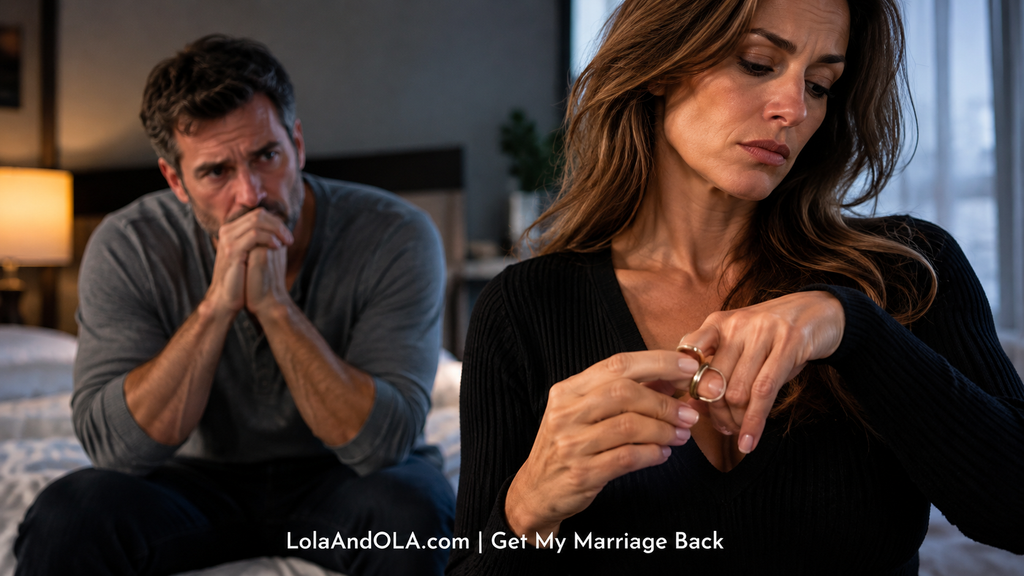
my wife took off her wedding ring

2. Your Reaction Can Become More Damaging Than Her Decision

I remember helping a gentleman who was practically crying because his wife had removed her wedding ring.

He kept repeating the same thing.

“She took off her wedding ring!”

I understood his pain.

But his attention had become so consumed by that one action that he was struggling to examine what was actually happening in his marriage.

It took approximately three coaching sessions to help him recognize that the wedding ring was only the tip of the iceberg.

And this is where many people trying to save their marriage make a serious mistake.

The wedding ring anxiety cycle

Your wife removes her ring.

You feel rejected.

That rejection creates fear.

You begin questioning her.

She becomes defensive or pulls away.

Now you feel even more insecure.

So you ask more questions, demand more reassurance, or attempt to convince her to wear the ring again.

Before long, the entire relationship becomes another struggle over your anxiety.

You’re no longer examining the marriage.

You’re trying to control the symbol.

Research on the demand-withdraw pattern in romantic relationships has examined how pressure from one partner and withdrawal from the other can become interconnected patterns during conflict. These dynamics aren’t exclusive to husbands or wives.

The lesson is especially relevant when your wife is already emotionally withdrawing.

Repeated demands for reassurance can turn an already difficult conversation into another exhausting confrontation.

And even if she eventually puts the wedding ring back on, what has changed in the underlying relationship?

Not necessarily anything.

Visible compliance is not the same thing as genuine reconciliation.
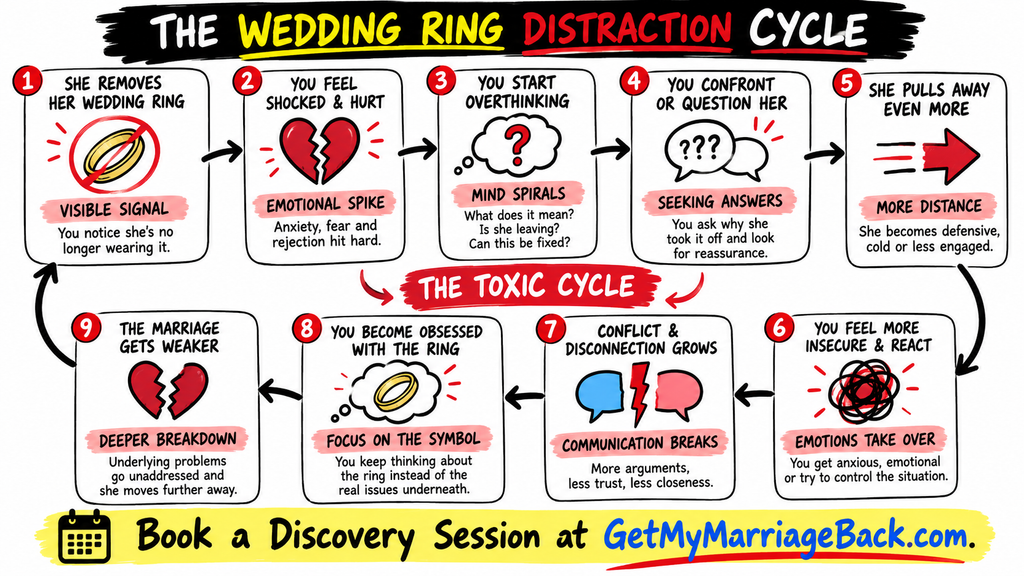
my wife took off her wedding ring - distraction cycle

3. Emotional Independence Is Not the Same as Pretending You Don’t Care

When Lola removed her wedding ring, I removed mine too.

Yes, you read that correctly.

I took off my wedding band and placed the rings somewhere safe.

I knew exactly where they were.

I wasn’t throwing them away, announcing that our marriage was finished, or trying to punish her.

At that point in my life, I had been learning important principles about attraction, influence, emotional intelligence, and personal power.

Something had become increasingly clear to me.

I couldn’t continue allowing every decision my wife made to dictate my emotional direction.

But here’s the distinction.

I’m not telling you to remove your wedding ring simply because your wife removed hers.

If you do that purely to provoke a reaction, you’re still allowing her behavior to control yours.

That’s not independence.

That’s another form of emotional dependence.

Stop confusing indifference with punishment

Healthy emotional independence doesn’t mean becoming cold, cruel, or deliberately unavailable.

It means recognizing that your wife can make decisions you dislike without those decisions automatically controlling your identity, dignity, or behavior.

You can acknowledge the crisis without interrogating her every evening.

You can recognize her emotional withdrawal without spending your entire day monitoring her finger.

And you can remain interested in saving your marriage without begging her to restore the appearance of commitment.

This is particularly important when you’re trying to save your marriage alone.

Your wife may not currently share your desire for reconciliation.

You cannot manufacture that desire by arguing with her.

What you can do is become more deliberate about how you respond, what you communicate, and how you carry yourself.

You don’t have to stop caring about your marriage to stop acting from fear.

That distinction changes the emotional atmosphere you contribute to the relationship.

4. The Real Marriage Crisis Is Underneath the Wedding Ring

Here’s what I want you to do.

Look beyond the ring.

Ask yourself what was happening in your marriage before she removed it.

Was there growing resentment?

Had emotional attraction disappeared?

Were your conversations increasingly becoming arguments?

Had she repeatedly expressed a desire to leave?

Was there a breakdown in trust, affection, respect, or intimacy?

And what role were your own reactions playing in those patterns?

These questions are more valuable than spending another week trying to determine exactly what the missing ring means.

Attraction loss and emotional disconnection

When a wife says she loves you but isn’t in love with you anymore, the problem often extends beyond a single argument.

The relationship may have lost emotional engagement, curiosity, playfulness, or romantic energy.

You might still be fulfilling responsibilities, paying bills, and demonstrating commitment.

But commitment and attraction are not identical experiences.

A marriage can have years of shared history while the emotional connection becomes increasingly strained.

This is why I teach the importance of becoming experientially attractive.

Not through manipulation, jealousy, or playing hard to get.

Through your actual presence, emotional intelligence, personal development, and the quality of your interactions.

Attraction is not something you can demand from your wife.

You can, however, work on becoming someone whose presence reflects confidence, direction, emotional steadiness, and genuine engagement.

Resentment and repeated conflict

Sometimes the missing wedding ring represents accumulated frustration.

Your wife may associate interactions with you with arguments, defensiveness, or unresolved disagreements.

Perhaps she says you never listen.

That statement communicates her emotional interpretation, but the word “never” doesn’t automatically establish an accurate history of every conversation.

Look for the legitimate concern underneath the language.

Have you been interrupting her?

Do you immediately defend yourself?

Are you repeatedly trying to win arguments rather than understanding what’s actually being discussed?

You can examine those patterns without accepting every accusation as an objective description of your character.

Divorce threats and separation

When your wife wants a divorce or says she needs separation, the situation becomes more urgent.

The missing wedding ring may accompany a broader pattern of preparing for life outside the marriage.

You need to distinguish between what she’s said, what she’s actually done, and what remains uncertain.

A statement about divorce is significant.

Removing a ring is significant.

But neither action alone reveals every underlying motivation or determines every future outcome.

Your responsibility is to understand the situation accurately instead of making fear-driven assumptions.

How to Save Your Marriage When Your Wife Wants Out

When I began examining my own marriage crisis, I recognized ways I had contributed to the relationship breakdown.

Not because I wanted to blame myself.

Because I wanted to empower myself.

There’s a major difference.

Blame keeps you trapped in the past.

Self-discovery helps you identify what you can change.

That’s why I developed the GPS framework.

Grounding: Return to your core

Grounding brings you back to your higher self, source of truth, and gratitude.

It doesn’t require pretending the crisis isn’t happening.

You acknowledge the pain while refusing to let it determine every action you take.

When you notice your wife’s empty ring finger, recognize the emotional reaction without automatically acting on it.

Purpose: Reclaim your direction

Your marriage is important.

But your entire identity cannot depend on whether your wife wears her wedding ring.

Purpose redirects your energy toward your greater mission, contribution, and legacy.

You become less dependent on immediate reassurance because your life has meaningful direction beyond the current conflict.

Self-Discovery: Recognize your capacity

Examine your patterns without turning that examination into self-punishment.

What behaviors are you repeating?

Which reactions intensify conflict?

What personal capacities have you neglected?

Self-discovery is about identifying opportunities for development, not taking responsibility for every decision your wife makes.

Value, curiosity, attraction, influence, and leverage

As you strengthen your emotional direction, you begin expressing value through the way you live and interact.

Your presence becomes less dominated by anxiety.

Your conversations can become more thoughtful, engaging, and emotionally grounded.

These changes create better conditions for curiosity and attraction, although your wife’s response remains her decision.

Influence grows through consistent behavior and credible personal development, not coercion.

Leverage means having greater capacity to navigate your circumstances with dignity and intentionality.

The objective isn’t to force your wife to wear her ring again. It’s to address the conditions that contributed to the marriage crisis.

What You Should Do When Your Wife Stops Wearing Her Wedding Ring

Start by recognizing the difference between information and interpretation.

The information is that your wife removed her ring.

Your interpretation may be that she no longer loves you, has permanently rejected you, or is preparing to file for divorce.

Those conclusions require additional context.

Next, examine the patterns preceding her decision.

Identify whether the central problem involves emotional withdrawal, attraction loss, resentment, separation, or a stated desire to end the marriage.

Then pay attention to your own emotional habits.

If your instinct is to interrogate, argue, beg, or repeatedly seek reassurance, recognize how those reactions influence the interactions you’re creating.

You don’t need to pretend the ring doesn’t matter.

You need to stop making the ring more important than the relationship underneath it.

And remember that rebuilding attraction isn’t about performing indifference to provoke curiosity.

Genuine emotional independence is reflected in your consistency, composure, and ability to remain grounded without controlling someone else’s choices.

The Wedding Ring Is Not the Marriage

Your wife taking off her wedding ring can be a painful signal of emotional distance, resentment, or a developing marriage crisis.

But the ring itself doesn’t explain everything.

More than ten years ago, I learned that restoring the appearance of commitment was not the same thing as rebuilding the relationship.

I had to understand the underlying dynamics, examine my own contribution, and redirect my attention toward the things I could influence.

That’s the distinction I want you to remember.

The ring represents your marriage. It is not your marriage.

When you stop fighting over the symbol, you can begin identifying the real problem.

And that’s where meaningful personal change begins.

“I Feel Disgusted When My Husband Touches Me” – [5 Solutions]

Frequently Asked Questions

What does it mean when my wife takes off her wedding ring?

It can signal emotional withdrawal, resentment, a desire for separation, or a change in how she currently views the marriage. Her previous statements and the broader relationship pattern provide more reliable context than the ring alone.

Does taking off a wedding ring mean the marriage is over?

No, removing a wedding ring does not automatically mean the marriage is permanently over. It is an important signal to examine alongside her expressed intentions, actions, and the history of your relationship.

Should I take off my wedding ring if my wife takes hers off?

Make that decision according to your own values rather than using it to punish her or provoke a reaction. Removing your ring simply to mirror her behavior can become another fear-driven response.

Can I save my marriage if my wife wants a divorce?

You can begin changing your own reactions, rebuilding your emotional direction, and addressing patterns that contributed to the crisis, even when your wife isn’t participating. Reconciliation also depends on her independent choices, so focus on creating healthier conditions rather than trying to force an outcome.


Wife Wants to Separate? 5 Mistakes That Push Her Further Away

Your wife says she needs space, and suddenly the person you love most feels like the one person you cannot reach.

Take This 2 Minutes Quiz

Question 1 of 15

The temptation is immediate: call her, send another text, explain yourself, remind her of your history, and convince her that the marriage deserves another chance.

I understand that urgency. When the woman who once wanted your attention starts asking for distance, rejection can awaken an obsession you didn’t even know you had.

But here’s the contradiction you need to recognize: the harder you try to close the emotional distance, the more you may contribute to it.

A wife who wants to separate is not necessarily announcing that the marriage is over. She may be overwhelmed, emotionally exhausted, resentful, disconnected, or questioning whether she can experience love and attraction in the relationship again.

Those are different situations requiring different responses.

Your first responsibility is not to force an answer out of her. It is to understand what has changed, what your reactions are communicating, and whether your behavior is making you someone she wants to move toward—or further away from.

What Does It Mean When Your Wife Wants to Separate?

When your wife says she wants to separate, the words matter. The circumstances behind those words matter even more.

Perhaps she wants a few days without another argument. Maybe she has stopped initiating affection, avoids spending time together, or has begun discussing separate living arrangements.

In a more serious situation, she may have already moved out.

You cannot treat all these circumstances as the same marriage problem.

A request for space can indicate emotional overload after repeated conflict. It can also reveal resentment that has been building for years, a loss of romantic attraction, or uncertainty about remaining married.

Her request for distance is a symptom. It is not the complete diagnosis.

I want you to separate what you know from what you fear.

You know she has asked for space. You may not yet know whether she wants temporary relief, a trial separation, or a permanent ending.

Assuming divorce is inevitable can send you into a panic. Pretending nothing serious is happening can be equally destructive.

The intelligent response begins with observing the pattern behind her withdrawal.

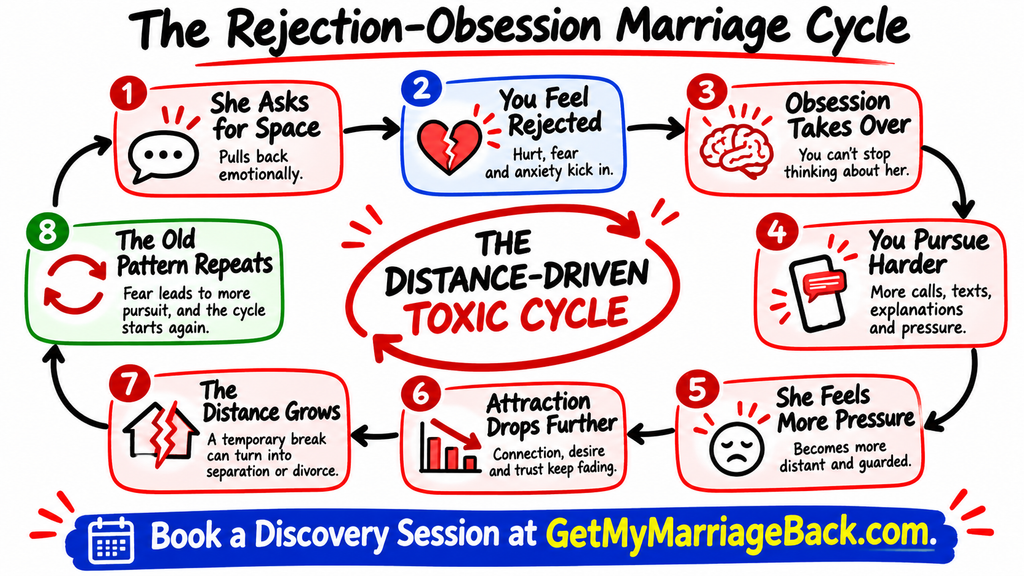
wife wants to separate

Why Rejection Makes You Want to Chase Her

Before your wife started pulling away, you probably weren’t thinking about her every minute.

Now you monitor your phone.

A delayed response feels threatening. A short message becomes something to analyze, and silence makes you want to send another explanation.

This is how rejection can turn your attention into obsession.

Your mind begins treating reconnection as an emergency. Instead of asking whether a conversation would be useful, you ask how quickly you can get her to respond.

The difference is enormous.

A genuine desire to repair the marriage considers both people’s emotional experience. Fear-driven pursuit focuses on relieving your own discomfort.

That is why repeated attempts to reassure, explain, apologize, or argue can feel so intrusive to a spouse who has requested distance.

She asks for breathing room, but every interaction brings another demand for emotional engagement.

Over time, the pressure itself becomes part of what she wants to escape.

wife wants to separate - the rejection-obsession marriage cycle

Mistake 1: Making Your Anxiety Her Responsibility

There is nothing unusual about feeling frightened when your marriage becomes uncertain.

The mistake is expecting your wife to regulate that fear for you.

You may want her to promise she still loves you, explain exactly how long she needs, or reassure you that she isn’t considering divorce.

But reassurance extracted under pressure rarely creates the romantic connection you’re seeking.

You cannot skillfully rebuild attraction while making another person responsible for calming every uncomfortable feeling you experience.

Emotional intelligence begins when you can feel rejection without automatically acting on it.

That doesn’t mean pretending you aren’t hurt. It means choosing a response based on the marriage you want to build rather than the anxiety you want to escape.

Mistake 2: Treating Her Request for Space as the Entire Problem

Many people become obsessed with the question, “How much space should I give my wife?”

It’s understandable, but the question is incomplete.

The more important question is what created the distance in the first place.

Consider these possibilities:

  • Repeated arguments have made conversations emotionally exhausting.
  • Unresolved resentment has weakened trust and affection.
  • Your spouse no longer feels understood or valued.
  • Romantic attraction has deteriorated through predictable negative interactions.
  • Separation has become an option because earlier attempts to resolve problems went nowhere.

Each situation calls for a different level of repair.

If the problem is one emotionally charged disagreement, a brief pause may allow both people to settle down.

When the marriage has endured years of resentment, a day without arguing doesn’t erase the underlying damage.

Researchers studying relationship conflict have documented the importance of physiological calming during arguments. The Gottman approach, for example, emphasizes taking a break when partners become emotionally flooded, then returning to the conversation when they can engage more constructively.

That research supports a practical distinction: taking space can help interrupt escalation, but space alone does not repair a damaged relationship.

Mistake 3: Turning Separation Into a Countdown

Some people respond to a request for space by creating an imaginary deadline.

They decide that 24 hours should be enough. If their spouse doesn’t reconnect, they extend it to 48 hours or three days.

Then the ultimatum appears.

“I’ve given you enough space. We need to talk now.”

This approach treats separation like a negotiation in which the person who controls the calendar controls the outcome.

It doesn’t work that way.

A boundary isn’t automatically unreasonable because it makes you uncomfortable. Likewise, respecting a request for distance doesn’t require abandoning your own legitimate needs or accepting indefinite uncertainty.

You can discuss practical matters, household responsibilities, parenting arrangements, and reasonable opportunities to revisit the relationship.

What you cannot do is manufacture emotional readiness by declaring that the waiting period has expired.

The Client Whose Wife Moved to Her Mother’s House

One of my clients experienced an especially painful version of this situation.

His wife had moved to her mother’s house.

He was confused, frightened, and determined to repair the marriage. So he kept sending long text messages—paragraph after paragraph.

Sometimes he apologized. Other times he defended himself, criticized her, or tried to explain why her interpretation of the marriage was wrong.

At certain moments, he even declared that he didn’t care.

Yet his actions communicated something very different.

Those messages were not addressing the deeper problems behind the separation. They were expressing his panic.

We worked to understand his particular circumstances and change his approach.

It was difficult because familiar reactions don’t disappear simply because someone understands that they are unhelpful.

Over time, he began making meaningful changes without waiting for his wife to participate directly in every part of the process.

The important distinction was how he measured progress.

He stopped treating the number of messages he sent as evidence that he was fighting for the marriage.

Instead, he began paying attention to whether he was interrupting the behaviors contributing to the crisis.

That is a far more useful measure of personal growth.

Mistake 4: Losing Yourself While Trying to Save the Marriage

Here’s something I want you to examine carefully.

Have you become so consumed with saving your marriage that you’ve abandoned the person you were before the crisis?

Your confidence now depends on whether she responds.

A good day requires her affection. Your peace disappears whenever her mood changes.

You may still be going to work, paying bills, and handling responsibilities, but emotionally your entire identity has become attached to the marriage’s immediate condition.

That is emotional dependency, not personal power.

And dependency can quietly undermine attraction.

Romantic connection becomes difficult when every interaction carries the unspoken demand, “Please make me feel secure again.”

Rebuild the Person Your Spouse Can Experience Differently

I teach a progression that begins with grounding, purpose, and self-discovery.

Grounding means learning to experience difficult emotions without allowing them to dictate your next move.

When you feel the urge to send an angry or desperate message, notice the feeling before acting. Let the emotional intensity settle, then decide whether communication is necessary and appropriate.

Purpose means reconnecting with responsibilities and meaningful pursuits beyond your immediate marriage crisis.

Your health, work, relationships, personal growth, and contribution to the world still matter.

Self-discovery requires examining the patterns you would rather avoid.

Where have you been arguing instead of listening? When have you begged for reassurance, reacted defensively, or repeated behavior that clearly wasn’t working?

This isn’t about accepting blame for everything that has gone wrong.

It’s about taking ownership of what you can actually change.

You don’t need your spouse’s permission to become more grounded, confident, thoughtful, and emotionally disciplined.

Mistake 5: Trying to Explain Your Way Back Into Attraction

One of the biggest misunderstandings about marriage reconciliation is the belief that the right explanation will restore romantic attraction.

You imagine that if you could finally make your wife understand your intentions, she would see you differently.

But attraction isn’t simply an intellectual conclusion.

It is influenced by what someone repeatedly experiences in your presence.

Does interacting with you feel exhausting or enjoyable? Does a disagreement become a contest, or can you remain curious and composed?

Are your words consistent with your actions?

These experiences matter more than another carefully written promise.

Emotional Safety Creates Room for Romantic Curiosity

Research on intimate relationships helps explain why.

Studies of perceived partner responsiveness have found that feeling understood, validated, and cared for is closely associated with intimacy. Research published in the journal Psychological Science also examined how perceived partner responsiveness relates to affectionate touch, finding evidence that responsiveness and affectionate behavior are connected in romantic relationships.

The lesson is not that being agreeable automatically creates desire.

It is that closeness develops through experiences of connection, not through explanations alone.

Your spouse needs opportunities to experience meaningful differences in how you listen, communicate, handle conflict, and carry yourself.

That is where emotional intelligence becomes attractive.

Stop Using Text Messages to Force Emotional Resolution

When your wife wants space, texting can become one of your most destructive habits.

A simple logistical message may be necessary. Respectful communication about children, finances, or shared responsibilities can remain appropriate.

A seven-paragraph essay demanding that she understand your feelings is something else entirely.

Avoid using texts to litigate the marriage, extract reassurance, or force a conversation she has declined.

Also avoid the opposite manipulation: deliberately ignoring her to provoke jealousy or manufacture mystery.

Both behaviors are attempts to control her response.

The goal is not to become mysteriously unavailable.

The goal is to become genuinely different in the way that matters: you stop repeating destructive reactions.

How to Rebuild Attraction When Your Wife Wants Space

Attraction grows through a different experience of you.

That means your strategy should focus less on persuading your wife to feel something and more on becoming capable of creating healthier interactions.

1. Become Emotionally Steady

You can be concerned about your marriage without allowing every uncomfortable emotion to turn into an action.

Practice slowing your reactions, especially during disagreements or periods of silence.

Calmness is not indifference. It is the ability to remain responsible for yourself under pressure.

2. Respect Distance Without Becoming Cold

If your wife has requested space, take the request seriously.

You don’t have to punish her with silence, act detached, or pretend that the relationship means nothing.

When communication is appropriate, let it be warm, clear, and free from hidden demands.

Respect can be quietly attractive because it changes the emotional experience of interacting with you.

3. Replace Defensiveness With Curiosity

When your spouse expresses frustration, resist the urge to immediately prove that her interpretation is inaccurate.

Listen for the experience beneath the complaint.

You can acknowledge that she feels hurt without agreeing with every conclusion she draws.

That distinction allows you to remain confident while becoming easier to communicate with.

4. Create Experiential Value

I use the phrase experiential value to describe the positive experience someone has through interacting with you.

This is different from merely claiming to have good moral values.

You might consider yourself loyal, hardworking, and committed. Those qualities matter, but they don’t automatically tell you how your spouse experiences a conversation, an evening together, or a disagreement.

Experiential value comes from the way you live, communicate, listen, respond, and carry yourself.

Romantic curiosity has more room to develop when the familiar pattern of pressure and conflict begins to change.

5. Let Consistency Speak Louder Than Promises

A dramatic apology may capture attention.

Consistent behavior is what allows someone to notice that an old pattern is no longer dominating the relationship.

If you have promised to listen better, demonstrate it when a difficult conversation arises.

When you say you’re working on emotional control, practice it when you’re disappointed.

Attraction cannot be negotiated into existence. It develops in the context of lived experiences, including trust, emotional connection, individuality, and mutual desire.

What to Do When Your Wife Wants to Separate but You Don’t

Start by recognizing the seriousness of her request without assuming you already know the ending.

Ask for clarity when an appropriate conversation is possible. Respect the distance she has requested, and handle necessary responsibilities without turning every interaction into a discussion about reconciliation.

Meanwhile, examine the behaviors you control.

If you tend to pursue harder when you feel rejected, learn to interrupt that reaction. Should resentment and conflict have become normal, focus on communicating with greater awareness and less defensiveness.

Rebuild your personal stability instead of waiting for your spouse to supply it.

You also need to distinguish between doing your part and trying to do both people’s parts.

A marriage involves two individuals with independent choices. You can improve your own behavior and create conditions more supportive of connection, but you cannot decide for another person whether they will participate in rebuilding the relationship.

That is why personal power matters.

It allows you to act deliberately rather than desperately.

How Long Should You Give Your Wife Space?

There is no universal number of days that resolves every marriage crisis.

A short cooling-off period after an argument is fundamentally different from a separation involving a move out of the marital home.

Consider the severity and duration of the conflict, the specific boundary your wife has expressed, and the practical responsibilities you share.

A request for a quiet evening should not automatically become a month of silence.

Similarly, years of emotional disconnection will not necessarily disappear after 48 hours apart.

The better question is whether the space is helping interrupt destructive interactions while allowing both people to make thoughtful decisions.

Your role is to remain respectful, clear about practical needs, and focused on meaningful change.

The Real Shift: From Chasing Reassurance to Building Attraction

When your wife wants to separate, your instinct may be to fight harder for immediate closeness.

But a marriage crisis often exposes the limitations of that approach.

Repeated pursuit can become pressure. Explanations can become arguments, and attempts to save the relationship can turn into behaviors that make connection feel less appealing.

You need a different foundation.

Grounding helps you respond instead of react. Purpose restores a meaningful life beyond the crisis, while self-discovery reveals the habits you need to change.

From there, you can build experiential value through how you communicate, handle disagreements, and show up consistently.

This is the deeper distinction between trying to convince someone to love you and becoming someone who contributes to a more attractive relationship experience.

Your wife has asked for space.

The question is whether you will use that space to repeat the same cycle—or become capable of breaking it.

“I Feel Disgusted When My Husband Touches Me” – [5 Solutions]

Frequently Asked Questions

Does my wife wanting space mean she wants a divorce?

Not necessarily; a request for space can reflect emotional overwhelm, unresolved resentment, lost attraction, or uncertainty about the marriage. Pay attention to her specific words, actions, and circumstances rather than assuming divorce is inevitable.

How long should I give my wife space when she wants to separate?

There is no fixed timeline because a brief conflict break and a serious marital separation involve different levels of damage. Respect her stated boundaries while addressing necessary practical matters and discussing future communication when appropriate.

Should I text my wife when she asks for space?

Keep necessary communication respectful, brief, and consistent with the boundaries she has expressed. Avoid repeated emotional essays, demands for reassurance, or messages designed to force an immediate resolution.

Can I save my marriage if my wife wants to separate?

You can begin improving your communication, emotional stability, and relationship patterns without waiting for your wife to participate in every step. Reconciliation also requires her independent willingness to rebuild the relationship.

How to Save Your Marriage When Your Spouse Wants Out – Saving a Marriage in Crisis

You ever been in one of those situations where you walk into a room, and you can immediately tell something’s off?

Click the image below to Watch the Video

Click the image below to Watch the Video

Like… the air is just thick with tension.

You say “Hey, babe,” and all you get back is a grunt. Or worse—absolute silence.

Now, if you’re like me, you probably start running through a mental checklist: “Did I forget the anniversary? Did I leave the toilet seat up? Did I—Oh wait… it’s worse than that.”

And then… BOOM.

Your spouse hits you with the words no one ever wants to hear:

“I don’t think this is working. I think we should separate.”

Listen, if you’ve ever been in this situation or you’re in it right now, I need you to do one thing for me. Breathe. Seriously. Breathe in. Breathe out.

Because this isn’t the end of your marriage—yet. And even if it feels like it, I promise, there’s still a way forward.

I’m Ola, one half of a partnership with my wife, Lola. After 11+ years of friendship and 8+ years of marriage, we almost gave up on each other.

The pain, the distance, the constant fights—it felt like there was no way forward.

But through heartbreak, trial, and relentless effort, we discovered something powerful.

That journey led us to create the Get My Marriage Back system, launch this website in 2018, and co-author the book Get My Marriage Back.

Since then, we’ve helped countless individuals and couples get their marriage back and make it even better.

At press time, we’ve celebrate 17+ years of marriage and 20+ years of friendship.

And today, we’re going to talk about how to save your marriage when your spouse wants out.

And no, before you ask, the answer isn’t to beg, plead, or suddenly become the most romantic version of yourself that ever existed. Trust me, we’ve seen it all, and that’s not how this works.

So, let’s talk about it.

Tip #1 of 5—It’s Not About Whose Fault It Is

I know, I know. The first thing we all want to do when a relationship is falling apart is figure out who’s to blame.

“If she would just listen to me!” “If he would stop ignoring my feelings!” “If they weren’t always on their phone!” Sound familiar?

One of our clients—let’s call him Jason—came to us convinced his wife was the problem. She had become distant, she stopped laughing at his jokes, and worst of all… she stopped complaining about his bad habits. And if you’re married, you know: when they stop complaining, that’s when you should worry.

Jason was stuck in the blame game, and the more he tried to prove his innocence, the worse things got. He’d say, “But I do everything for you!” and she’d respond with, “I never asked you to.” Ouch.

Look, if your spouse wants out, the goal isn’t to prove you’re right. The goal is to understand what’s happening. And that leads me to the next point…

Tip #2 of 5—Accept and Understand It

Here’s the thing—you can’t fix what you refuse to accept. If your spouse says they want out, that’s their reality right now. Telling them they’re wrong or acting like it’s just a phase isn’t going to help.

Think about it like this: If someone is drowning and they’re flailing their arms, you don’t say, “You’re not actually drowning. Just stop panicking.” No! You acknowledge the panic, then you help them in a way that doesn’t make it worse.

When Jason finally accepted that his wife felt disconnected, instead of fighting it, he started to see things differently. He realized she wasn’t just being cold—she was hurting. And when you recognize that your spouse is hurting, you stop trying to “win” the argument and start focusing on the real problem.

By the way, if this is hitting home for you, go ahead and hit that like button. And while you’re at it, subscribe, follow, and turn on notifications because we’ve got more coming that’ll help you get your marriage back on track.

Alright, let’s keep going.

Tip #3 of 5—Be Accountable

(And No, Accountability Is Not the Same as Fault)

Jason had to learn this the hard way. See, he thought being accountable meant admitting everything was his fault. But that’s not what we’re talking about.

Accountability means asking, “What’s my role in this?” without turning it into self-blame or self-pity. It’s about seeing where you can improve—not so you can take all the blame, but so you can take control of what you can change.

Jason realized he had stopped being emotionally present years ago. His wife didn’t wake up one day and say, “I’m done.” It was a slow fade. And when he finally took accountability for his own emotional unavailability, that’s when things started to shift.

Tip #4 of 5—Let Go

I know. This one is tough. But listen—the more you try to control the outcome, the worse things get.

Jason spent months trying to convince his wife to stay. He wrote long text messages. He over-explained every little thing. He even made one of those dramatic “I can’t live without you” speeches in the rain. Okay, maybe not in the rain, but you get the idea.

And guess what? None of it worked.

But the moment he stopped trying to force her to stay… the moment he stopped clinging to control… she noticed.

Because here’s the truth: Desperation pushes people away. Confidence and self-assurance bring them closer.

Which leads us to the last and most important tip…

Tip #5—Engage in Self-Development

If you take nothing else from this video, take this: The best way to save your marriage is to become the best version of yourself—not for your spouse, but for you.

Jason stopped focusing on “fixing” his wife and started working on himself. He rediscovered hobbies. He started learning about emotional intelligence. He even started listening instead of just waiting for his turn to talk.

And you know what happened?

His wife started noticing.

Because when you work on yourself, the energy shifts. Your confidence grows. You stop being the person who’s begging for love and start being the person who naturally attracts it.

And here’s the crazy part—Jason’s wife eventually started engaging in conversations again. Not because he convinced her to, but because she felt the difference.

So if your spouse wants out, the best thing you can do isn’t to chase them—it’s to work on you.

And if you need help with that, consider working with us for personal coaching.

Just go to Click Here or Go to ww.GetMyMarriageBack.com

Alright, now before we go, don’t forget to hit like, subscribe, and turn on notifications so you don’t miss the next video.

And here’s a question for you: Do you think love alone is enough to save a marriage, or is something else more important? Drop your thoughts in the comments, and let’s talk about it.

Here is part 2 of the “Saving a Marriage in Crisis” series; 7 Signs Your Marriage Can Still Be Saved.

FAQ: Saving Your Marriage

What is the No. 1 rule for saving your marriage?

The most important step is to focus on your own self-development rather than trying to control your spouse or the outcome.

How can I save my broken marriage?

You can begin to save your marriage by accepting your spouse’s feelings and understanding their perspective.

What are the hard years of marriage?

The “hard years” of marriage often occur in the first few years as couples adjust and between years 5 and 8 when deeper issues may surface.

At what year do most marriages fail?

While statistics vary, research suggests that most marriages tend to fail either in the first few years (1-2) as couples adjust, or between years 5 and 8.

CRISIS WITH IN-LAWS ❤️ Help For Marriage

QUESTION ⁉️ “Hi, I am having marriage problems and I have some questions. My husband started to act weird when he started talking to his sister.

His feelings of love went from me to her; I don’t know what went wrong.

It all changed when he came into our lives. He says he loves me but tells her he never says it to me. I need help.”

ENJOY THE VIDEO.

My In Laws Are Ruining My Marriage


What Would Help You Most Right Now?

Choose the option that best matches where you are with your marriage.

I Need Personalized Help

My Marriage Is in Serious Trouble

If you're dealing with separation, divorce, loss of attraction, infidelity, intimacy problems, or a spouse who's pulling away, get help looking at what's happening in your specific situation.

Get Personalized Help →
Get My Marriage Back book cover
I'd Rather Learn What to Do First

Start With Get My Marriage Back

Get the book and start learning the principles for moving your marriage in a better direction.

Get the Free Book →