


Your wife has stopped touching you, moved into another bedroom, and started ignoring your heartfelt messages—but the most dangerous bad signs during separation may now be coming from your own desperate attempts to save the marriage.
Take This 2 Minutes Quiz
You remember when your wife wanted to be around you.
She used to ask about your day, laugh at your jokes, and reach for you without thinking twice.
Now, she locks her phone, avoids physical affection, and says she needs space.
You send a heartfelt message explaining why your marriage deserves another chance.
She reads it.
No response.
Twenty minutes later, you’re preparing another message because the silence feels unbearable.
I understand that pain.
It’s unfair to watch someone you have sacrificed years for behave as though your marriage barely matters.
But I want you to understand something important.
Your wife pulling away is one problem. How you respond to her withdrawal is another.
When those two problems collide, they create a destructive cycle.
You feel rejected, so you chase harder. She experiences more pressure and withdraws further.
Then you interpret her distance as evidence that your marriage is finished, which makes you even more desperate.
This is how separation mistakes can intensify the very emotional disconnection you’re trying to repair.
The solution begins with recognizing what you’re actually doing, why you’re doing it, and how your behavior affects the emotional experience of being around you.
What Are the Bad Signs During Separation?
Bad signs during separation include persistent emotional withdrawal, reduced affection, avoidance of meaningful conversations, repeated disrespect, and a growing unwillingness to participate in the relationship.
But not every warning sign means the same thing.
When your wife says she needs space, she may be describing emotional exhaustion, unresolved resentment, a need for independence, or a serious decision about the future of your marriage.
What you need to know is whether her words reflect a temporary emotional state, an established pattern, or a concrete decision supported by consistent actions.
A spouse who is overwhelmed after repeated arguments is not necessarily in the same emotional position as someone who has already begun legal divorce proceedings.
Both situations deserve serious attention.
However, they require different levels of practical preparation, emotional restraint, and respect for boundaries.
The biggest mistake is allowing fear to decide what every symptom means.
And that brings us to eight separation mistakes that deserve your immediate attention.

1. Taking Your Wife’s Words Too Literally
Your wife looks at you and says:
“I don’t love you anymore.”
Those words hit hard.
You remember everything you’ve built together, and suddenly it feels as though your entire history has been erased.
Your immediate instinct is to treat her statement as a permanent diagnosis of the marriage.
But emotional language and permanent decisions are not always identical.
When someone has experienced months of resentment, conflict, or exhaustion, their words can describe the intensity of their present emotional experience.
That doesn’t mean you should dismiss what she says.
It means you need to differentiate what she has actually communicated from what your fear adds to it.
What You Need to Know
Pay attention to the surrounding behavior.
Has she repeatedly communicated the same decision during calm conversations? Is she establishing practical boundaries, pursuing a legal process, or reacting immediately after another painful argument?
Those details matter.
If she says she doesn’t want to be touched, respect that boundary.
When she requests space, stop trying to force another emotional conversation.
Your responsibility is not to reinterpret her words until they become comforting.
It’s to recognize their meaning accurately without turning today’s emotional reality into an invented prediction about forever.
That creates a more grounded starting point for reconciliation.
2. Begging Your Wife to Come Back
You tell her you’ll do anything.
Every promise becomes bigger than the last.
You’ll change your schedule, abandon your hobbies, surrender your preferences, and agree with whatever she says.
All you want is one more chance.
Yet the more desperately you beg, the colder she becomes.
Here’s why.
Begging is often an attempt to make your spouse regulate your fear.
Instead of experiencing your presence as emotionally steady, she experiences the pressure of being responsible for your relief.
That’s a heavy burden when she’s already asking for distance.
Pursuit Is Not Begging
There’s nothing inherently wrong with pursuing the wife you love.
Dignified pursuit communicates interest while respecting her freedom to respond.
Begging demands reassurance because you cannot tolerate uncertainty.
One approach comes from confidence and self-respect. The other is driven by panic.
Consider the difference.
“I care about our marriage, and I’m taking responsibility for the changes I need to make.”
That statement communicates your position.
Compare it with repeatedly asking her to promise she won’t leave, demanding an immediate answer, or making dramatic sacrifices to obtain affection.
The first communicates grounded interest.
The second turns your emotional security into her responsibility.
You cannot nurture attraction by making your spouse feel trapped inside your anxiety.
3. Apologizing When You Don’t Mean It
Your wife accuses you of being selfish, controlling, or emotionally unavailable.
You immediately apologize.
Then you apologize again.
Eventually, you’re accepting responsibility for things you don’t believe you actually did wrong.
Why?
Because you’re afraid that disagreeing with her will push her closer to divorce.
But false accountability creates a different problem.
Your words lose credibility.
An apology is meaningful when it reflects genuine understanding, ownership, and a willingness to change a specific behavior.
When you’re apologizing simply to stop your wife from leaving, you’re using the apology as a bargaining tool.
That’s not emotional intelligence.
It’s fear disguised as humility.
Replace False Agreement With Real Accountability
Ask yourself three questions.
What did I actually do? How did my behavior affect the relationship? What specific change am I prepared to make?
If you interrupted her repeatedly during arguments, acknowledge that behavior.
When you ignored an important commitment, take ownership.
But don’t accept an inaccurate accusation simply because you’re terrified of conflict.
Self-accountability is not self-blame.
A person who can own real mistakes without surrendering personal integrity becomes more trustworthy, more emotionally stable, and more capable of creating a healthy relationship.
4. Apologizing When She Never Asked for an Apology
This mistake surprises people because apologizing is generally considered a positive relationship behavior.
But context changes everything.
Imagine your wife announces that she’s spending the weekend away.
You ask how the plans affect existing household responsibilities.
She replies, “I don’t need your permission.”
You weren’t necessarily demanding permission.
You wanted consideration regarding commitments that affect your shared life.
But instead of addressing that issue, you apologize repeatedly for being controlling.
Now the original problem remains unresolved.
Worse, your apology has replaced a legitimate concern with a conversation about your supposed character flaw.
Are You Repairing an Injury or Seeking Reassurance?
Here’s another situation.
Your wife tells you she’s exhausted and wants a quiet evening.
Instead of respecting her request, you deliver a lengthy emotional apology about everything you’ve done wrong.
You believe you’re demonstrating humility.
She experiences another attempt to restart a conversation she’s trying to end.
The issue isn’t whether apologies are good or bad.
It’s whether the apology serves a genuine repair process or your immediate need for reassurance.
Sometimes the emotionally intelligent response is to respect the requested space without adding another speech.
That doesn’t mean abandoning accountability.
It means allowing your actions to become more meaningful than repeated explanations.
5. Sending Long Text Messages During Separation
You write six paragraphs.
The message explains your sacrifices, your intentions, your childhood experiences, your commitment, and everything your wife has misunderstood.
You read it three times before pressing send.
Then you wait.
Her response arrives:
“Okay.”
That one word hurts more than an argument.
You expected your vulnerability to create connection.
Instead, the conversation feels even colder.
Why Long Text Messages Often Backfire
The length of your explanation doesn’t increase your wife’s emotional capacity to receive it.
When someone is overwhelmed, a long message can feel like another responsibility.
She has to read it, interpret it, manage your expectations, and decide how to respond.
Even a heartfelt message can contain defensiveness, criticism, guilt, and demands for reassurance.
That’s why I want you to evaluate your intention before sending another text.
Are you communicating necessary information?
Or are you trying to force an emotional breakthrough through the volume of your words?
Those are different purposes.
What Should You Text Your Wife During Separation?
Keep practical communication clear, relevant, and respectful.
If you need to coordinate a responsibility, communicate the necessary details without turning the message into another argument about the marriage.
For example:
“I’ll handle the school pickup at 3:30 as planned.”
That’s enough.
You don’t need to attach three paragraphs explaining how responsible you’ve become.
If your wife has explicitly requested no contact, honor that request except for necessary communications permitted by the circumstances.
Your goal is not to disappear strategically to make her jealous.
It’s to stop using communication as an instrument for managing your fear.
6. Treating Separation as a Permanent Decision
Your wife says she wants separation.
Immediately, you begin behaving as though divorce is inevitable.
You stop sleeping properly, abandon your routines, and interpret every interaction through the expectation of rejection.
When she doesn’t smile, you see confirmation.
If she declines a conversation, you treat it as another sign that reconciliation is impossible.
Your emotional state becomes dependent on predictions you cannot verify.
Separation and Divorce Are Not the Same Event
Separation is serious.
It deserves respect, practical planning, and an accurate understanding of your circumstances.
But a request for distance is not identical to a finalized divorce.
What you need to know is whether your wife has established temporary boundaries, requested a trial separation, initiated legal proceedings, or expressed emotional exhaustion without a defined plan.
Don’t ignore concrete decisions.
At the same time, don’t transform uncertainty into certainty simply because you’re afraid.
The most useful question isn’t whether your marriage is permanently finished.
It’s this:
What facts do I actually have, and what am I assuming?
That question interrupts catastrophic thinking and helps you focus on your next responsible action.
7. Trying to Make Your Wife See Logic
You prepare a convincing argument.
There are financial calculations, family consequences, dictionary definitions, and reasons staying married makes practical sense.
Your case is organized.
The numbers are accurate.
Yet your wife says:
“You still don’t understand me.”
You respond by explaining everything again.
Now you’re trapped in a conversation where each new explanation creates more frustration.
Logic Cannot Replace Emotional Responsiveness
Here’s what you’re missing.
Your wife may be describing loneliness, resentment, emotional exhaustion, or a loss of attraction.
You’re responding to those experiences with a financial presentation.
Practical facts matter, especially when making serious decisions.
But they don’t automatically address the emotional experience underneath the disagreement.
Relationship research reinforces this point.
A 2024 study involving 122 couples examined emotional regulation during relationship conflict and found that perceived responsiveness, cognitive support, and physical presence were generally associated with higher daily sexual satisfaction and desire, while hostility was associated with lower satisfaction and desire.
You can read the research on emotional responsiveness and sexual well-being during relationship conflict for the findings.
The lesson is not that you must agree with everything your wife says.
It’s that understanding the emotional meaning of a complaint is different from defeating its literal wording.
Learn to Hear What the Complaint Is About
When your wife says you never listen, don’t begin by listing the occasions when you listened.
Pay attention to the recurring experience she’s describing.
Does she feel interrupted, dismissed, criticized, or emotionally alone during difficult conversations?
What behavior of yours contributes to that experience?
You can acknowledge the feeling without agreeing with an inaccurate absolute statement.
For example:
“I understand that our conversations have left you feeling unheard. I’ve interrupted you during difficult moments, and I’m changing that.”
That’s a more useful response than presenting evidence that you’ve listened at least 47 times.
You cannot explain someone into feeling attracted to you.
You have to develop the qualities and behaviors that make your presence a more engaging emotional experience.
8. Badmouthing Your Wife to Everyone
You’re hurt.
Your wife has withdrawn after years of sacrifice, and you want someone to understand how unfair the situation feels.
So you tell relatives, coworkers, and mutual friends everything she’s done.
You describe her coldness, her decisions, and the ways you’ve been disappointed.
People begin agreeing with you.
For a moment, that feels validating.
But you’ve created another problem.
Your private marriage conflict has become a public reputation battle.
Constructive Support Is Different From Public Condemnation
You need support during a marriage crisis.
Isolation makes emotional pressure harder to manage.
However, seeking confidential guidance from someone capable of helping you think clearly is different from recruiting an audience to condemn your wife.
Ask yourself what your conversations accomplish.
Are you gaining perspective and becoming more grounded?
Or are you rehearsing resentment until it becomes your entire interpretation of the marriage?
You can acknowledge harmful behavior, seek appropriate professional or legal support, and protect yourself without spreading unnecessary humiliation.
That matters for your own emotional development.
A person consumed by resentment struggles to bring warmth, curiosity, and emotional openness into future interactions.
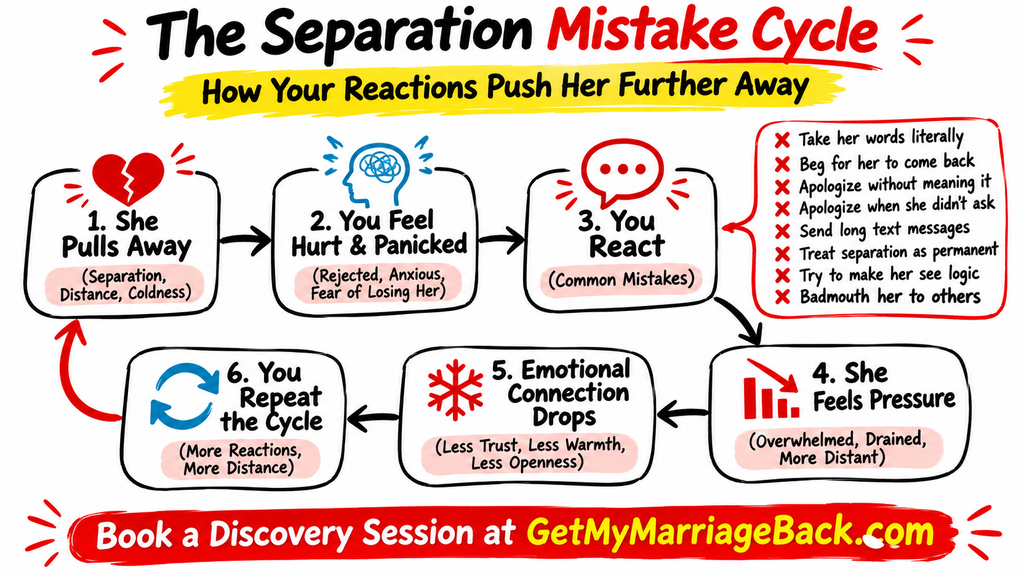
The Hidden Cycle Behind These Marriage Separation Mistakes
Most of these mistakes follow the same pattern.
Your wife becomes distant.
You interpret that distance as rejection.
Fear rises, and you attempt to regain control through begging, apologizing, texting, arguing, or seeking outside validation.
She experiences additional pressure.
Her withdrawal intensifies.
You interpret the increased distance as proof that your worst fear was correct.
Then the cycle repeats.
I want you to recognize something.
The original symptom and your reaction to that symptom are two separate problems.
You don’t control whether your wife feels affectionate tonight.
But you do control whether you send another desperate message, restart an argument, or abandon your personal standards.
That is where your power begins.
How to Stop Pushing Your Wife Away and Rebuild Attraction
Stopping the mistakes is important, but stopping alone doesn’t create a compelling relationship experience.
You also need to develop the personal qualities that make emotional connection more inviting.
I teach this through GPS5, beginning with Grounding, Purpose, and Self.
Grounding: Stop Letting Her Mood Control Your Identity
Grounding means redirecting your attention away from the immediate symptom toward your higher self, your source of truth, and gratitude.
It doesn’t mean pretending your wife isn’t distant.
You acknowledge what’s happening without allowing her latest reaction to determine your worth or behavior.
When she gives you the cold shoulder, you don’t have to follow her around demanding reassurance.
Put your phone down.
Relax your shoulders.
Return to the meaningful responsibilities already in front of you.
This is emotional self-leadership in practice.
Purpose: Become More Than Your Marriage Crisis
Your marriage matters deeply.
But your life must contain a purpose greater than the crisis.
Reconnect with your calling, mission, legacy, and the impact you want to make beyond yourself.
Invest in your health, meaningful work, personal development, and responsibilities.
You’re not doing these things to manufacture jealousy.
You’re developing a life directed by values rather than fear.
That changes how you carry yourself.
Your conversations become less desperate because every interaction no longer determines whether your entire life has meaning.
Self: Build Capacity Without Blaming Yourself
Self is about becoming a sustainable source of love, personal responsibility, and emotional stability.
It includes accountability for your mistakes.
But it doesn’t require accepting blame for everything that went wrong.
You can recognize that your wife has made choices that hurt you while taking responsibility for how you respond.
Build the capacity to tolerate discomfort without immediately reacting.
Practice expressing boundaries without aggression and interest without desperation.
Over time, those habits help you become a more emotionally mature person.
The Attraction Principle: Become Experientially Valuable
Here’s where many people misunderstand marriage advice.
They assume that because they’ve been loyal, hardworking, or financially responsible, their spouse should automatically feel romantic attraction.
Those qualities matter.
Integrity and responsibility are essential foundations.
But romantic attraction also involves the experience of being around you.
I call that experiential value.
Are your interactions engaging or exhausting?
Does your presence create emotional safety or constant pressure?
Can you bring warmth, humor, curiosity, and genuine interest into a conversation without demanding an immediate romantic response?
These questions matter because attraction isn’t simply a reward for doing enough household tasks or making enough sacrifices.
It’s connected to the emotional experience of the relationship.
Seduction Without Manipulation
Skillful seduction in marriage is not about playing games, withholding affection as punishment, or creating jealousy.
It’s about developing the confidence, playfulness, emotional intelligence, and presence that make connection feel inviting.
You can express interest without demanding affection.
A thoughtful compliment doesn’t need to become a request for reassurance.
When an appropriate opportunity for humor appears, enjoy it without turning the moment into a discussion about whether your marriage is improving.
Let positive experiences remain positive.
That freedom matters.
Research involving 786 participants across three studies found associations between perceived support for sexual autonomy, sexual need fulfillment, and relationship satisfaction.
In practical terms, romantic and sexual connection benefit from an environment where affection feels freely chosen.
Pressure works against that experience.
From Value to Curiosity and Attraction
As your emotional steadiness and experiential value improve, your wife has the opportunity to encounter a different version of your presence.
You become less predictable in one important way: You no longer respond to every uncomfortable emotion with panic.
Instead of another long text, she encounters respectful restraint.
Rather than another argument, she experiences someone capable of listening.
When you’re together, your behavior communicates grounded confidence instead of a demand for validation.
That creates room for curiosity.
And curiosity is one of the pathways through which attraction can begin to develop.
Confidence is always sexy.
Not arrogance.
Not emotional suppression.
Confidence grounded in self-respect, accountability, purpose, and emotional intelligence.
What to Do Tonight When Your Wife Gives You the Cold Shoulder
Tonight, your wife may ignore you, decline a conversation, or respond coldly to something ordinary.
Your instinct will be to repair the moment immediately.
Don’t.
Here’s what I want you to do.
Put your phone down, release the tension in your shoulders, and continue your evening without following her around or demanding reassurance.
If practical communication is necessary, keep it brief and respectful.
Avoid sending another emotional essay or asking for a decision about the future of the marriage.
You’re not giving her the silent treatment.
You’re removing unnecessary pressure.
That creates breathing room.
However, breathing room is only the beginning.
The deeper work involves developing the skills, support, and systems needed to replace familiar panic reactions with healthier habits.
You need to understand your specific relationship history, recognize the patterns that created emotional disconnection, and build a more attractive experience of interacting with you.
What These Bad Signs During Separation Really Mean
Your wife’s emotional distance deserves serious attention.
But the most important question isn’t whether every cold response proves your marriage is over.
It’s whether you’re responding to the actual circumstances or reacting to the worst story your fear can create.
Taking her words literally, begging, apologizing without conviction, apologizing for reassurance, sending long texts, assuming separation is permanent, arguing with logic, and badmouthing her all have one thing in common.
They can turn your fear into additional pressure.
You don’t need to become indifferent to your marriage.
Instead, develop the emotional strength to care deeply without abandoning yourself.
Learn to pursue with dignity rather than chase from panic.
Build experiential value instead of demanding attraction.
And remember that the most important change begins with what you can control.
5 Physical Signs She Just Slept With Someone Else: The Truth
Frequently Asked Questions
Persistent emotional withdrawal, repeated disrespect, disappearing affection, and avoidance of meaningful communication are significant warning signs. Their meaning depends on the relationship history, stated boundaries, and consistency of the behavior.
Avoid begging, repeated emotional texting, insincere apologies, unnecessary arguments, and recruiting others to condemn your spouse. These reactions can increase emotional pressure and make constructive communication harder.
Text when communication is necessary, appropriate, and consistent with her stated boundaries, keeping your message brief and respectful. Avoid using long emotional messages to demand reassurance or force a relationship conversation.
Yes, reconciliation can occur when the underlying relationship problems are addressed and trust, emotional safety, and attraction begin to develop again. Focus on your own accountability, emotional intelligence, and behavior rather than trying to control your spouse’s feelings.