


Your wife used to reach for you, kiss you without being asked, and enjoy being close to you—but now she turns away when you touch her, avoids sex, and seems perfectly comfortable living without physical intimacy.
Take This 2 Minutes Quiz
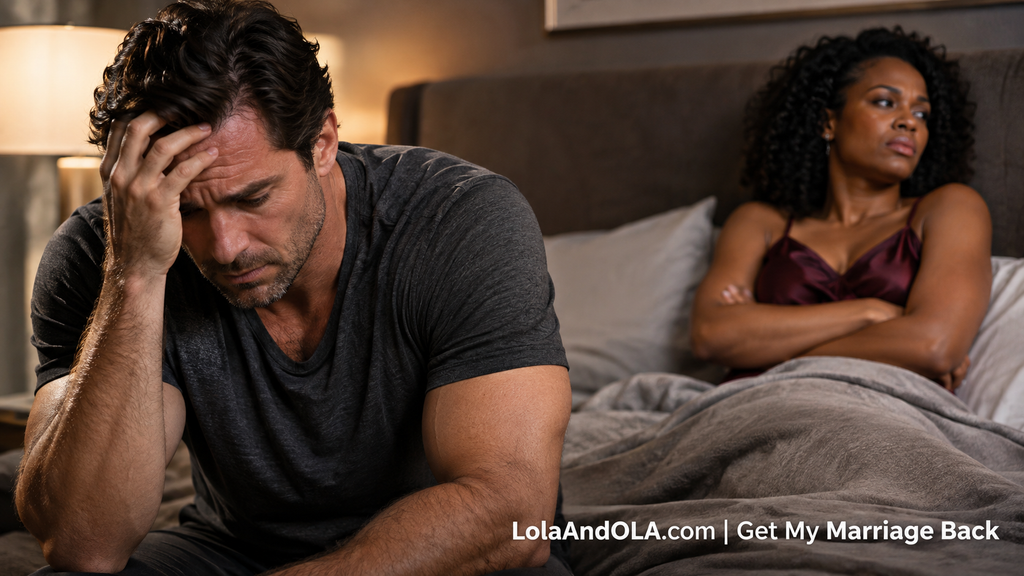
After years of marriage, sacrifice, and building a life together, sexual rejection hurts differently. You’re not simply missing sex. You’re missing the feeling that your wife actually wants you.
And when that feeling disappears, the questions become painful.
Why doesn’t my wife want to have sex with me anymore? Why does she reject me sexually? Has she lost attraction? Does she still love me?
Here’s what I want you to understand immediately:
Your wife rejecting sex does not automatically mean she has lost sexual attraction to you.
The behavior is real. The explanation requires a closer look.
Sometimes attraction has weakened. Other times, stress, unresolved resentment, emotional disconnection, physical discomfort, or the pressure surrounding intimacy creates the same outward behavior.
Your responsibility is to recognize what’s happening before reacting in ways that make an already difficult situation worse.
I’m going to show you seven signs worth paying attention to, what they can mean, and how to start rebuilding the conditions that make attraction possible.
7 Signs Your Wife Is No Longer Sexually Attracted to You
1. She Consistently Avoids Sexual Intimacy
You initiate sex, and she’s tired.
Tomorrow comes, and there’s another reason.
Eventually, you stop initiating because rejection becomes more painful than silence.
What used to feel natural between you now feels like an uncomfortable negotiation.
But before concluding that your wife is no longer sexually attracted to you, identify when the rejection started.
Did it begin after childbirth, a medical issue, a major disagreement, or months of unresolved marital tension?
Has her interest in sex disappeared entirely, or does she specifically avoid intimate situations with you?
These are different problems.
Research supports taking stress seriously when evaluating changes in sexual desire. A 2024 study of newlywed couples found that greater daily stress was associated with changes in sexual activity and physical affection. The researchers examined these patterns using repeated daily reports rather than relying on a single snapshot.
You can review the research on stress and physical intimacy in marriage to understand why reduced affection does not always indicate reduced attraction.
What you need to know: Sexual avoidance is a symptom. The timing, circumstances, and surrounding relationship patterns help explain its meaning.
2. Your Wife Never Initiates Physical Affection Anymore
Remember when your wife would spontaneously hug you, kiss you, or rest her hand on your shoulder?
Now every affectionate interaction begins with you.
When you stop initiating, nothing happens.
You aren’t simply missing physical contact. You’re missing the experience of being desired.
That absence can gradually damage your confidence, especially when you start interpreting every rejection as proof that something is wrong with you.
But here’s an important question:
Was your wife always less physically expressive, or has something dramatically changed?
A spouse who has never been especially affectionate is different from someone who was once physically expressive and has recently withdrawn.
Pay attention to whether she welcomes affection when there’s no expectation of sex.
If she enjoys an occasional hug but pulls away when she senses sexual pressure, the problem may involve the expectations surrounding physical contact.
On the other hand, if nearly every form of closeness has disappeared, you’re looking at a broader change in the relationship.
Don’t overlook that difference.
3. The Flirting and Playfulness Have Disappeared
Your wife used to tease you.
An ordinary conversation could turn into a playful exchange, a meaningful glance, or an unexpected kiss.
Now your conversations revolve around bills, children, responsibilities, and schedules.
You attempt something flirtatious, and she responds as though you’re discussing tomorrow’s grocery list.
The romantic energy has disappeared.
Here’s something many people misunderstand about attraction in marriage:
Being responsible, dependable, and committed does not automatically create romantic excitement.
Those qualities matter tremendously. But attraction also benefits from enjoyable experiences, emotional engagement, individuality, and opportunities to discover something interesting about each other.
When every interaction becomes another household obligation, the marriage can begin to feel like a business partnership.
That doesn’t mean you should manufacture excitement or become someone you’re not.
It means you need to recognize whether your daily interactions still create room for laughter, curiosity, warmth, and genuine enjoyment.
Ask yourself whether your wife has become less playful only around you or whether she’s experiencing a broader period of exhaustion or emotional withdrawal.
A difficult season is not necessarily a permanent verdict on your marriage.
4. She Avoids Spending Time Alone With You
There’s always another errand.
Another responsibility.
Another reason to stay occupied.
When you finally have an evening together, she disappears into her phone, finds something to clean, or goes to bed early.
You begin feeling like your wife is deliberately avoiding you.
And sometimes, that’s exactly what her behavior indicates.
But why?
Consider what typically happens when you finally get her alone.
Do you immediately bring up the marriage?
Do you ask why she doesn’t want sex?
Do you repeatedly demand reassurance that she still loves you?
If every private moment becomes another emotionally exhausting conversation, spending time alone with you can begin to feel like an obligation.
Your desire for reassurance can unintentionally become the very pressure she’s trying to escape.
This doesn’t mean you’re wrong for wanting affection or clarity.
It means your method of seeking those things matters.
Attraction becomes difficult to nurture when someone associates private time with conflict, interrogation, or emotional pressure.
5. Emotional Intimacy Has Disappeared Alongside Physical Intimacy
Your wife no longer asks about your day.
Personal conversations have become shorter.
When you share something meaningful, her response feels distant or obligatory.
You live in the same house, but the emotional connection feels increasingly absent.
Here’s what you need to know:
Sexual attraction and emotional intimacy are not identical.
However, changes in both can reveal important patterns in the marriage.
Start by identifying which disappeared first.
Did emotional disconnection develop months before sexual rejection?
Or did sexual difficulties create resentment, embarrassment, and emotional withdrawal afterward?
The order matters because different problems require different responses.
For example, unresolved conflict can make affection feel emotionally unsafe.
Alternatively, ongoing sexual difficulties can create tension even when affection and goodwill remain.
Your job isn’t to assign blame.
It’s to understand the sequence.
When you identify what changed first, you gain a clearer picture of what needs attention.
6. Your Presence Seems to Irritate Her
You ask an ordinary question, and she snaps.
You offer help, and somehow you’re doing it wrong.
Small things that never bothered her before suddenly become arguments.
It feels like you can’t win.
Let me tell you a story.
Imagine coming home determined to reconnect with your wife.
You arrange a romantic dinner, make an effort with your appearance, and approach her affectionately.
She pulls away.
The rejection hurts, so you demand an explanation.
You remind her how much you’ve sacrificed and ask why she can’t appreciate your efforts.
Within minutes, an attempted romantic evening becomes another argument.
Now look at what actually happened.
Your wife withdrew from physical affection.
You interpreted that withdrawal as evidence that she no longer desired you.
Then your reaction added another layer of emotional pressure.
Her behavior deserves attention. So does your response.
You cannot control whether your wife welcomes affection, but you can control whether rejection turns into another confrontation.
This is where emotional intelligence becomes practical rather than philosophical.
A skillful response requires enough self-control to recognize painful emotions without immediately acting on them.
7. Your Marriage Feels Like a Roommate Arrangement
You share a house.
You manage expenses.
You raise children, handle responsibilities, and maintain the household.
But the romantic relationship has practically disappeared.
There’s little flirting, limited affection, and almost no sense of sexual anticipation.
You function efficiently as a household while feeling increasingly disconnected as romantic partners.
This is what people commonly describe as a roommate marriage.
And it becomes especially painful when you remember how different your relationship used to feel.
Here’s what I want you to recognize:
One warning sign alone tells you very little. Several persistent changes, especially alongside expressed dissatisfaction, deserve serious attention.
If your wife no longer initiates intimacy, avoids being alone with you, expresses resentment, and describes the marriage as emotionally empty, you’re seeing a larger pattern.
Still, you cannot read her mind.
Attraction is not something you can demand, negotiate, or force.
Understanding the pattern is your starting point.
Why Your Wife May Love You but Not Feel Sexually Attracted to You
One of the most confusing experiences in marriage occurs when your wife says she loves you but no longer feels sexually attracted to you.
You hear the word love, but her behavior feels like rejection.
That contradiction can make you question everything.
However, love, commitment, affection, sexual desire, and romantic attraction are related experiences—not interchangeable ones.
Your wife can value the marriage while experiencing low sexual desire.
She can care about you while carrying unresolved resentment.
She can also feel emotionally connected but struggle with stress, exhaustion, pain, or changes in her sexual response.
And yes, attraction itself can weaken when the romantic dynamic changes.
The key is identifying which explanation fits your circumstances instead of treating every problem as proof that the marriage is over.
The Attraction Trap: Why Trying Harder Can Push Her Away
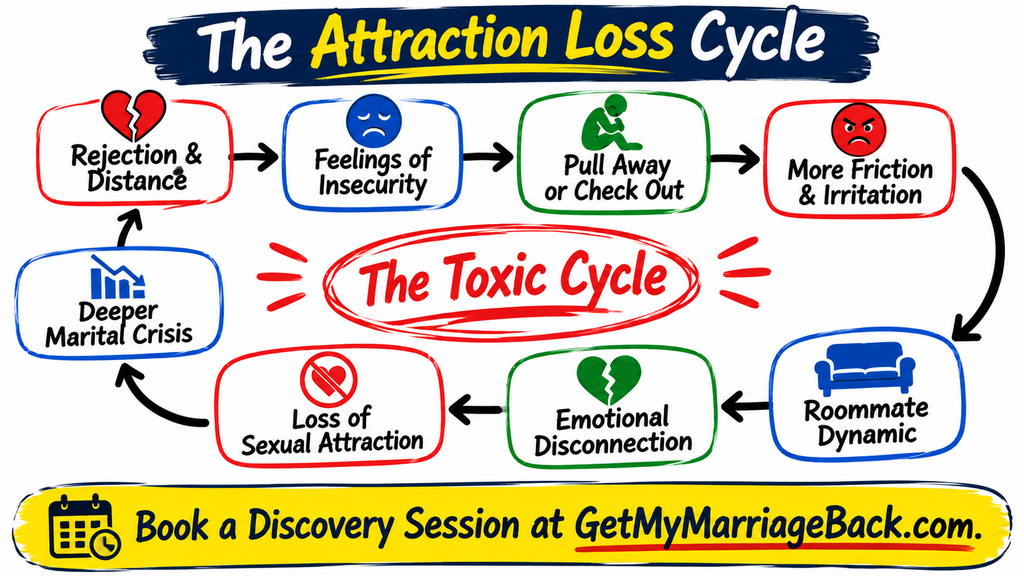
Here’s a painful cycle I want you to recognize.
Your wife becomes less affectionate.
You feel rejected.
That rejection creates anxiety, so you pursue reassurance.
You initiate more conversations about the relationship, increase romantic gestures, or repeatedly ask whether she still loves you.
She experiences additional pressure and withdraws further.
Her withdrawal increases your fear.
And the cycle repeats.
I call this the Rejection–Pressure–Withdrawal Cycle.
The tragedy is that your intentions can be loving while your behavior creates an experience that feels increasingly uncomfortable to your wife.
You want closeness.
She wants relief from pressure.
The harder you chase reassurance, the more difficult it becomes to create relaxed, enjoyable interactions.
This is why generic advice such as “just communicate more” doesn’t address every marriage crisis.
Communication matters, but timing, emotional regulation, and the experience surrounding communication matter too.
Your goal is not to stop caring.
It’s to stop allowing fear to determine how you express that care.
How to Start Rebuilding Attraction Without Chasing or Begging
Here is what I want you to do.
Start with yourself—not because you’re responsible for everything wrong in the marriage, but because your own behavior is where you have the most immediate influence.
Ground Yourself Before Reacting
When your wife rejects affection, resist the urge to turn that moment into an interrogation.
Relax your shoulders.
Give her physical space.
Continue your evening without sulking, punishing her, or demanding an explanation.
Confidence is always sexy, but respecting someone’s space isn’t a technique for manufacturing desire.
It’s a way to stop adding unnecessary pressure.
Reconnect With Your Purpose
A marriage crisis can consume your entire identity.
You become so focused on whether your wife wants you that your work, friendships, health, interests, and personal mission begin disappearing.
That imbalance makes every interaction emotionally heavier.
Redirect some of your attention toward meaningful responsibilities, personal growth, and the contribution you want to make beyond your immediate relationship problems.
Purpose gives you somewhere constructive to direct your energy.
Develop Emotional Self-Leadership
Self-leadership means taking responsibility for your reactions without blaming yourself for your wife’s feelings.
You can acknowledge that rejection hurts without using that pain to justify pressure, hostility, or manipulation.
Practice responding rather than reacting.
Pay attention to the difference between expressing genuine interest and pursuing reassurance out of fear.
Dignity-based pursuit respects another person’s choices.
Fear-driven chasing attempts to secure an emotional outcome immediately.
Those experiences feel very different to the person receiving them.
Become Experientially Attractive Again
Attraction isn’t simply about looking better, earning more money, or performing romantic gestures.
It’s also about the experience someone has in your presence.
Are your interactions consistently tense?
Do ordinary conversations become arguments?
Have you stopped developing your interests, confidence, humor, and emotional range?
You can work on becoming more engaging without pretending to be someone else.
Bring more steadiness into difficult situations.
Reintroduce playfulness where it’s welcome.
Build a life that remains meaningful even while your marriage is experiencing uncertainty.
The goal isn’t to create jealousy or manipulate your wife into noticing you.
It’s to develop genuine personal value that can support healthier romantic interactions.
Allow Curiosity and Attraction to Develop Naturally
When your conduct changes consistently, your wife has an opportunity to experience you differently.
She may notice that you no longer turn every rejection into an argument.
Conversations may become less tense.
Shared moments can begin feeling more enjoyable.
Curiosity and attraction can grow in an environment where both people have room to choose closeness.
You don’t need to announce every improvement or demand recognition for your efforts.
Let your conduct speak through repeated experiences.
That’s how self-leadership becomes a foundation for influence without turning your wife into a project you need to control.
What to Do Tonight When Your Wife Rejects You Again
Your next move doesn’t need to be dramatic.
When she turns away from a kiss or declines intimacy, respect the boundary without turning the moment into another emotional confrontation.
Don’t demand sex.
Avoid delivering a speech about everything you’ve done for the marriage.
And don’t use silence, resentment, or withdrawal as punishment.
Instead, carry yourself calmly and continue with your evening.
Later, when there’s an appropriate opportunity for a respectful conversation, you can express your concerns without making her responsible for immediately resolving your anxiety.
Pay attention to patterns over time rather than treating one interaction as the final answer.
Reducing pressure creates breathing room.
But breathing room is only the beginning.
Rebuilding attraction requires understanding the history of your marriage, identifying the underlying problems, and developing more effective emotional and relational skills.
The objective is not to convince your wife to desire you. It’s to become someone who can participate in a healthier, more engaging romantic relationship without sacrificing dignity or personal responsibility.
That’s where meaningful change begins.
Average Length of Separation Before Reconciliation: Data Reveals!
Frequently Asked Questions
Persistent sexual rejection, disappearing affection, reduced flirting, emotional withdrawal, and avoidance of private time can indicate declining attraction. Look for changes from her previous behavior and consider the surrounding circumstances before drawing conclusions.
Sexual attraction can change because of unresolved resentment, emotional disconnection, chronic stress, physical discomfort, medication, relationship conflict, or changing romantic dynamics. Understanding when the change began and what else was happening helps identify the most relevant explanation.
Yes, emotional attachment, commitment, and sexual desire are different experiences, so your wife can genuinely love you while experiencing reduced sexual attraction. The important question is whether the underlying issue involves desire, emotional connection, unresolved conflict, or another factor.
Start by reducing pressure, respecting her boundaries, improving emotional self-control, and rebuilding enjoyable interactions rather than chasing reassurance. Focus on your personal growth and the relationship patterns you can influence while allowing attraction to develop through genuine, voluntary connection.